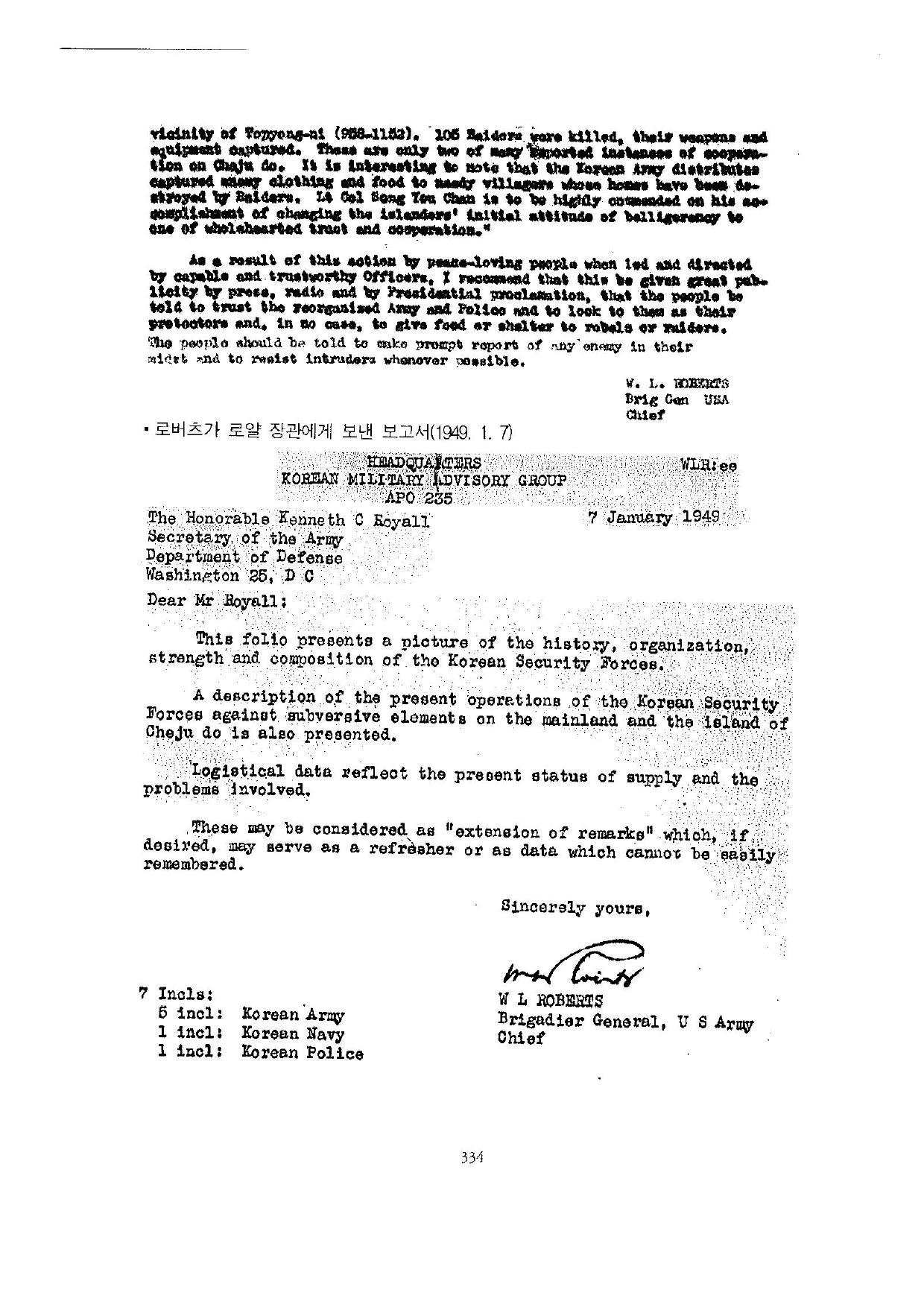
발신: 주한미군사고문단장
수신: 육군성 장관 케네드 로얄(Kenneth C. Royall)
친애하는 로얄(Royall) 장관님
다음의 보고서는 남한 방위병력의 역사, 조직, 규모, 구성 등에 대한 설명을 나타냅니다.
남한 본토와 제주도의 파괴분자들에 대한 남한 방위병력의 작전현황의 설명도 담고 있습니다.
보급자료는 현재의 보급현황과 관련된 문제를 반영하고 있습니다.
이 자료들은 쉽게 기억할 수 없는 자료나 보충자료로서 활용될 수 있는 부연된 논평으로 간주하셔도 될 것입니다.
미군사고문단장 로버츠(W. L. Roberts) 준장
첨부문서 7부:
첨부 5부: 한국군
첨부 1부: 한국해군
첨부 1부: 한국경찰
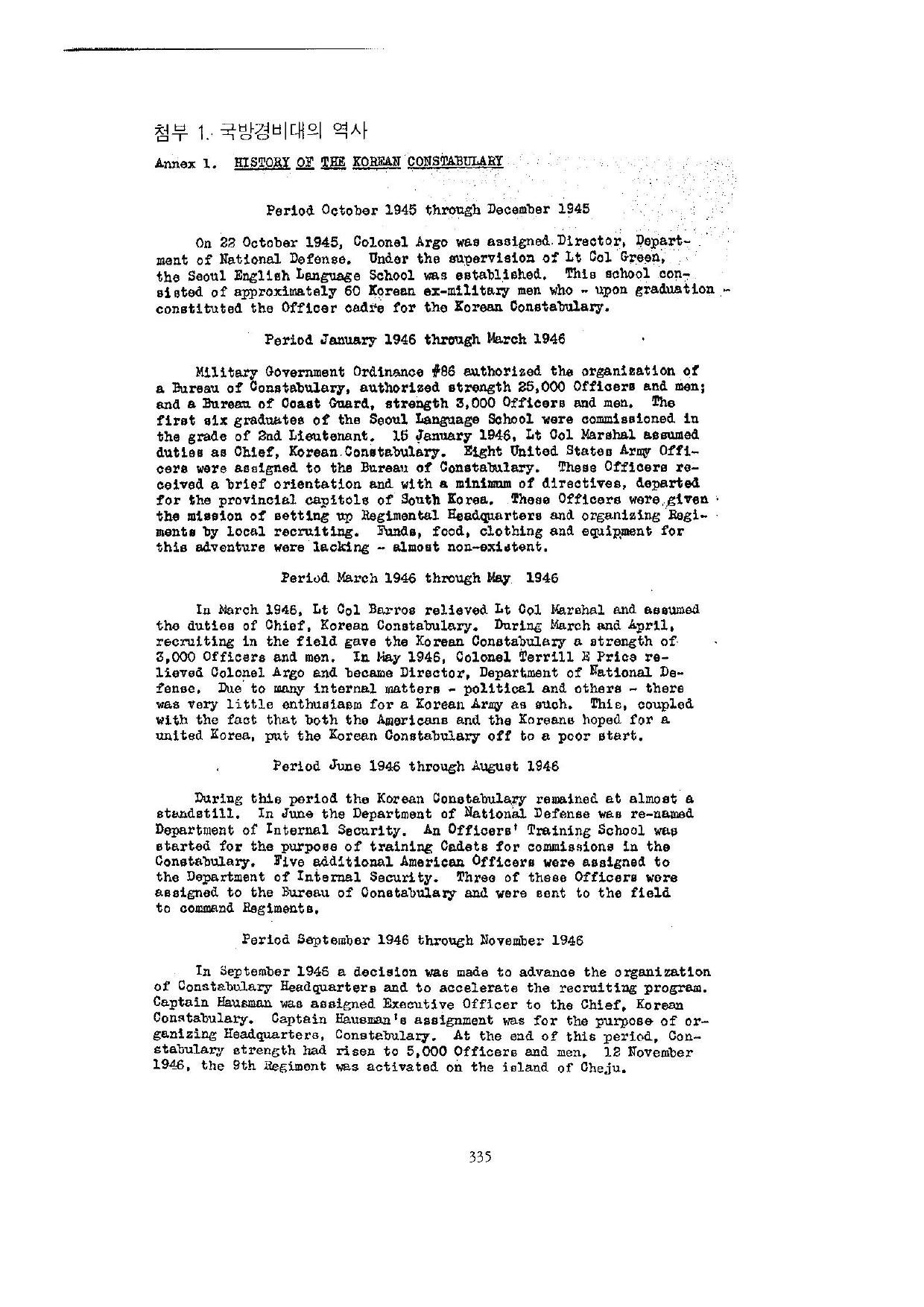
첨부 1. 국방경비대의 역사
1945년 10월~1945년 12월
1945년 10월 22일 아고(Argo) 대령은 국내경비부(Department of National Defense) 책임자(Director, Department of National Defense)로 부임하였다. 그린(Green) 중령의 감독아래 서울영어학교가 설립되었다. 이 학교는 졸업과 동시에 한국 국방경비대의 장교후보가 되었던 약 60명의 전직 한국인 군인들로 구성되었다.
1946년 1월~1946년 3월
군정명령 제86호는 경비대의 조직을 장교와 사병 2만 5,000명으로 구성할 권한을 부여하였으며, 장교와 사병 3,000명 규모의 해안경비대를 구성할 것을 규정하였다. 서울영어학교의 첫 졸업생 6명이 소위로 임관하였다. 1946년 1월 15일 마샬(Marshal) 중령이 국방경비대 사령관의 임무를 맡았다. 미육군 장교 8명이 국방경비대에 배속되었다. 이들은 간단한 오리엔테이션과 최소한의 지시를 받은 다음 남한 각도의 도청 소재지로 출발하였다. 이들 장교들은 해당지역에서 신병을 모집하여 연대를 구성하고 연대 본부를 조직하는 임무를 받았다. 이러한 임무에 필요한 자금, 식량, 의복, 장비 등이 거의 없는 형편이었다.
1946년 3월~1946년 5월
1946년 3월 베로스(Barros) 중령이 마샬 중령을 교대하여 경비대 사령관에 부임하였다. 3월과 4월에 현지 병력모집으로 경비대는 장교 사병 3,000명의 규모를 갖게 되었다. 1946년 5월 프라이스(Terrill E. Price) 대령이 아고 대령을 대신하여 국내경비부 책임자가 되었다. 정치문제를 포함하여 산적한 내부문제로 인하여 한국군 자체에 열정이 거의 없었다. 이것은 한미 양국 모두 통일된 한국을 희망했다는 사실과 결합되어 국방경비대의 보잘 것 없는 출범을 야기시켰다.
1946년 6월~1946년 8월
이 기간에 경비대는 거의 현 상황을 유지하고 있었다. 6월에 국내경비부는 통위부(Department of Internal Security)로 개칭되었다. 장교 훈련학교가 경비대의 장교후보생들을 훈련시킬 목적으로 개설되었다. 미국장교 5명이 추가로 통위부에 배속되었다. 이들 중 3명은 경비대에 배속되어 연대들을 지휘하기 위하여 임지로 파견되었다.
1946년 9월~1946년 11월
1946년 9월 경비대 본부조직과 신병모집 계획을 진전시키기 위한 결정이 내려졌다. 하우스만 대위가 경비대 사령관의 고위참모로 임명되었다. 하우스만의 임명은 경비대 본부를 조직하기 위한 목적이었다. 이 기간이 끝날 무렵 경비대의 규모는 장교 사병 5,000명에 이르렀다. 1946년 12월 12일 제9연대가 제주도에서 활동을 시작하였다.
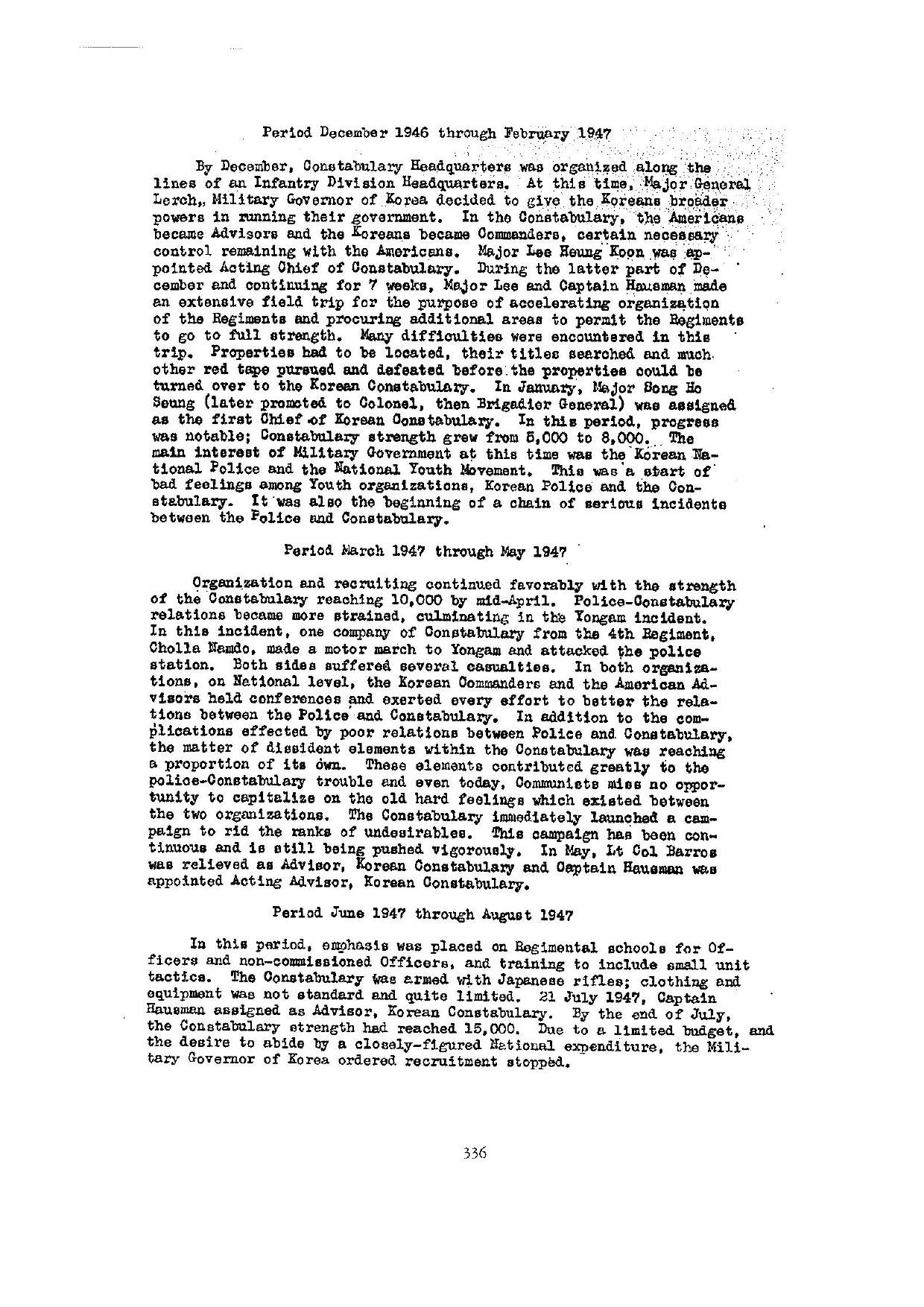
1946년 12월~1947년 2월
12월까지 경비대 본부가 보병사단 본부들과 함께 조직되었다. 동시에 군정장관 러치 소장은 한국인들에게 정부를 운용하는데 좀 더 광범위한 권력을 부여하기로 결정하였다. 경비대에서 미국인들은 고문관이 되었고 한국인들은 지휘관이 되었으나 필요한 통제권은 미국인들에게 남아 있었다. 이형근(Lee Heung Koon) 소령은 경비대 사령관 대행으로 임명되었다. 12월 하순과 그 후 7주 동안 이 소령과 하우스만 대위는 연대들의 조직을 촉진시키고 연대들이 완전한 규모를 갖추도록 몇몇 지역을 추가시키기 위하여 광범위한 현장 방문을 시행하였다. 이 현장 방문과정에서 많은 어려움에 봉착하였다. 장소에 대한 소유권이 파악되어야 하며, 소유권이 경비대에 이전되기 전에 권리증서를 찾아서 여러 다른 행정적인 형식절차를 추적하여 해결하여야 한다. 1월에 송호성(Song Ho Seung) 소령이 (후에 대령과 준장으로 진급) 경비대 초대 사령관으로 임명되었다. 이 기간 동안 괄목할 만한 진전이 있었다. 경비대 규모는 5,000명에서 8,000명으로 불어났다. 이 시점에서 군정의 주요 관심사는 국립경찰(National Police)과 국립청년운동(National Youth Movement)이었다. 이 시기는 청년단체, 경찰, 경비대 사이에 악감정들이 생겨난 시기였다. 또한 경비대와 경찰 사이에 일련의 사건들이 시작된 시기이기도 하였다.
1947년 3월~1947년 5월
조직과 신병모집은 순조롭게 계속되어 4월 중순까지 경비대는 1만명에 이르는 규모가 되었다. 경찰-경비대 관계는 더 악화되어 영암(Yongam)사건에서 극에 달하였다. 이 사건에서 전라남도의 경비대 제4연대 소속 일개 중대가 영암까지 자동차 행진을 감행하여 경찰지서를 공격하였다. 양측은 몇 명의 사상자를 냈다. 양측은 중앙적 차원에서 한국인 지휘관들과 미국인 고문관들이 회담을 열어 경찰과 경비대 관계를 좋게 하려는 모든 노력을 경주하였다. 경찰과 경비대 나쁜 관계에서 비롯된 복잡한 문제에 더하여 경비대 내부의 불만요소 문제는 그 자체로 상당한 부분을 차지하였다. 이들 요소들이 경찰-경비대 분규에 크게 기여했으며 오늘날도 공산주의자들은 두 조직 사이에 존재하는 해묵은 나쁜 감정을 극대화하려는 기회를 놓치지 않는다. 경비대는 즉시 바람직하지 않은 장교 사병들은 제거하려는 작전을 전개하였다. 이 작전은 계속되어 왔으며 아직도 과감히 전개되고 있다. 5월에 바로스 중령이 경비대의 고문관에서 물러나고 하우스만 대위가 경비대 고문관 대행으로 임명되었다.
1947년 6월~1947년 8월
이 기간 동안 장교와 하사관을 교육시키기 위한 연대 단위의 학교와 소부대 전술 훈련에 강조점이 주어졌다. 경비대는 일제 총으로 무장하였고 의복과 장비는 표준화되어 있지 않았으며 상당히 제한적으로 공급되었다. 1947년 7월 21일 하우스만 대위가 경비대 고문관으로 임명되었다. 7월 말까지 경비대 규모는 1만 5,000명에 이르렀다. 제한된 예산과 면밀하게 계산된 국가예산에 충실하는 것이 바람직하다는 이유 때문에 군정장관은 신병모집을 중지하라고 명령하였다.
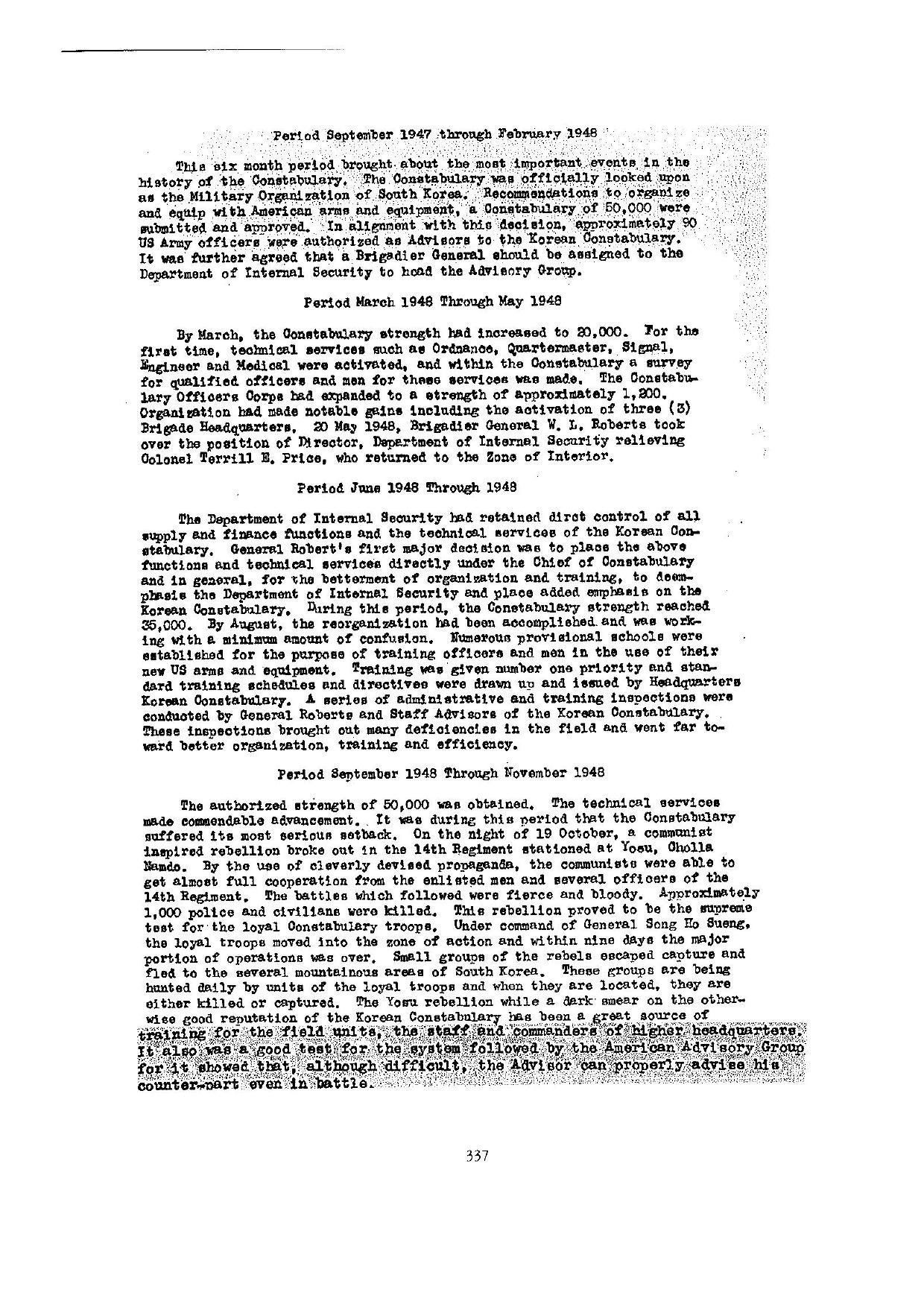
1947년 9월~1948년 2월
이 6개월 동안 경비대 역사에서 가장 중요한 사건들이 발생하였다. 경비대는 공식적으로 남한의 군사조직으로서 간주되었다. 미제 무기와 장비를 갖추고 5만명으로 경비대를 조직하도록 권유하는 추천서가 제출되어 승인을 받았다. 이 결정에 따라 미군장교 약 90명이 경비대의 고문관으로 임명되었다. 준장 1명이 고문단장으로서 통위부에 부임할 것도 합의되었다.
1948년 3월~1948년 5월
3월까지 경비대 규모는 2만명으로 증가되었다. 최초로 병참, 보급, 통신, 기술, 의료 등의 기술적인 업무가 시작되었으며 경비대 내부에서 이러한 임무에 적합한 장교와 사병에 대한 검토가 이루어졌다. 경비대의 장교단은 약 1,200명 규모로 확대되었다. 조직도 3개 여단 본부를 포함하여 괄목할만한 성장을 하였다. 1948년 5월 20일 로버츠(W. L. Roberts) 준장이 프라이스 대령을 교체하여 통위부 책임자로 부임하였으며 프라이스 대령은 Zone of Interior(국내 치안담당부서로 추정됨: 역주)로 복귀하였다.
1948년 6월~1948년 8월
통위부는 경비대의 모든 보급, 재정, 기술적인 업무를 직접 관장하였다. 로버츠 장군의 첫 번째 중요한 결정은 위에서 언급한 이러한 업무를 경비대 사령관의 직접적인 관할 하에 두었으며 훈련과 조직의 효율성을 위하여 통위부의 중요성을 경감시키고 경비대에 강조점을 두었다는 것이다. 이 기간동안 경비대 규모는 3만 5,000명에 이르렀다. 8월까지 재조직이 이루어져 큰 혼란없이 작동하고 있었다. 여러 임시학교들이 세워져 미국의 무기와 장비의 사용법을 장교와 사병에게 훈련시켰다. 훈련에 가장 우선권을 두었으며, 표준 훈련일정과 지침들이 마련되어 경비대 사령부에 의하여 발표되었다. 일련의 행정검열과 훈련검열이 로버츠 장군과 국방경비대의 참모 고문관들에 의하여 집행되었다. 이러한 검열은 현장에서 약점들을 드러내었으며 조직, 훈련, 효율성의 제고에 효과가 있었다.
1948년 9월~1948년 11월
인가된 5만명 규모의 병력이 구성되었다. 기술적인 업무들도 괄목할만한 성과를 이루었다. 경비대가 가장 심각한 좌절을 맛본 것도 바로 이 시기였다. 10월 19일 밤 공산주의의 사주를 받은 반란이 전라남도 여수에 주둔했던 제14연대에서 일어났다. 치밀하게 계획된 선동을 이용하여 공산주의자들은 제14연대의 사병들과 몇몇 장교들의 전폭적인 협조를 얻을 수 있었다. 뒤이은 전투는 잔인함과 피로 물들었다. 약 1,000명의 경찰과 민간인이 살해당했다. 이 반란은 충성스러운 경비대 군인들에게 최고의 시험인 것으로 판명되었다. 송호성 장군의 지휘하에 있던 정부군은 작전지역으로 들어갔고 9일 이내에 대부분의 작전을 끝냈다. 소규모의 폭도들은 사로잡히는 것을 피하여 남한의 여러 산악지역으로 도망쳤다. 이들 폭도들은 매일 정부군에 의하여 소탕 당했으며 그들의 위치가 드러나며 그들은 사살 당하거나 사로잡혔다. 여수반란은 경비대에 오점인 동시에 경비대의 현지 부대와 본부의 참모와 지휘관들에게 좋은 명성의 원천이기도 하였다. 여수반란은 또한 미군사고문단이 채택한 시스템에 대한 좋은 시험이 되었다. 왜냐하면 고문관들은, 쉽지는 않았지만, 전투에서도 그들의 한국 파트너에게 적절히 충고할 수 있다는 것을 보여주었기 때문이다.
1948년 12월~1949년 1월
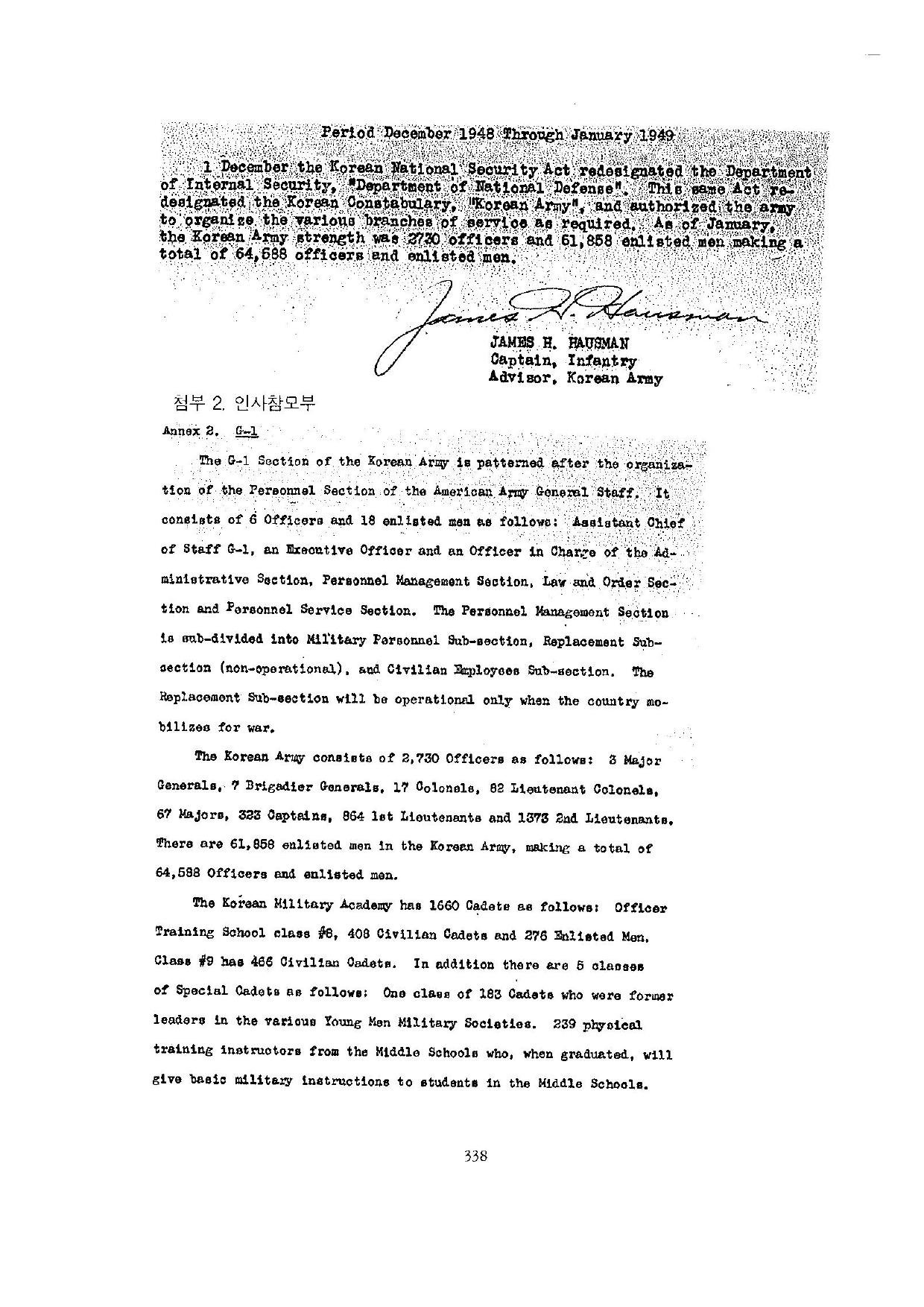
12월 1일 국가보안법(Korean National Security Act)은 통위부를 ‘국방부(Department of National Defense)’로 전환하였다. 동법은 국방경비대를 ‘한국군(Korean Army)’으로 전환하여 필요에 따라 각종 참모부를 조직할 수 있는 권한을 부여하였다. 1월 현재 한국군 규모는 장교 2,730명 사병 6만 1,858명으로서 장교 사병 합쳐 전체 6만 4,588명이었다.
한국군 고문관 제임스 하우스만(James H. Housman) 대위
첨부 2.. 인사참모부
한국군의 인사참모부(G-1)는 미국 육군 참모부의 인사 참모부의 조직을 본보기로 삼아 편성되었다. G-1은 장교 6명, 사병 18명으로 구성되었다. (중략)
한국군은 장교 2,730명으로 구성되었는데 그 인원은 다음과 같다. 소장 3명, 준장 7명, 대령 17명, 중령 82명, 소령 67명, 대위 323명, 중위 864명, 소위 1,373명이다. 사병은 6만 1,858명으로서 한국군은 장교 사병 합쳐 모두 6만 4,588명이다.
사관학교(Korean Military Academy)는 1,660명의 후보생을 보유하고 있는데 그 구성은 다음과 같다. 장교훈련학교 제8학급에 민간인 후보생 408명 사병후보생 276명. 제9학급에 민간인 후보생 466명. 추가로 특별 후보생 5개 학급의 구성은 다음과 같다. 각종 청년군사연합(Young Men Military Societies)의 지도자 출신이었던 183명의 후보생 1개 학급. 중학교에서 졸업 후 학생들에게 기본 군사훈련을 지도할 중학교에서 온 체육교사 239명. 교습과정을 받고 의료단에서 장교로 근무할 의사 21명. 교습과정을 받고 통신대에서 전기 기술장교로 근무할 후보생 12명. 교습과정을 받고 공병대에서 근무할 후보생 55명.
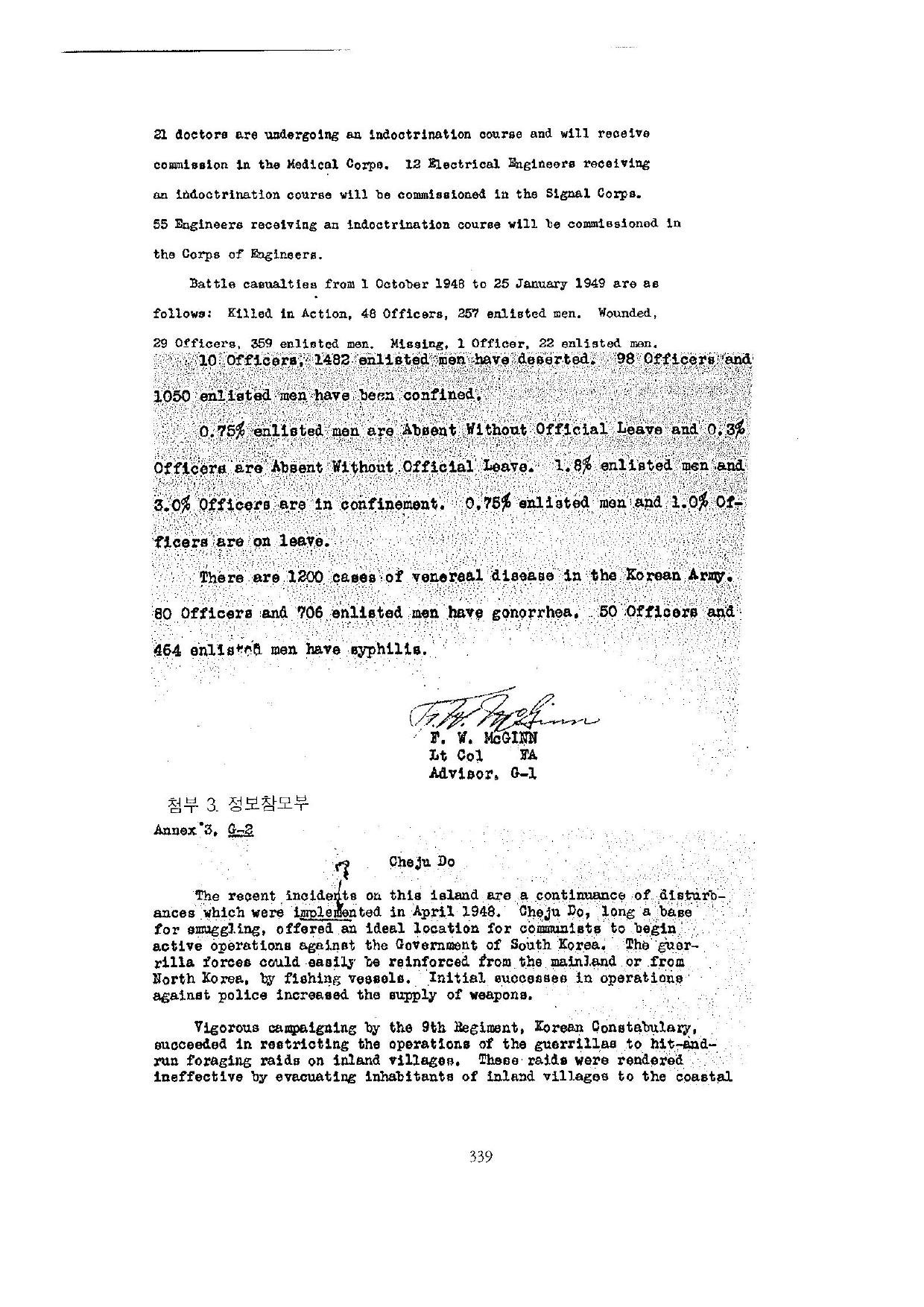
1948년 10월 1일부터 1949년 1월 25일까지 전상자 수는 다음과 같다. 작전 중 사망 장교 48명 사병 257명. 부상 장교 29명 사병 359명. 실종 장교 1명 사병 22명. 탈영 장교 10명 사병 1,482명. 투옥 장교 98명 사병 1,050명.
사병의 0.75%와 장교 0.3%가 무단 이탈하였으며, 사병 1.8%와 장교 3%가 투옥되었고, 사병 0.75%와 장교 1%가 휴가중이다.
한국군 내에 1,200건의 성병 감염이 있었다. 장교 80명 사병 706명이 임질에 감염되었으며 장교 50명 사병 464명이 매독에 감염되었다.
인사참모, 고문관 맥긴(F. W. McGinn) 중령
첨부 3. 정보참모부
제주도
제주도의 최근 사건들은 1948년 4월에 시작된 소요의 연속이다. 오랫동안 밀수의 근거지였던 제주도는 공산주의자들이 남한 정부에 대하여 활발한 작전을 개시할 수 있는 이상적인 장소이다. 게릴라 병력은 본토나 북한으로부터 어선을 이용하여 쉽게 보강될 수 있다. 경찰에 대한 작전에서 최초의 성공은 무기의 공급을 증가시켰다.
국방경비대 제9연대의 활발한 작전은 섬 마을들을 급습하여 약탈하는, 치고 빠지는 식의 게릴라들의 작전을 제한하는 데 성공하였다. 이러한 기습공격은 산간마을의 주민들을 해안지역으로 소개시킴으로써 비효율적으로 되었다. 더욱 활발한 순찰활동은 게릴라들의 작전을 차단하였다. 수많은 무고한 민간인들이 제주도에서 죽어갔다. 그들의 대부분은 게릴라의 공격으로 살해당하였으며, 일부의 민간인들은 의심할 여지없이 한국군에 의하여 살해당하였다.
총으로 무장한 게릴라의 수는 150명을 넘지 않는다. 이들 총으로 무장한 게릴라들이 주로 칼, 곤봉, 창 등으로 무장한 공격집단의 핵심을 이루었다.
활동 속도의 증가는 남한의 모든 지역에서와 마찬가지로 오직 한 가지 목적 즉, 승인된 한국정부를 불신임하는 것이다.
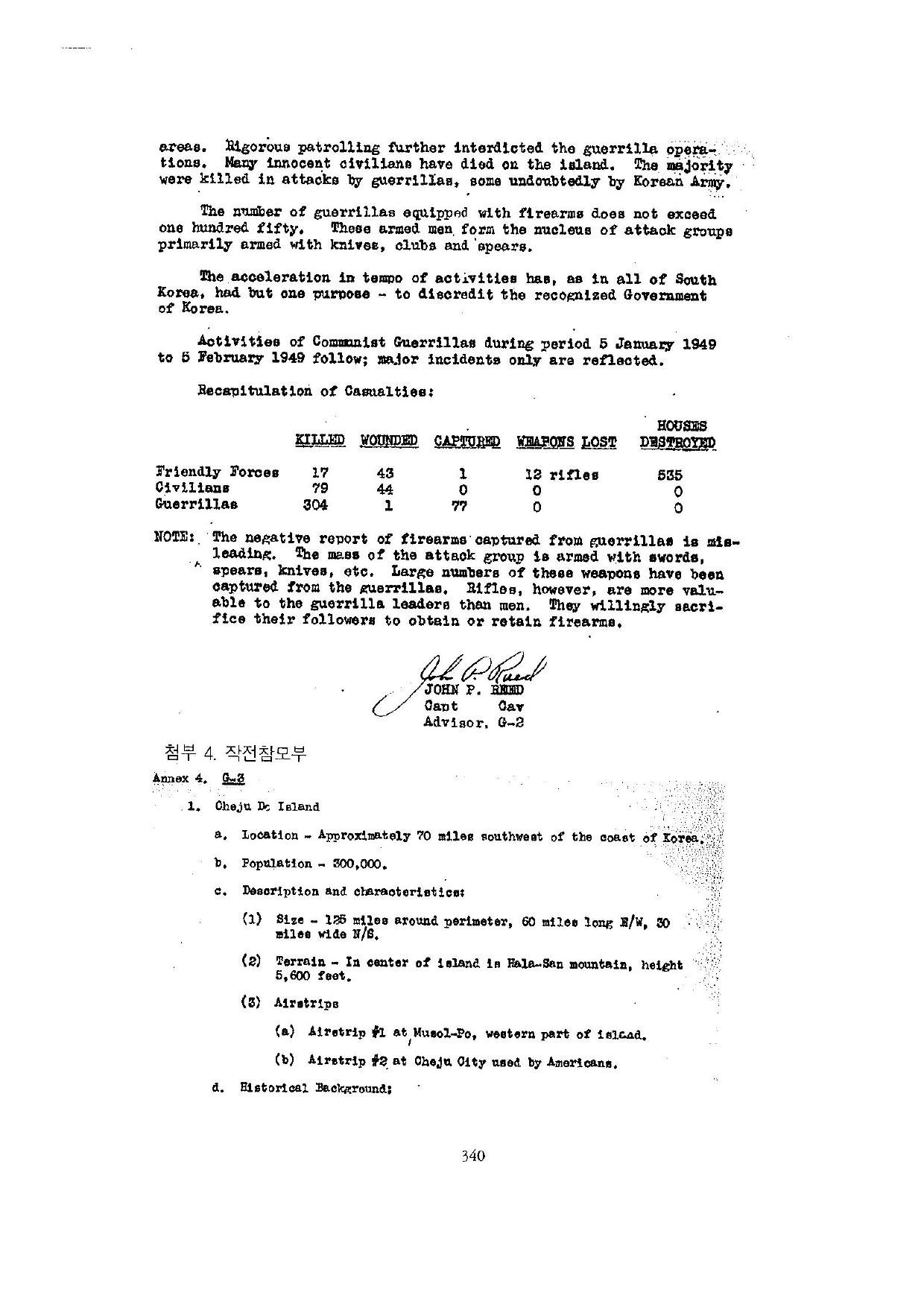
1949년 1월 5일부터 1949년 2월 5일까지 공산게릴라의 활동은 다음과 같다. 주요 사건들만 반영되었다.
전상자 요약
주: 게릴라들로부터 노획한 총기에 대한 부정적인 보고가 오해를 일으키고 있다. 공격집단의 대다수는 장검, 창, 칼 등으로 무장하였다. 수많은 이런 종류의 무기들이 게릴라들로부터 노획되었다. 다만, 총은 게릴라 병사들보다는 지휘자들에게 더 소중하다. 그들은 총기를 보유하거나 획득하기 위하여 동료들을 기꺼이 희생시킨다.
정보참모, 고문관 존 리드(John P. Reed) 대위
첨부 4. 작전참모부
1. 제주도
a) 위치 - 한국해안의 남서쪽 약 70마일
b) 인구 - 30만
c) 특색:
(1) 크기 - 둘레 125마일, 동서길이 60마일, 남북길이 30마일.
(2) 지형 - 섬의 중심에 높이 5,600피트의 한라산이 있다.
(3) 활주로
ⓐ 섬의 서쪽에 위치한 모슬포의 1번 비행장
ⓑ 미국인들이 사용하고 있는 제주읍의 2번 비행장
d) 역사적 배경:
(1) 귀양지 - 섬은 한때 본토사람들의 귀양지로 사용되었다. 이러한 상황은 본토 사람들과 제주도 주민들 사이에 존재하는 악감정의 부분적인 이유이다.
(2) 일본인의 영향:
ⓐ 전쟁 중 일본인들은 제주도에 약 25만명의 병력을 주둔시켰다.
ⓑ 모슬포의 1번 비행장은 전쟁 초기에 상하이 폭격을 위한 기지로 사용되었다.
e) 미군 병력
(1) 제59군정중대는 1948년 9월까지 제주도에 주둔하였다.
(2) 미육군 제6사단 소속 1개 소대는 1949년 1월 1일까지 제주 비행장에 주둔하였다.
f) 정치적 배경과 군사작전
(1) 제주도 섬사람들과 일본인들은 매우 사이좋게 지냈다.
(2) 남로당 - 5월 선거 때까지 매우 강력했음. 기본적으로 공산주의 노선을 추종함.
(3) 1948년 10월 분쟁이 걷잡을 수 없는 상황이 됨. 공산주의자들은 오름과 동굴을 장악함. 섬의 모든 읍면에 집단으로 조직됨.
2. 제주도 작전
a) 적의 상황:
(1) 공산주의 그룹의 본부들이 지하에 위치함. 그룹본부에서 모든 공산주의자들의 무기를 통제함.
(2) 공산주의자들(기습자들)은 한 마을의 공산주의자들에게 다른 마을을 기습하도록 요청한다.
(3) 공산주의 노선을 추종하고 인민을 해체하여 서로 싸우도록 만든다.
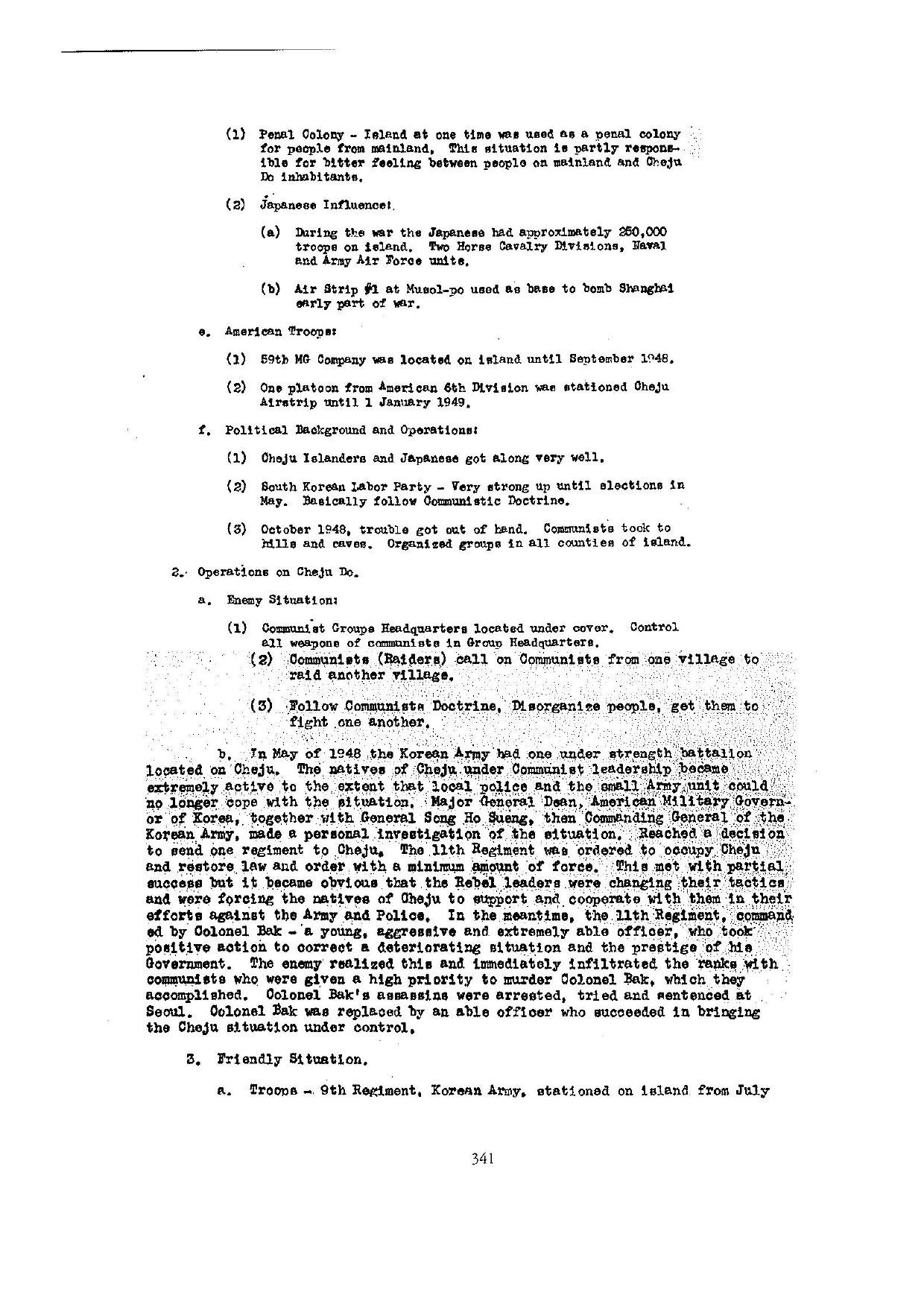
b) 1948년 5월 한국군은 제주도에 1개 대대 병력 미만의 규모를 주둔시켰다. 공산주의 지도 하에 제주도 태생의 주민들은 지역 경찰과 소규모의 군부대가 상황을 처리할 수 없을 정도로 매우 활동적이었다. 한국의 미군정장관 딘 소장은 한국군 사령관 송호성 장군과 함께 친히 상황을 조사하여 제주도에 1개 연대를 파견할 것을 결정하였다. 제11연대는 제주도를 장악하여 최소한의 병력으로 법과 질서를 회복하라는 명령을 받았다. 이것은 약간의 성공을 거두었으나 폭도 지도자들은 그들의 전략을 바꾸어 제주도민들로 하여금 군대와 경찰에 대항하는 그들의 노력에 지지와 협조를 강요하였다. 한편 제11연대는 박(Bak) 대령의 지휘를 받고 있었는데 박 대령은 젊고 공격적이며 매우 유능한 장교로서 악화된 상황을 바로잡고 정부의 권위를 세우기 위하여 적극적인 작전을 전개하였다. 적은 이 점을 간파하고 즉시 박 대령 살해에 우선 과제를 둔 공산주의자 간부들을 침투시켜 살해하는데 성공하였다. 박 대령의 암살자들은 체포되어 재판을 거쳐 서울에서 처형되었다. 제주 상황을 통제하는데 성공할 유능한 장교가 박 대령을 대신하였다.
3. 아군상황
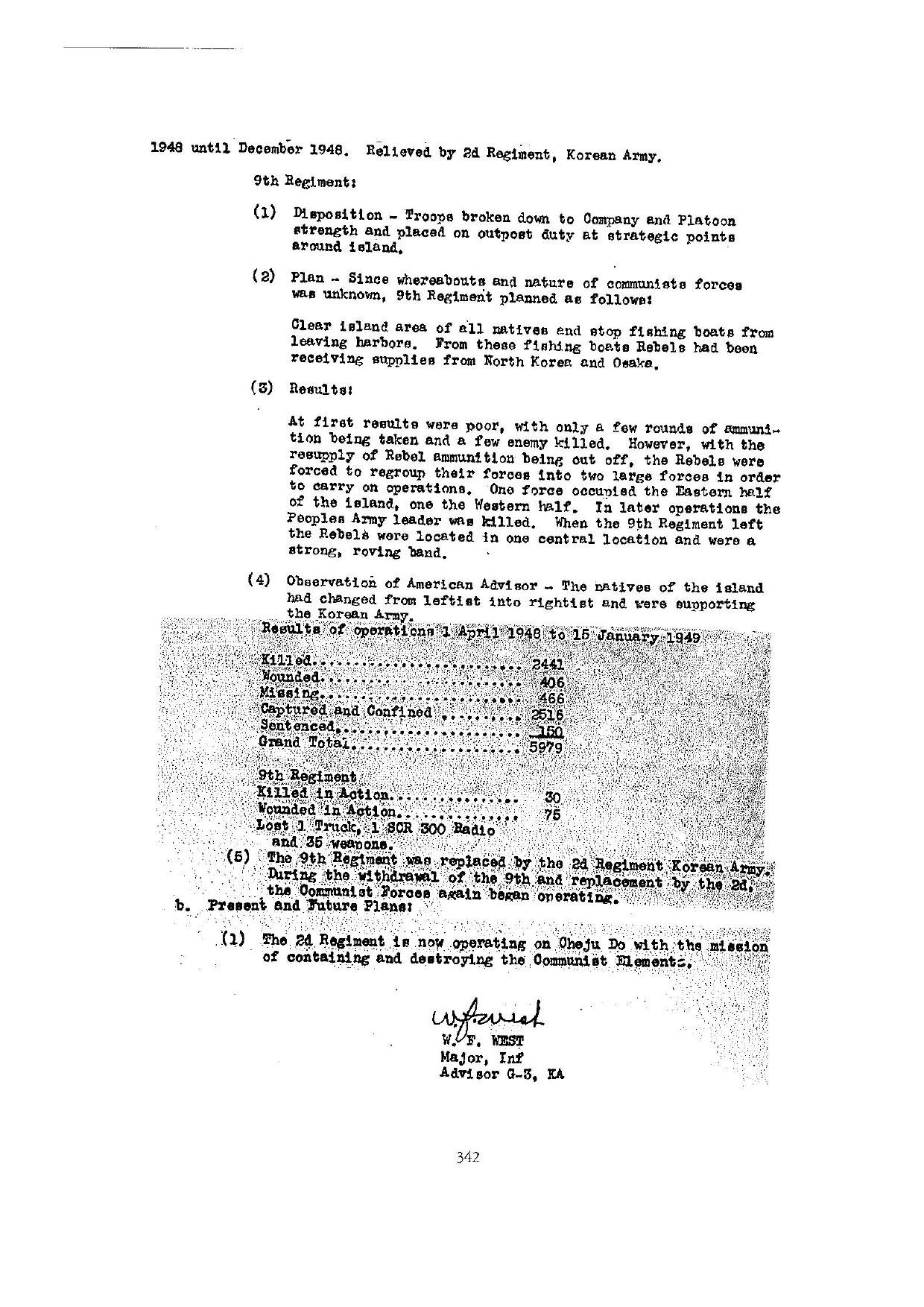
a) 병력 - 한국군 제9연대는 1948년 7월부터 12월까지 제주도에 주둔하였다. 한국군 제2연대로 교체.
제9연대
(1) 배치 - 병력은 중대와 소대규모로 나누어져 섬의 전략지점의 전초기지에 배치됨.
(2) 계획 - 공산주의 세력의 거점과 성격이 알려지지 않았으므로 제9연대는 다음과 같이 계획하였다. 모든 주민들을 섬 지역에서 쫒아내고 어선이 항구를 떠나는 것을 금지함. 이들 어선을 이용하여 폭도들은 북한과 오사카로부터 보급을 받아왔다.
(3) 결과 - 처음에는 소수의 실탄 노획과 소수의 적 사살 등 결과가 별로 좋지 않았다. 그러나 폭도들의 실탄 재보급이 끊긴 후 폭도들은 작전을 수행하기 위하여 병력을 두 개의 큰 무리로 재조직할 수밖에 없었다. 한 무리는 섬의 동쪽 절반을 그리고 다른 한 무리는 서쪽 절반을 장악하였다. 뒤이은 작전에서 인민군 지도자(the Peoples Army leader)가 사살 당하였다. 제9연대가 떠날 무렵 폭도들은 한 중심 장소에 위치하였으며 강력하고 이동이 잦은 무리들이었다.
(4) 미군 고문관의 관찰 - 섬 주민들은 좌익에서 우익으로 변화하였으며 한국군을 지지하고 있었다.
1948년 4월 1일부터 1949년 1월 15일까지 작전결과
9연대
(5) 제9연대는 제2연대로 교체되었다. 교체기간 중 공산세력은 다시 작전을 개시하였다.
b) 현재와 장래 계획:
(1) 제2연대는 현재 공산주의자들의 억제와 분쇄 임무를 띠고 제주도에서 작전중이다.
작전참모, 고문관 웨스트(W. F. West) 소령
HEADQUARTERS
KOREAN MILITARY ADVISORY GROUP
APO 235
The Honorable Kenneth C Royall
Secretary of the Army
Department of Defense
Washington 25, D C
Dear Mr Royall:
This folio presents a picture of the history, organization, strength and composition of the Korean Security Forces.
A description of the present operations of the Korean Security Forces against subversive elements on the mainland and the island of Cheju do is also presented.
Logistical data reflect the present status of supply and the problems involved.
These may be considered as "extension of remarks" which, if desired, may serve as a refresher or as data which cannot be easily remembered.
Sincerely yours,
W L ROBERTS
Brigadier General, U S Army
Chief
7 Incls:
5 incl: Korean Army
1 incl: Korean Navy
1 incl: Korean Police
WLRiee
7 January 1949
첨부 1. 국방경비대의 역사
Annex 1. HISTORY OF THE KOREAN CONSTABULARY
Period October 1945 through December 1945
On 22 October 1945, Colonel Argo was assigned Director, Department of National Defense. Under the supervision of Lt Col Green, the Seoul English Language School was established. This school consisted of approximately 60 Korean ex-military men who - upon graduation - constituted the Officer cadre for the Korean Constabulary.
Period January 1946 through March 1946
Military Government Ordinance #86 authorized the organization of a Bureau of Constabulary, authorized strength 25,000 Officers and men; and a Bureau of Coast Guard, strength 3,000 Officers and men. The first six graduates of the Seoul Language School were commissioned in the grade of 2nd Lieutenant. 15 January 1946, Lt Col Marshal assumed duties as Chief, Korean Constabulary. Eight United States Army Officers were assigned to the Bureau of Constabulary. These Officers received a brief orientation and with a minimum of directives, departed for the provincial capitols of South Korea. These Officers were given the mission of setting up Regimental Headquarters and organizing Regiments by local recruiting. Funds, food, clothing and equipment for this adventure were lacking - almost non-existent.
Period March 1946 through May 1946
In March 1946, Lt Col Barros relieved Lt Col Marshal and assumed the duties of Chief, Korean Constabulary. During March and April, recruiting in the field gave the Korean Constabulary a strength of 3,000 Officers and men. In May 1946, Colonel Terrill E Price relieved Colonel Argo and became Director, Department of National Defense. Due to many internal matters - political and others - there was very little enthusiasm for a Korean Army as such. This, coupled with the fact that both the Americans and the Koreans hoped for a united Korea, put the Korean Constabulary off to a poor start.
Period June 1946 through August 1946
During this period the Korean Constabulary remained at almost a standstill. In June the Department of National Defense was re-named Department of Internal Security. An Officers' Training School was started for the purpose of training Cadets for commissions in the Constabulary. Five additional American Officers were assigned to the Department of Internal Security. Three of these Officers wore assigned to the Bureau of Constabulary and were sent to the field to command Regiments.
Period September 1946 through November 1946
In September 1946 a decision was made to advance the organization of Constabulary Headquarters and to accelerate the recruiting program. Captain Hausman was assigned Executive Officer to the Chief, Korean Constabulary. Captain Hausman's assignment was for the purpose of organizing Headquarters, Constabulary. At the end of this period, Constabulary strength had risen to 5,000 Officers and men. 12 November 1946, the 9th Regiment was activated on the island of Cheju.
Period December 1946 through February 1947
By December, Constabulary Headquarters was organized along the lines of an Infantry Division Headquarters. At this time, Major General Lerch, Military Governor of Korea decided to give the Koreans broader powers in running their government. In the Constabulary, the Americans became Advisors and the Koreans became Commanders, certain necessary control remaining with the Americans. Major Lee Heung Koon was appointed Acting Chief of Constabulary. During the latter part of December and continuing for 7 weeks, Major Lee and Captain Hausman made an extensive field trip for the purpose of accelerating organization of the Regiments and procuring additional areas to permit the Regiments to go to full strength. Many difficulties were encountered in this trip. Properties had to be located, their titles searched and much other red tape pursued and defeated before the properties could be turned over to the Korean Constabulary. In January, Major Song Ho Seung (later promoted to Colonel, then Brigadier General) was assigned as the first Chief of Korean Constabulary. In this period, progress was notable; Constabulary strength grew from 5,000 to 8,000. The main interest of Military Government at this time was the Korean National Police and the National Youth Movement. This was a start of bad feelings among Youth organizations, Korean Police and the Constabulary. It was also the beginning of a chain of serious incidents between the Police and Constabulary.
Period March 1947 through May 1947
Organization and recruiting continued favorably with the strength of the Constabulary reaching 10,000 by mid-April. Police-Constabulary relations became more strained, culminating in the Yongam incident. In this incident, one company of Constabulary from the 4th Regiment, Cholla Namdo, made a motor march to Yongam and attacked the police station. Both sides suffered several casualties. In both organizations, on National level, the Korean Commanders and the American Advisors held conferences and exerted every effort to better the relations between the Police and Constabulary. In addition to the complications effected by poor relations between Police and Constabulary, the matter of dissident elements within the Constabulary was reaching a proportion of its own. These elements contributed greatly to the police-Constabulary trouble and even today, Communists miss no opportunity to capitalize on the old hard feelings which existed between the two organizations. The Constabulary immediately launched a campaign to rid the ranks of undesirables. This campaign has been continuous and is still being pushed vigorously. In May, Lt Col Barros was relieved as Advisor, Korean Constabulary and Captain Hausman was appointed Acting Advisor, Korean Constabulary.
Period June 1947 through August 1947
In this period, emphasis was placed on Regimental schools for Officers and non-commissioned Officers, and training to include small unit tactics. The Constabulary was armed with Japanese rifles; clothing and equipment was not standard and quite limited. 21 July 1947, Captain Hausman assigned as Advisor, Korean Constabulary. By the end of July, the Constabulary strength had reached 15,000. Due to a limited budget, and the desire to abide by a closely-figured National expenditure, the Military Governor of Korea ordered recruitment stopped.
Period September 1947 through February 1948
This six month period brought about the most important events in the history of the Constabulary. The Constabulary was officially looked upon as the Military Organization of South Korea. Recommendations to organize and equip with American arms and equipment, a Constabulary of 50,000 were submitted and approved. In alignment with this decision, approximately 90 US Army officers were authorized as Advisors to the Korean Constabulary. It was further agreed that a Brigadier General should be assigned to the Department of Internal Security to head the Advisory Group.
Period March 1948 Through May 1948
By March, the Constabulary strength had increased to 20,000. For the first time, technical services such as Ordnance, Quartermaster, Signal, Engineer and Medical were activated, and within the Constabulary a survey for qualified officers and men for these services was made. The Constabulary Officers Corps had expanded to a strength of approximately 1,200. Organization had made notable gains including the activation of three (3) Brigade Headquarters. 20 May 1948, Brigadier General W. L. Roberts took over the position of Director, Department of Internal Security relieving Colonel Terrill E. Price, who returned to the Zone of Interior.
Period June 1948 Through 1948
The Department of Internal Security had retained direct control of all supply and finance functions and the technical services of the Korean Constabulary. General Robert's first major decision was to place the above functions and technical services directly under the Chief of Constabulary and in general, for the betterment of organization and training, to deemphasize the Department of Internal Security and place added emphasis on the Korean Constabulary. During this period, the Constabulary strength reached 35,000. By August, the reorganization had been accomplished and was working with a minimum amount of confusion. Numerous provisional schools were established for the purpose of training officers and men in the use of their new US arms and equipment. Training was given number one priority and standard training schedules and directives were drawn up and issued by Headquarters Korean Constabulary. A series of administrative and training inspections were conducted by General Roberts and Staff Advisors of the Korean Constabulary. These inspections brought out many deficiencies in the field and went far toward better organization, training and efficiency.
Period September 1948 Through November 1948
The authorized strength of 50,000 was obtained. The technical services made commendable advancement. It was during this period that the Constabulary suffered its most serious setback. On the night of 19 October, a communist inspired rebellion broke out in the 14th Regiment stationed at Yosu, Cholla Namdo. By the use of cleverly devised propaganda, the communists were able to get almost full cooperation from the enlisted men and several officers of the 14th Regiment. The battles which followed were fierce and bloody. Approximately 1,000 police and civilians were killed. This rebellion proved to be the supreme test for the loyal Constabulary troops. Under command of General Song Ho Sueng, the loyal troops moved into the zone of action and within nine days the major portion of operations was over. Small groups of the rebels escaped capture and fled to the several mountainous areas of South Korea. These groups are being hunted daily by units of the loyal troops and when they are located, they are either killed or captured. The Yosu rebellion while a dark smear on the otherwise good reputation of the Korean Constabulary has been a great source of training for the field units, the staff and commanders of higher headquarters. It also was a good test for the system followed by the American Advisory Group for it showed that, although difficult, the Advisor can properly advise his counter-part even in battle.
Period December 1948 Through January 1949
1 December the Korean National Security Act redesignated the Department of Internal Security, "Department of National Defense". This same Act re-designated the Korean Constabulary, "Korean Army", and authorized the army to organize the various branches of service as required. As of January, the Korean Army strength was 2730 officers and 61,858 enlisted men making a total of 64,588 officers and enlisted men.
JAMES H. HAUSMAN
Captain, Infantry
Advisor, Korean Army
첨부 2. 인사참모부
Annex 2. G-1
The G-1 Section of the Korean Army is patterned after the organization of the Personnel Section of the American Army General Staff. It consists of 6 Officers and 18 enlisted men as follows: Assistant Chief of Staff G-1, an Executive Officer and an Officer in Charge of the Administrative Section, Personnel Management Section, Law and Order Section and Personnel Service Section. The Personnel Management Section is sub-divided into Military Personnel Sub-section, Replacement Sub-section (non-operational), and Civilian Employees Sub-section. The Replacement Sub-section will be operational only when the country mobilizes for war.
The Korean Army consists of 2,730 Officers as follows: 3 Major Generals, 7 Brigadier Generals, 17 Colonels, 82 Lieutenant Colonels, 67 Majors, 323 Captains, 864 1st Lieutenants and 1373 2nd Lieutenants. There are 61,858 enlisted men in the Korean Army, making a total of 64,588 Officers and enlisted men.
The Korean Military Academy has 1660 Cadets as follows: Officer Training School class #8, 408 Civilian Cadets and 276 Enlisted Men. Class #9 has 466 Civilian Cadets. In addition there are 5 classes of Special Cadets as follows: One class of 183 Cadets who were former leaders in the various Young Men Military Societies. 239 physical training instructors from the Middle Schools who, when graduated, will give basic military instructions to students in the Middle Schools.
21 doctors are undergoing an indoctrination course and will receive commission in the Medical Corps. 12 Electrical Engineers receiving an indoctrination course will be commissioned in the Signal Corps. 55 Engineers receiving an indoctrination course will be commissioned in the Corps of Engineers.
Battle casualties from 1 October 1948 to 25 January 1949 are as follows: Killed in Action, 48 Officers, 257 enlisted men. Wounded, 29 Officers, 359 enlisted men. Missing, 1 Officer, 22 enlisted men. 10 Officers, 1482 enlisted men have deserted. 98 Officers and 1050 enlisted men have been confined.
0.75% enlisted men are Absent Without Official Leave and 0.3% Officers are Absent Without Official Leave. 1.8% enlisted men and 3.0% Officers are in confinement. 0.75% enlisted men and 1.0% Officers are on leave.
There are 1200 cases of venereal disease in the Korean Army. 80 Officers and 706 enlisted men have gonorrhea. 50 Officers and 464 enlisted men have syphilis.
F. W. McGINN
Lt Col FA
Advisor, G-1
첨부 3. 정보참모부
Annex 3, G-2
Cheju Do
The recent incidents on this island are a continuance of disturbances which were implemented in April 1948. Cheju Do, long a base for smuggling, offered an ideal location for communists to begin active operations against the Government of South Korea. The guerrilla forces could easily be reinforced from the mainland or from North Korea, by fishing vessels. Initial successes in operations against police increased the supply of weapons.
Vigorous campaigning by the 9th Regiment, Korean Constabulary, succeeded in restricting the operations of the guerrillas to hit-and-run foraging raids on inland villages. These raids were rendered ineffective by evacuating inhabitants of inland villages to the coastal
areas. Rigorous patrolling further interdicted the guerrilla operations. Many innocent civilians have died on the island. The majority were killed in attacks by guerrillas, some undoubtedly by Korean Army.
The number of guerrillas equipped with firearms does not exceed one hundred fifty. These armed men form the nucleus of attack groups primarily armed with knives, clubs and spears.
The acceleration in tempo of activities has, as in all of South Korea, had but one purpose - to discredit the recognized Government of Korea.
Activities of Communist Guerrillas during period 5 January 1949 to 5 February 1949 follow; major incidents only are reflected.
Recapitulation of Casualties:
KILLED WOUNDED CAPTURED WEAPONS LOST HOUSES DESTROYED
Friendly Forces 17 43 1 12 rifles 535
Civilians 79 44 0 0 0
Guerrillas 304 1 77 0 0
NOTE: The negative report of firearms captured from guerrillas is misleading. The mass of the attack group is armed with swords, spears, knives, etc. Large numbers of these weapons have been captured from the guerrillas. Rifles, however, are more valuable to the guerrilla leaders than men. They willingly sacrifice their followers to obtain or retain firearms.
JOHN P. REED
Cant Cav
Advisor, G-2
첨부 4. 작전참모부
Annex 4. G-3
1. Cheju Do Island
a. Location - Approximately 70 miles southwest of the coast of Korea.
b. Population - 300,000.
c. Description and characteristics:
(1) Size - 125 miles around perimeter, 60 miles long E/W, 30 miles wide N/S.
(2) Terrain - In center of island is Hala-San mountain, height 5,600 feet.
(3) Airstrips
(a) Airstrip #1 at Musol-Po, western part of island.
(b) Airstrip #2 at Cheju City used by Americans.
d. Historical Background;
(1) Penal Colony - Island at one time was used as a penal colony for people from mainland. This situation is partly responsible for bitter feeling between people on mainland and Cheju Do inhabitants.
(2) Japanese Influence:
(a) During the war the Japanese had approximately 250,000 troops on island. Two Horse Cavalry Divisions, Naval and Army Air Force units.
(b) Air Strip #1 at Musol-po used as base to bomb Shanghai early part of war.
e. American Troops:
(1) 59th MG Company was located on island until September 1948.
(2) One platoon from American 6th Division was stationed Cheju Airstrip until 1 January 1949.
f. Political Background and Operations:
(1) Cheju Islanders and Japanese got along very well.
(2) South Korean Labor Party - Very strong up until elections in May. Basically follow Communistic Doctrine.
(3) October 1948, trouble got out of hand. Communists took to hills and caves. Organized groups in all counties of island.
2. Operations on Cheju Do.
a. Enemy Situation:
(1) Communist Groups Headquarters located under cover. Control all weapons of communists in Group Headquarters.
(2) Communists (Raiders) call on Communists from one village to raid another village.
(3) Follow Communists Doctrine, Disorganize people, get them to fight one another.
b. In May of 1948 the Korean Army had one under strength battalion located on Cheju. The natives of Cheju under Communist leadership became extremely active to the extent that local police and the small Army unit could no longer cope with the situation. Major General Dean, American Military Governor of Korea, together with General Song Ho Sueng, then Commanding General of the Korean Army, made a personal investigation of the situation. Reached a decision to send one regiment to Cheju. The 11th Regiment was ordered to occupy Cheju and restore law and order with a minimum amount of force. This met with partial success but it became obvious that the Rebel leaders were changing their tactics and were forcing the natives of Cheju to support and cooperate with them in their efforts against the Army and Police. In the meantime, the 11th Regiment, command ed by Colonel Bak - a young, aggressive and extremely able officer, who took positive action to correct a deteriorating situation and the prestige of his Government. The enemy realized this and immediately infiltrated the ranks with communists who were given a high priority to murder Colonel Bak, which they accomplished. Colonel Bak's assassins were arrested, tried and sentenced at Seoul. Colonel Bak was replaced by an able officer who succeeded in bringing the Cheju situation under control.
3. Friendly Situation.
a. Troops - 9th Regiment, Korean Army, stationed on island from July
1948 until December 1948. Relieved by 2d Regiment, Korean Army.
9th Regiment:
(1) Disposition - Troops broken down to Company and Platoon strength and placed on outpost duty at strategic points around island.
(2) Plan - Since whereabouts and nature of communist forces was unknown, 9th Regiment planned as follows:
Clear island area of all natives and stop fishing boats from leaving harbors. From these fishing boats Rebels had been receiving supplies from North Korea and Osaka.
(3) Results:
At first results were poor, with only a few rounds of ammunition being taken and a few enemy killed. However, with the resupply of Rebel ammunition being cut off, the Rebels were forced to regroup their forces into two large forces in order to carry on operations. One force occupied the Eastern half of the island, one the Western half. In later operations the Peoples Army leader was killed. When the 9th Regiment left the Rebels were located in one central location and were a strong, roving band.
(4) Observation of American Advisor - The natives of the island had changed from leftist into rightist and were supporting the Korean Army.
Results of operations 1 April 1948 to 15 January 1949
Killed............................. 2441
Wounded........................... 406
Missing........................... 466
Captured and Confined............. 2516
Sentenced......................... 150
Grand Total....................... 5979
9th Regiment
Killed in Action.................. 30
Wounded in Action................. 75
Lost 1 Truck, 1 SCR 300 Radio
and 35 weapons.
(5) The 9th Regiment was replaced by the 2d Regiment Korean Army. During the withdrawal of the 9th and replacement by the 2d, the Communist Forces again began operating.
b. Present and Future Plans:
(1) The 2d Regiment is now operating on Cheju Do with the mission of containing and destroying the Communist Elements.
W. F. WEST
Major, Inf
Advisor G-3, KA
출처:
제주4·3사건진상규명및희생자명예회복위원회 편,
『제주4·3사건자료집 8』 [미국자료편],
번역문 p.125
/ 원문 p.334–342.