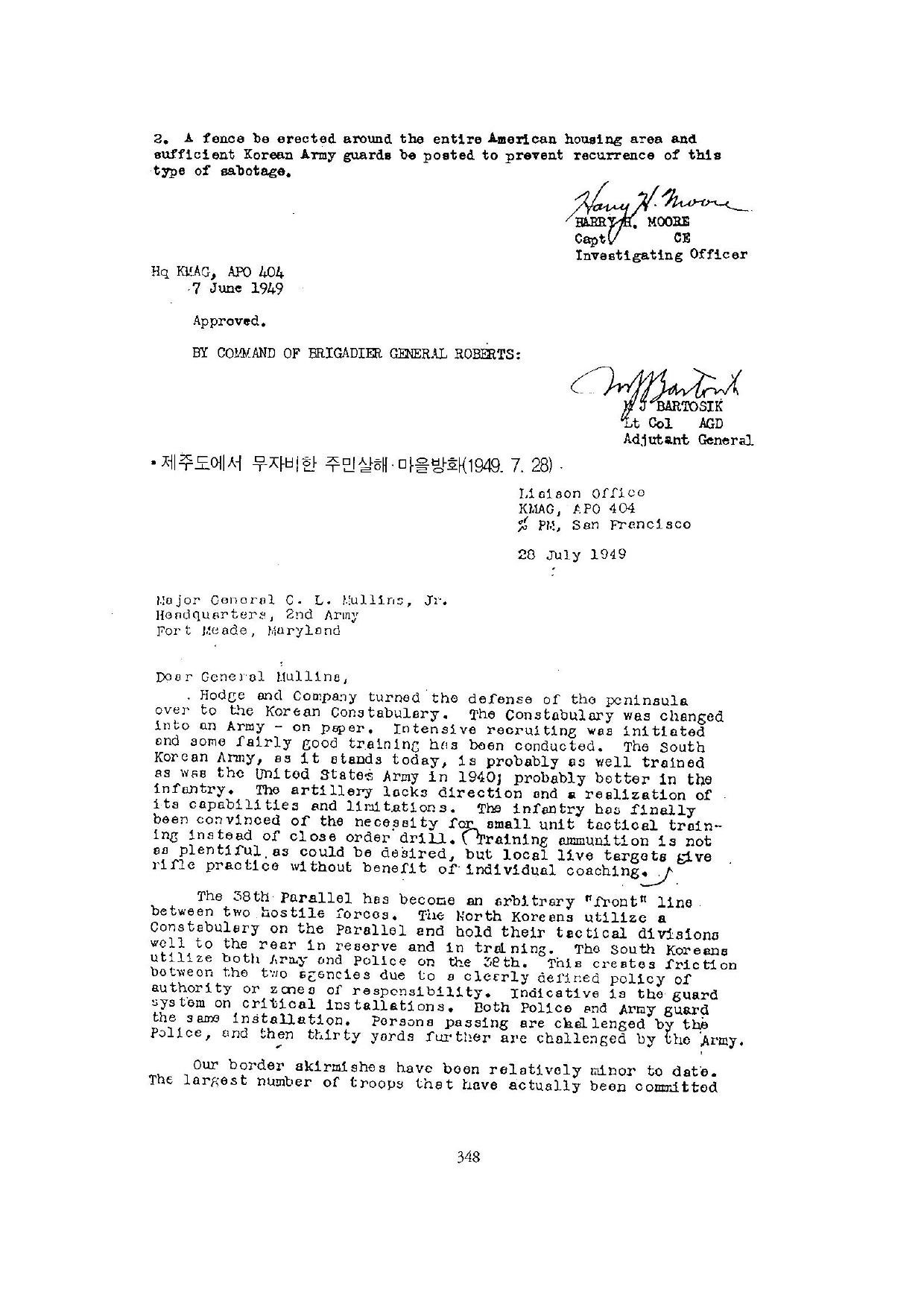
수신: 제2군사령관 멀린스 2세(C. L. Mullins Jr.) 육군소장
발신: 주한미군사 고문단 연락사무소
멀린스(Mullins) 장군 귀하
하지와 주한미군은 (한)반도의 방어를 국방경비대에 넘겼습니다. 국방경비대는 서류상 군으로 바뀌었습니다. 국방경비대는 신병 모집을 강력하게 추진했고, 질 높은 훈련을 실시하고 있습니다. 남한군은 1940년의 미국 육군처럼 훈련을 잘 받고 있습니다. 아마도 보병 분야에서는 더 나으리라 생각합니다. 포병은 방향성 뿐만 아니라 능력과 한계에 대한 인식이 결핍돼 있습니다. 보병은 마침내 밀집대형 훈련 대신 소규모 부대의 전술훈련이 필요하다는 사실을 분명히 인식하게 되었습니다. 훈련용 탄약은 바라는 것만큼 충분하지는 않지만, 개개인에 대한 교육 없이도 지역의 살아있는 목표물을 대상으로 사격훈련을 하고 있습니다.
38선은 두 적대적인 군대 사이에 임의의 ‘전선’(前線)이 되어가고 있습니다. 북한은 38선 경계에 경비대를 활용하고 있으며, 전술사단을 후방에 대기시켜 훈련하고 있습니다. 남한은 38선에서 군과 경찰을 활용하고 있습니다. 이것은 명백히 당국의 정책을 제한하거나 책임 지역 문제를 초래해 두 기관 사이에 마찰을 일으키는 요인이 되고 있습니다. 중요시설에는 경계체제가 마련되어 있습니다. 경찰과 군 모두 같은 시설을 경계하고 있습니다. 통과하는 사람들은 경찰에 의해 수하를 받고, 그리고 나서 27m(30야드) 정도 더 가서 군에 의해 수하를 받습니다.
현재까지 국경선에서 발생한 소규모 전투는 얼마 되지 않았습니다. 실제 과거에 창설된 가장 큰 부대의 병력은 연대 규모 정도입니다. 여단도 승인 받았지만 정원을 채워본 적이 없습니다.
북한은 남한의 북부 지역에서 작전을 벌이기 위해 2,000~3,000여 명의 게릴라를 훈련시키고 있습니다. 이들 게릴라들은 일반적으로 능력이 모자라며, 장비도 빈약하고, 지휘 체계는 더 더욱 초라합니다. 국경선을 넘은 최초의 2개 중대는 일 주일 안에 소탕됐습니다. 그들의 훈련은 정치적이며, 대체로 소규모 부대의 전술에 관해서는 거의 강조하지 않습니다. 그들은 귀찮은 존재들입니다. 남한의 참모총장은 야산 주위를 추적하는데 많은 훈련시간을 낭비하고 있고, 의심할 여지없이 그것은 그들의 임무입니다.
지난해 여수 반란은 제지되지 않았더라면 아주 심각할 수도 있었습니다. 우리는 미래의 골치 덩어리들을 뿌리 뽑을 수 있었기 때문에 현재와 같이 상황이 더 나아졌다고 생각합니다. 뿌리 뽑는다는 것은 간단한 절차입니다. 연대 지휘관들이 임명하는 사람들로 구성된 즉결 및 특별재판소는 사형을 선고하려고 노력하고 있고, 또 그렇게 하고 있습니다. 즉결재판소에서 근무하는 훌륭한 장교라면 오전에 60~70건을 판결하고, 오후에는 처형을 감독할 수 있습니다. 탄약이 부족할 때에는 죽창이 매우 유용하게 사용됩니다. 그러나 죽창은 여러 번 공격(찌르기)해야 하기 때문에 병사들은 쉬 지쳐버립니다. 그렇지만 많은 병사들은 피곤한 줄도 모르고 제비뽑기를 합니다.
제주도에서 반도들의 저항이 확산된 것은 부분적으로는 경찰과 군의 무능한 지휘관 때문이었습니다. 그들은 공산주의자들과 마찬가지로 무자비하게 마을 주민들을 살해하고 마을을 불질렀습니다. 제주도에서 활동하고 있는 모든 토벌부대를 철수시키고, 관용을 베풀도록 지시 받은 새로운 부대로 교체시킬 필요가 있었습니다. 주민들은 투항하면 더 이상 죽음을 당하지 않을 것이라는 확신이 서자 폭도들에 대한 지원을 중단했습니다. 한 달 안에 명목상의 저항을 제외한 거의 모든 저항이 사라졌습니다. (후략)
.
Liaison Office
KMAG, APO 404
% PM, San Francisco
28 July 1949
Major General C. L. Mullins, Jr.
Headquarters, 2nd Army
Fort Meade, Maryland
Dear General Mullins,
. Hodge and Company turned the defense of the peninsula over to the Korean Constabulary. The Constabulary was changed into an Army - on paper. Intensive recruiting was initiated and some fairly good training has been conducted. The South Korean Army, as it stands today, is probably as well trained as was the United States Army in 1940; probably better in the infantry. The artillery lacks direction and a realization of its capabilities and limitations. The infantry has finally been convinced of the necessity for small unit tactical training instead of close order drill. Training ammunition is not as plentiful as could be desired, but local live targets give rifle practice without benefit of individual coaching.
The 38th Parallel has become an arbitrary "front" line between two hostile forces. The North Koreans utilize a Constabulary on the Parallel and hold their tactical divisions well to the rear in reserve and in training. The South Koreans utilize both Army and Police on the 38th. This creates friction between the two agencies due to a clearly defined policy of authority or zones of responsibility. Indicative is the guard system on critical installations. Both Police and Army guard the same installation. Persons passing are challenged by the Police, and then thirty yards further are challenged by the Army.
Our border skirmishes have been relatively minor to date. The largest number of troops that have actually been committed
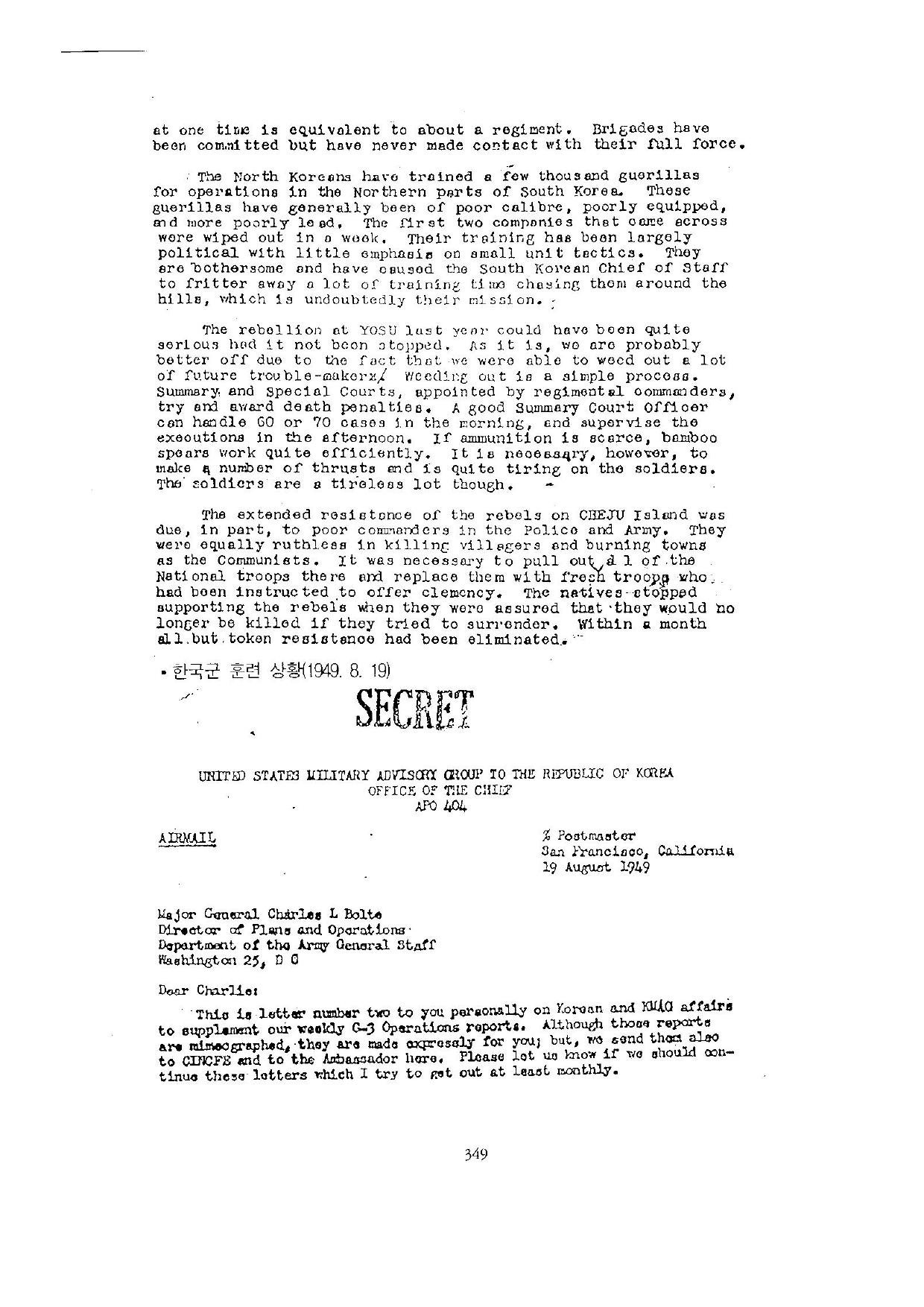
at one time is equivalent to about a regiment. Brigades have been committed but have never made contact with their full force.
The North Koreans have trained a few thousand guerillas for operations in the Northern parts of South Korea. These guerillas have generally been of poor calibre, poorly equipped, and more poorly lead. The first two companies that came across were wiped out in a week. Their training has been largely political with little emphasis on small unit tactics. They are bothersome and have caused the South Korean Chief of Staff to fritter away a lot of training time chasing them around the hills, which is undoubtedly their mission.
The rebellion at YOSU last year could have been quite serious had it not been stopped. As it is, we are probably better off due to the fact that we were able to weed out a lot of future trouble-makers. Weeding out is a simple process. Summary and Special Courts, appointed by regimental commanders, try and award death penalties. A good Summary Court Officer can handle 60 or 70 cases in the morning, and supervise the executions in the afternoon. If ammunition is scarce, bamboo spears work quite efficiently. It is necessary, however, to make a number of thrusts and is quite tiring on the soldiers. The soldiers are a tireless lot though.
The extended resistance of the rebels on CHEJU Island was due, in part, to poor commanders in the Police and Army. They were equally ruthless in killing villagers and burning towns as the Communists. It was necessary to pull out d 1 of the National troops there and replace them with fresh troops who had been instructed to offer clemency. The natives stopped supporting the rebels when they were assured that they would no longer be killed if they tried to surrender. Within a month all but token resistance had been eliminated.
출처:
제주4·3사건진상규명및희생자명예회복위원회 편,
『제주4·3사건자료집 8』 [미국자료편],
번역문 p.142
/ 원문 p.348–349.