주한미군사고문단
신성모 장관님
고문단 소속 피쉬그룬드(Fischgrund) 대위는 11월 16, 17, 18, 19일에 제주도를 방문하였으며, 본인은 그의 관찰기와 권고안을 귀하에게 보냅니다.
a. 이곳 사람들이 집을 재건축하는데 일부 건축자재, 특히 시멘트가 매우 부족합니다. 이 불쌍한 사람들이 좋은 집을 지을 수 있도록 사령관께서 적절한 기관에 건의해 주십시오. 제주도 국회의원들이 그들을 적절히 도울 것입니다.
b. 현재 섬 주변에 있는 유일한 전화선은 경찰의 것뿐입니다. 상업적인 사용에 있어서도 최소한 다른 전화선들이 복구되기 이전까지는 경찰의 전화선을 사용해야 할 것 같습니다. 이것 역시 제주도 국회의원들과 통신부의 업무입니다.
c. 제주도 국회의원들이 마을을 거의 방문하지 않는다고 마을 주민들은 말합니다. 선거이후에 두 명은 한번 방문하고, 한 명은 세 번 방문했습니다.
d. 서북청년단원 300명이 현재 경찰에 있고, 200명은 지방정부에 있습니다. 사람들이 말하기를 서북청년단원들은 더욱 부유해지고 있다고 합니다. 언론은 서북청년단의 통제하에 있습니다.
e. 경찰은 폭도 200명이 오름에 있다고 보고했지만, 최근에는 활동하지 않고 있습니다. 폭도 300명은 현재 수감중입니다.
f. 제1독립대대가 모슬포에 주둔해 있습니다. 본부는 제주읍입니다. 장소는 부대의 소재가 이동함에 따라서 본부와 함께 바뀔 것입니다. 헌병 51명이 있는데 이것은 너무 많습니다. 만일 존재한다 하더라도 그들은 군인들을 감시하기 위하여 있는 것인데 6명을 제외하고는 모두 아무 할 일도 없는 제주읍에 주둔하면서 그 곳에서 민간인들을 간섭합니다. 헌병들은 첫째 합리적인 규모로 감원되어야 하며 (전체 섬에 10명 정도) 둘째 모두 모슬포의 부대 근처에 주둔하도록 하여야 합니다.
g. 모슬포에 있는 막사들은 약간의 재건축을 필요로 합니다.
h. 믿을 만한 고위 관리가 자주 제주도와 제주도 군 주둔지를 방문하여 군대와 주민들의 상태를 점검할 것을 제안합니다.
고문단장 로버츠(W. L. Roberts) 준장
주한미육군 971방첩대
971 Counter Intelligence Corps, USAFIK
역사(歷史)
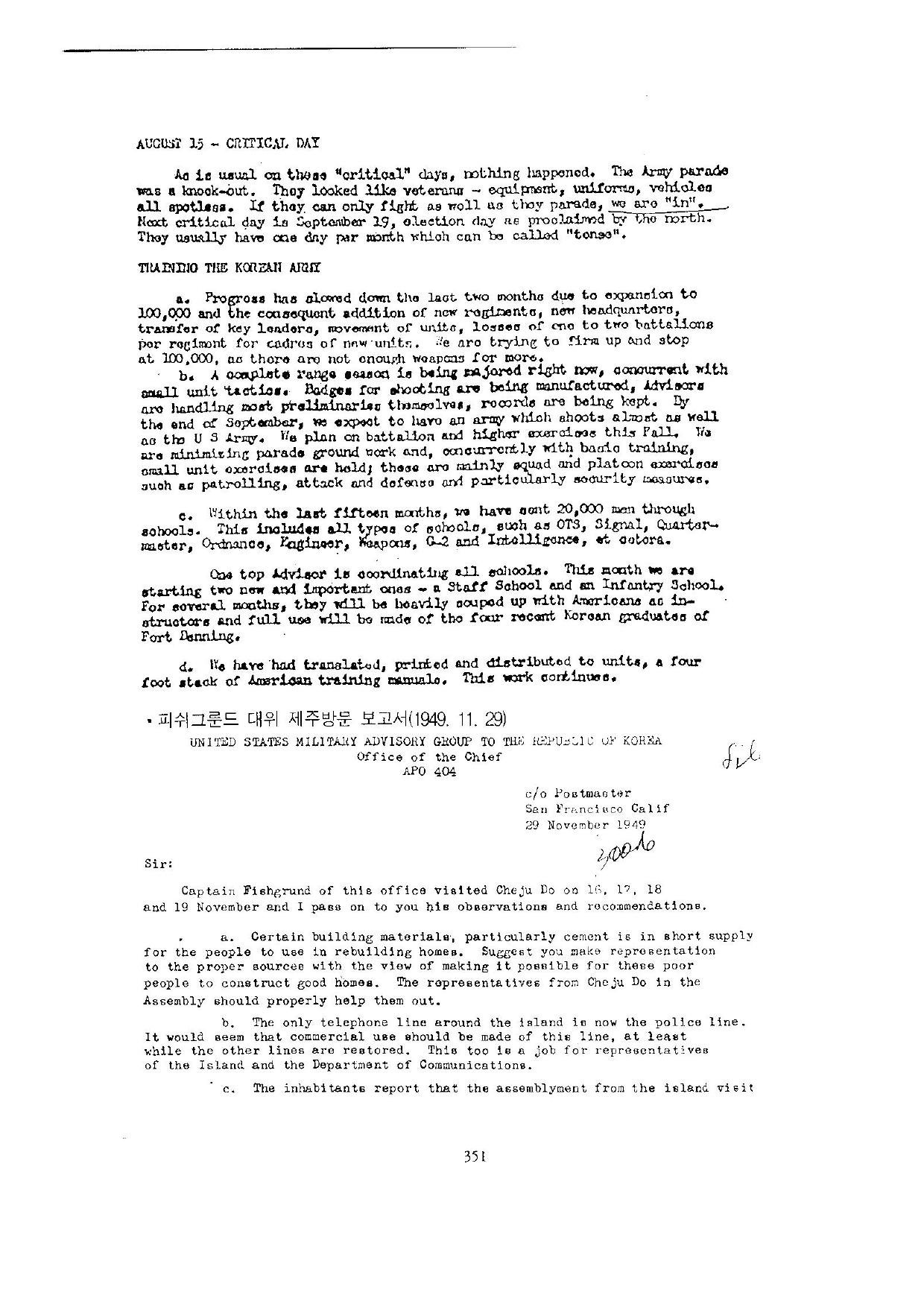
UNITED STATES MILITARY ADVISORY GROUP TO THE REPUBLIC OF KOREA
Office of the Chief
APO 404
c/o Postmaster
San Francisco Calif
29 November 1949
2,000 lo
Sir:
Captain Fishgrund of this office visited Cheju Do on 16, 17, 18 and 19 November and I pass on to you his observations and recommendations.
a. Certain building materials, particularly cement is in short supply for the people to use in rebuilding homes. Suggest you make representation to the proper sources with the view of making it possible for these poor people to construct good homes. The representatives from Cheju Do in the Assembly should properly help them out.
b. The only telephone line around the island is now the police line. It would seem that commercial use should be made of this line, at least while the other lines are restored. This too is a job for representatives of the Island and the Department of Communications.
c. The inhabitants report that the assemblyment from the island visit
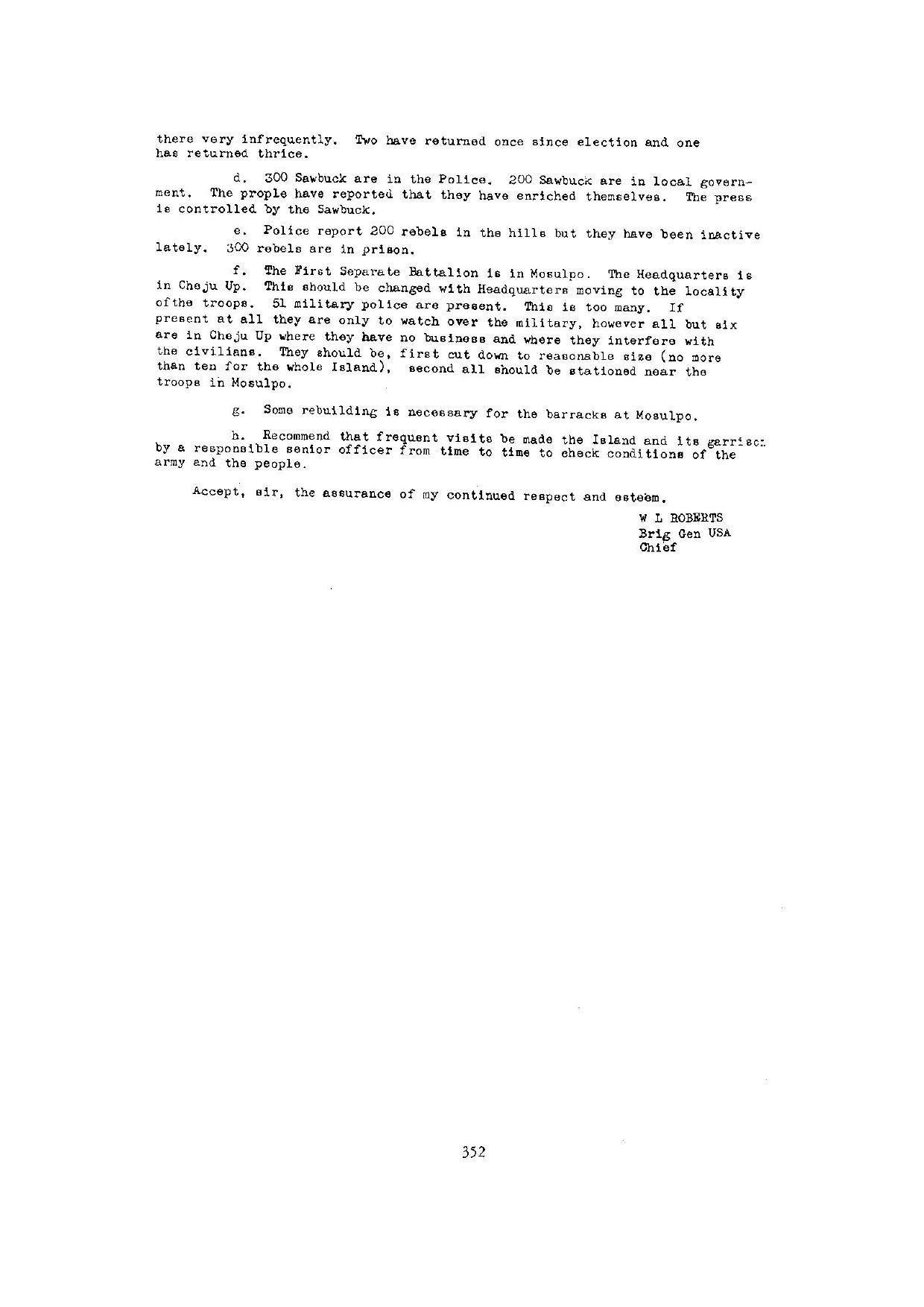
there very infrequently. Two have returned once since election and one has returned thrice.
d. 300 Sawbuck are in the Police. 200 Sawbuck are in local government. The prople have reported that they have enriched themselves. The press is controlled by the Sawbuck.
e. Police report 200 rebels in the hills but they have been inactive lately. 300 rebels are in prison.
f. The First Separate Battalion is in Mosulpo. The Headquarters is in Cheju Up. This should be changed with Headquarters moving to the locality of the troops. 51 military police are present. This is too many. If present at all they are only to watch over the military, however all but six are in Cheju Up where they have no business and where they interfere with the civilians. They should be, first cut down to reasonable size (no more than ten for the whole Island), second all should be stationed near the troops in Mosulpo.
g. Some rebuilding is necessary for the barracks at Mosulpo.
h. Recommend that frequent visits be made the Island and its garrison by a responsible senior officer from time to time to check conditions of the army and the people.
Accept, sir, the assurance of my continued respect and esteem.
W L ROBERTS
Brig Gen USA
Chief
주한미육군 971방첩대
971 Counter Intelligence Corps, USAFIK
The image appears to be completely blank/white with no visible text content to extract.
주한미육군 971방첩대
1. 방첩대사(CIC History)(1959. 4. 8)
HEADQUARTERS
U. S. ARMY INTELLIGENCE CENTER
FORT HOLABIRD, BALTIMORE 19, MARYLAND
ACSIH-GC 250/58/M
8 April 1959
SUBJECT: CIC History
TO: All Personnel Reading this Document
Section 2
ORGANIZATION OF CIC
On 9 September 1945, the first agents of the 224th CIC Detachment, many of them veterans of the campaigns of Leyte and Okinawa, arrived in Inchon, Korea, on the USS Chilton.* The Commanding Officer during these first few weeks was Lt. Col. Byron M. Meurlott.
The 224th CIC Detachment was attached to Headquarters, XXIV Corps, located in the capital city of Seoul, a city of nearly a million persons. This detachment coordinated the activity of a long list of other combat unit detachments, metropolitan units and area units.** The 85th and 86th Metropolitan Units operated out of Seoul with the latter on temporary duty in the area of Kunsan.*** The 78th Area Unit also operated out of Seoul with suboffices in Kaesong,**** Inchon,***** and Chongju.****** The 84th Metropolitan Unit was located in Pusan******* along with the 77th Area Unit, which had suboffices at Taegu, ******** Masan********* and Chinju.********** The 58th Area Unit was located at Taejon*********** and the 59th Area Unit at Kunsan. All metropolitan and area units were attached to Headquarters, XXIV Corps.
The 7th CIC Detachment was attached to Headquarters, 7th Infantry Division and located at Seoul. The 40th CIC Detachment, with offices in Pusan, was attached to the 40th Infantry Division, and the 6th CIC Detachment, attached to the 6th Infantry Division, was located in Chonju.************
* 224th CIC Detachment Historical Data Card, Unclassified.
** The organization and significance of metropolitan and area units in Korea is not documented.
*** Kunsan is on the West coast of Korea, 110 miles south of Seoul.
**** Kaesong is located just south of the 38th Parallel, 35 miles north- west of Seoul.
***** Inchon, the major port city on the west coast of Korea, is 20 miles southwest of Seoul.
****** Chongju is 80 miles south of Seoul.
******* Pusan is the major port city on the east coast of Korea, 220 miles southwest of Seoul.
******** Taegu is 155 miles southeast of Seoul.
********* Masan is 190 miles southeast of Seoul.
********** Chinju is 180 miles south of Seoul.
*********** Taejon is 100 miles south of Seoul.
************ Chonju is 130 miles south of Seoul.
Has USAFIK, Hq XXIV Corps, 224th CIC Det, Subject: CIC
Detachments in Korea, To: Director of Counterintelligence, Hqs USAFIK, 21 October 1945, (Confidential), (Kansas City Depot, BX 25099) (41)
Administration of all these units was under the jurisdiction of the 441st CIC Detachment in Tokyo, Japan.
This confusing organizational set-up was further complicated by numerous personnel changes in these early months. The 441st which sent agents to the 224th was just as likely to take them away. Many of the agents were due to be separated from the service and others were long overdue for a stateside assignment. Actually few of the men who originally came to Korea with the 224th stayed for any length of time. Meurlott was soon returned to Tokyo and replaced by Captain William R. Gordon, who was replaced later by Captain Van C. Holmes.
On 13 February 1946, CIC in Korea was reorganized in an attempt to simplify the situation. The 224th remained in Seoul and kept control over all operations. The 6th, 7th, and 40th remained attached to their combat units and were located in Pusan, Seoul, and Taegu respectively. New units were set up as follows: 1034th in Taejon, 1035th in Songdo,* 1036 in Inchon, 1110th in Kwangju** and the 1111th in Chonju.*** At this time there were 57 CIC agents in Korea.****
971st CIC Detachment Organized
On 1 April 1946 all the above units were replaced by the 971st CIC Detachment with Major Jack B. Reed, who had been sent from the Philippines, as Commanding Officer.*****
The 971st operated under the G2 Section, XXIV Corps, with some degree of administrative jurisdiction still resting with the 441st. Personnel were to come from the 441st, and the 971st was to channel all reports headed for the United States through the 441st.
Immediately under the Commanding Officer were the Operations, Administrative and Liaison Officers. The Operations Officer was responsible for the following sections: Espionage, Sabotage, and Miscellaneous; Political; Reports and Analysis; and Security. Administration was divided into the
* Songdo is located just south of the 38th Parallel, north of Seoul.
** Kwangju is 170 miles south of Seoul.
*** 224th CIC Det, Subject: Assignment of CIC Dets, To: ACofS, G2, XXIV Corps, 13 February 1946, /s/ Van C. Holmes, Captain, Commanding, Unclassified, Kansas City Depot, BX 25099.
**** Hqs, XXIV Corps, 224th CIC Det, Subject: CIC Monthly Administration Report, To: Chief, Counter Intelligence Corps Branch, Intelligence Division, Army Service Forces, Washington 25, D.C., 11 March 1946, /s/ Maurice D. Sergeant, Captain, CAC, Adjutant (for the Commanding Officer), Unclassified, (Kansas City Depot BX 25103) (58).
***** Hqs, XXIV Corps, General Order #58, Activation of the 971st CIC Det, 30 March 1946, (Secret), (Kansas City Depot, BX 25099). (41)
following sections: Confidential Funds and Informants; Translators and Interpreters; Billets; Motor Pool; Supply; and Detachment Administration.
The original plan specified that the Liaison Officer was to travel as field representative of the Commanding Officer among the following District Offices: Seoul, Songdo, Inchon, Kangnung,* Taejon, Pusan, Kwangju, Chonju, and Taegu. Three District Offices has suboffices as follows: Kangnung in Chunchon,**
Taejon in Chongju, and Pusan in Chinju.
The total authorized strength of the Detachment was 126, but the 971st never reached its full T/O. Total actual strength in September 1946, when the above organization was in effect, was 89.*** Although the T/O called for a Lieutenant Colonel as Commanding Officer, it was not until February 1948 that an officer of this rank was assigned.
Shortage of personnel and the fact that CIC had come to Korea without much preparation and with little idea of what to expect, made frequent organizational changes necessary. This was particularly true in the Operations Sections and subsections. It was not until 29 March 1947 that a permanent SOP for the organization could be drawn up. 1st Lt. Harry H. Dow, one of the handful of men who had come to Korea with the 224th and remained with the 971st, was responsible for this SOP. Lieutenant Dow was Operations Officer of the 971st until leaving Korea in mid-1947. His work in adapting CIC organization and operations to the peculiar situation in Korea earned for him an Oak Leaf Cluster on the Army Commendation Ribbon and a Letter of Commendation from Lieutenant General John R. Hodge, Commanding General, XXIV Corps.****
The provisions of the SOP made the Commanding Officer responsible to the ACofS, G2, USAFIK, for "the administration and operations of CIC in Korea and for the employment of personnel to insure the maximum Counter Intelligence Coverage for Korea."
The Executive Officer acted "in the stead of the Commanding Officer to supervise and be responsible for all administrative matters including the
* Kangnung is located 115 miles east of Seoul on the east coast of Korea.
** Chunchon, located just south of the 38th Parallel, is 55 miles northeast of Seoul.
*** 971st CIC Detachment Organizational Chart, dated 7 September 1946, drawn up for ACofS, G2, XXIV Corps, (Confidential), (Kansas City Depot C3743) (122).
**** USAFIK, CIC, Monthly Information Report for March 1947, dated 2 April 1947, thru: Commander-in-Chief, USAFPE, To: Director of Intelligence WDGS, Pentagon, (Secret), (Staff and Faculty Library).
preparation of the Monthly Administrative Report....
Major Reed was the Commanding Officer of the 971st until February 1948. When Major Reed left Korea, Maj. Theodore J. Roberts served as interim Commanding Officer until the arrival of Lt. Col. Joseph Huckins late in March 1948. The 971st was without an Executive Officer until early 1948, after which Capt. Marion R. Panell and Major Roberts held the position.**
The Operations Officer was responsible for the training and proficiency of all agents, procurement of personnel, supervision of the seven sections under Operations, planning necessary CI coverage, and dissemination of information.***
Lieutenant Dow served as Operations Officer until April 1947 when he was replaced by 1st Lt. James K. Patchell. In June 1947, Captain Orlando A. Molina, a former OSS man, assumed the position and held it until late 1948 when he was relieved by Captain George I. Hessevick.****
The duties of the first five of the seven sections under the Operations
Officer will be outlined in full in the later sections devoted to their operations. It need only be mentioned in passing that two of these sections dealt with matters usually outside the mission of CIC. The Political Section acted as a reporter of all political activity in South Korea, and the Information Section gathered positive intelligence on the situation in North Korea.
The Liaison Section was responsible for maintaining liaison with Military Government, tactical units and Provost Marshal units for collection of information and with CIC District Offices for administrative matters.*****
The overall shortage of CIC personnel in Korea forced the Liaison Section to exist only on paper. Around the middle of 1947, Headquarters, 971st CIC Detachment, created the position of Detachment Supervisor, best described as a "traveling representative" of the Commanding Officer to facilitate contact between Headquarters and the District Offices. The position
* USAFIK, CIC, Subject: Standing Operating Procedure for CIC, USAFIK, To: All Personnel, CIC, Korea, 29 March 1947, (Secret), p. 15, (Staff & Faculty Lib.). NOTE: The SOP is attached as appendix 3 to this chapter
** Numerous interviews with former agents of the 971st CIC Detachment.
*** USAFIK, CIC Subject: Standing Operating Procedure for CIC, USAFIK, To: All Personnel, CIC, Korea, 29 March 1947.(Secret), p. 16, (Staff and Faculty Library).
**** Numerous interviews with former agents of the 971st CIC Detachment.
***** USAFIK, CIC, Subject: Standing Operating Procedure for CIC, USAFIK, To: All Personnel, CIC, Korea, (Secret). p. 22, 29 March 1947, (Staff and Faculty Library).
was first held by Captain Panell and later by Capt. Arthur Biestel.* In no way, however, did the creation of this position take the place of the ideal Liaison Section outlined in the SOP. That the Liaison Section never existed is unfortunate especially since CIC badly needed an officer specifically charged with maintaining liaison with Military Government units.
The Reports and Analysis Section usually consisted of only one officer who was responsible for preparing the Monthly Information Report for the Director of Intelligence in the Pentagon, the semi-monthly situation report required by the 441st CIC Detachment, and the daily periodic report required by the ACofS, G2, USAFIK. The District Offices were required to submit a daily summary of all investigative activity from which the daily periodic reports for the G2 were compiled.**
Later this section also prepared the Weekly Information Bulletin which was sent to all District Offices and suboffices in an attempt to keep CIC's farflung agents aware of the overall situation in Korea.
The five men who held the position of Officer-in-Charge, Reports and Analysis Section, were 2d Lt. Albert R. Moses, Capt. Ellis A. Ream, 1st Lt. Kenneth E. MacDougall, 1st Lt. A.B. Cassidy, and Capt. George I. Hessivick***
971st Provides Wide Coverage
No other intelligence agency in Korea could claim more complete coverage of Korea than CIC. Changes were made in the location of District Offices and suboffices as dictated by shifts in the current situation. By the end of 1948, District Offices were in operation in the following thirteen towns: Seoul, Inchon, Kangnung, Taejon, Pusan, Kwangju, Chanju, Taegu, Kaesong, Ongjin, **** Chunchon, Chongju, and Cheju Do.***** These District Offices controlled the
following suboffices: Seoul in Uijongbu, \*\*\*\*\*\* Kangnung in Samchok, \*\*\*\*\*\*\*
Pusan in Masan, Kwangju in Mokpo, \*\*\*\*\*\*\* Chonju in Kunsan and Taeju in
\* Interview with Major Marion R. Panell, 18 October 1954, Fort Holabird.
\*\* USAFIK, CIC, Subject: Standing Operating Procedure, for USAFIK, CIC,
To: All Personnel, CIC, Korea, 29 March 1947, p. 22, (Secret) (Staff
and Faculty Library).
\*\*\* Interview with Captain Theodore E. Griemann, 10 December 1954, Fort
Holabird.
\*\*\*\* Ongjin is 80 miles west of Seoul.
\*\*\*\*\* Cheju Do is an island in the East China Sea about 50 miles from the
southern most part of Korea.
\*\*\*\*\*\* Uijongbu is 20 miles northeast of Seoul.
\*\*\*\*\*\*\* Samchok is 120 miles east of Seoul on the east coast of Korea.
\*\*\*\*\*\*\*\* Mokpo is 180 miles south of Seoul on the west coast of Korea.
Pohang.\* The greatest coverage was reached during 1948 when CIC maintained
21 field offices. At this time the Criminal Investigation of the Provost Marshal
operated offices only in Seoul, Pusan, and Inchon.\*\* CIC's mission of covering
the ever-changing political situation in Korea made such a widespread network
an absolute necessity.
The District Offices performed investigations in their areas for the
various sections at Headquarters. The results of these investigations were
reported to the proper section and Daily Periodic Reports and Semi-monthly
Situation Reports were submitted to the Reports and Analysis Section.\*\*\*
\* Pohang is 180 miles southeast of Seoul on the east coast of Korea. 1948
Annual Progress Report, 971st CIC Detachment, (Secret), (Staff and Faculty
Library).
\*\* Interview with Captain Theodore E. Griemann, 10 December 1954, Fort
Holabird.
\*\*\* USAFIK, CIC, Subject: Standing Operating Procedure for USAFIK, CIC, To:
All Personnel, CIC, Korea, 29 March 1947, p. 23, (Secret), (Staff and
Faculty Library).
The broad coverage of South Korea through District Offices made good
communications an essential of CIC organization. As noted in this section, the
District Offices all reported daily to Headquarters; and, beginning in March
1947, Headquarters sent out a Weekly Information Bulletin to the District
Offices. The Weekly Information Bulletin grew out of the Weekly Political News,
a periodical prepared by 1st Lt. James K. Patchell, OIC of the Political Section
that was designed to orient the District Offices on the Korean parties and
politics.\*\*\*\* The Weekly Information Bulletin not only dealt with political
developments but included reports from all the sections of the 971st. These
reports outlined important cases, discussed specific problems and operational
weakpoints, backed up important orders, and commended particular agents or
District Offices for good work. It proved the best means of keeping each District Office briefed on activities of all segments of the 971st. In May 1948,
the Weekly Information Bulletin became the CIC Monthly Bulletin, but no
changes, other than the frequency of publication, were made.
The District Offices were able to contact Headquarters in a number of
ways. Civilian telephone, police telephone and Army radio were used for the
routine reports; more important messages were hand-carried by agents; and
air travel was available for matters requiring immediate action. Many District Offices ran a daily Korean courier to Seoul. All reports were stored at
\*\*\*\* USAFIK, CIC, Monthly Information Report for April 1947, dated 30 April 1947.
To: Director of Intelligence, WDGS, Pentagon, (Secret), (Staff and Faculty
Library).
Headquarters with the District Offices keeping only skeleton files. All file-checks were made at Headquarters.*
* Interview with Major Prudencio D. Ulibarri, 9 October 1954, Fort Holabird.
Language Barrier Poses Major Problem
The greatest problem CIC faced during the Korean occupation can be stated in a single word: language. Because the 971st never had more than a handful of Korean-speaking agents, far too much reliance had to be placed on native Korean interpreters and translators. Many of these men were motivated by strictly mercenary impulses and could not be trusted to any great extent. Since procurement and supervision of indigenous personnel was the responsibility of the Special Squad, the problem will be fully discussed when that section's activities are considered.
[illegible]
Obviously those agents who could speak Korean were of extreme value. S. Sgt., later 2d Lt. Gordon W. Avison, Jr., and T. Sgt. Donald P. Whitaker, who continued to serve the 971st as a civilian after his discharge, were the only non-Orientals who spoke Korean fluently. Avison was the son of a missionary in Korea before World War II and had spent most of his life on the peninsula.***
*** Interview with Captain Kenneth E. MacDougall, 5 October 1954, Fort Holabird.
CIC also had about twelve Korean Nisei agents, most of whom were from Hawaii.* Francis Tanka worked in the Political Section of the 971st and Yukinobu Fujioka, known to everyone as "Roy," was in charge of the 971st's files. Harry Ahn, a WOJG, worked out of the Seoul District Office; he later served as an agent for the 441st in Osaka, returning to Korea and the 705th CIC Detachment in 1953. Lee Yong Soon (or Y. Lee and hence Anglicized "Wylie") was born in Korea, but had spent twenty years of his life in New York City. Wylie came to Korea with the 224th after serving with OSS during World War II. Wylie was a particularly valuable operative, since he was related to the Korean royal family and could gain access to many "closed circles." Other well-remembered Nisei with the 971st included Stephan Yang, Cho Kee Nam, Daniel Pang and Peter Kang. Kang was allegedly the judo champion of one of the provinces.**
Every operation under the 971st had, as its first and major problem, overcoming of the language barrier. A CIC operation was stymied unless an interpreter or translator could be found. Too often, the linguist who was found proved to be a man of questionable motives.
* Interview with Captain Theodore E. Griemann, 10 December 1954, Fort Holabird.
** Interview with Master Sergeant Donald O. Shirley, 12 October 1954, Fort Holabird.
Section 5
SUBVERSIVE ACTIVITY IN KOREA
Communists Gain On Both Sides Of The Parallel
The Communist-controlled trading companies in the south marketed in South Korea goods they had purchased from the North Korean Communists. The profits from these sales in South Korea were channelled into the coffers of the South Korea Labor Party. A report dated 9 September 1947 stated that, of the twenty-five million yen needed to run the South Korean Labor Party for one month, ten million yen came from trade profits.
[illegible]Among the goods that CIC discovered had been shipped to North Korea against customs regulations were railroad equipment, military shoes, gasoline, light motor oil, tires, coke, arms and flour. A report dated 6 October 1947 revealed that a leftist trading company in Cheju Do had shipped seventy million yen worth of fuel to North China. Another representative instance appeared in a report dated 19 September 1947 which stated that one thousand pairs of military shoes manufactured in Seoul were on their way to North Korea for use by the Constabulary there.*
USAFIK, CIC, Memorandum, Subject: Trade Between South Korea and Communist Dominated States, 4 December 1947, (Secret), Staff & Faculty Library and 1947 Annual Progress Report, 971st CIC Detachment, pp. 65-68, (Secret) Staff & Faculty Library.
Constabulary Revolts
Shortly after the South Korean government was organized, but before the Americans had left the peninsula, there occurred another major disturbance. Officially CIC did nothing more than observe the events that are recounted in the next few paragraphs.
The South Korean Constabulary had long been a prime target for Communist infiltration. Some estimates placed Communist membership as high as forty per cent of the forces. In October 1948, the 14th Constabulary Regiment was assigned to duty on Cheju Do Island and were in the port of Yosu waiting to embark. With passes in their hands, the men set out for a night on the town. When they had had their fill of sake and had been prodded by local Communists and the Communists within their ranks, the soldiers mutinied against their officers and killed most of them. The port of Yosu was completely taken over by the Constabulary enlisted men, who then proceeded north to Sunchon where their terroristic activities seemed to increase in intensity. Soon they were able to locate the arms and ammunition being shipped to Yosu for their use on Cheju Do. It was not long before most of Cholla Namdo Province was in the hands of the Communist rebels. The brutality of the rebels rose unabated and scores of rightists were publicly executed.
Meanwhile, in Taejon, countermoves were being organized, and a Constabulary brigade was sent to meet the rebels. Several times the rebels were surrounded only to slip easily through Constabulary lines weakened by the heavy infiltration of men in sympathy with the cause of the rebels.
The rebels with plenty of arms and ammunition then broke into small groups, never over three hundred men, and scattered to work as guerrillas. They headed for the Chiri Mountain range located along the border of Cholla Pukto and Cholla Namdo provinces. Their future operations were based from this impenetrable range of mountains.*
The estimated number of fatalities included 138 men of the Constabulary, 286 from the National Police, 672 civilian rightists and 228 rebels.
Politically the Yosu Rebellion had the effect of uniting the officials of the newly-organized Republic of Korea. The Rhee cabinet and the National Assembly, previously at odds, put aside many of their petty differences to form a solid
* Interviews with Major Prudencio D. Ulibarri, 9 October 1954 and Captain Theodore E. Griemann, 10 December 1954 at Fort Holabird.
block of opposition to the menace of Communism. The rebellion also started a movement of greater cooperation between the National Police and the Constabulary, long rivals in spite of their common interests.*
It was also significant that the Yosu Rebellion brought the great masses of people closer to the rightist government. The rough techniques of the National Police had alienated many people who consequently were tempted to turn to organizations that spoke strongly against the police. If the Communists had not been even more brutal than the police, they might have won great favor with large segments of the public. As it turned out, the Reds merely showed to one and all their true character, and managed to lose much prestige.**
* 1948 Annual Progress Report, 971st CIC Detachment, pp.61-62, (Secret), Staff and Faculty Library.
** Interview with Captain Theodore E. Griemann, 10 December 1954, Fort Holabird, Maryland.
<첨부 1> 제971방첩대 지대의 지구대 현황
1. District Offices in 2. District Offices 3. District Offices in
September 1946* in May 1947** December 1948***
SEOUL SEOUL SEOUL (Uijongbu
SONGDO SONGDO (Kaesong, Ongjin, Sub-office)
INCHON Chunchon, Kangnung, Wonju) INCHON
KANGNUNG (Chunchon INCHON KANGNUNG (Samchok
Sub-office) TAEJON (Chongju Sub-office)
TAEJON (Chongju Sub-office) TAEJON
Sub-office) PUSAN PUSAN (Masan
PUSAN (Chinju KWANGJU (Mokpo Sub-office)
Sub-office) Sub-office) KWANGJU (Mokpo
KWANGJU CHONJU (Kunsan Sub-office)
CHONJU Sub-office) CHONJU (Kunsan
TAEGU TAEGU Sub-office)
CHEJU DO TAEGU (Pohang
Sub-office)
CHEJU DO
KAESONG
ONGJIN
CHUNCHON
CHONGJU
* 971st Counter Intelligence Corps Detachment Organizational Chart dated 7 September 1946, attached to letter from GHQ, USAF, Pacific, MI Section, General Staff, dated 28 August 1946, Subject: Organization, Disposition, and Strength of the 971st CIC Detachment within the XXIV Corps, To: ACofS, G2, XXIV Corps, APO 235, (Unclassified), Kansas City Depot files, C3743.
** USAFIK, CIC, Subject: Weekly Information Bulletin #5, 22 May 1947, To: All District Offices of the 971st CIC Detachment, (Secret), CIC Central Files.
*** 1948 Annual Progress Report, 971st CIC Detachment, from a map included in this document, (Secret), Staff and Faculty Library.
<첨부 2>한국조사국
EARLY HISTORY OF KOREAN CIC
In July 1948, when it was known that American CIC would withdraw from Korea later that same year, Dr. Rhee Syngman, President of the Republic of Korea, Col Thomas Wattington, G2, XXIV Corps, and Lt Col H. F. Erickson, American advisor to the Korean National Police, after many conferences, decided that a South Korean organization, modeled after the United States Army 971st CIC Detachment, should be established. The organization, at the insisten
of Dr. Rhee, must be an all-civilian agency.
The commanding officer of the 971st CIC Detachment selected Maj Theodore Roberts and Capt Richard A. Fox from the detachment to procure, organize, train, and assign personnel for this civilian counterintelligence corps. The officers were informed that the Korean personnel would be trained and in the fie by the end of September 1948.
In order to procure potential agents, a recruiting campaign was initiated in the ranks of the National Police and among Koreans employed by American C Lt Col Erickson handled procurement from the National Police while the Ameri advisors, in direct liaison with the several CIC district field offices in the provinces of South Korea, scoured the indigenous ranks of the 971st CIC Detachme.
The training school was established at the National Police Academy in Sec and a six week's course organized (Incl 1). The two American advisors, utiliz interpreters and personnel from various government positions, instructed the first class of 60 students which convened in mid-July 1948.
While the first class was in session, much remained to be accomplished t ready the organization to assume American CIC duties. Conferences among Dr Rhee, the National Police advisor, and the American CIC advisors produced the following results:
a. Organization would be known as the Korean Research Bureau.
b. Appropriation, by executive order, of W 203,000,000 for the fis year 1948-49 (Incl 2).
c. Table of organization approved (Incl 3).
d. Letters from Headquarters, 971st CIC Detachment, informed commanding officers of the CIC district offices that Korean Research Bureau perso would assume the duties of American CIC (Incl 4).
Dr. Rhee also made several unsuccessful attempts before the National Assembly to have the Korean Research Bureau recognized as a legal government entity.
Before the first class graduated in late August 1948, the American advisors decided to continue recruiting in order to bring the bureau up to its 315 men T/O strength.
Immediately following the graduation of the first class, a second group of 240 students commenced training. Because the National Police Academy's facilities were inadequate, larger quarters must be found. Kyonggi Middle School, on the side of North Mountain in the rear of the capitol building, was the chosen site. Instructors were key personnel from the first class plus some of the original teachers.
During the closing weeks of the second class, a Korean Research Bureau headquarters building was procured in Seoul, and plans were made for the reception of Korean personnel at the CIC district offices.
In the meantime, Dr. Rhee continued his efforts to have the National Assembly recognize the Research Bureau. However, because the majority of the assemblymen felt that the bureau was an organization whose purpose was to ferret out Dr. Rhee's political adversaries, his attempts were in vain.
When the second class graduated in early October 1948, Research Bureau personnel were assigned to the CIC district field offices. The National Police advisor and the American CIC advisors selected Min Jung Sik to be the first director of the bureau.
Because it was obvious that the National Assembly would not sanction the Korean Research Bureau, G2, XXIV Corps, decided that a military CIC should be established within the Korean constabulary forces. In September 1948, a group of Korean Army and Navy officers and cadets (Incl 6) were ordered to Seoul for a one month's CIC course. The American CIC advisors organized the "Special Investigations Section" school and set up a classroom in a former Japanese shrine in the "Gold Coast"-section of Seoul. The students were told that upon conclusion of the course they would return to their units and organize CIC detachments; the details of organization were their responsibility. It is believed that the G2 advisor to the Korean Military Advisory Group exerted some influence in the formulation of CIC within the Korean constabulary.
When the personnel of the 971st CIC Detachment departed Korea in December 1948, the American CIC advisors were relieved of their duties. Subsequent reports revealed that the Korean Research Bureau ceased to exist, and the Special Investigations Section within the armed forces performed CIC functions.
HEADQUARTERS
RESEARCH BUREAU
Seoul, Korea
2 Sep 1948
Class I Offices
Location Officer in Charge
1. Seoul OHM SAH SUN
2. Pusan KIM CHUNG TAE
3. Taegu KWON OH YONG
Class II Offices
1. Inchon MIN YUNG SIK
2. Kaesong CHA SANG ICK
3. Chunchon PAK SO YUNG
4. Chongju HAN PILL WOO
5. Taejon LEE JAI WHA
6. Chonju RA CHONG DAI
7. Kwangju KIM HONG KI
8. Cheju SA MYUNG
9. Kunsan KIM BYUNG KI
10. Mokpo MOON TAL SUB
11. Pohang KOUN HANG JAB
12. Masau KIM IL
Class III Offices
1. Ongjan HONG IN YUNG
2. Kangnung KIM HUN HI
3. Hoengsong HONG KAP PYO
4. Samchock WHONG JI SAM
Han:
MIN JUNG SIK
Director
1947~1948년 활동보고
출처:
제주4·3사건진상규명및희생자명예회복위원회 편,
『제주4·3사건자료집 8』 [미국자료편],
번역문 p.147
/ 원문 p.351–352.