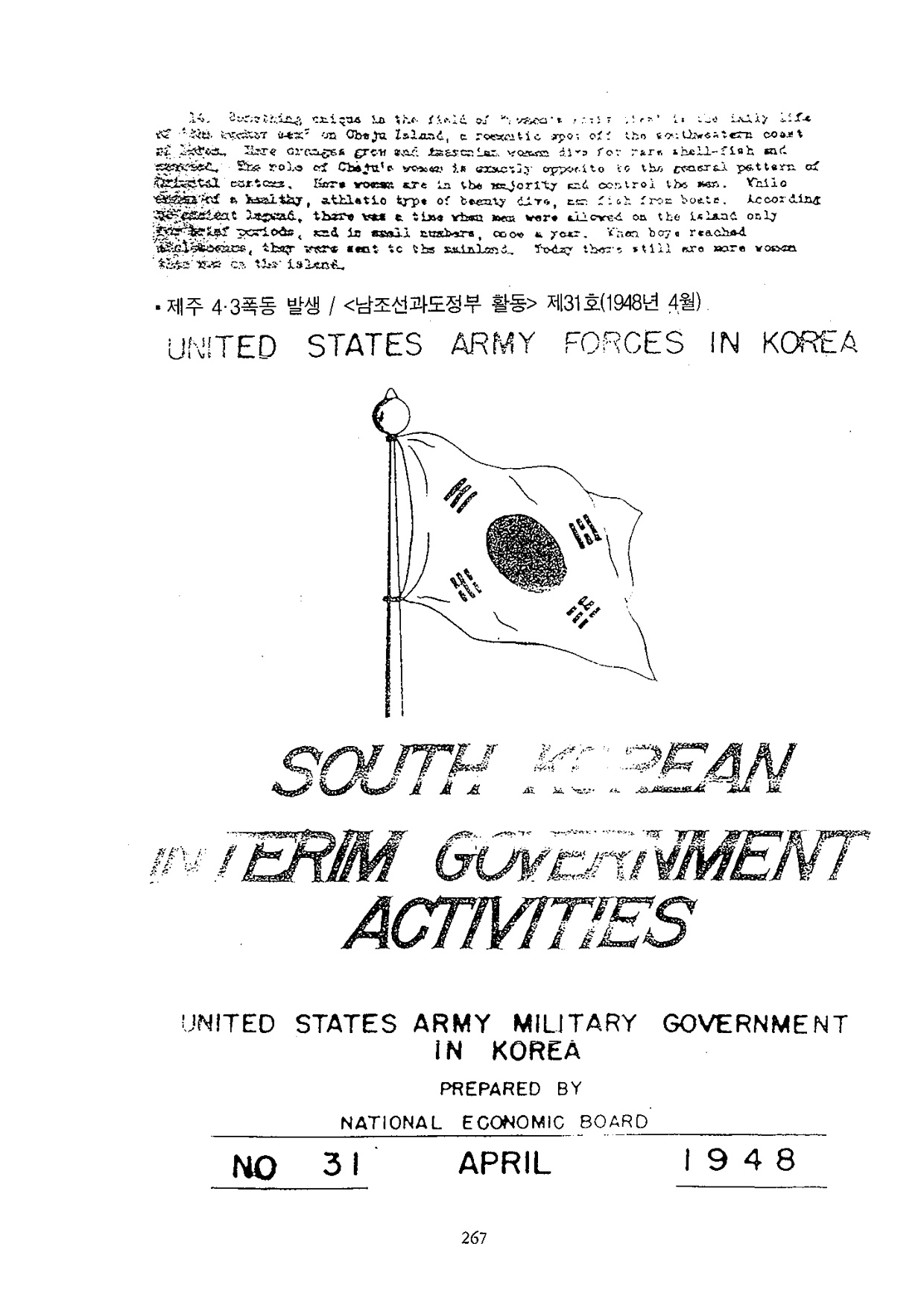
<남조선과도정부 활동> 제31호
1. 폭력행위
1) 정치적 동기
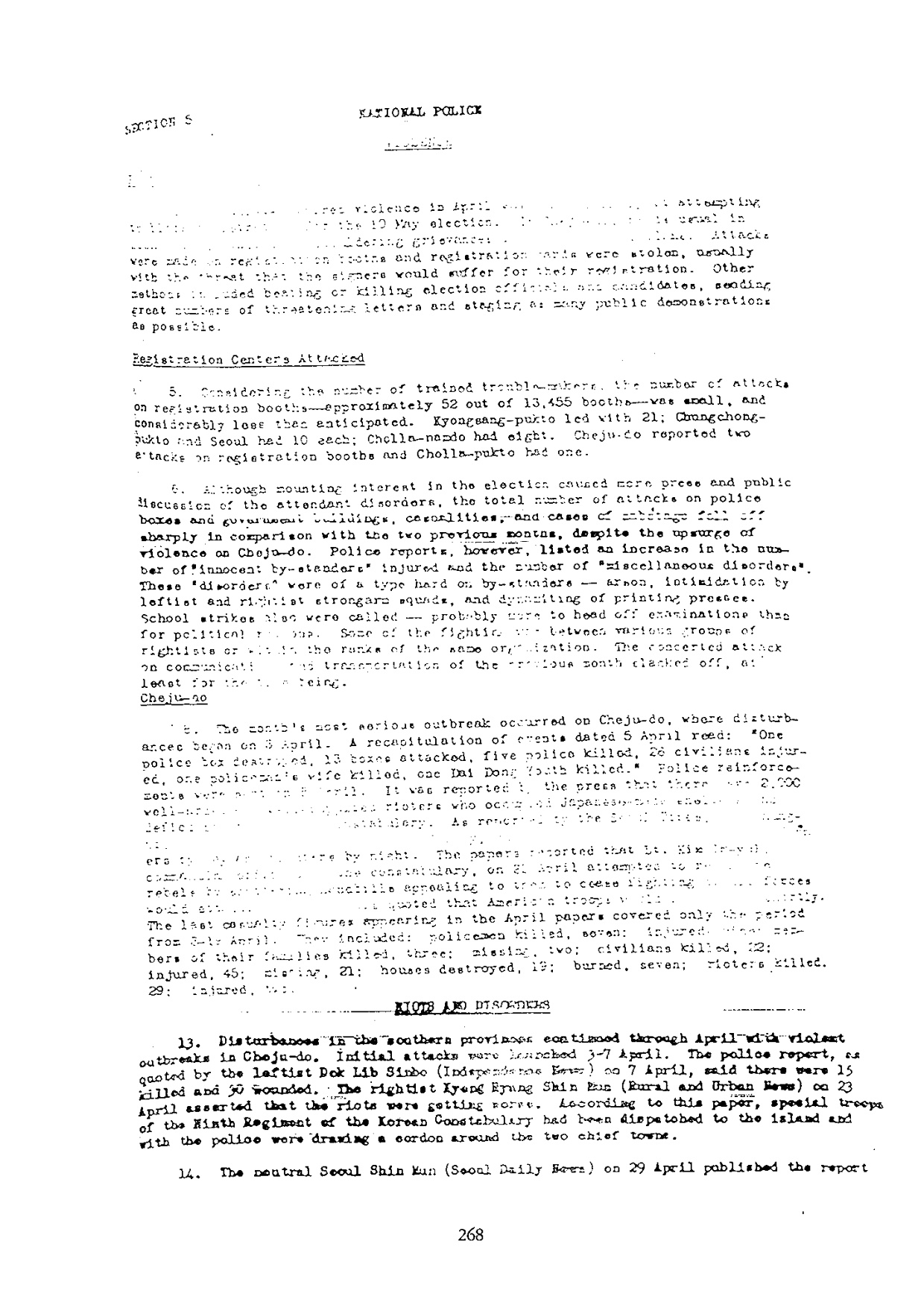
(1) 4월에 공산주의자들이 선동한 폭력행위는 주로 5‧10선거의 선거인 등록을 저지하는 시도에 맞춰졌다. 제주도에서 일상적인 다른 사건들처럼 마음에 쌓인 불평이 타올랐다. 선거등록사무소에 대한 습격이 이뤄졌고, 주로 선거인 등록자들이 고통을 겪을 것이라는 위협과 함께 등록명부가 도난 당했다. 이밖에 상당한 양의 위협서한을 보내고 가능한한 많이 공개 시위를 벌이면서 선관위원과 후보자들에 대한 폭행과 살인도 자행됐다.
2) 선거등록사무소 습격
(1) 훈련받은 소요가담자들의 숫자를 고려해 볼 때 습격받은 선거등록사무소의 숫자(약 1만 3,455곳 가운데 52곳)는 적었고 기대했던 것보다 상당히 경미했다. 경상북도가 21곳으로 가장 많았고, 충청북도와 서울은 각각 10곳이다. 전라남도는 8곳이며, 제주도는 선거등록사무소에 대한 2건의 습격이 보고됐으며, 전라북도는 1곳이 보고됐다.
(2) 선거에 대한 관심의 고조가 더 많은 대중들과 언론들로 하여금 소요에 대한 토론을 불러 일으켰지만 경찰지서와 관공서에 대한 전체 습격 건수와 사상자, 사보타주 건수는, 제주도에서의 폭력행위 급증에도 불구하고, 이전 2개월과 비교하면 급격하게 감소했다. 그러나 경찰보고서는 부상당한 ‘무고한 방관자들’의 숫자와 ‘기타 소요’의 숫자가 증가했음을 기록하고 있다. 이들 ‘소요’는 좌‧우익 폭력단의 방화와 협박, 신문언론에 대한 폭파 등 방관자들에는 강력한 유형의 성격을 지니고 있었다. 동맹휴교도 이뤄졌으나 정치적 이유보다는 시험을 피하기 위한 이유가 더 큰 것 같았다. 여러 우익단체 간이나 같은 조직원 사이에 일부 싸움이 있었다. 이전 달에 집중됐던 통신과 교통시설에 대한 습격이 적어도 당분간 약화됐다.
3) 제주도
(1) 이번 달 가장 심각한 폭동은 4월 3일 제주도에서 발생한 소요였다. 4월 5일자 사건에 대한 개요는 다음과 같이 쓰고 있다. “경찰지서 1곳이 파괴됐고 13곳은 습격을 받았으며, 경찰관 5명이 사망하고 민간인 26명이 다쳤다. 또 경찰관 부인 1명과 대동청년단원 1명도 사망했다”
응원경찰대가 4월 5일 파견됐다. 일본인들이 만든 은신처를 장악한 잘 무장되고 장비를 제대로 갖춘 폭도 2,000여 명이 있으며 경찰과 경비대에 도전했다고 언론에 보도됐다.『서울타임즈』의 보도에 따르면 공안국장 김정호는 4월 2□일 폭도들이 낮에는 농민이고 밤에는 전사라고 말했다. 신문들은 경비대 사령관 김익렬 중령이 4월 22일 반도들에게 전투를 중지할 것을 호소하는 삐라를 뿌리면서 이들과 연락을 시도했다고 보도했다. 김 중령은 그렇지 않을 경우 경비대가 공격할 것이라고 밝혔다. 미군부대가 이른 시일 안에 파견될 것이라는 소문도 인용 보도됐다.
신문들은 4월에 나타난 최종 사상자수에 대해 단지 4월 3일부터 19일까지 다루었다. 이것에는 경찰관 사망 7명, 부상 9명. 경찰관 가족 사망 3명, 행방불명 2명. 민간인 사망 22명, 부상 45명, 행방불명 21명. 주택 파괴 19채, 방화 7채. 폭도 사망 29명, 부상 2명이 포함돼 있다.
2. 사회
1) 폭동과 소요
(1) 남부지방의 소요가 제주도의 격렬한 폭동과 함께 4월 내내 계속됐다. 최초의 습격은 4월 3일~7일에 시작됐다. 4월 7일자 좌익『독립신보』가 인용한 경찰보고는 15명이 사망하고 30명이 다쳤다고 밝혔다. 우익『경향신문』은 4월 23일자에서 폭동이 점점 악화되고 있다고 주장했다. 이 신문에 따르면 국방경비대 제9연대 특수부대가 제주도에 급파돼 경찰과 함께 2개 주요 읍면에 비상경계선을 치고 있다.
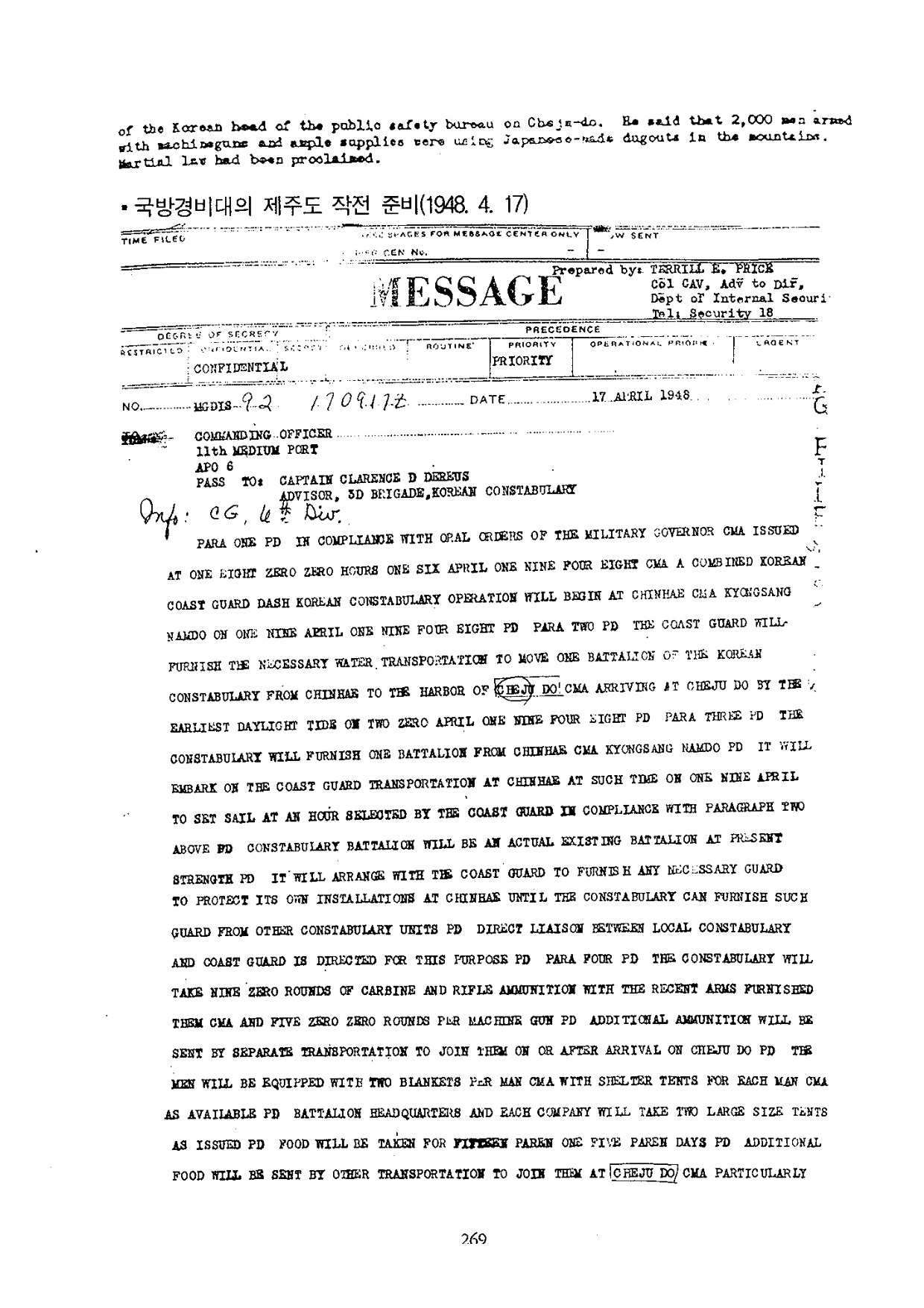
(2) 온건『서울신문』은 4월 29일자에서 제주도와 관련한 한국인 공안국장의 보고를 보도했다. 그는 기관총과 충분한 보급품으로 무장한 2,000여 명이 산간지역에 있는 일본인들이 만든 참호를 사용하고 있다고 말했다. 계엄령이 선포되었다.
SECTION 5 NATIONAL POLICE
Illegible
… … violence in April … … … attempting
to … … … the 10 May election. In … … … as usual in
… … … … Election Grievances … … … Attacks
were made on registration booths and registration cards were stolen, usually with the threat that the signers would suffer for their registration. Other methods included beating or killing election officials and candidates, sending great numbers of threatening letters and staging as many public demonstrations as possible.
Registration Centers Attacked
5. Considering the number of trained trouble-makers, the number of attacks on registration booths—approximately 52 out of 13,455 booths—was small, and considerably less than anticipated. Kyongsang-pukto led with 21; Chungchong-pukto and Seoul had 10 each; Cholla-nando had eight. Cheju-do reported two attacks on registration booths and Cholla-pukto had one.
6. Although mounting interest in the election caused more press and public discussion of the attendant disorders, the total number of attacks on police boxes and government buildings, casualties, and cases of rioting fell off sharply in comparison with the two previous months, despite the upsurge of violence on Cheju-do. Police reports, however, listed an increase in the number of "innocent by-standers" injured and the number of "miscellaneous disorders". These "disorders" were of a type hard on by-standers — arson, intimidation by leftist and rightist strongarm squads, and dynamiting of printing presses. School strikes also were called — probably more to head off examinations than for political reasons. Some of the fighting was between various groups of rightists or within the ranks of the same organization. The concerted attack on communications and transportation of the previous month clashed off, at least for the time being.
Cheju-do
8. The month's most serious outbreak occurred on Cheju-do, where disturbances began on 3 April. A recapitulation of events dated 5 April read: "One police box destroyed, 13 boxes attacked, five police killed, 28 civilians injured, one policeman's wife killed, one Dai Dong Youth killed." Police reinforcements were sent on 5 April. It was reported in the press that there were 2,000 well-armed … guerrilla rioters who occupied Japanese-built shelters … well-left … … Constabulary. As reported by the Seoul Times, … …
… … … … by night. The papers reported that Lt. Kim … …, commanding officer … the constabulary, on 21 April attempted to … … rebels by … … guerrillas appealing to them to cease fighting … … forces would ask … … … quoted that American troops would … … …tly.
The last casualty figures appearing in the April papers covered only the period from 3-15 April. These included: policemen killed, seven; injured, … members of their families killed, three; missing, two; civilians killed, 12; injured, 45; missing, 21; houses destroyed, 19; burned, seven; rioters killed, 29; injured, 10.
RIOTS AND DISORDERS
13. Disturbances in the southern provinces continued through April with violent outbreaks in Cheju-do. Initial attacks were launched 3-7 April. The police report, as quoted by the leftist Dok Lib Sinbo (Independence News) on 7 April, said there were 15 killed and 50 wounded. The rightist Kyong Hyang Shin Mun (Rural and Urban News) on 23 April asserted that the riots were getting worse. According to this paper, special troops of the Ninth Regiment of the Korean Constabulary had been dispatched to the island and with the police were drawing a cordon around the two chief towns.
14. The neutral Seoul Shin Mun (Seoul Daily News) on 29 April published the report of the Korean head of the public safety bureau on Cheju-do. He said that 2,000 men armed with machineguns and ample supplies were using Japanese-made dugouts in the mountains. Martial law had been proclaimed.
출처:
제주4·3사건진상규명및희생자명예회복위원회 편,
『제주4·3사건자료집 9』 [미국자료편]
/ 원문 p.267–269.