발신: 제24군단 사령부 정치고문관실
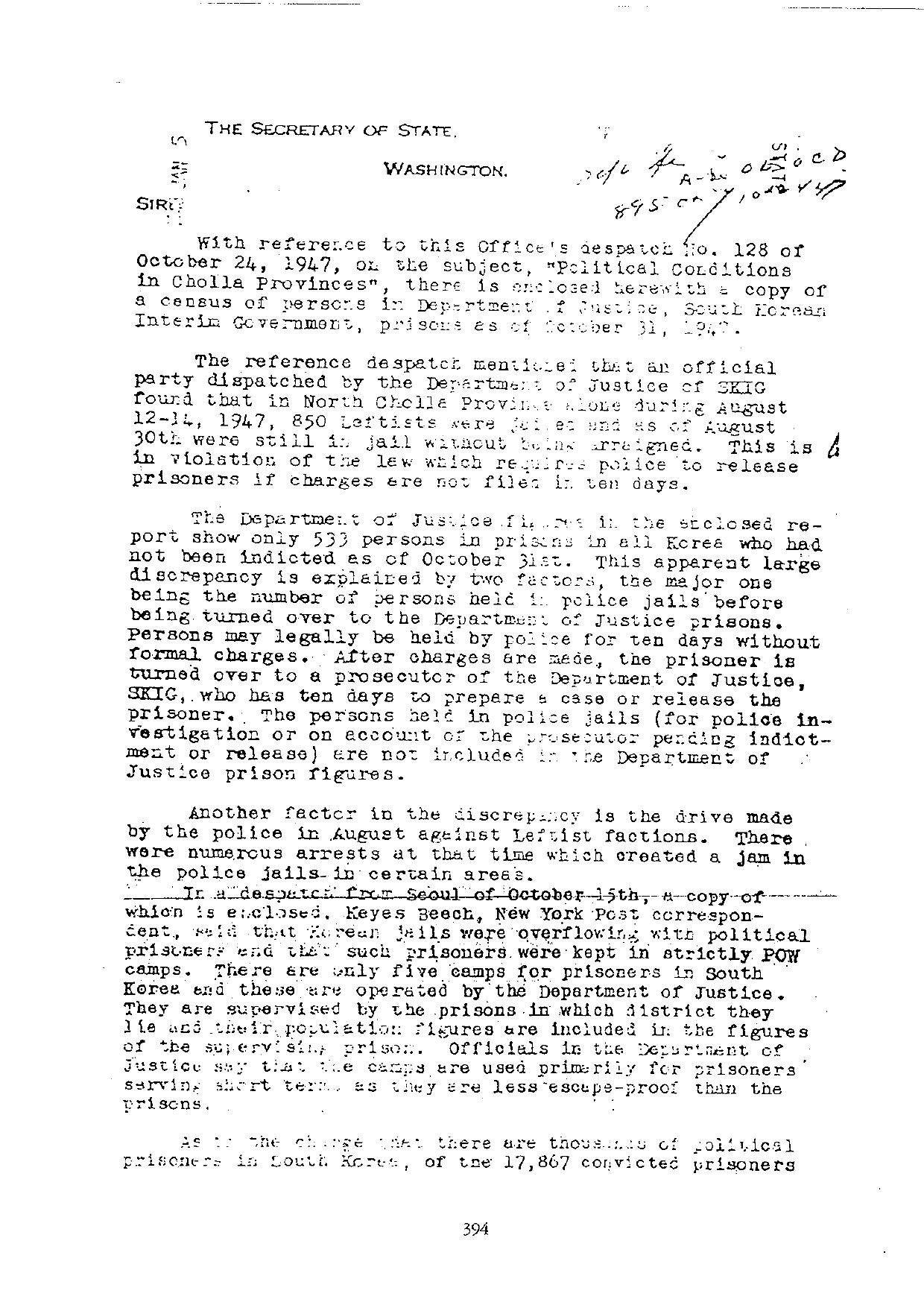
존경하는 국무장관 귀하
‘전라도의 정치상황’이라는 제목의 1947년 10월 24일자 본 정치고문관실의 <급송문서> 제128호에 덧붙여 1947년 10월 31일 현재 남조선과도정부 재소자 현황 사본을 여기 동봉합니다.
급송된 참고문건에 의하면 남조선과도정부 사법부가 파견한 공식 임무단은 1947년 8월 12일~14일 기간동안 전라북도에만 좌익인사 850명이 수감되어 있으며 8월 30일 현재 여전히 심문도 받지 않은 채 수감돼 있음을 밝혀냈습니다. 이는 10일 이내에 혐의를 제기하지 않으면 경찰이 죄수들을 석방하도록 한 법을 위반한 것입니다.
동봉된 보고서의 사법부 집계는 10월 31일 현재 남한 전체에서 아직 기소되지 않은 채 투옥되어 있는 인사가 533명뿐이라고 나타내고 있습니다. 이러한 커다란 숫자상의 차이는 두 가지 요소로 설명됩니다. 우선 한가지 중요한 요소는 수많은 사람들이 사법부 감옥으로 이관되기 전에 경찰 유치장에 투옥된다는 것입니다. 사람들은 공식혐의 없이도 10일 동안 경찰에 의해 합법적으로 억류될 수 있습니다. 혐의사실이 드러나면 이들은 남조선과도정부 사법부 검찰관에게 넘겨집니다. 검찰관은 10일 안에 소송을 준비하거나 석방합니다. 경찰 유치장에 유치된 사람들(경찰 조사를 받거나 검찰관이 기소나 석방을 결정하지 않은 경우)은 사법부의 집계에 포함되지 않습니다.
수치가 다른 또 다른 원인은 경찰의 좌익세력에 대한 8월의 검거선풍 때문입니다. 당시 특정 지역의 경찰 유치장은 과밀현상을 보일 정도로 엄청난 체포바람이 불었습니다.
본 문서에도 사본으로 동봉된 10월 15일자 서울발『뉴욕포스트』의 키즈 비치(Keyes Beech) 특파원의 기사는 한국의 유치장은 정치범으로 넘쳐나고 있으며 이런 수감자들은 엄격하게 포로수용소에 수감돼 있다고 말했습니다. 한국에는 죄수를 수용하는 수용소가 5곳 밖에 없으며 이곳은 사법부가 관리합니다. 이들 수용소는 수용소가 있는 지역의 형무소가 관리하며 수용소 인원은 감독 형무소의 숫자에 포함됩니다. 법무부 관리들은 이들 수용소는 형무소보다 탈출방지 시스템이 허술하기 때문에 주로 단기형을 받은 재소자용으로 활용한다고 말합니다.
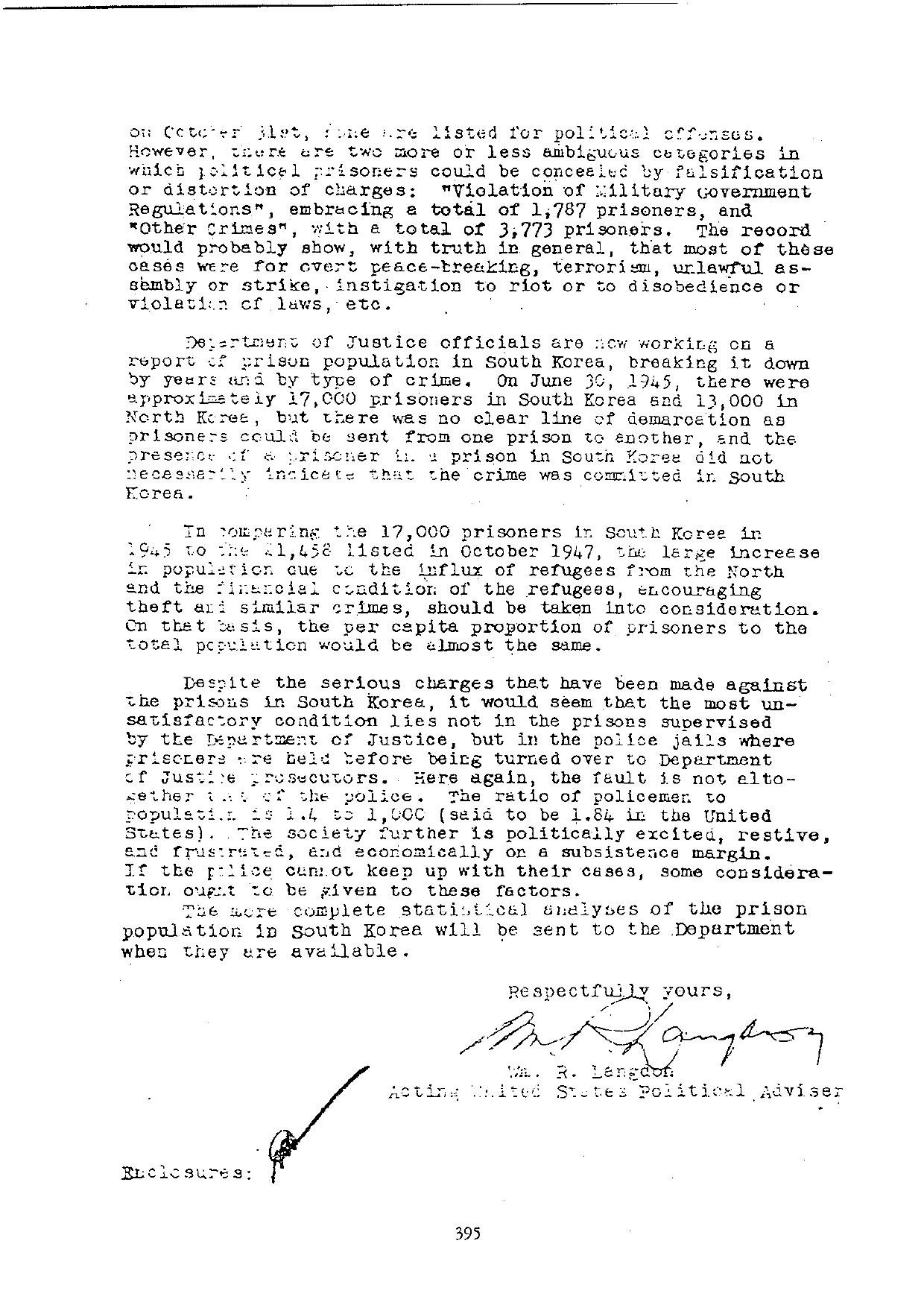
남한에 수천 명의 정치범이 있다는 비난과 관련해 10월 31일 현재 1만 7,867명의 기결수 가운데 아무도 정치범으로 등록되어 있지 않습니다. 그러나 정치범들이 다소 모호한 두 가지 범주, 즉 사실왜곡이나 혐의왜곡으로 인하여 가려질 수 있습니다. 즉 ‘군정 규칙 위반’이 1,787명이며, ‘기타 범죄’가 3,773명입니다. 이 기록은 대체적으로 사실과 부합하는데 이들 사건의 대부분은 명백한 치안방해, 테러, 불법집회나 파업, 폭동 선동, 법 불복종 및 위반 등에 기인했다는 것을 보여주고 있습니다.
법무부 관리들은 현재 남한의 재소자에 대한 형기별, 범죄유형별 분류작업을 하고 있습니다. 1945년 6월 30일 남한에는 약 1만 7,000여명의 재소자가 있었으며 북한에는 1만 3,000여명이 있었습니다. 그러나 재소자의 형무소간 이동 가능성 때문에 경계구분의 명확한 지침이 없었습니다. 그리고 남한의 한 형무소에 한 재소자가 있다고 해서 그가 반드시 남한에서 범죄를 저지른 것이라고 말할 수는 없습니다.
1945년 남한의 재소자 1만 7,000여명과 1947년 10월의 2만 1,458명을 비교해보면 재소자의 대폭 증가는 북으로부터의 피난민 유입에 따른 것으로 절도나 기타 범죄를 조장하는 피난민들의 경제상황을 고려해야 합니다. 그런 근거에 따라 총인구당 재소자들의 1인당 비율은 거의 같습니다.
남한의 형무소에 대한 심한 비난이 있지만 가장 불만족스러운 상황은 법무부가 관장하는 형무소에 있는 것이 아니라 법무부 검찰관에게 넘겨지기 전 범죄자들이 억류되는 경찰유치장에 있는 것으로 보입니다.
다시 한번 잘못은 모두 경찰에게만 있는 것은 아님을 강조합니다. 인구대비 경찰관의 비율은 1,000명당 1.4명입니다(미국은 1.84명으로 알려져 있습니다). 사회는 점점 정치적으로 흥분돼 있고 반항적이고, 좌절감을 일으키고 있으며, 경제적으로는 생존의 한계상황입니다. 경찰이 이들 사건들에 대처할 수 없다면 이러한 원인들에 대해 몇 가지 고려사항이 주어져야 합니다.
남한의 형무소 수감자에 대한 보다 완전한 통계분석은 나오는 대로 국무부에 보내겠습니다.
정치고문관 대리 랭던(Rangdon)
첨부문서:
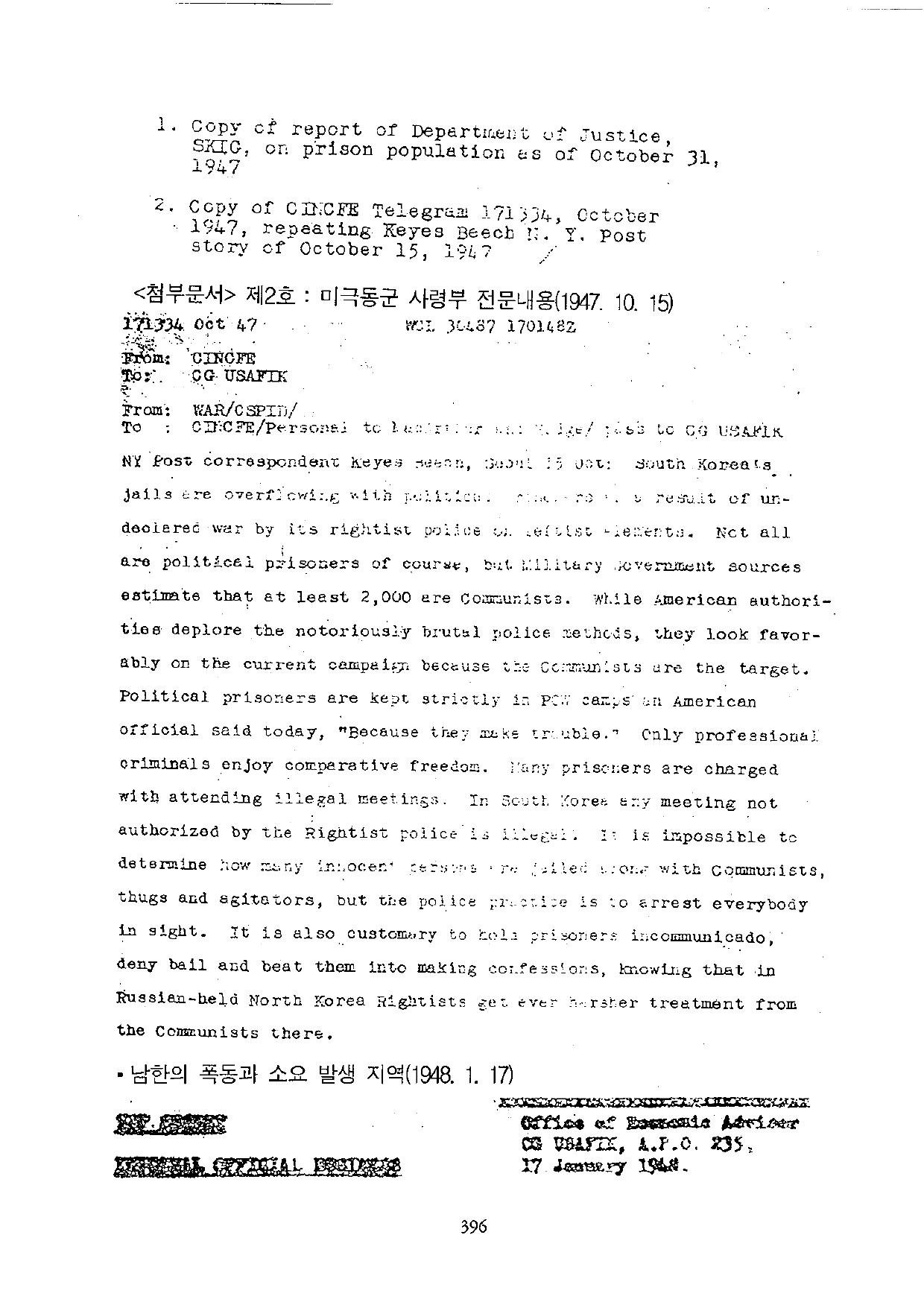
1. 1947년 10월 31일 현재 형무소 수감인원에 대한 남조선과도정부 법무부 보고서
2. 1947년 10월 15일자『뉴욕 포스트』키즈 비치 특파원의 보도내용에 대한 1947년 10월의 극동군사령부 전문 171334
<첨부문서> 제2호: 미극동군 사령부 전문내용
발신: 극동군사령부
수신: 주한미육군사령부 사령관
『뉴욕 포스트』특파원 키즈 비치, 10월 15일 서울: 남한의 유치장은 좌익분자들에 대한 우익경찰의 ‘선전포고를 하지 않은 전쟁’으로 정치범들로 넘쳐나고 있다. 물론 모두가 정치범은 아니지만 군정 소식통은 최소한 2,000여 명이 공산주의자들일 것으로 추정하고 있다.
미군당국은 악명 높은 야만적인 경찰의 방법을 통탄하고 있는 가운데 공산주의자들이 대상이기 때문에 경찰의 현재 행위를 우호적으로 보고 있다.
정치범들은 엄격하게 포로수용소에 구금되고 있으며 이에 대해 한 미국인 관리는 “그들이 말썽을 일으키기 때문”이라고 답변했다. 상습 형사범들만이 비교적 자유를 누리고 있다. 많은 죄수들은 불법집회에 참가한 혐의를 받고 있다. 남한에서는 우익 경찰이 승인하지 않은 어떠한 집회도 불법이다. 얼마나 많은 무고한 사람들이 공산주의자, 흉한, 선동가들과 함께 체포됐는지 헤아리기는 불가능하지만 경찰은 눈에 보이는 모든 사람을 체포하고 있다.
또 러시아가 장악하고 있는 북한에서 우익들이 그곳 공산주의자들로부터 유례없이 가혹하게 취급받은 것을 알고 있는 그들이 죄수를 독방에 가두고 보석을 금지하며 자백을 강요하며 폭행하는 것은 흔히 있는 일이다.
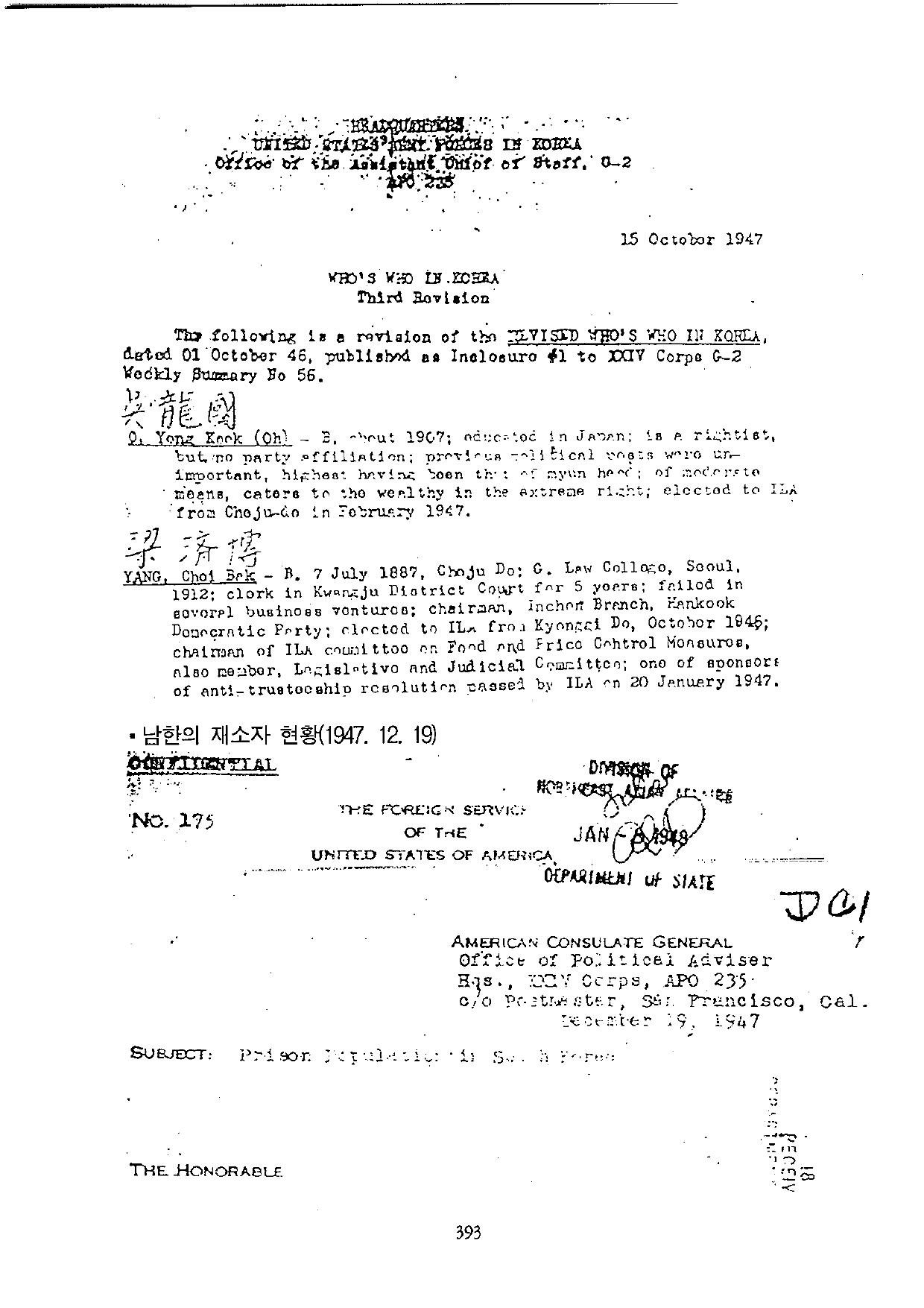
CONFIDENTIAL
DIVISION OF
KOREAN AFFAIRS
NO. 175
THE FOREIGN SERVICE
OF THE
UNITED STATES OF AMERICA
JAN [illegible] 1948
DEPARTMENT OF STATE
DC1
AMERICAN CONSULATE GENERAL
Office of Political Adviser
Hqs., XXIV Corps, APO 235
c/o Postmaster, San Francisco, Cal.
December 19, 1947
SUBJECT: Prison Population in South Korea
THE HONORABLE
THE SECRETARY OF STATE
WASHINGTON.
SIR:
With reference to this Office's despatch No. 128 of October 24, 1947, on the subject, "Political Conditions in Cholla Provinces", there is enclosed herewith a copy of a census of persons in Department of Justice, South Korean Interim Government, prisons as of October 31, 1947.
The reference despatch mentioned that an official party dispatched by the Department of Justice of SKIG found that in North Cholla Province alone during August 12-14, 1947, 850 Leftists were jailed and as of August 30th were still in jail without being arraigned. This is a violation of the law which requires police to release prisoners if charges are not filed in ten days.
The Department of Justice figures in the enclosed report show only 533 persons in prisons in all Korea who had not been indicted as of October 31st. This apparent large discrepancy is explained by two factors, the major one being the number of persons held in police jails before being turned over to the Department of Justice prisons. Persons may legally be held by police for ten days without formal charges. After charges are made, the prisoner is turned over to a prosecutor of the Department of Justice, SKIG, who has ten days to prepare a case or release the prisoner. The persons held in police jails (for police investigation or on account of the prosecutor pending indictment or release) are not included in the Department of Justice prison figures.
Another factor in the discrepancy is the drive made by the police in August against Leftist factions. There were numerous arrests at that time which created a jam in the police jails in certain areas.
In a despatch from Seoul of October 15th, a copy of which is enclosed. Keyes Beech, New York Post correspondent, said that Korean jails were overflowing with political prisoners and that such prisoners were kept in strictly POW camps. There are only five camps for prisoners in South Korea and these are operated by the Department of Justice. They are supervised by the prisons in which district they lie and their population figures are included in the figures of the supervising prison. Officials in the Department of Justice say that the camps are used primarily for prisoners serving short terms as they are less escape-proof than the prisons.
As to the charge that there are thousands of political prisoners in South Korea, of the 17,867 convicted prisoners
on October 31st, the are listed for political offenses. However, there are two more or less ambiguous categories in which political prisoners could be concealed by falsification or distortion of charges: "Violation of Military Government Regulations", embracing a total of 1,787 prisoners, and "Other Crimes", with a total of 3,773 prisoners. The record would probably show, with truth in general, that most of these cases were for overt peace-breaking, terrorism, unlawful assembly or strike, instigation to riot or to disobedience or violation of laws, etc.
Department of Justice officials are now working on a report of prison population in South Korea, breaking it down by years and by type of crime. On June 30, 1945, there were approximately 17,000 prisoners in South Korea and 13,000 in North Korea, but there was no clear line of demarcation as prisoners could be sent from one prison to another, and the presence of a prisoner in a prison in South Korea did not necessarily indicate that the crime was committed in South Korea.
In comparing the 17,000 prisoners in South Korea in 1945 to the 21,458 listed in October 1947, the large increase in population due to the influx of refugees from the North and the financial condition of the refugees, encouraging theft and similar crimes, should be taken into consideration. On that basis, the per capita proportion of prisoners to the total population would be almost the same.
Despite the serious charges that have been made against the prisons in South Korea, it would seem that the most unsatisfactory condition lies not in the prisons supervised by the Department of Justice, but in the police jails where prisoners are held before being turned over to Department of Justice prosecutors. Here again, the fault is not altogether that of the police. The ratio of policemen to population is 1.4 to 1,000 (said to be 1.84 in the United States). The society further is politically excited, restive, and frustrated, and economically on a subsistence margin. If the police cannot keep up with their cases, some consideration ought to be given to these factors.
The more complete statistical analyses of the prison population in South Korea will be sent to the Department when they are available.
Respectfully yours,
Wm. R. Langdon
Acting United States Political Adviser
Enclosures:
1. Copy of report of Department of Justice, SKIG, on prison population as of October 31, 1947
2. Copy of CINCFE Telegram 171334, October 1947, repeating Keyes Beech N. Y. Post story of October 15, 1947
<첨부문서> 제2호 : 미극동군 사령부 전문내용(1947. 10. 15)
171334 Oct 47 WCL 30437 1701482
From: CINCFE
To: CG USAFIK
From: WAR/CSPIN/
To : CINCFE/Personnel to headquarters or [illegible] pass to CG USAFIK
NY Post correspondent Keyes Beech, dated 15 Oct: South Koreas jails are overflowing with political prisoners. [illegible] result of un- declared war by its rightist police on leftist elements. Not all are political prisoners of course, but Military Government sources estimate that at least 2,000 are Communists. While American authori- ties deplore the notoriously brutal police methods, they look favor- ably on the current campaign because the Communists are the target. Political prisoners are kept strictly in POW camps an American official said today, "Because they make trouble." Only professional criminals enjoy comperative freedom. Many prisoners are charged with attending illegal meetings. In South Korea any meeting not authorized by the Rightist police is illegal. It is impossible to determine how many innocent persons are jailed along with Communists, thugs and agitators, but the police practice is to arrest everybody in sight. It is also customary to hold prisoners incommunicado, deny bail and beat them into making confessions, knowing that in Russian-held North Korea Rightists get ever harsher treatment from the Communists there.
출처:
제주4·3사건진상규명및희생자명예회복위원회 편,
『제주4·3사건자료집 9』 [미국자료편],
번역문 p.161
/ 원문 p.393–396.