(정보요약 특별호)
한국
군사, 정치, 경제, 사회정세, 신문논평, 민정정보, 기타
정치상황
1. 남한에서의 총선거:
(a) 선거를 위한 조직: 한국 역사상 최초의 총선거가 한국에 파견된 유엔임시위원단의 감독 하에 1948년 5월 10일 미군 점령 지역에서 시행되었다. 한국인들로 구성된 중앙선거관리위원회는 미군정장관에 의해 임명되었고, 선거를 수행하는 기구를 구성하는 책임을 맡았다. 1946년에 시행한 마지막 공식적 인구조사를 근거로 해서, 선거관리위원회는 총선거에서 투표할 수 있는 남한 유권자의 수를 대략 8백21만 6,851명으로 추정하였다. 선거 본부들은 남한 각 도의 행정 중심 도시에 설립되었고, 독립된 하나의 선거 본부가 수도 서울에 세워졌다. 미군 점령 지역은 200개의 선거구로 분할되었다. 각각의 선거구는 대략 15만명의 유권자 수를 보유하고 있었으며 1만 3,407개의 투표소가 설립되었다. 대략 7백88만 4,095명의 유권자, 즉 전체 유권자의 95.9%가 총선거에 등록했다. 그리고 938명의 남한인이 국회 의석 200석을 놓고 국회의원 입후보를 공식 천명했다. 그러나 몇몇 후보들은 사퇴했거나 선거 이전에 곧바로 자격을 박탈당하였다. 대략 12개 선거구에서 단독후보가 출마하였다. 남한 전체를 통하여 볼 때 우익인사와 무소속 계열의 입후보자가 가장 많았다. 비록 일부 좌익인사들이 무소속으로서 선거운동을 하여 그들이 정치적으로 위장을 하였다고 의심받았지만, 어떤 후보도 공산주의자로서 출마하지는 않았다. 또한 일부 우익과 온건파는 그들의 정당이 우세를 점하지 못했던 지역에서 무소속으로 출마하였다.
(b) 투표소에서의 활동: 투표소는 5월 10일 아침 7시에 문을 열었다. 그리고 많은 유권자들이 이미 투표소 밖에서 줄지어 서 있었다. 남한의 경찰은 질서를 유지하는 책임을 떠맡고 있었고, 국방경비대와 해안경비대의 도움을 받았다.
민보단(Community Protective units)은 경무부장 조병옥의 권고를 수용하여 미군정장관에 의해 그 권한을 부여받았다. 이 단체는 질서를 유지시키는데 협조하기로 자원했던 보수 우익단체의 청년요원들로 구성되었다. 민보단에 의한 투표 장소의 보호는 자발적이며 애국적인 행동으로 간주되었으며 청년요원들은 공식적인 권한을 가지고 임무를 수행하지는 않았다.
각 도에 산재한 이용 가능한 건물들은 투표소로 사용되었고 국회의원 입후보자들의 이름과 사진이 투표소 입구 위에 붙여졌다. 투표자들의 왕래를 원활히 하기 위하여 대략 20평방 야드의 공간을 각 투표소 입구에서 밧줄로 둘러쳐 확보하였다. 유권자들은 확보된 공간 밖에서 줄을 서고 있었다. 그리고 오직 두 명이나 세 명만이 주어진 시간에 투표소 안으로 들어가도록 허용되었다. 이러한 행위는 분명히 투표에 관여한 공무원의 수가 투표소 안의 유권자의 수보다 지속적으로 많게 유지하도록 보장하기 위한 조처였다. 때때로 유권자는 투표소 안으로 들어가도록 허락받기 전에 검사를 받기도 했다. 예를 들면, 한 여성 투표자가 어느 한국 여자에게 조사 받고 있는 것이 관찰되기도 하였다. 투표 장소에서의 유권자들의 연속되는 출입 행렬은 민간인 복장을 하고 다양한 형태의 완장을 두르고 있었던 공동체보호대 요원들의 통제를 받았다. 이들은 곤봉으로 무장하였고, 임의적으로 검열을 하였다. 각 투표소마다 단지 세 명 내지 네 명이 임무를 수행하는 것으로 드러났다. 그러나 더욱 철저한 감독은 추가적인 경비 요원들이 근처 거리 교차로에, 건물 입구 안에, 그리고 투표소에서 가까운 구석진 장소에 배치된 것으로 드러났다. 충분히 잘 감독되었던 한 투표소에서 보호대의 지휘자는 명령을 내리기 위해 그의 요원들을 집합시켰고, 28명의 요원들이 모였다. 그 투표소가 문을 닫았을 때 그는 다시 그들을 집합시켰고 대략 50명이 대형을 이루었다.
한 명 내지 두 명의 경찰과 거의 그와 동일한 수의 국방경비대원이 각 개표구 근처에서 머물렀다. 경찰은 카빈과 소총으로 무장하였고, 경비대원은 착검된 소총을 소지했다. 그러나 그 경비대원은 개표소 입구에서 30야드 보다 더 가깝게 접근하는 것이 허용되지 않았다. 10명에서 20명까지의 조그만 예비집단 형태를 갖추고 나타났던 추가적인 국방경비대 혹은 해안경비대는 몇몇 투표장소 근처의 구석진 골목길에서 관찰되었다. 동일한 경비요원들이 그 날 처음부터 끝까지 임무를 지속하였고 대부분이 상당한 경계심을 갖고 있었다. 투표했던 사람들의 어떠한 회합도 투표소 근처에서 발견되지 않았다. 서울지역의 일반적인 모습은 준비가 되어 있음을 나타내었다. 말과 트럭에 탄 경찰은 거리를 순찰하였다. 선거의 치안 유지를 위임받았던 보조 경찰은 자전거 순찰을 행했다. 보조 경찰은 일본군 복장을 하고 있었다. 유엔요원들은 선거 과정을 점검하기 위해 남한 지역을 돌아다녔다. 그리고 미군 헌병은 정상적인 순찰을 수행했다. 미군은 방심하지 않았지만 거의 거리에 모습을 나타내지 않았다. 미국 요원들은 투표 장소로 들어가는 것이 금지되었다.
투표소는 19시에 문을 닫았다. 그리고 무기명 투표 용지는 즉시 상자에 넣어져 밀봉되었고, 개표를 위하여 선거구 본부로 운송되었다. 당선된 후보들은 선거구 본부로부터 그들의 당선을 비공식적으로 전달받았다. 그리고 투표 결과는 각 도의 선거 본부를 거쳐서 서울에 있는 중앙선거관리 위원회에서 처리되었다.
(c) 선거 분위기: 서울 지역에서 관찰된 투표소의 분위기는 유권자가 방해받지 않은 채 투표소로 가서 그들이 원하는 후보에 무기명 투표를 할 수 있을 만큼 자유스러운 것으로 나타났다. 그러나 파업, 살인, 선거등록 장소에 대한 공격으로 남한의 선거계획을 저지시키려는 공산주의자들의 책동은 투표를 옹호하는 사람들로 하여금 투표소와 투표용지의 보호가 필수적임을 확신하게 하였다. 이러한 보호는 투표소에서 질서정연한 방식으로 수행된 것으로 나타났으며 비록 몇몇 유권자들이 수색을 받았지만 아무도 투표소에 입장하는 것을 거절당하지 않았다.
(d) 선거 결과: 민정청(Office of Civil Administration)의 발표는 선거 등록자의 거의 90%가 투표에 응했다는 사실을 알려준다. 각 도와 서울에서 투표하였던 선거 등록인의 비율은 다음과 같다:
서울 92
경기도 90
충청북도 94
충청남도 93
경상북도 90
경상남도 96
강원도 95
전라북도 93
전라남도 92
제주도 70
중앙선거관리위원회는 입후보자들의 신청서를 접수하였을 때 입후보자들이 공언한 소속 정당에 따라 여러 정당에 의하여 선출된 국회의원의 수는 다음과 같다고 알려왔다:
조선민족청년단(우익) 5
(e) 설립될 정부: 총선거의 목적은 남한 내에 있는 각각의 200개 선거구로부터 국회의원을 선출하는 것이었다. 대략 한국 인구의 1/3 가량이 소련 점령지역 안에 위치하기 때문에, 국회에 있는 의석 100석은 이론적으로는 북한 국회의원을 위해 개방되어야 할 것이다.
새로운 정부가 유엔한국임시위원단에 의해 지원을 받게될 국회에 의해 설립될 것이다. 신 정부의 모든 중요한 관리들은 국회로부터 선출될 것이다. 남한 정부가 직면하고 있는 하나의 주요한 문제는 남한에는 적절한 입법기관을 위한 회의장이 없기 때문에 입법기관이 회의를 하기에 충분한 큰 장소를 확보하는 것이다.
(f) 이승만 박사의 저택을 방문함: 5월 10일 아침에 저명한 우익 지도자 이승만 박사의 저택을 방문하였다. 서울의 빈곤한 지역 가운데 하나였던 동대문 구역에 살고 있던 이승만 박사는 그 지역 대표로서 국회의 입후보자였다. 영어 이름이 다니엘 최(Daniel Choi)인 최능진(TCHEI Nung Jin)이 처음부터 이승만에게 대항하였으나, 최는 소위 등록 문서에 지문을 위조한 혐의로 자격을 박탈당하였다.
커다란 언덕 옆에 있는 이 박사의 저택은 대략 7피트 정도의 높이가 되는 벽돌 담장으로 둘러싸여 있었다. 경호원의 주택이 (이 박사의 저택)문 근처에 있었으며, 일본제로 여겨지는 소총들이 그 경호원 주택 안에 있는 선반 위에 차곡차곡 쌓여 있었다. 담장으로 둘러 쌓인 지역은 경호를 받았고, 보고에 따르면 경호원들이 추가로 그 저택 후방에 있는 언덕에 전초로 나가 있었다.
미국 요원들은 이 박사 저택의 정문에서 그들의 이름을 묻는 한 경찰관을 만났다. 그 경찰관은 자신이 이 박사로부터 출입허가를 받을 때까지 기다려 줄 것을 요청했다. 몇 분 후 그는 돌아와서 이 박사, 이 박사 부인, 정치고문 병씨(PYONG)가 정원에 앉아 있는 저택으로 방문객들을 안내하였다.
오스트리아 태생의 이 박사 부인은 이 박사보다도 더 젊은 것으로 보였으나, 방문객을 위해 정장 차림을 한 것으로 보이지는 않았고 소개가 끝난 후에 집안으로 물러났다. 이 박사는 매우 친절하였고 그와 병 박사 모두 당시의 사태에 관해서 토론하였다. 이 박사는 그가 이번 선거에서 상대자가 없었던 것을 유감으로 생각하며 한 두 명의 상대자가 있었더라면 좋았을 것이라고 피력하였다. 병 박사는 이번 선거에서 이 박사의 지역구에 상대 후보가 없었으므로 투표하지 않았고 투표용지도 필요 없었다고 말했다. 이 박사는 그가 잠시 실수를 저질러 왔고, 남한의 총선거를 반대해 왔으며, 미국의 정책을 비판해 왔지만 이렇게 생각한 것은 그의 실책으로 여겨지며 선거에 관한 한 미국과 같은 입장을 가지고 있다고 진술했다. 그는 경무부장 조병옥 씨가 경찰에게 저항하고 무질서를 선동하는 사람들에 대해 사격할 것을 지시했다는 내용을 라디오를 통해 공표하였기 때문에 선거일에 남한에서 소동이 폭넓게 확산되지는 않을 것이라는 견해를 피력했다. 이 박사는 선거 결과가 그의 우익 정당에 호의적으로 나타나리라는 확신을 가지고 있는 것으로 보였다. 그리고 한국인들은 자신들의 문제들을 해결할 권리를 가진 분석적이고 사려깊은 민족이라고 말했다.
이 박사는 공산주의자들은 정상적이고 합법적인 수단으로는 다룰 수 없다고 주장했다. 그리고 법치국가라면 남한에서 공산주의자들에 의해 행해진 살인을 용납하지 않을 것이라고 주장하였다. 그는 모든 외국의 공산주의자들은 그들 자신의 국가를 가지고 있다는 점을 지적했다. 그리고 공산주의자들이 ‘선동하여 말썽을 일으키려면’ 자기 나라에서나 그렇게 해야 한다고 진술했다. 그는 강제적인 수단으로 공산주의자들을 다룰 것을 주장했다. 그리고 (공산주의자들에 대한) 몇 번의 강제적인 조치의 선례는 남한에서의 모든 말썽거리를 멈추게 할 것이라고 진술했다. 그는 과거의 독재자들이 실패해 왔던 증거로서 나폴레옹, 히틀러, 그리고 무쏠리니의 운명을 인용하였다. 그리고 스탈린도 역시 그의 야망을 성취하는데 실패할 것이라고 예언하였다.
이 박사는 남한의 우익 지도자인 김구와 저명한 온건파 지도자인 김규식 박사가 참석하였던 남북한 정치 지도자들 사이에 일어난 최근의 회담에 대해서 논평하였다. 이 박사는 그 회의에 김구가 참석하지 못하도록 그를 단념시키려고 했다고 말했다. 그리고 그는 북한 공산주의자들과 토론을 통해서 아무것도 얻는 것이 없을 것이라고 김구에게 말했다고 진술했다. 그러나 김구는 남한에서의 독립된 선거에 반대하였고 남북한을 통일시키려는 시도가 무의미하다고 생각지 않았다. 이 박사는 김구와 김규식 박사 양자가 그 회의를 마치고 돌아왔을 때 북한 공산주의자들을 비난하고 남한의 선거를 지지함으로써 그들의 애국심을 입증할 수 있는 황금 같은 기회를 가졌다는 점을 지적했다. 그러나 김구와 김규식 박사 모두 그렇게 행동하기를 거절하였다. 이러한 (사태의) 불행한 전개에도 불구하고, 이 박사는 김구는 구제될 수 있었지만 김규식 박사는 패배하였다는 확신을 표현했다. 병 박사는김구가 나무를 보고 숲을 볼 수 없었다고 첨언하였다. (이 표현은 원문에 “couldn't see the trees for the woods”라고 되어 있는데 couldn't see the woods for the trees를 잘못 표현한 것으로 보임-역주)
이 박사는 남한인들이 스스로의 문제를 처리할 수 있다는 확신을 드러내었다. 그러나 한국의 장래 문제들을 해결할 어떤 계획도 언급하지 않았다.
사회 정세
2. 일반:
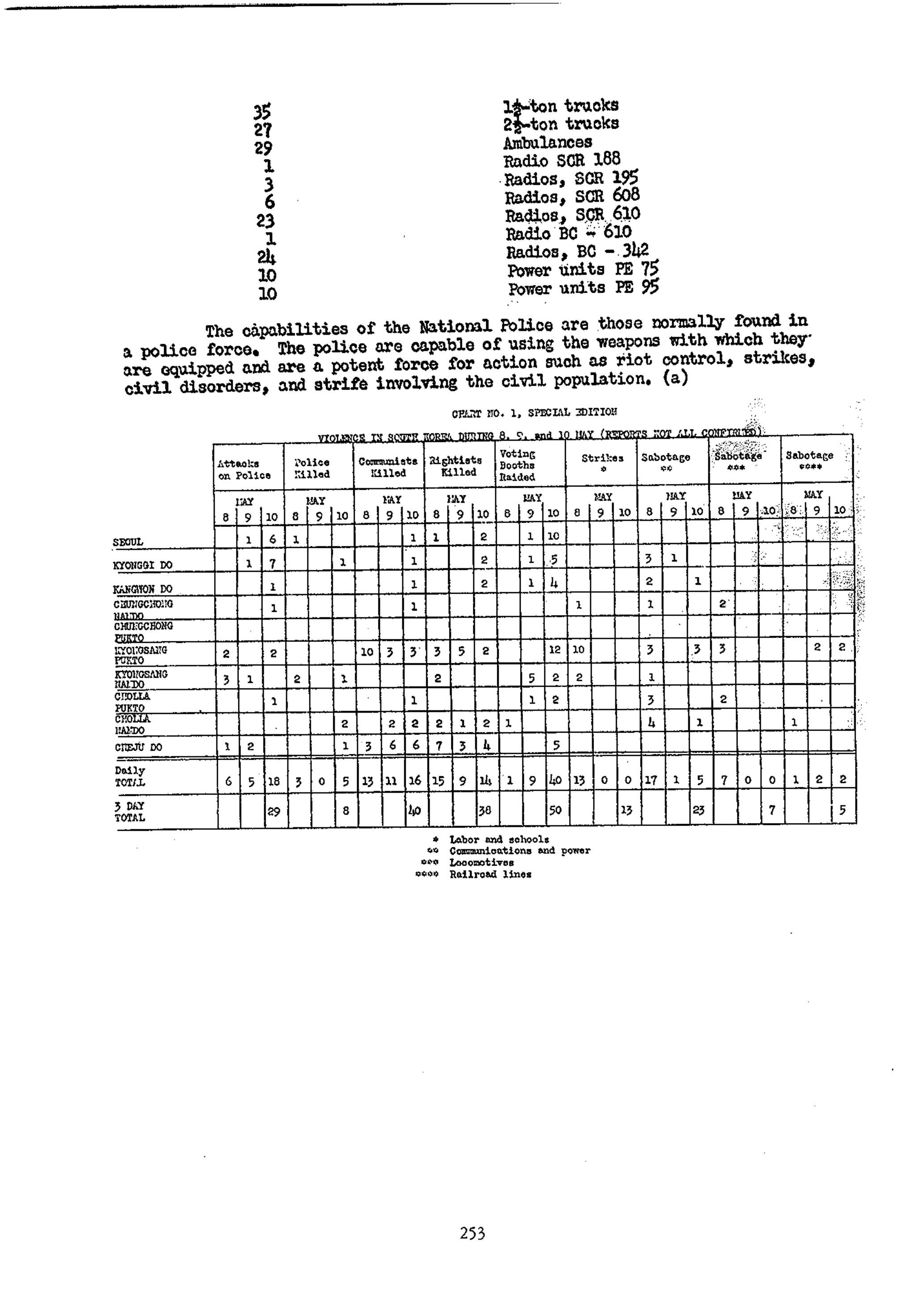
(a) 공산주의자들의 적극성: 5월 10일이 다가왔을 때, 남한의 공산주의자들은 선거 계획을 방해하고 한국 인구의 대부분이 유엔 감독 하에 치러지는 총선거에 반대하고 있다는 것을 외부 세계에 납득시키기 위해서 그들의 노력을 증대시켰다. 남한에서의 총선거를 비난하고 분단을 획책하는 제국주의자들에 대항하여 죽을 때까지 투쟁할 것”을 남한 사람들에게 주장하는 삐라가 뿌려졌다. 비록 큰 규모의 소요 사태가 보고되지는 않았지만 민간인 소요는 미국 점령지 도처에서 공산주의자들에 의해 선동되었다. 이러한 소요는 통신 시설에 대한 사보타지, 투표소 습격, 그리고 공산주의자와 우익 단체‧경찰 사이의 충돌이 주를 이루었다(도표 1을 참고할 것). 대부분의 소요는 남한의 전라도, 제주도, 대구 지역에서 발생하였다. 그러나 산발적인 폭력 사태는 미 점령지 전역에서 일어났다.
(b) 1948년 5월 8일의 소요:
1) 서울 - 5월 8일: 선거관리위원이 그의 집 근처에서 정체 불명의 사람에게 살해되었다. 서대문 경찰서에서 일어난 폭발물 사고는 건물 벽에 피해를 입혔다.
2) 수원 - 5월 8일: 좌익 단체가 수원 역 바로 남쪽에서 기차를 멈춰 세우고 기관실 안의 장비를 파손시켰다.
3) 횡성 - 5월 8일: 횡성과 홍천 사이의 전화선이 두 번 끊겼다.
4) 전주 - 5월 8일: 두 대의 기관차가 정면으로 충돌하였다.
5) 대전 - 5월 8일: 두 대의 기관차가 정면으로 충돌하였다.
6) 대구 - 5월 8일: 도시의 전력 공급이 중단되었다. 대구와 청주 사이의 철도, 전화, 전신선이 끊겼다. 대구와 경주 사이의 전선도 끊어졌다. 좌익신문은 폭발로 소실되었다. 기관차 14대의 피스톤과 엔진 브레이크를 잃어 버렸다. 전화선은 폭도들에 의해 끊어졌다. 경찰이 폭도 한 명을 살해했다. 전력 회사 노동자들은 발전소 장비를 떼어 내었고 검거되었다.
7) 경주 - 5월 8일: 사람들 무리가 엔진 격납고에 들어와서 총으로 위협하고 기관차를 탈취해갔다. (그들은) 탈취한 기관차로 다른 두 대의 기관차에 충돌하였다.
8) 목포 - 5월 8일: 목포시 남쪽 네 정거장 떨어진 곳에서 기차가 선로에서 열차의 바퀴가 제거된 채 파손되었다.
9). 명산(Myongsan) - 5월 8일: 군 객차가 공격받았는데, 그 기차는 읍내 근처에서 탈선되었다.
10) 나주 - 5월 8일: 목포에서 서울로 가던 열차가 나주 남쪽에서 탈선하였다.
11) Mayu-Up - 5월 8일: 정체 불명의 사람이 총을 쏴서 한 우익 지도자를 살해하였다.
12) 광주 - 5월 8일: 전선 8줄과 전신주들이 끊겼다; 전력 공급선이 끊어졌다. 도시 밖에 연결되어 있는 경찰 전화선도 끊겼다.
13) 화순 - 5월 8일: 전력 공급선이 끊겼다.
14) 순천 - 5월 8일: 순천에서 5 마일 거리의 노상에 있는 철로가 제거되었고 동일한 위치에서 전신주 6개가 끊겼다. 전신소를 불태우려는 시도가 있었지만 어떤 피해도 입히기 전에 그 화재는 진압되었다.
15) 부산 - 5월 8일: 전화선이 도시 근처에서 끊겼다. 40명의 공산주의자들은 철도 기관차 창고를 공격했다. 경찰관이 도시 근처에 있는 야산에서 살해당했다. 대략 50명의 남로당원들이 도시 근처에서 체포되었다.
16) 동래 - 5월 8일: 철도 정거장이 공격당했다.
17) Ponsong - 5월 8일: 전력 공급선이 읍내 근처에서 끊겼다. 15명이 발전소를 공격해서 장비를 파손시켰고 필수적인 부품들을 약탈해 갔다. 수도 공급 체계가 피해를 입었다.
(c) 5월 9일의 소요:
1) 옹진 - 5월 9일: 경찰 지서가 20명의 정체불명의 폭도들에 의해 공격받았다. 두 명의 경찰관과 폭도 한 명이 부상당했다.
2) 인천 - 5월 9일: 남로당 소녀 요원은 전화 교환국에 불을 질렀다. 화재는 기름에 적셔진 누더기에서 시작되었다.
3) 서울 - 5월 9일: 집에서 제조한 폭탄이 우익인사가 소유한 백화점의 창고 지붕에 떨어졌다. 폭탄은 대동청년단 본부에도 던져졌다. 피해 입은 사람은 없었다.
4) 강릉 - 5월 9일: 수류탄(소화탄)이 읍내 근처의 선거 입후보자의 집에 던져졌다.
5) Koemongki - 5월 9일: 곤봉으로 무장한 20인이 마을 지도자의 집을 공격했다. 그 집을 경호하던 경찰은 구타당했으나 마을 지도자는 탈출하여 목숨을 건졌다.
6) Naesong - 5월 9일: 두 정파간의 분쟁에서 우익인사 한 명이 죽었고, 좌익인사 한 명이 부상당했다.
7) Chunyang - 5월 9일: 40명의 폭도에 의해서 우익인사 4명이 죽었고, 5명이 부상을 입었다.
8) 광주 - 5월 9일: 선거관리위원장이 살해되었다.
9) 진주 - 5월 9일: 집에서 제조한 폭탄이 선거 본부 건물에 투척되었다. 피해 정도는 알려지지 않았다.
10) 전주 - 5월 9일: 불이 붙은 화염병(가솔린이 들어 있는)이 투표소에 투척되었다. 피해는 단지 깨진 유리창뿐이었다.
11) 거창(Kochang) - 5월 9일: 5개 투표함과 6,000장의 투표 용지가 불에 탔다.
12) 대구 - 5월 9일: 20명의 공산주의자 폭도가 경찰서를 습격했다. 경찰은 폭도 2명을 죽였고 8명을 체포했다. 우익인사 두 명이 좌우익간의 싸움 속에서 사망했다. 경찰은 (이 싸움에)개입하였고 좌익인사 둘을 죽였다. 52명이 체포되었다. 도시 근교에 사는 마을 직원이 칼을 소지한 4사람에게 죽음을 당했다. 18대의 기관차 부품들이 약탈당했다. 유리병(화염병)이 집으로 투척되고 폭발하여 남자 1명이 죽었다.
13) 부산 - 5월 9일: 투표소를 다이너마이트로 파괴하려는 시도가 있었다. 사상자는 없었다.
14) 울산 - 5월 9일: 집을 습격한 어떤 무리에 의해 선거 입후보자가 죽음을 당했고 그의 가족 가운데 한 명이 부상을 당했다.
15) 답양리(Topyang-Ni) - 5월 9일: 경찰이 폭도 4명을 죽였다.
16) 제주도 - 5월 9일: 남한 국방경비대 요원과 해안경비대 20명이 파출소를 습격했다. 경찰 7명과 마을 사람 몇 명을 납치해 갔다. 경찰관 4명이 부상당했다.
(d) 5월 10일의 소요:
1) 개성 - 5월 10일: 경찰 초소 세 곳이 수류탄 공격을 당했다. 습격자 한 명이 죽었고 경찰관 한 명이 부상당했다.
2) 인천 - 5월 10일: 투표소가 공격당했다; 투표용지 안전했다.
3) 서울 - 5월 10일: 두 발의 다이너마이트가 투표소에 투척되어 2명의 한국인이 사망하였다. 네 사람이 투표소를 불태우려고 시도했다. 경찰이 둘을 죽였고 둘을 체포하였다. 투표소 안에서 업무를 보고 있는 두 사람이 정체불명의 괴한에게 죽음을 당했다. 투표소가 폭탄공격을 받았다. 사상자는 없었고 약간의 피해만 있었다. 두 사람이 투표소를 습격하여 그 곳을 지키고 있었던 한국인 하나가 부상당했다. 한 습격자는 경찰에게 죽음을 당했다. 투표소 다섯 곳이 공격당했다. 공산주의자 세 명이 체포되었다.
4) Sansunae-Ri - 5월 10일: 우익인사 한 명이 마을에서 일어났던 소요로 인해 사망했다.
5) Wolchong - 5월 10일: 경찰서가 습격당했다. 습격자 한 명이 죽었다.
6) 춘천 - 5월 10일: 좌익인사 20명이 투표소를 공격하여 투표함에 불을 놓고 경비대원에게 폭행을 가했다. 숫자를 알 수 없는 투표 용지가 불탔지만 사본 투표 용지가 사용되었다.
7) 주문진 - 5월 10일: 수류탄이 선거구 본부에 투척되었다. 한 사람이 경미한 부상을 입었고 건물이 손상되었다.
8) Wanchang-Ni - 5월 10일: 시위대 20명이 경찰 초소를 습격했다. 습격자 한 명이 죽었다.
9) Chunchon-Ni - 5월 10일: 투표소가 습격당했고 선거인 등록명부가 훼손되었다. 우익인사 한 명이 부상당했다. 사본의 선거인 등록 명부가 사용되었고 투표는 계속되었다. 그 마을에서 일어난 소요로 공산주의자 한 명이 죽고 경찰관 한 명이 부상당했다.
10) Changsong-Ni - 5월 10일: 투표소를 보호할 임무를 부여받은 요원 15명이 창으로 경찰관 두 명을 살해하였다.
11) Oktung-Ni - 5월 10일: 투표소가 공격당했고 투표함이 훼손되었다. 공산주의자 한 명이 죽었고 우익인사 한 명이 부상당했다.
12) Namjon-Ni - 5월 10일: 투표소가 습격당했고 투표함이 훼손되었다.
13) Chujong-Ni - 5월 10일: 투표함 하나가 불에 탔다.
14) 대구 - 5월 10일: 경찰이 폭도를 해산시키는 과정에서 시위자 두 명을 죽였다. (폭도들은) 전기를 사용하지 못하게 하려고 변압기를 고의로 파손시켰다. 폭도의 무리는 서북청년단 요원들(우익)에게 사격했고 두 명이 부상을 입었다. 선거구 바깥에 있는 시장의 집이 불에 탔다. 철도는 제천으로 향하는 철로를 따라 제거되었다. 투표소가 파괴되었다. 다섯 명이 부상을 입었다. 다이너마이트가 근처의 선거 장소에 투척되었고 한 명이 부상을 당했다. 건물은 손상되지 않았다. 우익 가족의 어린이 한 명이 죽었고 우익 두 명이 부상을 당했다. 투표소 두 곳이 습격을 당하여 창문이 부서졌다. 공산주의자 15명이 체포되었다.
15) 목포 - 5월 10일: 가솔린 수류탄이 선거관리 위원 집에 투척되어 그 집은 불에 탔고 선거관리 위원은 부상을 입었다.
16) Sochang Myan - 5월 10일: 한 투표소가 모든 투표용지와 함께 파괴되었다. 우익인사 두 명이 사망했다.
17) 광주 - 5월 10일: 50명의 폭도가 국회의원(우익) 사무소를 습격했다. 폭도 가운데 한 명과 경찰을 돕고 있었던 한 사람이 죽음을 당했다. 우익인사 한 명이 죽었다.
18) Whanang Gun - 5월 10일: 선거관리 위원장의 집이 습격을 당해 그 위원장은 맞아 죽었다.
19) Chosu Myun - 5월 10일: 좌익 20명이 창을 가지고 투표소를 습격했다. 투표함과 선거인 등록 명부가 훼손되었다.
20) 산동면 - 5월 10일: 투표소가 습격당했다. 투표함 한 개, 선거인 등록 명부 사본 하나, 그리고 투표용지 700장이 탈취되었다.
21) 칠곡 - 5월 10일: 투표소 네 곳이 좌익들에게 공격당했다. 경찰관 한 명이 죽었다.
22) Togan-Ni - 5월 10일: 마을에서 일어난 소요로 공산주의자 7명이 죽었고 우익분자 한 명이 부상을 입었다.
23) 제주도 - 5월 10일: 집 일곱 채가 불에 탔다. 제주 지역 전역에 발생한 작은 소요들의 파동은 제주도의 질서를 회복시키도록 원조해 달라는 한 미군정 관리의 요청을 초래하였다.
(e) 결론 : 다음의 결론은 개인적 관찰에 근거한 것이고 남한에 있는 미 점령군 직원에게서 얻은 정보에 기초한 것이다.
(1) 몇몇 공산주의자들과 온건주의자들이 무소속으로 국회의원에 당선되었다.
(2) 선거 절차는 자유스런 투표권 행사를 용인하였다.
(3) 투표소의 보호는 필수적이었으며 법률 집행 부서들은 대개 만족할만한 방식으로 기능하였다.
(4) 미국 직원들은 투표에 개입하지 않았다.
(5) 선거의 분위기는 유권자들이 선거관리위원, 법률집행 부서, 혹은 미 점령군의 간섭을 받지 않고 그들이 선택한 후보에게 무기명 투표를 하는 것이 용인될 정도로 자유스러웠다.
(6) 공산주의자들이 선동한 무질서는 성공적인 선거를 가로막는데 실패했고, 남한인 대다수가 유엔 감찰 하에 실시되는 선거에 반대했다는 사실을 외부 세계에 납득시키는 데에도 실패하였다.
(7) 하나로 통일된 한국이 지금으로서는 불가능하다고 할지라도 남한 인구의 대다수가 남한 정부를 기꺼이 지지하고 있었다.
(8) 남한 사람들이 선출한 국회의원들로 구성되는 남한 정부의 설립을 위한 토대가 마련되었다.
안전보장 부서들(Security Agencies)
3. 법률 집행:
(a) 통제: 남한의 군사‧법률 집행 부서들은 과거에 질서를 유지시키는 중요한 역할을 수행해 왔고, 6월 첫째 주에 소집되는 국회의원들에 의해 수립되는 미래의 정부에서 중요한 책임을 떠맡게 될 것이다. 현재 군대화된 무력은 통위부의 통제를 받는다. 그리고 국립 경찰은 주요한 법률 집행 부서로 자리잡고 있다.
통위부는 미군정의 통제를 받고 있고 내부의 안전을 유지하고 있는 정부를 지원하기 위해 경찰과 해병대를 제공하는 임무를 맡고 있다. 그 부서는 육군 준장 유동열(Riu Tong Yul)에게 지시를 받고 있으며 국방경비국과 해안경비국으로 분리되어 있다.
(b) 국방경비국:
1948년 5월 7일 현재 남한 국방경비국은 상비군 2만 8,324명의 병력을 보유하고 있었다. 국방경비국은 서울에 참모본부를 두고 있으며 대령 정일권에 의해 지휘통제를 받았고, 각각 3개 연대를 보유한 3개 여단으로 구성되어 있다. 국방경비대는 이전에 일본제 소총과 카빈으로 무장되어 왔었지만 상당할만한 미군 장비가 지금 국방경비국에 조달되고 있다. 배당된 미군 무기는 cal .30 M-1 소총, cal .30 BAR M-1 소총, cal .30 M-1 카빈 소총, cal .45 M-3 기관단총과 cal .45 권총을 포함하였다.
국방경비대원들은 일반적으로 군대가 주둔하고 있던 각 도에서 채용되었다. 군인들은 훌륭한 신체적 조건을 구비하고 있었고 교육적인 자격 면에서 평균을 약간 상회하고 있었다. 통위부에 있는 미국 고문관들은 대체적으로 훈련 상태는 양호하지만 오직 소규모의 부대 훈련이 수행되어 왔다고 진술한다. 대략 140명의 미군 장교들이 지금 국방경비대의 고문관으로서 임명되어 있고, 현재의 훈련은 무기류의 숙지, 군사훈련, 대대급을 포함한 부대의 야전 훈련 등이다. 주둔지 훈련이나 기동훈련을 실시하지 못했다. 미군 고문관들은 국방경비대가 충분히 무장되었을 때, 내부의 안전을 유지할 수 있게 될 것이지만 남한의 국경이 위협받는다면 단지 명목상 저항을 하게 될 것이라고 평가했다.
(c) 해안경비국:
남한 해안경비대 사령부는 서울에 있고 그 기구는 해군 준장 손원일의 명령을 받는다. 지금 해안경비대 병력은 대략 3,000명이고 기지들은 남한의 주요 항구들에 위치해 있다. 해안경비대 학교와 해군(the Service Force) 사령부는 진해에 위치해 있다.
해안경비대가 창설된 이후 해안경비대는 원양 항해 노선을 따라 꾸준한 발전을 이룩해 왔고 특히 갑판 훈련에 있어서는 확고한 진보를 가져왔다. 이러한 훈련의 일부는 미국 구축함이 남한의 해안을 순찰하는 동안에 미국 구축함에 한국 해안경비대원을 승선시킴으로써 수행되기도 하였다. 한국인들은 기계적인 훈련을 적절히 소화해내지 못했고, 기관사 훈련도 뒤쳐져 왔다. 그러나 미국 고문관들은 해안경비대 장교들의 다수가 그들의 선박을 다룰 수 있으리라고 믿었다. 해안경비국은 응모병과 장교 수의 부족으로 장애를 받았고, 해당 계급에 존경받지 못하는 군인이 끼어있어서 어려움을 겪었다. 그러나 지금 부적격한 군인(병력)을 내쫓고 부서의 효율성을 증대시키기 위한 운동이 표면 아래에서 진행되고 있다.
해안경비대 기구는 관세법의 시행을 위해 해안을 경비하는 부서로서 설립되었고 긴급 사태 발생시 해상의 군대로서 사용하기 위해 발전돼 왔었다. 그러나 해안경비대의 기술적으로 잘 훈련된 인원, 군비, 장비의 부족은 그것이 어떤 작은 해상작전도 제대로 수행하지 못할 만큼 무기력하게 만들었다.
(d) 경무부:
경무부 기구는 1945년 9월에 경찰국으로써 설립되었고 1946년 1월에 경무부로 재편되었다. 그것은 미군정과 남한 임시정부의 연합 통제 하에서 기능하도록 되어 있고 행정상의 권한은 경무부의 지휘권자인 조병옥 박사에게 귀속되어 있다. 조 박사는 경찰 직원을 임명하고 훈련시킬 권한을 가지고 있으며 경무부의 일반 정책에 대해서 책임을 질 의무가 있다.
경무부의 주요한 임무는 38선 이남의 법과 질서의 수호이다. 그러나 경찰은 지금 북한으로부터의 침략에 맞서서 그리고 남한 내에서 국가 체제를 전복시키려는 활동에 맞선 제1방어선으로 간주되고 있다.
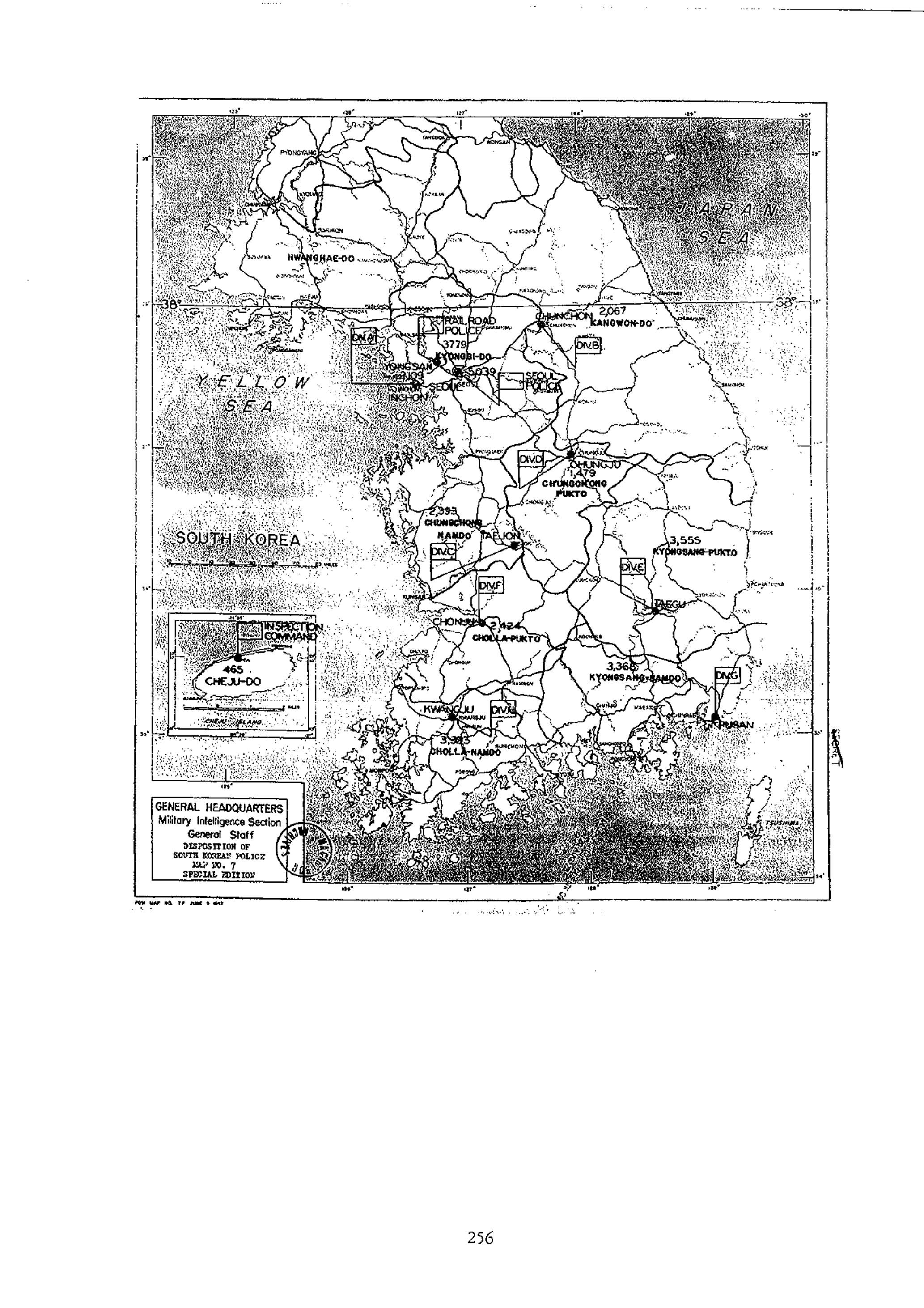
경무부는 10개의 분과와 하나의 감찰지휘부로 나뉘어 있었다. 현재 인원은 447명의 여성 경찰을 포함하여 대략 3만 4,330명이다. 경찰 부서의 위치와 인원수는 지도 7에 제시되어 있다.
경찰 요원은 이전의 범죄 행위와 국가를 전복시키려는 분자들과의 접촉 여부를 철저히 심사한 받은 후에 채용되었다. 정상적인 경찰 훈련은 제쳐두고, 모든 경찰관들은 군사 훈련, 무기관리, 사격 숙지, 몇 가지 밀착대오 훈련 등 군사 훈련을 받았다. 기회 있을 때마다, 이러한 훈련은 수행되거나 미군정 요원에 의해 감독되었다. 경무부의 장비는 다음과 같은 것들을 포함하고 있다.
수량 장비 유형
18,984 미제 cal .30 카빈소총
500 미제 cal .45 권총
4,594 일제 7.7mm 소총
7,973 일제 6.5mm 소총
50 일제 cal .30 기관총
1,575 일제 다양한 유형의 권총들
108 1/4톤 트럭
170 3/4톤 트럭
35 1과 1/2톤 트럭
27 2와 1/2톤 트럭
29 앰블런스
1 Radio SCR 188
3 Radios, SCR 195
6 Radios, SCR 608
23 Radios, SCR 610
1 Radio BC - 610
24 Radios, BC - 342
10 Power units PE 75
10 Power units PE 95
경무부의 능력은 경찰병력 내에서 발견되는 능력이다. 경찰은 그들이 구비한 무기를 사용할 수 있고 폭동 진압, 파업, 민간인 소요, 그리고 주민을 연관된 쟁의와 같은 행위에 대처하는 유력한 무력집단이다.
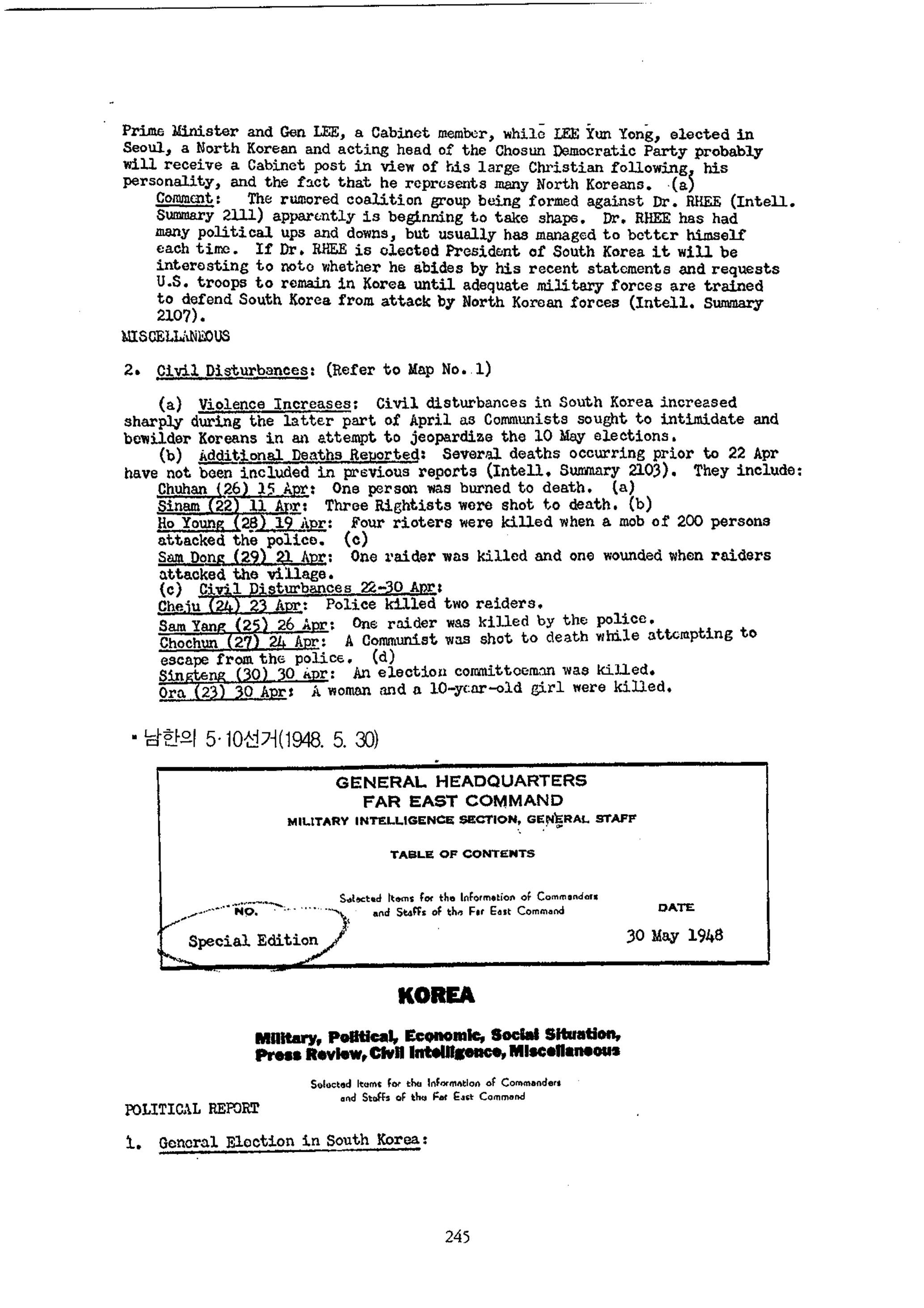
도표 1. SPECIAL EDITION
남한에서 5월 8‧9‧10일 동안에 발생한 폭력 소요(모두 확실하게 파악된 보고는 아님)
* 노동자와 학교
** 통신과 전력
*** 기관차
****철 로
GENERAL HEADQUARTERS
FAR EAST COMMAND
MILITARY INTELLIGENCE SECTION, GENERAL STAFF
TABLE OF CONTENTS
Selected Items for the Information of Commanders
NO. and Staffs of the Far East Command DATE
Special Edition 30 May 1948
KOREA
Military, Political, Economic, Social Situation,
Press Review, Civil Intelligence, Miscellaneous
Selected Items for the Information of Commanders
and Staffs of the Far East Command
POLITICAL REPORT
1. General Election in South Korea:
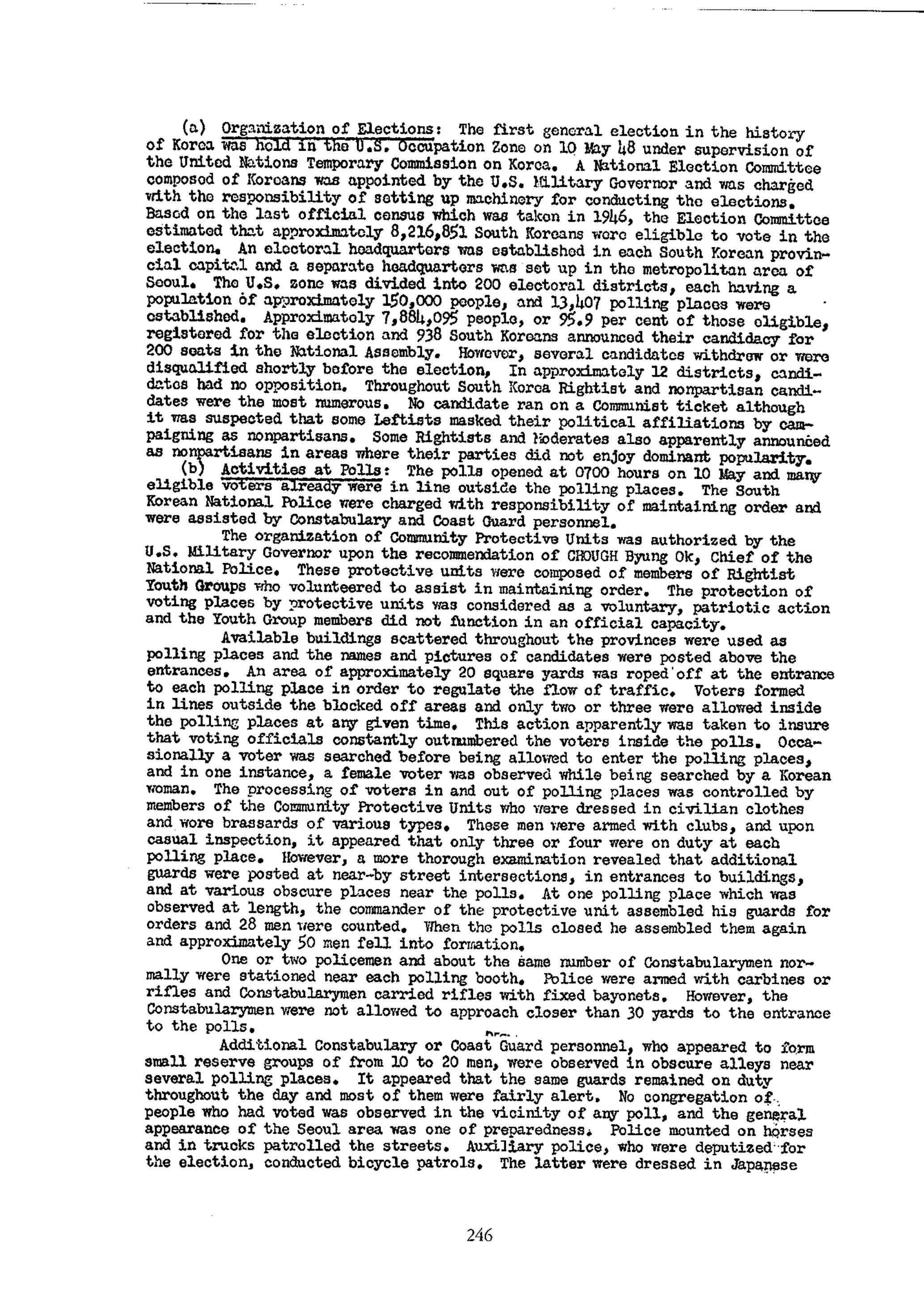
(a) Organization of Elections: The first general election in the history of Korea was held in the U.S. Occupation Zone on 10 May 48 under supervision of the United Nations Temporary Commission on Korea. A National Election Committee composed of Koreans was appointed by the U.S. Military Governor and was charged with the responsibility of setting up machinery for conducting the elections. Based on the last official census which was taken in 1946, the Election Committee estimated that approximately 8,216,851 South Koreans were eligible to vote in the election. An electoral headquarters was established in each South Korean provincial capital and a separate headquarters was set up in the metropolitan area of Seoul. The U.S. zone was divided into 200 electoral districts, each having a population of approximately 150,000 people, and 13,407 polling places were established. Approximately 7,884,095 people, or 95.9 per cent of those eligible, registered for the election and 938 South Koreans announced their candidacy for 200 seats in the National Assembly. However, several candidates withdrew or were disqualified shortly before the election. In approximately 12 districts, candidates had no opposition. Throughout South Korea Rightist and nonpartisan candidates were the most numerous. No candidate ran on a Communist ticket although it was suspected that some Leftists masked their political affiliations by campaigning as nonpartisans. Some Rightists and Moderates also apparently announced as nonpartisans in areas where their parties did not enjoy dominant popularity.
(b) Activities at Polls: The polls opened at 0700 hours on 10 May and many eligible voters already were in line outside the polling places. The South Korean National Police were charged with responsibility of maintaining order and were assisted by Constabulary and Coast Guard personnel.
The organization of Community Protective Units was authorized by the U.S. Military Governor upon the recommendation of CHOUGH Byung Ok, Chief of the National Police. These protective units were composed of members of Rightist Youth Groups who volunteered to assist in maintaining order. The protection of voting places by protective units was considered as a voluntary, patriotic action and the Youth Group members did not function in an official capacity.
Available buildings scattered throughout the provinces were used as polling places and the names and pictures of candidates were posted above the entrances. An area of approximately 20 square yards was roped off at the entrance to each polling place in order to regulate the flow of traffic. Voters formed in lines outside the blocked off areas and only two or three were allowed inside the polling places at any given time. This action apparently was taken to insure that voting officials constantly outnumbered the voters inside the polls. Occasionally a voter was searched before being allowed to enter the polling places, and in one instance, a female voter was observed while being searched by a Korean woman. The processing of voters in and out of polling places was controlled by members of the Community Protective Units who were dressed in civilian clothes and wore brassards of various types. These men were armed with clubs, and upon casual inspection, it appeared that only three or four were on duty at each polling place. However, a more thorough examination revealed that additional guards were posted at near-by street intersections, in entrances to buildings, and at various obscure places near the polls. At one polling place which was observed at length, the commander of the protective unit assembled his guards for orders and 28 men were counted. When the polls closed he assembled them again and approximately 50 men fell into formation.
One or two policemen and about the same number of Constabularymen normally were stationed near each polling booth. Police were armed with carbines or rifles and Constabularymen carried rifles with fixed bayonets. However, the Constabularymen were not allowed to approach closer than 30 yards to the entrance to the polls.
Additional Constabulary or Coast Guard personnel, who appeared to form small reserve groups of from 10 to 20 men, were observed in obscure alleys near several polling places. It appeared that the same guards remained on duty throughout the day and most of them were fairly alert. No congregation of people who had voted was observed in the vicinity of any poll, and the general appearance of the Seoul area was one of preparedness. Police mounted on horses and in trucks patrolled the streets. Auxiliary police, who were deputized for the election, conducted bicycle patrols. The latter were dressed in Japanese
--- p256 ---
military uniforms. United Nations personnel toured South Korea to inspect election procedures and U.S. Military Police conducted normal patrols. U.S. troops were alerted, but few were on the streets, and U.S. personnel were prohibited from entering polling places.
The polls closed at 1900 hours and ballots were boxed immediately and transported to district headquarters for counting. Successful candidates are being notified unofficially of their election by the district headquarters and voting results were processed through provincial headquarters to the National Election Committee Headquarters in Seoul.
(c) Atmosphere of Election: The atmosphere at polling places observed in the Seoul area appeared free to the extent that eligible voters apparently were able to go to the polls unmolested and cast their ballots for candidates of their choice. However, Communist efforts to block election plans by sabotage, murder, and attacks upon registration places/had convinced those favoring the election that protection of polling places and ballots was necessary. This protection appeared to have been carried out in an orderly manner at the polls observed, and although some voters were searched, none was denied entrance to the polls.
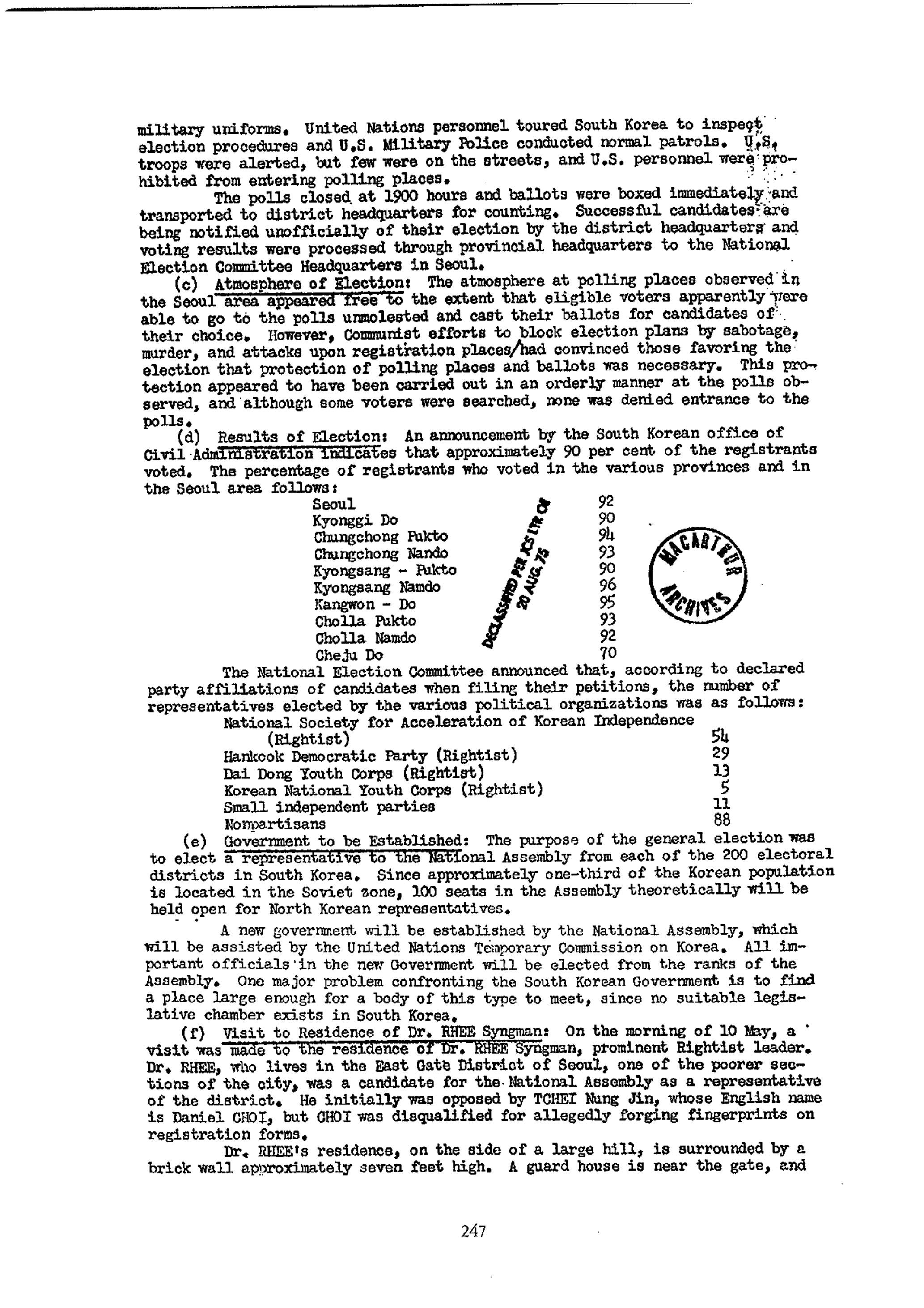
(d) Results of Election: An announcement by the South Korean office of Civil Administration indicates that approximately 90 per cent of the registrants voted. The percentage of registrants who voted in the various provinces and in the Seoul area follows:
Seoul 92
Kyonggi Do 90
Chungchong Pukto 94
Chungchong Nando 93
Kyongsang - Pukto 90
Kyongsang Namdo 96
Kangwon - Do 95
Cholla Pukto 93
Cholla Namdo 92
Cheju Do 70
The National Election Committee announced that, according to declared party affiliations of candidates when filing their petitions, the number of representatives elected by the various political organizations was as follows:
National Society for Acceleration of Korean Independence
(Rightist) 54
Hankook Democratic Party (Rightist) 29
Dai Dong Youth Corps (Rightist) 13
Korean National Youth Corps (Rightist) 5
Small independent parties 11
Nonpartisans 88
(e) Government to be Established: The purpose of the general election was to elect a representative to the National Assembly from each of the 200 electoral districts in South Korea. Since approximately one-third of the Korean population is located in the Soviet zone, 100 seats in the Assembly theoretically will be held open for North Korean representatives.
A new government will be established by the National Assembly, which will be assisted by the United Nations Temporary Commission on Korea. All important officials in the new Government will be elected from the ranks of the Assembly. One major problem confronting the South Korean Government is to find a place large enough for a body of this type to meet, since no suitable legislative chamber exists in South Korea.
(f) Visit to Residence of Dr. RHEE Syngman: On the morning of 10 May, a visit was made to the residence of Dr. RHEE Syngman, prominent Rightist leader. Dr. RHEE, who lives in the East Gate District of Seoul, one of the poorer sections of the city, was a candidate for the National Assembly as a representative of the district. He initially was opposed by TCHEI Nung Jin, whose English name is Daniel CHOI, but CHOI was disqualified for allegedly forging fingerprints on registration forms.
Dr. RHEE's residence, on the side of a large hill, is surrounded by a brick wall approximately seven feet high. A guard house is near the gate, and
--- p257 ---
rifles, believed of Japanese manufacture, were stacked in racks in the guard house. The walled area was guarded and additional guards reportedly outposted the hill in rear of the residence.
The U.S. personnel were met at the gate by a policeman who asked for their names and requested that they wait while he obtained clearance from Dr. RHEE. He returned a few minutes later and escorted the visitors toward the house where Dr. RHEE, Mrs. RHEE, and Dr. PYONG, a political adviser, were sitting in a garden.
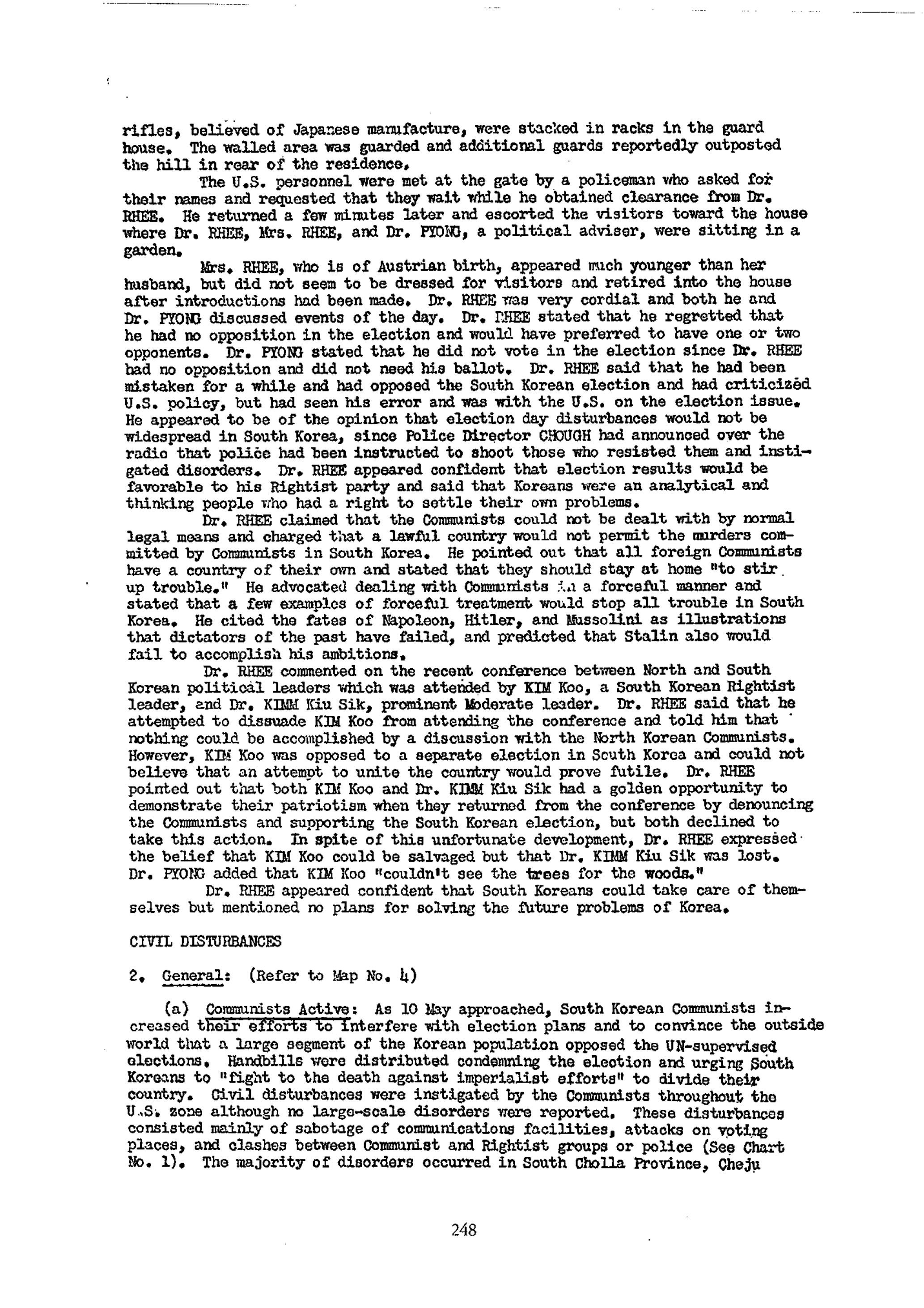
Mrs. RHEE, who is of Austrian birth, appeared much younger than her husband, but did not seem to be dressed for visitors and retired into the house after introductions had been made. Dr. RHEE was very cordial and both he and Dr. PYONG discussed events of the day. Dr. RHEE stated that he regretted that he had no opposition in the election and would have preferred to have one or two opponents. Dr. PYONG stated that he did not vote in the election since Dr. RHEE had no opposition and did not need his ballot. Dr. RHEE said that he had been mistaken for a while and had opposed the South Korean election and had criticized U.S. policy, but had seen his error and was with the U.S. on the election issue. He appeared to be of the opinion that election day disturbances would not be widespread in South Korea, since Police Director CHOUGH had announced over the radio that police had been instructed to shoot those who resisted them and instigated disorders. Dr. RHEE appeared confident that election results would be favorable to his Rightist party and said that Koreans were an analytical and thinking people who had a right to settle their own problems.
Dr. RHEE claimed that the Communists could not be dealt with by normal legal means and charged that a lawful country would not permit the murders committed by Communists in South Korea. He pointed out that all foreign Communists have a country of their own and stated that they should stay at home "to stir up trouble." He advocated dealing with Communists in a forceful manner and stated that a few examples of forceful treatment would stop all trouble in South Korea. He cited the fates of Napoleon, Hitler, and Mussolini as illustrations that dictators of the past have failed, and predicted that Stalin also would fail to accomplish his ambitions.
Dr. RHEE commented on the recent conference between North and South Korean political leaders which was attended by KIM Koo, a South Korean Rightist leader, and Dr. KIMM Kiu Sik, prominent Moderate leader. Dr. RHEE said that he attempted to dissuade KIM Koo from attending the conference and told him that nothing could be accomplished by a discussion with the North Korean Communists. However, KIM Koo was opposed to a separate election in South Korea and could not believe that an attempt to unite the country would prove futile. Dr. RHEE pointed out that both KIM Koo and Dr. KIMM Kiu Sik had a golden opportunity to demonstrate their patriotism when they returned from the conference by denouncing the Communists and supporting the South Korean election, but both declined to take this action. In spite of this unfortunate development, Dr. RHEE expressed the belief that KIM Koo could be salvaged but that Dr. KIMM Kiu Sik was lost. Dr. PYONG added that KIM Koo "couldn't see the trees for the woods."
Dr. RHEE appeared confident that South Koreans could take care of themselves but mentioned no plans for solving the future problems of Korea.
CIVIL DISTURBANCES
2. General: (Refer to Map No. 4)
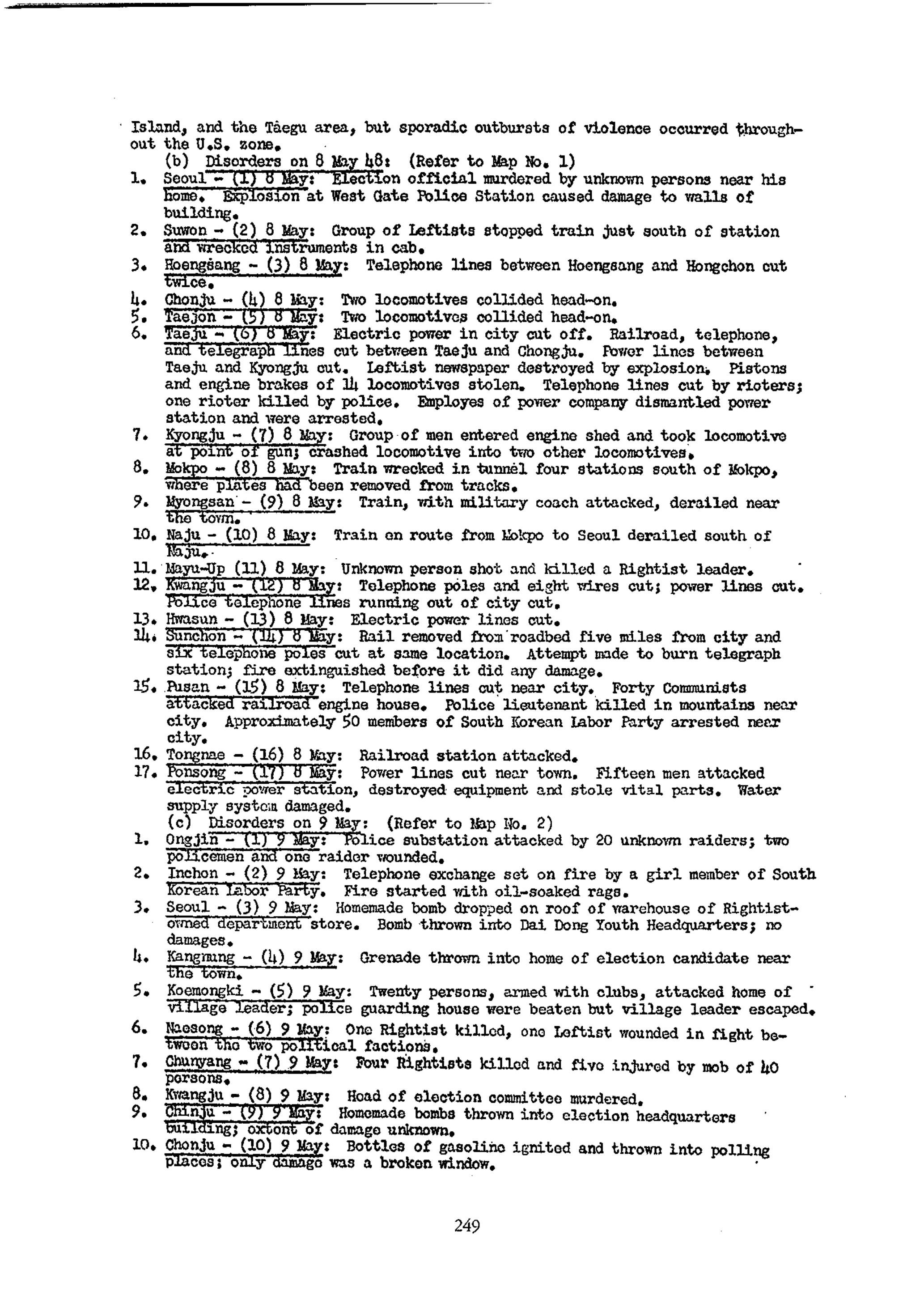
(a) Communists Active: As 10 May approached, South Korean Communists increased their efforts to interfere with election plans and to convince the outside world that a large segment of the Korean population opposed the UN-supervised elections. Handbills were distributed condemning the election and urging South Koreans to "fight to the death against imperialist efforts" to divide their country. Civil disturbances were instigated by the Communists throughout the U.S. zone although no large-scale disorders were reported. These disturbances consisted mainly of sabotage of communications facilities, attacks on voting places, and clashes between Communist and Rightist groups or police (See Chart No. 1). The majority of disorders occurred in South Cholla Province, Cheju
--- p258 ---
Island, and the Taegu area, but sporadic outbursts of violence occurred throughout the U.S. zone.
(b) Disorders on 8 May 48: (Refer to Map No. 1)
1. Seoul - (1) 8 May: Election official murdered by unknown persons near his home. Explosion at West Gate Police Station caused damage to walls of building.
2. Suwon - (2) 8 May: Group of Leftists stopped train just south of station and wrecked instruments in cab.
3. Hoengsang - (3) 8 May: Telephone lines between Hoengsang and Hongchon cut twice.
4. Chonju - (4) 8 May: Two locomotives collided head-on.
5. Taejon - (5) 8 May: Two locomotives collided head-on.
6. Taeju - (6) 8 May: Electric power in city cut off. Railroad, telephone, and telegraph lines cut between Taeju and Chongju. Power lines between Taeju and Kyongju cut. Leftist newspaper destroyed by explosion. Pistons and engine brakes of 14 locomotives stolen. Telephone lines cut by rioters; one rioter killed by police. Employes of power company dismantled power station and were arrested.
7. Kyongju - (7) 8 May: Group of men entered engine shed and took locomotive at point of gun; crashed locomotive into two other locomotives.
8. Mokpo - (8) 8 May: Train wrecked in tunnel four stations south of Mokpo, where plates had been removed from tracks.
9. Myongsan - (9) 8 May: Train, with military coach attacked, derailed near the town.
10. Naju - (10) 8 May: Train on route from Mokpo to Seoul derailed south of Naju.
11. Mayu-Up (11) 8 May: Unknown person shot and killed a Rightist leader.
12. Kwangju - (12) 8 May: Telephone poles and eight wires cut; power lines cut. Police telephone lines running out of city cut.
13. Hwasun - (13) 8 May: Electric power lines cut.
14. Sunchon - (14) 8 May: Rail removed from roadbed five miles from city and six telephone poles cut at same location. Attempt made to burn telegraph station; fire extinguished before it did any damage.
15. Pusan - (15) 8 May: Telephone lines cut near city. Forty Communists attacked railroad engine house. Police lieutenant killed in mountains near city. Approximately 50 members of South Korean Labor Party arrested near city.
16. Tongnae - (16) 8 May: Railroad station attacked.
17. Ponsong - (17) 8 May: Power lines cut near town. Fifteen men attacked electric power station, destroyed equipment and stole vital parts. Water supply system damaged.
(c) Disorders on 9 May: (Refer to Map No. 2)
1. Ongjin - (1) 9 May: Police substation attacked by 20 unknown raiders; two policemen and one raider wounded.
2. Inchon - (2) 9 May: Telephone exchange set on fire by a girl member of South Korean Labor Party. Fire started with oil-soaked rags.
3. Seoul - (3) 9 May: Homemade bomb dropped on roof of warehouse of Rightist-owned department store. Bomb thrown into Dai Dong Youth Headquarters; no damages.
4. Kangnung - (4) 9 May: Grenade thrown into home of election candidate near the town.
5. Koemongki - (5) 9 May: Twenty persons, armed with clubs, attacked home of village leader; police guarding house were beaten but village leader escaped.
6. Naesong - (6) 9 May: One Rightist killed, one Leftist wounded in fight between the two political factions.
7. Chunyang - (7) 9 May: Four Rightists killed and five injured by mob of 40 persons.
8. Kwangju - (8) 9 May: Head of election committee murdered.
9. Chinju - (9) 9 May: Homemade bombs thrown into election headquarters building; oxtont of damage unknown.
10. Chonju - (10) 9 May: Bottles of gasoline ignited and thrown into polling places; only damage was a broken window.
--- p259 ---
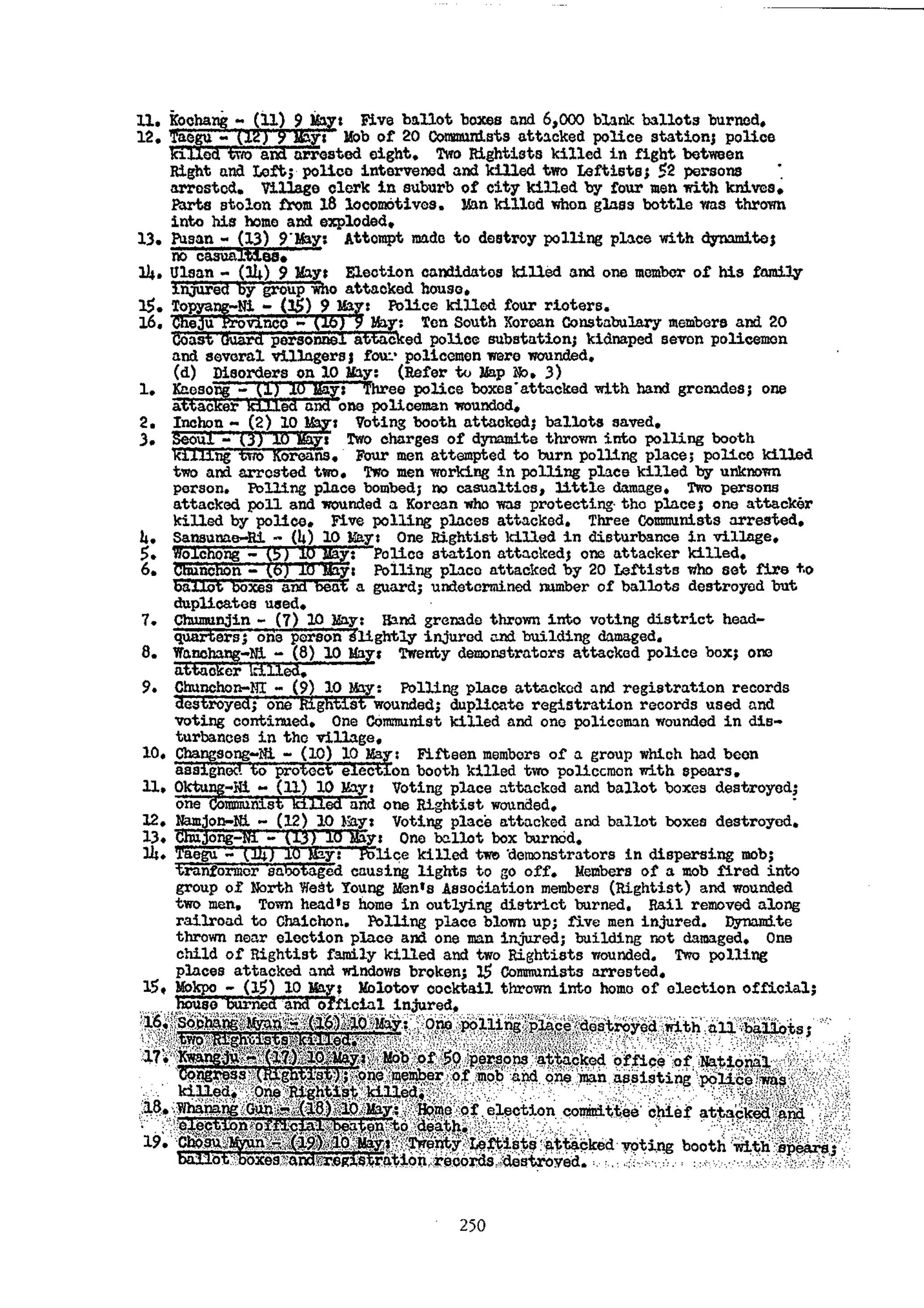
11. Kochang - (11) 9 May: Five ballot boxes and 6,000 blank ballots burned.
12. Taegu - (12) 9 May: Mob of 20 Communists attacked police station; police killed two and arrested eight. Two Rightists killed in fight between Right and Left; police intervened and killed two Leftists; 52 persons arrested. Village clerk in suburb of city killed by four men with knives. Parts stolen from 18 locomotives. Man killed whon glass bottle was thrown into his home and exploded.
13. Pusan - (13) 9 May: Attempt made to destroy polling place with dynamite; no casualties.
14. Ulsan - (14) 9 May: Election candidates killed and one member of his family injured by group who attacked house.
15. Topyang-Ni - (15) 9 May: Police killed four rioters.
16. Cheju Province - (16) 9 May: Ten South Korean Constabulary members and 20 Coast Guard personnel attacked police substation; kidnaped seven policemen and several villagers; four policemen were wounded.
(d) Disorders on 10 May: (Refer to Map No. 3)
1. Kaesong - (1) 10 May: Three police boxes attacked with hand grenades; one attacker killed and one policeman wounded.
2. Inchon - (2) 10 May: Voting booth attacked; ballots saved.
3. Seoul - (3) 10 May: Two charges of dynamite thrown into polling booth killing two Koreans. Four men attempted to burn polling place; police killed two and arrested two. Two men working in polling place killed by unknown person. Polling place bombed; no casualties, little damage. Two persons attacked poll and wounded a Korean who was protecting the place; one attacker killed by police. Five polling places attacked. Three Communists arrested.
4. Sansunae-Ri - (4) 10 May: One Rightist killed in disturbance in village.
5. Wolchong - (5) 10 May: Police station attacked; one attacker killed.
6. Chunchon - (6) 10 May: Polling place attacked by 20 Leftists who set fire to ballot boxes and beat a guard; undetermined number of ballots destroyed but duplicates used.
7. Chumunjin - (7) 10 May: Hand grenade thrown into voting district headquarters; one person slightly injured and building damaged.
8. Wanchang-Ni - (8) 10 May: Twenty demonstrators attacked police box; one attacker killed.
9. Chunchon-NI - (9) 10 May: Polling place attacked and registration records destroyed; one Rightist wounded; duplicate registration records used and voting continued. One Communist killed and one policeman wounded in disturbances in the village.
10. Changsong-Ni - (10) 10 May: Fifteen members of a group which had been assigned to protect election booth killed two policemen with spears.
11. Oktung-Ni - (11) 10 May: Voting place attacked and ballot boxes destroyed; one Communist killed and one Rightist wounded.
12. Namjon-Ni - (12) 10 May: Voting place attacked and ballot boxes destroyed.
13. Chujong-Ni - (13) 10 May: One ballot box burned.
14. Taegu - (14) 10 May: Police killed two demonstrators in dispersing mob; transformer sabotaged causing lights to go off. Members of a mob fired into group of North West Young Men's Association members (Rightist) and wounded two men. Town head's home in outlying district burned. Rail removed along railroad to Chaichon. Polling place blown up; five men injured. Dynamite thrown near election place and one man injured; building not damaged. One child of Rightist family killed and two Rightists wounded. Two polling places attacked and windows broken; 15 Communists arrested.
15. Mokpo - (15) 10 May: Molotov cocktail thrown into home of election official; house burned and official injured.
16. Sochang Myan - (16) 10 May: One polling place destroyed with all ballots; two Rightists killed.
17. Kwangju - (17) 10 May: Mob of 50 persons attacked office of National Congress (Rightist); one member of mob and one man assisting police was killed. One Rightist killed.
18. Whanang Gun - (18) 10 May: Home of election committee chief attacked and election official beaten to death.
19. Chosu Myun - (19) 10 May: Twenty Leftists attacked voting booth with spears; ballot boxes and registration records destroyed.
--- p260 ---
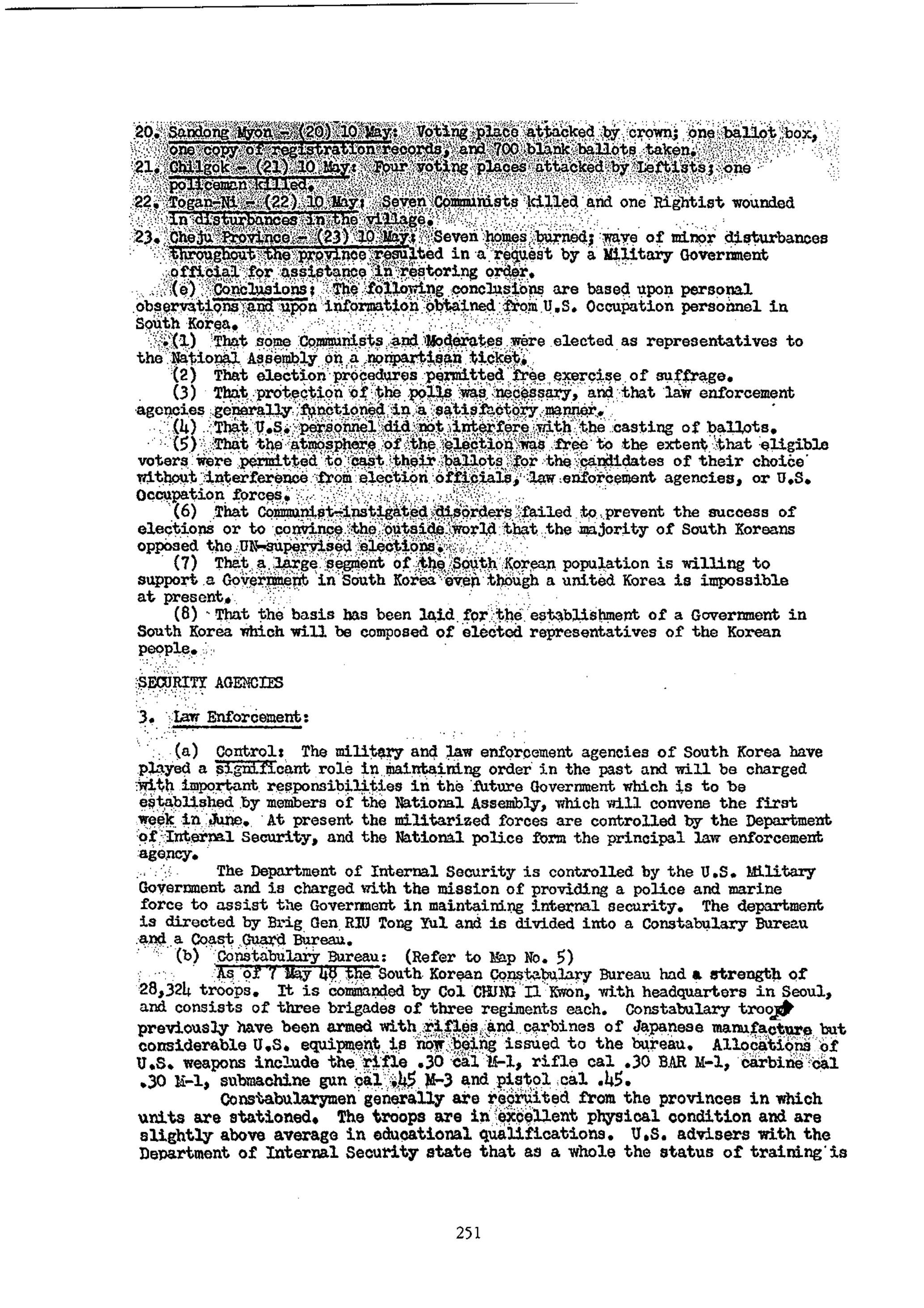
20. Sandong Myon - (20) 10 May: Voting place attacked by crown; one ballot box, one copy of registration records, and 700 blank ballots taken.
21. Chilgok - (21) 10 May: Four voting places attacked by Leftists; one policeman killed.
22. Togan-Ni - (22) 10 May: Seven Communists killed and one Rightist wounded in disturbances in the village.
23. Cheju Province - (23) 10 May: Seven homes burned; wave of minor disturbances throughout the province resulted in a request by a Military Government official for assistance in restoring order.
(e) Conclusions: The following conclusions are based upon personal observations and upon information obtained from U.S. Occupation personnel in South Korea.
(1) That some Communists and Moderates were elected as representatives to the National Assembly on a nonpartisan ticket.
(2) That election procedures permitted free exercise of suffrage.
(3) That protection of the polls was necessary, and that law enforcement agencies generally functioned in a satisfactory manner.
(4) That U.S. personnel did not interfere with the casting of ballots.
(5) That the atmosphere of the election was free to the extent that eligible voters were permitted to cast their ballots for the candidates of their choice without interference from election officials, law enforcement agencies, or U.S. Occupation forces.
(6) That Communist-instigated disorders failed to prevent the success of elections or to convince the outside world that the majority of South Koreans opposed the UN-supervised elections.
(7) That a large segment of the South Korean population is willing to support a Government in South Korea even though a united Korea is impossible at present.
(8) That the basis has been laid for the establishment of a Government in South Korea which will be composed of elected representatives of the Korean people.
SECURITY AGENCIES
3. Law Enforcement:
(a) Control: The military and law enforcement agencies of South Korea have played a significant role in maintaining order in the past and will be charged with important responsibilities in the future Government which is to be established by members of the National Assembly, which will convene the first week in June. At present the militarized forces are controlled by the Department of Internal Security, and the National police form the principal law enforcement agency.
The Department of Internal Security is controlled by the U.S. Military Government and is charged with the mission of providing a police and marine force to assist the Government in maintaining internal security. The department is directed by Brig Gen RIU Tong Yul and is divided into a Constabulary Bureau and a Coast Guard Bureau.
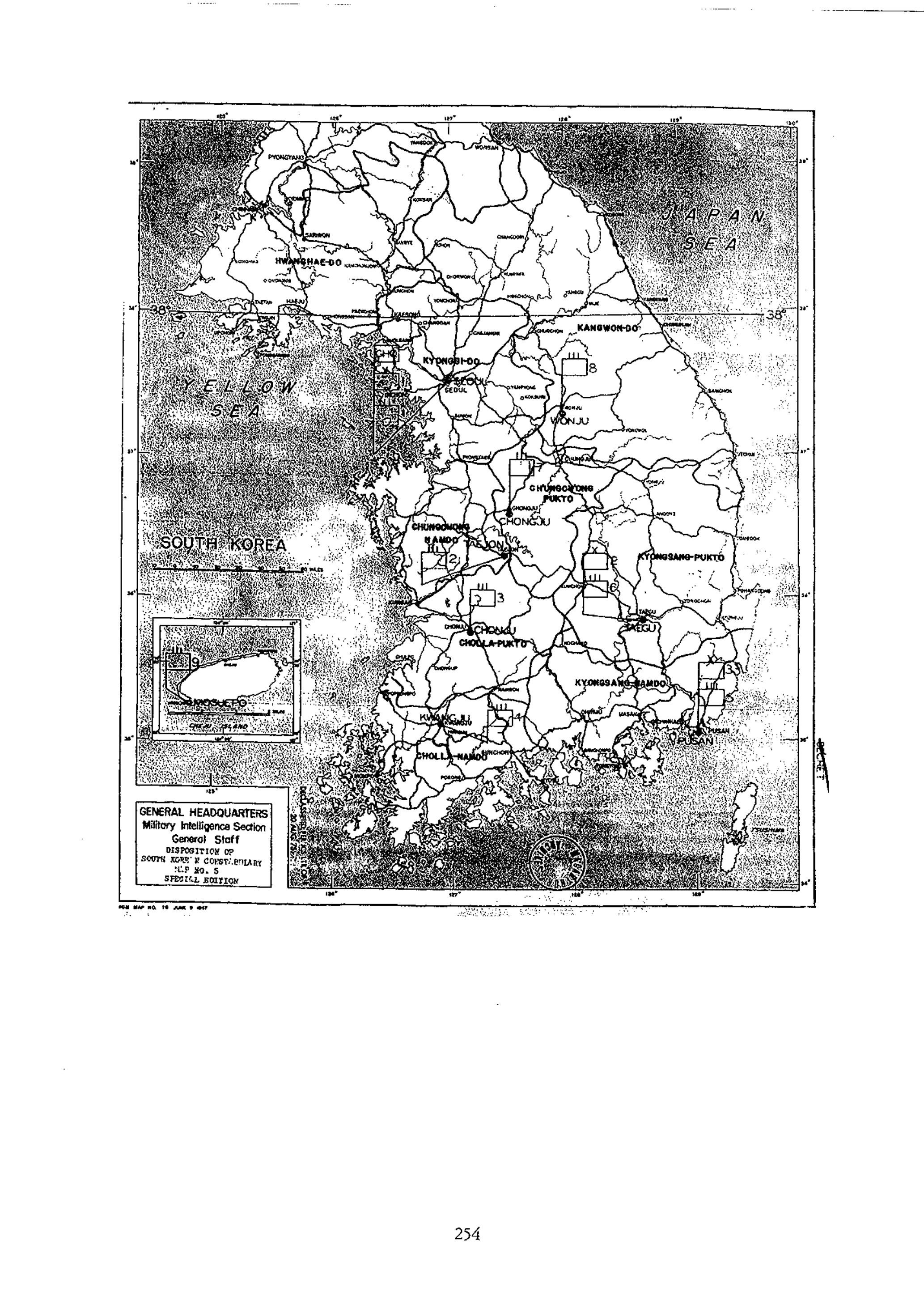
(b) Constabulary Bureau: (Refer to Map No. 5)
As of 7 May 48 the South Korean Constabulary Bureau had a strength of 28,324 troops. It is commanded by Col CHUNG Il Kwon, with headquarters in Seoul, and consists of three brigades of three regiments each. Constabulary troop previously have been armed with rifles and carbines of Japanese manufacture but considerable U.S. equipment is now being issued to the bureau. Allocations of U.S. weapons include the rifle .30 cal M-1, rifle cal .30 BAR M-1, carbine cal .30 M-1, submachine gun cal .45 M-3 and pistol cal .45.
Constabularymen generally are recruited from the provinces in which units are stationed. The troops are in excellent physical condition and are slightly above average in educational qualifications. U.S. advisers with the Department of Internal Security state that as a whole the status of training is
--- p261 ---
good but only small-unit training has been conducted. Approximately 140 U.S. officers are now assigned as advisers to the Constabulary and current training includes familiarization with weapons, drill, and field exercises involving units up to and including the battalion level. No command post exercises nor maneuvers have been conducted. U.S. advisers estimate that the Constabulary, when fully equipped, will be capable of maintaining internal security but could offer only a token resistance if the borders of South Korea were threatened.
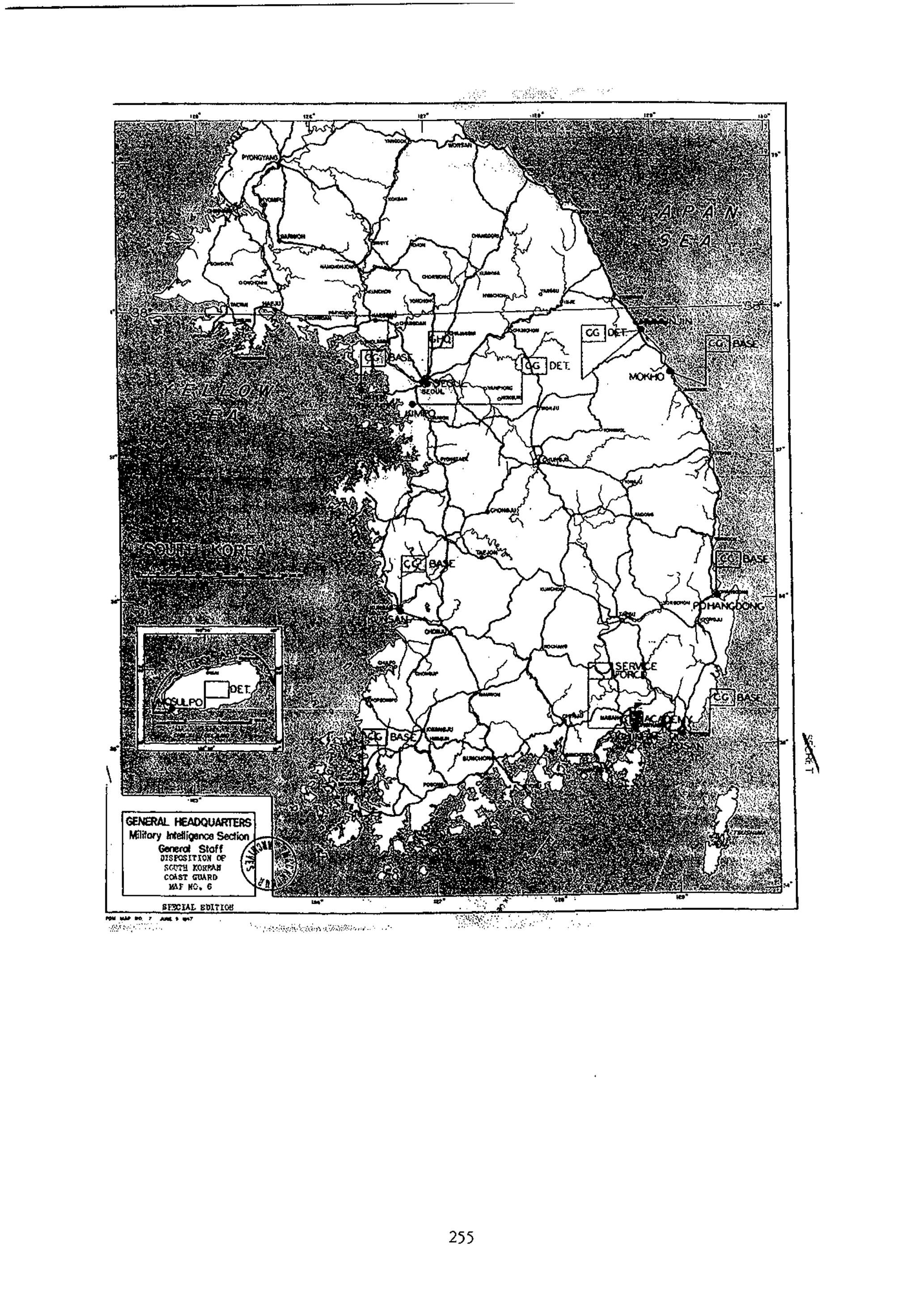
(c) Coast Guard Bureau: (Refer to Map No. 6)
The headquarters of the South Korean Coast Guard is in Seoul and the organization is commanded by Commodore SOHN Won YI1. Present Coast Guard strength is approximately 3,000 men and bases are located at the major South Korean ports. The Coast Guard Academy and the Service Force Headquarters are located at Chinnhae.
Since its inauguration, the Coast Guard has made steady progress along sea-going lines, especially in deck training. Part of this training has been accomplished by placing Korean personnel aboard U.S. destroyers while patrolling off South Korea. Koreans are inept mechanically and engineering training has lagged behind, but U.S. advisers believe that the majority of Coast Guard officers are capable of handling their craft. The Coast Guard Bureau has been handicapped by a shortage of both enlisted and officer personnel and by the infiltration of undesirables into the ranks, but a campaign is now underway to rid the service of undesirables and increase the efficiency of the bureau.
The Coast Guard organization was established as a floating agency for enforcement of customs laws and has been developed for use as the military forces afloat, in event of an emergency. However, its limitations in technically trained personnel, armament, and equipment render it impotent for other than minor naval operations.
(d) National Police Department: (Refer to Map No. 7)
The National Police organization was established as the Bureau of Police in Sep 45 and was reorganized as the National Police Department in Jan 46. It functions under joint control of the U.S. Military Government and the South Korean Interim Government, and administrative authority is vested in Dr. CHOUGH Byung Ok, director of the National Police. Dr. CHOUGH has authority to appoint and discipline personnel and is responsible for the general policy of the Police Department.
The primary mission of the department is the preservation of law and order south of the 38th Parallel, but at present the police are considered as the first line of defense against an invasion from the North and against subversive activities in South Korea.
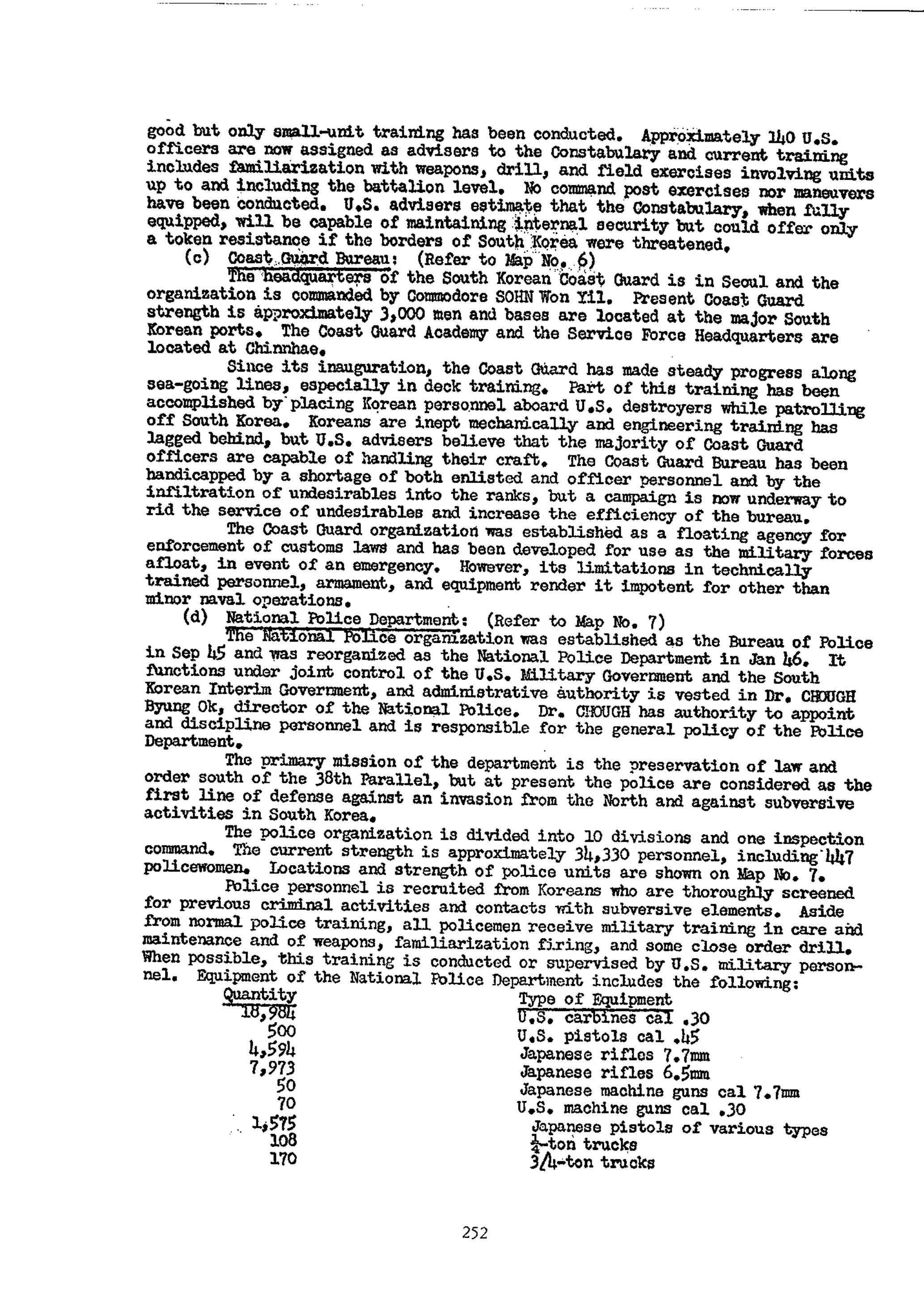
The police organization is divided into 10 divisions and one inspection command. The current strength is approximately 34,330 personnel, including 447 policewomen. Locations and strength of police units are shown on Map No. 7.
Police personnel is recruited from Koreans who are thoroughly screened for previous criminal activities and contacts with subversive elements. Aside from normal police training, all policemen receive military training in care and maintenance and of weapons, familiarization firing, and some close order drill. When possible, this training is conducted or supervised by U.S. military personnel. Equipment of the National Police Department includes the following:
Quantity Type of Equipment
18,984 U.S. carbines cal .30
500 U.S. pistols cal .45
4,594 Japanese rifles 7.7mm
7,973 Japanese rifles 6.5mm
50 Japanese machine guns cal 7.7mm
70 U.S. machine guns cal .30
1,575 Japanese pistols of various types
108 ¼-ton trucks
170 3/4-ton trucks
--- p262 ---
35 1½-ton trucks
27 2½-ton trucks
29 Ambulances
1 Radio SCR 188
3 Radios, SCR 195
6 Radios, SCR 608
23 Radios, SCR 610
1 Radio BC - 610
24 Radios, BC - 342
10 Power units PE 75
10 Power units PE 95
The capabilities of the National Police are those normally found in a police force. The police are capable of using the weapons with which they are equipped and are a potent force for action such as riot control, strikes, civil disorders, and strife involving the civil population. (a)
CHART NO. 1, SPECIAL EDITION
VIOLENCE IN SOUTH KOREA DURING 8, 9, and 10 MAY (REPORTS NOT ALL CONFIRMED)
Attacks on Police Police Killed Communists Killed Rightists Killed Voting Booths Raided Strikes * Sabotage ** Sabotage *** Sabotage ****
MAY MAY MAY MAY MAY MAY MAY MAY MAY
8 9 10 8 9 10 8 9 10 8 9 10 8 9 10 8 9 10 8 9 10 8 9 10 8 9 10 8 9 10
SEOUL 1 6 1 1 1 2 1 10
KYONGGI DO 1 7 1 1 2 1 5 3 1
KANGWON DO 1 1 2 1 4 2 1
CHUNGCHONG NAMDO 1 1 1 2
CHUNGCHONG PUKTO
KYOLLOSANG PUKTO 2 2 10 3 3 3 5 2 12 10 3 3 3 2 2
KYUNGSANG NAMDO 3 1 2 1 2 5 2 2 1
CHOLLA PUKTO 1 1 1 2 3 2
CHOLLA NAMDO 2 2 2 2 1 2 1 4 1 1
CHEJU DO 1 2 1 3 6 6 7 3 4 5
Daily TOTAL 6 5 18 3 0 5 13 11 16 15 9 14 1 9 40 13 0 0 17 1 5 7 0 0 1 2 2
3 DAY TOTAL 29 8 40 38 50 13 23 7 5
* Labor and schools
** Communications and power
*** Locomotives
**** Railroad lines
--- p263 ---
GENERAL HEADQUARTERS
Military Intelligence Section
General Staff
DISPOSITION OF
SOUTH KOREA N CONSTABULARY
ACP NO. 5
SPECIAL EDITION
--- p264 ---
GENERAL HEADQUARTERS
Military Intelligence Section
General Staff
DISPOSITION OF
SOUTH KOREAN
COAST GUARD
MAP NO. 6
SPECIAL EDITION
CG DET.
CG DET.
CG BASE
MOKHO
CG BASE
CG BASE
POHANGDONG
SERVICE FORCE
CG BASE
[illegible] BASE
[illegible] BASE
DET.
PYONGYANG
SEOUL
[illegible]
JAPAN SEA
SOUTH KOREA
--- p265 ---
GENERAL HEADQUARTERS
Military Intelligence Section
General Staff
DISPOSITION OF
SOUTH KOREAN POLICE
MAP NO. 7
SPECIAL EDITION
HWANGHAE-DO
YELLOW SEA
SOUTH KOREA
INSPECTION COMMAND
465
CHEJU-DO
CHEJU ISLAND
RAILROAD POLICE
DV.A
3,779
KYONGGI-DO
YONGSAN
SUWON SEOUL POLICE
INCHON
CHUNCHON 2,067
KANGWON-DO
DIV.B
DIV.C
CHUNGJU
1,479
CHUNGCHONG PUKTO
2,393
CHUNGCHONG NAMDO
TAEJON
DIV.D
3,555
KYONGSANG-PUKTO
DIV.E
DIV.F
TAEGU
CHONSU 2,924
CHOLLA-PUKTO
3,365
KYONGSANG-NAMDO
DIV.G
KWANGJU
DIV.H
3,385
CHOLLA-NAMDO
PUSAN
출처:
제주4·3사건진상규명및희생자명예회복위원회 편,
『제주4·3사건자료집 10』 [미국자료편],
번역문 p.44
/ 원문 p.245–256 / (Special).