(정보요약 제2241호)
정보하이라이트
한국
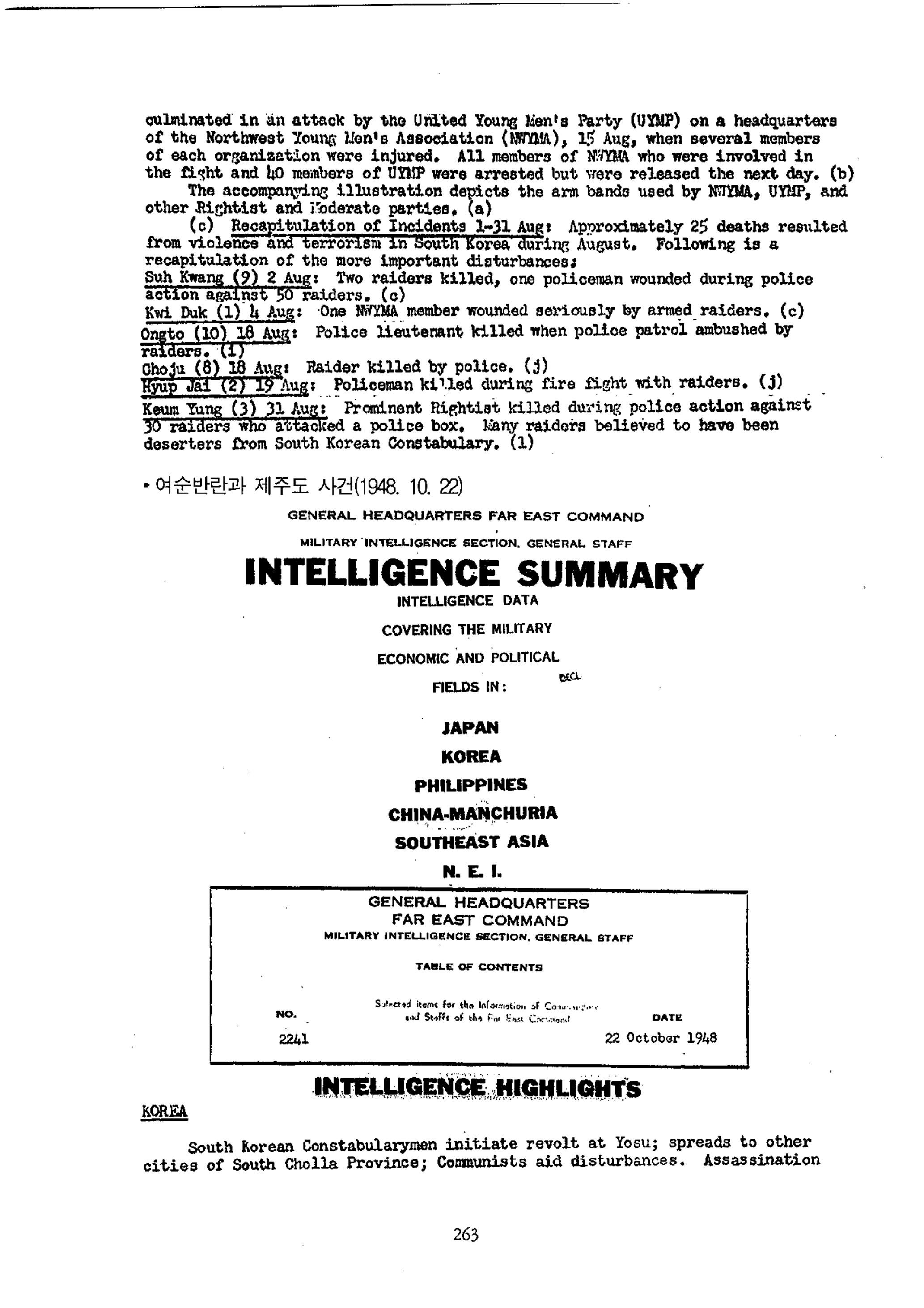
남한 국방경비대는 여수에서 반란을 일으켰으며 전라남도의 다른 도시들로 확산되었다. 공산주의자들이 지원한 소요이다. 이승만 대통령에 대한 암살 시도가 실패하였다. 경찰은 다이너마이트를 발견하였다. 국회는 정부조직법(Government Admini -stration Bill)을 통과시켰다. (중략)
한국
군사, 정치, 경제, 사회정세, 신문논평, 민정정보, 기타
군사 정세
1. 경비대 반란:
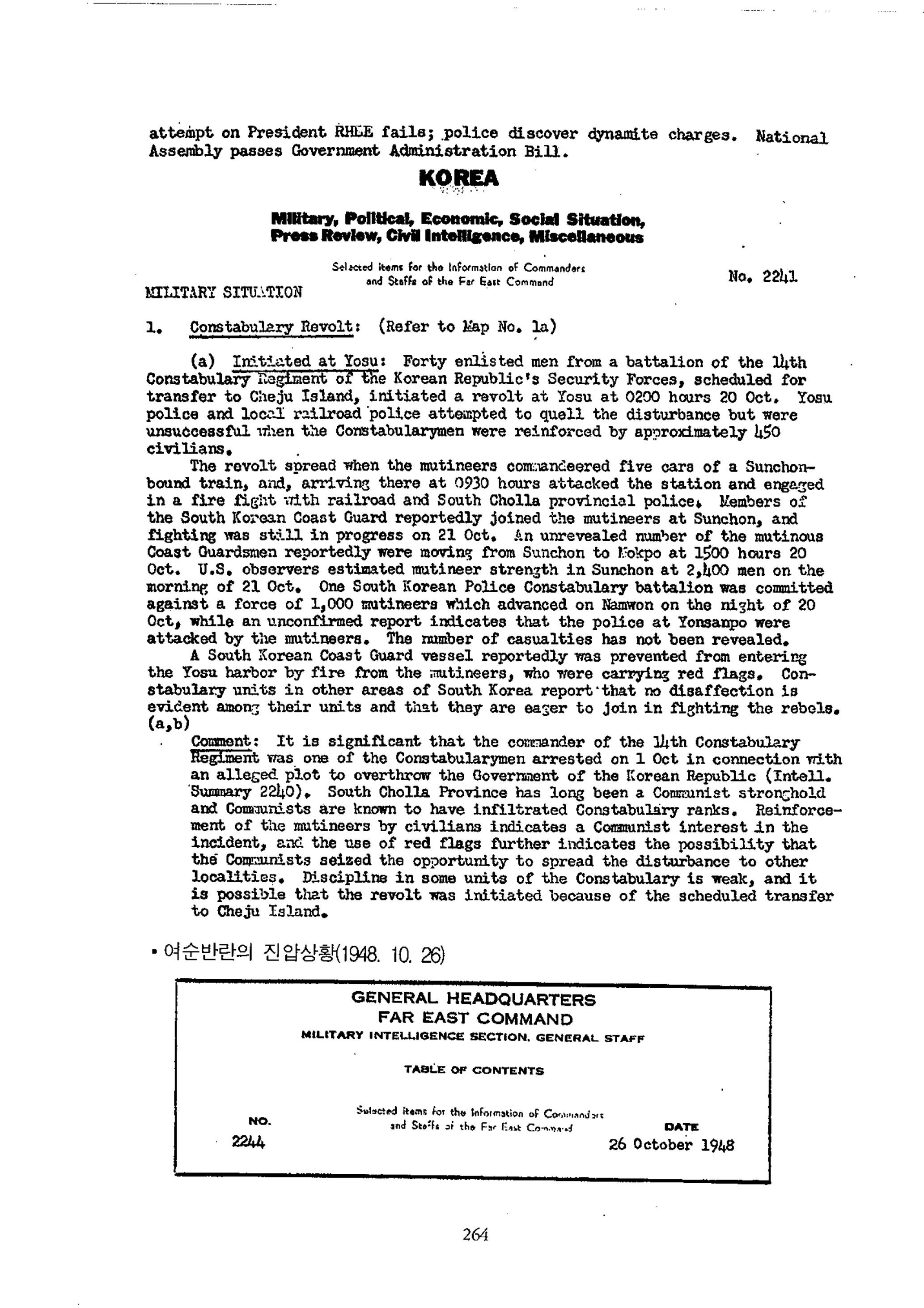
(a) 여수에서 시작: 10월 20일 02시 제주도로 이동이 예정된 국방경비대 제14연대 소속 사병 40여 명이 여수에서 반란을 일으켰다. 여수 경찰과 그 지역 철도 경찰이 반란 진압을 시도하였으나 민간인 450여 명이 가담하면서 반란군이 강화되자 진압은 실패하였다. 또 오전 9시 30분경 순천행 기차 5량을 탈취하여 순천역에 도착한 반란군은 순천역을 공격하고, 전라남도와 철도청 경찰들과 교전을 벌였다. 보고에 의하면 해안경비대 대원들도 순천에서 폭동에 가담하였으며, 10월 21일 현재 여전히 전투가 진행중이다. 숫자 미상의 해안경비대 폭도들이 10월 20일 15시경 순천에서 목포로 이동했다. 미군 관측자들은 10월 21일 오전 현재 순천에 있는 폭도의 규모를 약 2,400명으로 추정하였다. 남한 경찰 경비대 1개 대대가 10월 20일 밤에 남원으로 향한 1,000명의 반란군 병력에 대항하도록 파견되는 한편 미확인된 보고는 영산포(Yonsanpo)의 경찰이 반란군의 공격을 받았다는 것을 시사한다. 사상자 숫자는 미상이다.
남한 해안경비대 전함이 인공기를 소지한 반란군의 사격 때문에 여수항에 진입할 수 없었다고 한다. 남한의 타지역 경비부대들은 자신들의 부대에 어떠한 동요도 없으며 자신들도 폭도들과 싸우기를 갈망한다고 보고하였다.
논평: 14연대장이 소위 남한 정부의 전복음모와 연관되어 10월 1일에 체포된 자들 중 한 사람이라는 사실은 중요한 의미를 가진다(<정보요약> 제2240호). 전라남도는 오랫동안 공산주의의 근거지였으며 공산주의자들이 경비대에 침투했던 것으로 알려져 있다. 민간인들이 참여하여 반란군을 강화시켰다는 것은 그 사건에서 공산주의자들의 관심을 시사해 주며 인공기의 사용은 공산주의자들이 다른 지역에까지 소요를 확산시킬 기회를 가질 가능성을 훨씬 더 강하게 시사한다. 경비대의 일부 부대들의 군 기강이 해이해져서 제주도 출동 때문에 반란이 촉발되었을 가능성이 높다. (이하생략)
GENERAL HEADQUARTERS FAR EAST COMMAND
MILITARY INTELLIGENCE SECTION, GENERAL STAFF
# INTELLIGENCE SUMMARY
INTELLIGENCE DATA
COVERING THE MILITARY
ECONOMIC AND POLITICAL
EXCL
FIELDS IN:
**JAPAN**
**KOREA**
**PHILIPPINES**
**CHINA-MANCHURIA**
**SOUTHEAST ASIA**
**N. E. I.**
GENERAL HEADQUARTERS
FAR EAST COMMAND
MILITARY INTELLIGENCE SECTION, GENERAL STAFF
TABLE OF CONTENTS
Selected items for the Information of Commanding
NO. and Staffs of the Far East Command DATE
2241 22 October 1948
INTELLIGENCE HIGHLIGHTS
KOREA
South Korean Constabularymen initiate revolt at Yosu; spreads to other cities of South Cholla Province; Communists aid disturbances. Assassination
attempt on President RHEE fails; police discover dynamite charges. National Assembly passes Government Administration Bill.
# KOREA
## Military, Political, Economic, Social Situation, Press Review, Civil Intelligence, Miscellaneous
Selected items for the Information of Commanders
and Staffs of the Far East Command
No. 2241
MILITARY SITUATION
1. Constabulary Revolt: (Refer to Map No. 1a)
(a) Initiated at Yosu: Forty enlisted men from a battalion of the 14th Constabulary Regiment of the Korean Republic's Security Forces, scheduled for transfer to Cheju Island, initiated a revolt at Yosu at 0200 hours 20 Oct. Yosu police and local railroad police attempted to quell the disturbance but were unsuccessful when the Constabularymen were reinforced by approximately 450 civilians.
The revolt spread when the mutineers commandeered five cars of a Sunchon-bound train, and, arriving there at 0930 hours attacked the station and engaged in a fire fight with railroad and South Cholla provincial police. Members of the South Korean Coast Guard reportedly joined the mutineers at Sunchon, and fighting was still in progress on 21 Oct. An unrevealed number of the mutinous Coast Guardsmen reportedly were moving from Sunchon to Mokpo at 1500 hours 20 Oct. U.S. observers estimated mutineer strength in Sunchon at 2,400 men on the morning of 21 Oct. One South Korean Police Constabulary battalion was committed against a force of 1,000 mutineers which advanced on Namwon on the night of 20 Oct, while an unconfirmed report indicates that the police at Yonsanpo were attacked by the mutineers. The number of casualties has not been revealed.
A South Korean Coast Guard vessel reportedly was prevented from entering the Yosu harbor by fire from the mutineers, who were carrying red flags. Constabulary units in other areas of South Korea report that no disaffection is evident among their units and that they are eager to join in fighting the rebels. (a,b)
Comment: It is significant that the commander of the 14th Constabulary Regiment was one of the Constabularymen arrested on 1 Oct in connection with an alleged plot to overthrow the Government of the Korean Republic (Intell. Summary 2240). South Cholla Province has long been a Communist stronghold and Communists are known to have infiltrated Constabulary ranks. Reinforcement of the mutineers by civilians indicates a Communist interest in the incident, and the use of red flags further indicates the possibility that the Communists seized the opportunity to spread the disturbance to other localities. Discipline in some units of the Constabulary is weak, and it is possible that the revolt was initiated because of the scheduled transfer to Cheju Island.
출처:
제주4·3사건진상규명및희생자명예회복위원회 편,
『제주4·3사건자료집 10』 [미국자료편],
번역문 p.66
/ 원문 p.263–264 / No. 2241.