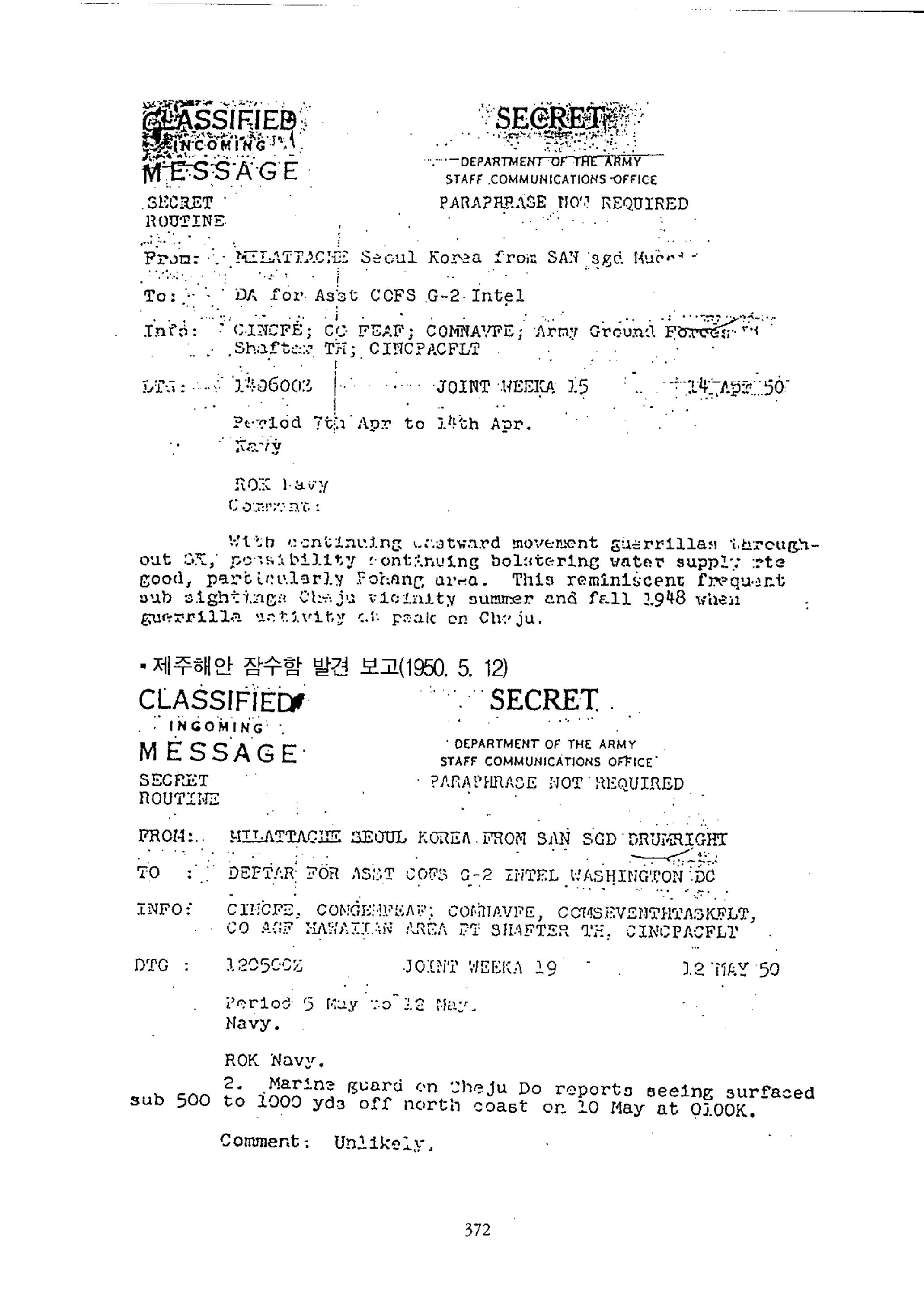
<JOINT WEEKA> 제19호(1950. 5. 5~12)
한국해군
제주도 해병대 경비병이 5월 10일 새벽 1시 정각에 500-1000야드 떨어진 북쪽 해안 수면위에 떠오른 잠수함을 보았다고 보고했다.
논평 : 그럴 것 같지 않다.
미국정부
CLASSIFIED SECRET
INCOMING
MESSAGE
SECRET
ROUTINE
DEPARTMENT OF THE ARMY
STAFF COMMUNICATIONS OFFICE
PARAPHRASE NOT REQUIRED
FROM: MILATTACHE SEOUL KOREA FROM SAN SGD DRUMRIGHT
TO : DEPTAR FOR ASST COFS G-2 INTEL WASHINGTON DC
INFO: CINCFE, COMGENREAR; COMNAVFE, COMSEVENTHASKFLT,
CO AGF HAWAIIAN AREA FT SHAFTER TH, CINCPACFLT
DTG : 1205002 JOINT WEEKA 19 12 MAY 50
Period 5 May to 12 May.
Navy.
ROK Navy.
2. Marine guard on Cheju Do reports seeing surfaced sub 500 to 1000 yds off north coast on 10 May at 0100K.
Comment: Unlikely.
미국 정부
I can see this appears to be a very faint or mostly blank page from a document collection. The image is extremely low contrast with barely visible text at the very top of the page. Let me extract what I can make out:
[illegible] **[illegible]** [illegible] [illegible] [illegible] [illegible] [illegible] [illegible] [illegible] [illegible] [illegible] [illegible] [illegible] [illegible] [illegible]
The page appears to be essentially blank or so faded that the text content is not legible. There are only very faint marks/text visible at the very top edge of the page, and a couple of small dots/marks scattered on the otherwise blank page.
미국 정부
• 드래퍼와 이승만 간의 회담(1948년 3월 28일)
XXXX OF THE ARMY
10 April 1948
MEMORANDUM FOR RECORD
Subject: Conference between Under Secretary Draper and Mr. Syngman Rhee, on 28 March 1948
At the request of Dr. Rhee, Mr. Draper and Dr. Rhee had a conference for approximately one-half an hour in Mr. Draper's room at the Chosen Hotel. Outlined below are the views expressed by Dr. Rhee, in many instances as a result of prodding and questions by Mr. Draper.
Dr. Rhee said that he felt that continued cooperation is necessary between the United States and Korea. He felt that he was somewhat misunderstood by many Americans, and that he supported American policies. He said that he had supported General Hodge's until December 1946; but at that time felt that he had to work out his own policies because he felt that it was wrong to try to get along with the Soviets. He spoke at length on this subject and said that there is no sense in waiting for the Soviets to come to agreement on the future of Korea, and that the Koreans themselves must be the ones to work out their own problems.
He felt that the forthcoming elections were a step in the right direction, and that there will be a great turnout for these elections. He believes the elections will be orderly unless the communist terrorists become too great. He feels that the police, the youth groups, and labor will be able to keep the situation under control.
Dr. Rhee believes that any North-South conference of political leaders would have the same unsatisfactory result as the Joint Commission.
He stated that the Korean people realize, and are grateful for what the United States has done for Korea. While living conditions have not much improved, since before the war, he agreed that this was a result of the world-wide dislocation caused by the war and that the situation would have been much worse if the United States had not given help. He said that the hope of the Korean people is help from the United States, and that Korea needs United States assistance. (He did not make it clear whether he meant physical or moral assistance) to help drive the Soviets from Korea. He stated that Korea must count on the good-will and aid of the United States, and incidentally the United Nations, and that with this aid it should get on its feet in a short time.
Dr. Rhee said that he had heard it suggested that the United States might wish to have a Naval Base on Cheju Island. He said that he felt confident that when a Korean Government is established, that the Koreans would be very willing to have the United States establish a permanent base there. (Mr. Draper made no comment).
In reply to a question regarding the ability of Koreans to establish the requisite technical and manageability efficiency in factories, he said that the Koreans are rapidly learning mechanical and industrial know-how, and that further strides will be taken rapidly with United States advisers.
With regard to trade, he stated that trade must be assisted by industrializing Korea to take care of the increasing population. He said that Japan will need Korean products, as well as China, the Philippines and Australia. He said that Korea would be able to compete with Japan in trading with the United States and the Far East. In reply to a question regarding trade between Japan and Korea, he stated that certain "preliminary arrangements" will be required, He agreed that trade between Japan and Korea cannot be a "one-way street". He felt that in addition to industrial production, that products of Korean mines and other natural products, will be available for such trade.
He felt that Korea can be self-sufficient in food, despite the growing population, by introduction of new and improved agriculture methods. He said that fishing had been good recently. He stated that land reform will have to be one of the first steps which the Korean Government will have to take to help Korean agriculture. He indicated that he understood how difficult a problem it was for the United States to furnish food for Korea in the light of world-wide shortages and recent bad crops.
Dr. Rhee was very quiet during the conference and his statements were quite temperate, due perhaps, to the presence of General Dean in the room during the conference.
• 이국 신문 발췌(1948년 5월 5일)
MARQUISEGONDETCHEGRAM [illegible]
[illegible] Department's [illegible] Department of State
[illegible] Washington—
PLAIN
복원 촬영필름 COSTS at [illegible]
[illegible] 1 209 3, 1948[illegible]
article concludes.
SCRIPP[illegible] WASHINGTON NEWS fifth denounced Com-
munist terrorist methods Cheju Island and ceased QUOTE Stalin has now
added guerilla warfare to his efforts to sabotage UN supervised
election. Phony legal basis for absorption Korea into Soviet
system has been laid by Red conference in Russian zone. Now
question is whether Stalin, having enslaved one-third Koreans,
can extend his dictatorship over remaining two-th rds living in American zone. Since he cannot bluff UN Commission on er US Army there he is trying to wreck coming democratic ele tion by murder and terror UNQUOTE.
DALLAS NEWS third states QUOTE Korea deserve a better luck than it is having but its only hope is in UN action which in turn requires that mythical UN fighting force to effect uate it. Korea the population of close to twenty-four million. inly fifty thousand or these were estimated as Communists in nineteen forty. ow Korea wants above all things freedom and independence. What Korea needs is UN trusteeship until complete tel free elections can be guaranteed. Korea isn't likely to get either UNQUOTE.
• 묶은 서기와 5·10선거 반대 일지(1948년 10월 22일)
STANDARD FORM NO. 64
Office Memorandum · UNITED STATES GOVERNMENT
TO: DC/R DATE: October 22, 1948
FROM : UNP - Mr. Wells
SUBJECT: Enclosures to Despatch No. 51 from Seoul, Korea
The following enclosures have been withdrawn from the subject despatch and forwarded to the United States Delegation to the United Nations General Assembly in Paris:
1. One carbon copy of Enclosure 1.
2. Sole copy of Enclosure 2.
3. One carbon copy of Enclosure 3.
4. One carbon copy of Enclosure 4.
5. Sole copy of Enclosure 5 (a carbon copy).
6. Original copy of Enclosure 6.
7. Sole copy of Enclosure 7.
The following remaining enclosures, with original despatch No. 51, are returned herewith for your files:
1. Original copy of Enclosure 1.
2. Original copy of Enclosure 3.
3. Original copy of Enclosure 4, and one carbon copy.
4. Three photostats of Enclosure 6.
Attachments:
As stated in paragraph two above.
OPPOSITION TO SEPARATE KOREAN GOVERNMENTS
AND THE
NORTH KOREAN ELECTION
U.S.S.R. and U.S. Claims
It is probable that the USSR will include a number of the following claims in its stand on the Korean issue before the U.N. General Assembly in Paris:
1. The 25 August election is the only election which can be considered a national election since it was held in both zones. Suppression of U.S. and Korean authorities in South Korea forced the election underground in that area.
2. All geographic, economic, social and political segments of the population participated in the election.
3. The 25 August election was not accompanied by the coercion and bloodshed which occurred during 10 May. Two seats are still vacant in the so-called National Assembly because of the objection of the people of CHEJU DO to the 10 May election.
4. The majority of the people in South Korea did not support the 10 May election. All patriots opposed it. Only the capitalistic, traitorous pro-Japanese elements favored this scheme for dividing the nation because it meant the perpetuation of their authority in the American zone.
5. Election statistics: In North Korea, 4,529,938 or 97.97 per cent of the registered voters cast ballots; in South Korea, 6,735,407 or 77.48 per cent of the eligible electorate cast ballots.
6. The Supreme People's Council contains representation of the Korean people at the ratio of 50,000 to 1 -- twice
the representation allowed in the so-called National Assembly. The South Koreans with 360 representatives have a greater voice in the Government than the North Koreans with 212.
7. All essential positions in both North and South Korea have been filled. The central government is ready to function.
The following arguments might be advanced by U.S. spokesmen at the United Nations General Assembly in their efforts to prove that the 25 August election was a fraud, that it had no legal basis and that its outcome was pre-arranged by the Communists:
1. North Korean claims that more than 77 per cent of the eligible voters in South Korea participated in the North Korean election are absurd. (A rough estimate of those South Koreans willfully participating in the election would not exceed 5 per cent; an additional 20 per cent may have voted for "something," i.e., voted for an election, a land distribution program or against rice collection.)
In the UNTCOK-supervised election more than 50,000 election officials were necessary to insure a fair election for over 90 per cent of South Korea's eligible voters. Presumably it would take a comparable number of election officials to assure legal election practices if more than 77 per cent, as the Soviets claim, participated in the 25 August election. Such a force operating in the open could not have escaped detection by Korean law enforcement agencies. That only about 2,000 were arrested by South Korean police during the election period for all types of subversive activities indicates the degree of exaggeration
of Soviet claims for South Korean participation. Police confiscated approximately 100,000 ballots during the election, each ballot, on the average, containing about ten signatures, seals or finger prints.
An examination of the attached (Attachment 2.) random samples of the ballots cast in the communist election did not disclose a single acceptable fingerprint. All fingerprints appearing on the ballots were "smudges" or merely a few ridges from the tips of the fingers, indicating either (1) that the fingerprint takers knew nothing about fingerprinting or (2) that the fingerprints were deliberately defective. It will be noted that the size of the ballot does not permit ten bonafide "roll" fingerprints.
2. In the South Korean phase of the 25 August election the names of the candidates do not appear on the ballot.
3. Primary support of the 25 August election in South Korea came from the components of the Democratic People's Front, which South Korean authorities still permit to exist despite the Front's record of crimes against the people and government of South Korea. Members of the moderate parties who had reportedly made every effort to arrive at some compromise solution with the communists individually and for their parties denounced the election and refused to participate.
4. The 25 August election certainly cannot be called "popular" election. Many of the 1,080 so-called representatives departed from South Korea for HAEJU prior to the completion of the so-called election in South Korea. Further it is certain that the election did not represent the will of
approximately four and a half million North Koreans in the American zone who had come South of the 38th parallel rather than continue living under Communist subjugation. The foremost leader of these refugees, CHO Man Sik, has been under house arrest in North Korea for nearly three years. Neither he nor any of his followers were elected to the Supreme People's Council or to posts in their new Cabinet.
CHRONOLOGY OF ACTIVITIES OF OPPOSITION TO THE UN-SPONSORED ELECTION
NOTE: To furnish an indication of public thinking at a given time during the JAN-AUG 1948 period, extraneous concurrent activities are also included, in dotted lines.
26 Jan KIM Koo, in consultation with UNTCOX, opposes separate election; advocates withdrawal of troops and North-South (N-S) consultations.
27 Jan KIM Kyu Sik deplores division of Korea before UNTCOK; urges bizonal conferences, preferably in South Korea (SK).
. . . . . . . . . . . . . . . . . . . . . . . . . . . . .
08 Feb RHEE reiterates demands for immediate general election before estimated 10,000 persons in Seoul Stadium.
. . . . . . . . . . . . . . . . . . . . . . . . . . . . .
17 Feb KIM Kyu Sik publicly denies wishful reports which allege that he is in complete accord with RHEE on the question of government.
18 (?) Feb KIM Koo appeals to "30 million Koreans" to strive for "unification and complete independence"; to avert ruinous civil war being advocated by vicious
profiteers.
19 Feb Two SK KIMs receive death threats for their all-Korea election efforts.
23-27 Feb KIM Kyu Sik leads opposition to Korean Interim Legislative Assembly (KILA) action supporting Little Assembly resolution to hold election in the area accessible to UNTCOK -- i.e., SK; KIM
01 Mar Kyu Sik and followers walk out of KILA. Gen. Hodge issues proclamation setting 09 May as election date (later changed to 10 May because of eclipse on previously chosen date).
. . . . . . . . . . . . . . . . . . . . . . . . . . .
01 Mar KIM Koo and KIM Kyu Sik noticeably absent from SAM IL Day (March 1st) celebrations held in Seoul Stadium; KIM Koo publicly asserts Little Assembly recommendation "means the bankruptcy of the principle of Democracy."
05 Mar KIM Kyu Sik tells USAFIK official that there is no possibility that NATIONAL INDEPENDENCE FEDERATION (NIF) will change its attitude and support separate election.
15 Mar 100 representatives of KIM Koo's KOREAN INDEPENDENCE PARTY (KIP) convene in Seoul and reaffirm KIM Koo's "non-participation" stand on coming election.
10-17 Mar PYONGYANG and MOSCOW Radios show increased concern over approaching election (10 May).
. . . . . . . . . . . . . . . . . . . . . . . . . . .
18 Mar KILA "expels" and "accepts resignations" of 30 members who submitted resignations during preceding week.
. . . . . . . . . . . . . . . . . . . . . . . . . . . . .
19 Mar PYONGYANG admits monetary support to SK Communists hampering progress toward 10 May election.
. . . . . . . . . . . . . . . . . . . . . . . . . . . . .
20 Mar UNTCOK decides to observe elections in SK.
21 and 23 Mar Meetings of NIF Standing Committee adopt resolution to "cooperate with international efforts which aim at achieving Korean unification and independence."
25 Mar PYONGYANG Radio invites representatives of SK opposition to 10 May election to participate in an "all-Korea" conference in PYONGYANG beginning 13 April (later changed to 14 April); a preliminary list of 15 SKs invited contained only one rightist - KIM Koo; North Koreans (NKs) originally designated 10 conferees, all of them North or South Korean Communists; correspondence between KIM Il Sung and KIM Doo Bong and two SK KIMs revealed: on 15 Mar two NK KIMs replied to 16 Feb letter from two SK KIMs; foundation for joint conference laid.
. . . . . . . . . . . . . . . . . . . . . . . . . . . . . .
03 Apr Large-scale guerilla activity begins on CHEJU DO.
. . . . . . . . . . . . . . . . . . . . . . . . . . . . . . .
07 Apr SK KIMs dispatch representatives to PYONGYANG to prepare for N-8 meetings and attempt to postpone first meeting from 14 to 20 April.
09 Apr SK KIMs representatives return with no significant positive information except that arrangements for the N-S conference are near completion.
• 계속된 경비대 반란사건(1948년 11월 10일)
HEADQUARTERS FOR THE CHIEF OF STAFF:
SUBJECT: Intelligence Division Special Briefing.
FURTHER OUTBREAKS AMONG SOUTH KOREAN CONSTABULARY
Further militance incidents among the South Korean Constabulary since the suppression of the Yosu rebellion raise two important questions:
(1) What is the extent of serious disaffection among the Constabulary?
(2) Are these outbreaks the initial phases of a Communist plan for the gradual development of a Communist guerrilla rebellion in Korea patterned after the one in Greece?
The latest outbreaks have been on a much smaller scale than the Yosu incident last month. The principal one was at Taegu where on 2 November a large number of the Sixth Constabulary Regiment revolted when Korean Military Police attempted to arrest a member of the Constabulary for Communist activities. Early reports of the fighting which ensued gave the Police casualties as 4 killed and 15 wounded, and military casualties as 21 killed and 8 wounded. The mutiny was under control on 4 November, by which time some 400 Constabulary had been rounded up. Over 300 of them are reported to have surrendered to the Commanding Officer of the First [illegible] at Taegu [illegible] on the outskirts of Taegu. [illegible] and the military had intended to attack police bases on 2 November, [illegible] [illegible] presumably precipitated by the Police attempt to [illegible] [illegible] as mentioned above. While reports do not indicate [illegible] [illegible] directly responsible for the outbreak at Taegu, it is likely [illegible] to [illegible] state that Communist elements in the Sixth Regiment did their best to [illegible] the mutiny into a rebellion.
Two other minor mutinies in the Constabulary have occurred recently in South Korea. On 29 October 20 members of the Fourth Regiment in Cheju are reported to have mutinied. They were subdued by local units of the regiment. The other minor incident was on 2 November near Taegu where the commander of the second battalion of the Fourteenth Regiment was shot by a company commander who then fled to the hills with about 50 Constabulary.
On Chejudo, 244 guerrillas, including their deputy commander, are reported to have been killed recently by the Constabulary in a consolidated effort to smash Communists on the island. Whether any mutineers are among the guerrillas on Chejudo is not known.
The above incidents so soon after Yosu would suggest that disaffection among the Constabulary is more widespread than was at first suspected. It is still believed, however, that dissident elements in the Constabulary are in the minority.
Thus far there is insufficient evidence to warrant the conclusion that the recent incidents in Korea, including with Yosu, are part of a Communist plan to apply the techniques of Greek guerrilla warfare to Korea for the purpose of overthrowing the Government, but the number and violence of the outbreaks, with the Communists being rapidly involved, would indicate the definite possibility of Communist inspiration.
Copies to:
Secretary of Defense
Secretary of the Army
Deputy Chief of Staff
Director, Joint Staff
R&O (2)
D/I, USAF (3)
A. R. E[illegible]
Major Ge[illegible] [illegible]
Deputy [illegible] Intelligence
• 북한 공산폭도들의 남한침투(1948년 12월 6일)
MEMORANDUM FOR THE CHIEF OF STAFF
DEC 6 1948
SUBJECT: Intelligence Division Special Briefing.
COMMUNIST RAIDERS FROM NORTH INFILTRATE SOUTH KOREA
(See attached map)
South Korean Constabulary forces are continuing operations against Communist raiders in Kangwon Province. Reports indicate that four groups of Communist guerrillas, trained in North Korea, may have succeeded in infiltrating across the 38th parallel. The first three groups were companies of 80 men each, allegedly comprising a battalion, and entered South Korea early in November. The fourth group, whose presence has not yet been confirmed, was reported to be a second battalion which crossed the parallel on 2 December. The first battalion has now been reduced to the status of three small detachments totalling approximately 80 men. No further information is available on the strength or location of the reported second battalion.
Interrogation of prisoners indicates that 80% of the raiders were members of the South Korea Labor Party who had been given training in North Korea, and that the remaining 20% were North Koreans. The raider force was dressed in civilian clothes and armed with Japanese weapons. Rations and money were furnished by the group before it left North Korea. The mission of this force was to contact local [illegible] of the South Korea Labor Party and promote the spread of Communism by [illegible] new members, by carrying out sabotage, and by creating disturbances.
These Communist guerrilla forces apparently are being brought under control by South Korean Police and Constabulary shortly after they make their [illegible] in South Korea. It will probably be impossible, however, to prevent infiltration of this type because of the mountainous terrain along the 38th parallel in Kangwon Province. Prisoners state that a total of 500 to 1000 personnel were being trained for this duty in North Korea, and it is considered probable that many of these personnel will eventually find their way into South Korea. This infiltration will provide a continuing problem for South Korean security forces, although it is not probable that action on the present scale could result in the overthrow of the South Korean Government. However, it is believed that the recent infiltrations are only a beginning and that it must be anticipated that their scale can be increased in the future.
Elsewhere in South Korea the situation remained relatively quiet as Constabulary units continued mopping up rebel forces in South Cholla Province and on Cheju Island. A total of 217 Communists were reported killed by security forces on Cheju Island during the period 15 Nov - 4 Dec.
No major changes were reported from North Korea. Soviet units apparently are continuing their withdrawal. North Korean People's Army troops have been moving into areas relinquished by the Soviets. Although no firm identifications of units in their new stations have been made, reports indicate that People's Army troops have been deployed on a garrison basis rather than for tactical purposes. A [illegible] in reports of troop movements into the 38th parallel area may indicate that units have closed in new locations. The immediate vicinity of the 38th parallel is [illegible] by North Korean Constabulary personnel and no People's Army troops have been identified on border guard duty.
Copies to:
Secretary of Defense
Secretary of the Army
the Asst. Sec. of the Army
Vice Chief of Staff
Deputy Chief of Staff
Director, Joint Staff
PAO (2)
D/I. USAF (3)
1P/C3, [illegible]
A. R. BOLLING
Major General, GSC
Deputy Director of Intelligence
RECORD SECTION COPY
• 남한의 게릴라 상황(1949년 1월 10일)
DEPARTMENT OF THE ARMY
General Staff, United States Army
Washington 25, D. C.
7259/Dir Dickel
9.7
10 January 1949
INTELLIGENCE DIVISION DAILY BRIEFING
GUERRILLA SITUATION IN SOUTH KOREA
A Communist invasion of South Korea from North Korea does not appear likely in the near future. Rumors of such an invasion persist, but according to a fairly reliable report the invasion is contingent upon the outbreak of a Communist revolution in South Korea. The North Korean People's Army would then, it is reported, enter South Korea ostensibly to restore law and order. It is not believed that the Communists in South Korea are at present capable of fomenting a general revolt in the area.
Relative quiet prevailed throughout South Korea during the closing weeks of 1948 and the first week of 1949. Activity was confined to skirmishing between South Korean security forces and Communist raiders. Reports indicate that police and Constabulary activities against the Communist guerrillas in Kangwon Province have reduced the Communist groups to small, scattered bands whose morale is deteriorating. In other provinces of South Korea, mopping up operations against Communist raiders were also continued with success by the police and Constabulary. The campaign against Communists on Cheju Island resulted, according to Constabulary reports, in many Communist casualties. The decline in violence does not, however, indicate its early end or the termination of Communist capabilities to provoke disorders.
The South Korean Constabulary has stepped up recruiting, with an eventual goal of 65,000 men. Where the equipment for force of that size will be obtained is unknown, since the U.S. has agreed to furnish arms and equipment for only 50,000. There are no arms available locally, with the possible exception of some Japanese weapons.
The collection of grains for rationing in South Korea is progressing very slowly, largely because the Korean National Assembly has failed to provide sufficiently stringent enforcement provisions in the law. Only 34 percent of the quota had been collected by the end of the past year, whereas in 1947, under American supervision, 90 percent had been collected by the end of the year. A breakdown in the rationing system as the result of the failure of the grain collection would breed discontent and make the populace more susceptible to Communist propaganda and leadership.
Recent rumors of disaffection in North Korea have been supplemented by a report of certain concrete details of an alleged plan by dissidents in the North
Korean armed forces to begin an uprising on 14 January. While this report cannot be confirmed as yet, it appears more credible than previous rumors because it contains specific details and because it was revealed to South Korean officials in a bid for assistance. The leader of the plot stated it would be executed regardless of whether or not South Korean assistance was forthcoming.
FOR THE DIRECTOR OF INTELLIGENCE:
GEORGE S. SMITH
Colonel, GSC
Chief, Intelligence Group
• 남한에서 공산주의자들의 역량(1949년 2월 21일)
COPY NO. [illegible]
FOR THE DIRECTOR OF INTELLIGENCE
GENERAL STAFF, U.S. ARMY
532191
COMMUNIST CAPABILITIES
IN SOUTH KOREA
ORE 32-48
Published 21 February 1949
RECORDED
CENTRAL INTELLIGENCE AGENCY
THIS COPY [illegible]
Must be Forwarded to
INTELLIGENCE DOCUMENT BRANCH
within two weeks
COMMUNIST CAPABILITIES IN SOUTH KOREA
SUMMARY
Communist capabilities in South Korea are now at a low level and probably will be further reduced if the Republic continues its present trend toward increased stability.
The network of Communist organizations in South Korea is designed to provide control mechanisms for every segment of society and is sufficiently broad to draw new members from all classes should a severe economic crisis cause popular discontent and a swing to the left. The number of South Koreans who have consistently braved various degrees of police action to assist the Communist program may exceed 600,000, while the total number of Koreans enrolled in Communist front organizations may exceed 10 percent of the 20 million population. Underground combat organizations under Communist control and leadership are scattered throughout the mountain areas of South Korea and present a continuing threat to internal security.
The Communists in South Korea are under the direct control of Soviet agents in North Korea. Their adherence to the Moscow line has incurred the hostility and distrust of Korean nationalists, and periodic mass arrests of Communist leaders have forced them to concentrate organizational efforts on rebuilding party channels and strengthening the underground forces. The anti-Communist program undertaken by the Republic of Korea, since its inauguration in August 1948, has forced many Communist leaders to flee to the North.
The Communists have failed to control labor and have lost the ability they possessed in September 1946 to call a general strike. They have, however, improved their technique of coordinated sabotage as demonstrated in the anti-election campaign of February 1948. They have devoted considerable effort, with some success, to infiltrating youth groups, political parties, the security forces, and the government on all levels.
Current Communist propaganda is aimed at creating confusion, fear, and defeatism in the South. The constant threat of invasion from the North and the susceptibility of the isolated villagers to propaganda can be exploited by the Communists to produce these results in local areas. But the Communists have lost the advantage they possessed in the fall of 1948 when it appeared to the Koreans that the US was about to withdraw all troops, leaving the infant Republic to face alone the combined forces of Communism in the Far East. Favorable UN action on Korea, the expectancy of continued US aid under ECA, and the moderate success of security forces in suppressing the guerrillas have restored confidence in their future among the people and officials of South Korea.
The mission of the Communist forces in South Korea is to assist in carrying out the Soviet plan for the eventual absorption of South Korea into the Korean Democratic Peoples Republic by undermining popular government support through the creation
Note: The intelligence organizations of the Departments of State, Army, Navy, and the Air Force have concurred in this report. The information herein is as of 10 February 1949.
of political and economic chaos, dissipating the military strength of the Republic, and developing the conviction that Communist domination is inevitable, thereby achieving a favorable psychological climate for opportunist "coalition" with the north.
The present Communist strength in South Korea does not appear great enough to support a sustained, country-wide campaign that would accomplish this mission. The limitation of their future potential, however, depends primarily on the ability of gov-
ernment officials and the people to resolve their personal or party differences in presenting a united front to the Communists, and on the ability of the government to insure a minimum standard of living for both the farmer and the urban worker.
COMMUNIST CAPABILITIES IN SOUTH KOREA
1. SIZE AND ORGANIZATION OF THE SOUTH KOREAN COMMUNIST PARTY.
(3) *Militant Groups.*
Underground militant organizations under Communist control and leadership, the most important tools for the USSR's long-range program, are combat groups known collectively as the People's Liberation Army or the Action Vanguard Corps, consisting of separate guerrilla units. A Military Bureau, parallel with the Provincial Central Committee of the SKLP, is responsible for the organization and activities of the various forces within each province. In some provinces, at least, each town and village is in turn directly subordinate to the Provincial Bureau, and all directives emanating from the Bureau are rapidly disseminated to the local units. The existence of a centralized coordinating authority higher than the Provincial Bureaus has not been confirmed, nor is it known to what extent the SKLP issues specific directives to the guerrillas. However, as in South Korean Communist activities in general, it is known that important orders originate in Pyongyang and are transmitted to South Korea through agents who cross the 38th parallel daily. Trained organizers are dispatched from the North to assist in planning activities and in teaching guerrilla tactics.
Guerrilla strength fluctuates widely, depending on activities. South Korean groups are being steadily reinforced by special units infiltrating from the North. Casualties during periodic police actions serve to reduce their numbers, and, during periods of inactivity, many non-party guerrillas return to their homes and resume an outward appearance of normal life. During active periods, the guerrillas are likely to gain spot recruits among non-Communists who may be aroused by police brutality or unpopular government measures such as forced rice collections.
The island of Cheju-Do has long been a center of guerrilla strength and activity. Police brutality, the venality of public officials, and the historic clannishness of the islanders contribute to the discontent which trained Communists have fanned into chronic revolt. Recently, indiscriminate guerrilla activity against villages has caused many formerly sympathetic civilians to assist security forces in combing the hills, and the first mass surrenders of guerrillas on Cheju-Do have since been reported.
• 조병옥 유엔 연설 요지(1949년 5월 18일)
**Republic of Korea Determined Not To Surrender to Communistic Totalitarianism**
EXTENSION OF REMARKS
OF
**HON. JOSEPH R. FARRINGTON**
DELEGATE FROM HAWAII
IN THE HOUSE OF REPRESENTATIVES
*Wednesday, May 18, 1949*
Mr. FARRINGTON. Mr. Speaker, under leave to extend my remarks in the RECORD, I wish to include a statement made by Dr. Pyung Ok Chough, special representative of President Rhee, and Chief Korean Delegate to the United Nations under date of May 16.
The statement follows:
By mutual agreement between the Government of the Republic of Korea and the Government of the United States, and in consultation with the United Nations Commission on Korea, measures are being promulgated for the final withdrawal of the American armed forces in Korea. The withdrawal will be effected within a reasonably definite period of time. On that eventful day the Korean people will recall with sad but grateful memory the three full years in which they and the American people fought, shoulder to shoulder, with patience, understanding, and cooperation, for the noble ultimate objective of establishing a unified, democratic, and independent Korea.
This coming withdrawal bears important significance for both countries. As for the United States, it will testify to the world that in spite of all destructive communistic propaganda, she has had no other motive in occupying south Korea than to redeem her solemn promises pledged in the declaration of Cairo in which the United States, China, and the United Kingdom pledged to make Korea free and independent. The withdrawal of United States forces is not to be construed as implying that the United States has no further interest in Korea. On the contrary, it means only a change of form and method in assisting Korea to the realization of her complete independence and sovereignty.
On the part of Korea, the withdrawal of the American armed forces will prove to the world that she is capable of managing her own affairs, provided that she is not overrun by hostile foreign forces, or foreign-supported domestic elements. The Korean people will witness the withdrawal of American forces with gratitude to those American friends, military and civilian, who assisted in laying the political, economic, and educational foundations upon which the modern democracy of Korea is built. They also firmly believe that continued political, economic, and military support will be forthcoming from the United States.
The Republic of Korea will face the new situation with greater determination and a sense of greater responsibility. It realizes that its responsibility is great and its path is strewn with great obstacles. The nationally compelling task, the unification of Korea, is still an unsolved tragic problem. It has to achieve democracy in both political and economic life. The south Korean economy has to be further strengthened even before achievement of unification. Political stability must be maintained.
To insure the stability of the Government is the most urgent problem. The communistic forces have been, are, and will be carrying on activities to overthrow the Government. Even under American military government, hundreds and thousands of good citizens were killed by communistic terrorists. In the period from February 1948 to February
1949, in Jei Ju Island alone, 12,000 people were murdered, and 15,000 houses or buildings were burned. On another occasion more than 3,000 people were massacred within a week's time. Even now, by utilizing mountain and sea-coast entrances, illicit persons, and contraband are smuggled in to carry on guerrilla warfare and terroristic activities. At least 30 to 40 citizens are being killed every day. To this, an unfortunate international situation has been added. The Russians and the northern regime have entered into a practical alliance, north Korea being assured of military and economic aid. Further the north Korea regime and the expanding Chinese Communists have made a military alliance. Three divisions of the north Korea army are fighting in China now, and aggression from the north into south Korea is expected any time.
In the face of these dangers, I believe the American people will realize how critical and important are south Korea's problems of national defense. Present armed strength is far less than that of the north. All our armed services have to be strengthened. The withdrawal of the American forces and our national preparedness must go hand in hand. The Korean people are grateful for American economic aid, but they must also have further military aid.
We Koreans feel that the United States, and the United Nations have a joint responsibility in the destiny of the Republic of Korea. It was through the leadership of the United States that the problems of Korean independence were laid before United Nations. It was the United Nation that sponsored its birth; the Government of the Republic of Korea looks to that august body for collective security, and it is hoped that all the member nations of the United Nations which supported the General Assembly resolutions of December 12, 1948, will accord full recognition to it. Already the United States, China, the Philippines, the United Kingdom, and France have granted their full recognition. My Government also expects from the United States a definite assurance of military support in case of aggression by foreign forces or by foreign-supported domestic elements.
It also urges that a new military agreement be made between the Republic of Korea and the United States, reviving the friendly spirit and tradition embodied in the Treaty of Friendship and Commerce of 1882, which was entered into with Korea under the administration of President Arthur, the first clause of which reads:
"If other powers deal unjustly or oppressively with either Government, the other will exert their good offices, on being informed of the case, to bring about an amicable arrangement, thus showing their friendly feelings."
The only existing military agreement, which was signed on August 24, 1948, by President Syngman Rhee and Lieutenant General Hodge, must be replaced with a new one.
The Republic of Korea desires to assure all democratic nations of the world that the Korean people are determined not to surrender to Communist totalitarianism. They will fight to the end. They will faithfully discharge their duty as the bastion of democracy in the Far East.
• 이승만, "한국은 극동의 반공 교두보"(1949년 8월 18일)
First Anniversary of the Republic of Korea
EXTENSION OF REMARKS
OF
HON. MILLARD E. TYDINGS
OF MARYLAND
IN THE SENATE OF THE UNITED STATES
*Thursday, August 18 (legislative day of Thursday, June 2), 1949*
Mr. TYDINGS. Mr. President, I ask unanimous consent to have printed in the Appendix of the RECORD a statement prepared by President Syngman Rhee, of the Republic of Korea, on the first anniversary of the proclamation of the Republic, August 15, 1949.
There being no objection, the statement was ordered to be printed in the RECORD, as follows:
STATEMENT OF PRESIDENT SYNGMAN RHEE, OF THE REPUBLIC OF KOREA, ON THE FIRST ANNIVERSARY OF THE PROCLAMATION OF THE REPUBLIC, AUGUST 15, 1949
The first anniversary of the inauguration of the Republic of Korea marks the fourth anniversary of our liberation. Both the security and the stability of our nation have been greatly improved during the first critical year despite the difficulties that have beset us.
A year ago many among our friends, as well as our critics, were unconvinced that after a generation of foreign rule we Koreans would have the skill and experience to govern ourselves. Few expected that we should be able at once to start making headway against economic and military problems as serious as those existing anywhere in the world. As our first year of restored independence ends, the record speaks for itself.
NATIONAL SECURITY
When the Government of the Republic of Korea was inaugurated, Cheju Island, with its 300,000 population, was largely in the hands of brutal Communist terrorists. The election of May 10, 1948, could be held in only one of the island's three districts. By last spring, however, the Communist forces had been eliminated and the election was held peacefully.
Communists who had been allowed in the name of neutrality to infiltrate into our armed services before the government was in our hands, have been largely weeded out. The rebellion instigated by these Communist elements in the army at Yosu and Sunchon last October was promptly put down. The rebels who fled into the Chiri Mountains were captured and their attempts to inflame the people against the government failed.
Repeated Communist attacks acros[s] [the] thirty-eighth parallel have all been re[pulsed], [despi]te the aid which they have received [from] Russian and Chinese Communist forces. [De]spite our limited supply of arms and [am]unition, our army has been steadily and [subs]tantially increased in size and improved
uality. In the test of difficult mountain [fight]ing on Cheju Island, in the Chiri Moun[tain]s, on the Angjin Peninsula, and all along thirty-eighth parallel, the high morale fighting ability of our troops have re[peat]edly been proved. The seamanship and [cour]age of our Coast Guard have thrown a but determined shield around our long [coas]tline. The police cooperating with the [loca]l officers and general public have proved [thei]r high sense of loyalty and responsibility. [Fol]lowing the withdrawal of the last Amer[ican] troops, my statement of last April that Republic of Korea would be fully capable [mai]ntaining internal security—except in case of a full-scale attack from outside— been fully substantiated by the event. [In] the homes and villages, in the cities and [cou]ntry districts of southern Korea, our [peo]ple have remained loyal and steadfast, [desp]ite the propaganda, threats, and murder[ous] attacks of our Communist foe.
[B]olstered by the same love of freedom and [ind]ependence that kept us a liberty-seeking [nat]ion under 40 years of Japanese rule [and] which kept us determined for self-rule [dur]ing 3 years of division and occupa[tio]n, the people of Korea have not faltered [dur]ing the difficult first year of the Republic. [W]e have met the challenge of establishing [a n]ew government of our own under men [and] women unused to the technical adminis[tra]tive processes of large-scale democratic [ope]rations. We have woven together the [lon]g traditions of our 4,000-year-old history [an]d the new formulations of modern demo[cra]tic theory into a solid fabric of successful [gov]ernment. And we have done it while un[de]r a threat as great as that faced by any [pe]ople anywhere in the world.
NATIONAL REHABILITATION
Even before our new government was inaugurated, the puppet Communist regime lawfully operating in the northern part of [ou]r country shut off the flow of electricity [ac]ross the thirty-eighth parallel. This loss [of] 80 percent of all our electric power was [in]tended as a death-blow to destroy the Re[pu]blic before its official life had even com[m]enced. But today, a year later, we have [ne]utralized that cowardly blow completely [by] generating as much electricity as we had [be]fore the power flow from the north was [cu]t off.
With patriotic devotion our miners dou[bl]ed and then quadrupled the amount of coal [m]ined in south Korea. Our textile mills [ha]ve almost tripled their production. Our [ra]ilway transportation system is working [be]tter than ever before. Our stevedores and [la]bor union have cooperated to reduce the [av]erage time of unloading ships from 1 [m]onth to 1 week.
Staggered by the ruinous division of our [co]untry and by 3 years of deterioration of [o]ur industries, our people have literally [lif]ted themselves by their own bootstraps. [D]etermined to have a better way of life for [th]emselves and their children, our laborers [h]ave endured high prices and low wages. [T]hey have worked to fill our shops with the [p]roducts of household industries, to re[p]lenish our markets with the teeming pro[d]uce of the seas, and to feed our city worke[r]s with the harvests of the fields.
Despite the presence of almost 4,000,000 efugees, plus the natural increase of population, we have achieved better levels of health, nutrition, education, and public safety than a year ago seemed within the realm of foreseeable possibility. Without most of the basic essentials of life there has not been enough to supply all our people with all they need; but through sharing and sacrifice, the welfare of the great masses of our citizens has been hopefully advanced.
INTERNATIONAL RELATIONS
The Republic of Korea received overwhelming approval in the General Assembly of the United Nations as the only lawful government in Korea. In full cooperation with the United Nations Commission in Korea, we have sought by every means in our power to extend to our oppressed fellow countrymen north of the thirty-eighth parallel the full right of self-representation and free participation in their country's government. This effort, however, has been nullified by the ruthless refusal of the Communist puppet regime in the north to cooperate either with the United Nations or to follow the will of the 9,000,000 captive Korean patriots held under their police control.
During this first year of our national existence, full diplomatic relations have already been established with the United States, the United Kingdom, China, France, the Philippines, Canada, New Zealand, Brazil, Chile, the Dominican Republic, Cuba, the Netherlands, Greece, the Vatican, and Bolivia. During the coming year we hope to enter into the same friendly and formal relations with the other free nations of the world.
In accord with the other democratic nations of the Pacific area, we look forward to even closer cooperation in meeting the common problems of security, stability, and mutual prosperity. We welcome the initiative taken by Generalissimo Chiang Kai-shek and President Elpidio Quirino in calling for a Pacific pact—a step which I have long advocated for both security and economic reasons.
With the United States, the chief of our liberators from Japan, and the Nation that carried to the United Nations a fight for the restoration of Korea's unity and independence, our relations have been particularly cordial and beneficial. American military cooperation in our defense program and the economic support granted through the ECA are the principal factors enabling us to reestablish ourselves as a free nation and to make the fullest possible contribution of our own in the global struggle to safeguard democratic freedom against the aggressive drive of totalitarian communism.
In the world-wide alliance of peoples determined to be free, we believe that in our first year of renewed independence we have done our share. We intend in the future as in the past to stand shoulder to shoulder with the friends of freedom against every totalitarian threat.
GROWTH OF REPRESENTATIVE DEMOCRACY
The constitutional guaranties of freedom and well-being for every citizen have been the guiding stars of our policies.
We have carried out a land-reform measure that ranks in the forefront of economic democracy as practiced anywhere in the world. Under our new land laws, farm tenantry is in process of reduction almost to the vanishing point. The foundation of our
new Republic has been solidly established upon a base of free agriculture by which all but a small fraction of our farmers are becoming owners of the land they farm.
With a zeal for democracy of which any nation could be proud, over 90 percent of all our adults—men and women—have taken their part at the polls in choosing the officers by whom they are governed. Freedom to run for public office and the freedeom of the secret ballot have been safeguarded for all. Few other governments, anywhere in the world, have been so solidly based upon so broad a representation of an unhampered electorate.
With no prior opportunity to establish a disciplined system of responsible political parties, this new you... ... ... witnessed a growing consolidation of political views, without abridging the right of dissent within the broad framework of representative democracy. The necessary elimination of traitors seeking to betray our country into foreign control has been achieved while avoiding the opposite danger of creating a one-party state.
During this past year two world-wide surveys by a great American newspaper association have placed Korea in the very forefront of nations refraining from censorship of news reporting. We have thrown open our doors to press representatives from all the free nations of the world and have given them every possible access to the news and complete freedom from any kind of supervision in the stories they have chosen to write. Far from feeling we have anything we wish to conceal, we have welcomed and encouraged the fullest possible reporting of the news.
On this first anniversary of the inauguration of the Republic, I say again what I have repeatedly declared before, that we are striving to create a society that is free internally and free from foreign interference. We want every individual to have the utmost liberty of word, thought, and act, with the single restriction that none must be allowed to destroy the freedom of all in the false claim of freedom for himself. In this goal the administration, the national assembly, and the people of Korea are wholeheartedly united.
OUR FIGHT AGAINST COMMUNISM
Our joy in celebrating the anniversary of our national independence cannot be complete until the northern half of our beloved country is completely reunited with us. It is the Communists who are keping north Korea, after 40 centuries of unity as an inherent and integral part of one of the most homogeneous peoples in the world, from rejoining with us as brother to brother, sister to sister, and without bloodshed. We pledge ourselves here today never willing nor wantonly to shed a drop of Korean blood except to repulse an invader from beyond our borders or to resist and keep under control misled Koreans who, listening and succumbing to the false voice of communism, seek to overthrow our government by violence.
The voice of communism is a voice of empty promises. It promises you food, it promises you land and wealth, and it promises you freedom. How can they give what they have not?
These promises, if you accept them, are your submission to slavery. It matters not whether you live on an isolated farm or in
a distant village or have your home in a town or in a city, you will be found and made a part of the Communist scheme of things and you will cease to exist as an individual and a free man.
Slavery, actual and effective, is the price of communism.
Your Buddhist shrine, your Confucian temple, your Christian mission, all will go the way of your other freedoms. In the place of the God you worship, you will have to abide by the remorseless dictates of a little group of men far away. These men search and skull for power. We know their weapons. And I, as chief of state, can speak from experience. Assassination is the number one tenet of their attempt to seize control of the entire world.
Torture, arson, suspicion, the degradation of God and religion, the forcible degeneration of the individual to a mechanical assent of their actions through the horrible fears they implant in him—all these are only a few of the weapons they use from their arsenal of terrorism.
They strive to produce anarchy and chaos so that the citadel of oppression they rear upon the ruin of mankind may endure for the personal benefit of their limited number. For they, the few, prosper in direct ratio to the labor and obedience of the millions they have in their power.
Let me repeat: this is the anniversary of our independence. It is a new chapter in our long record as a free people.
We can balance, from the past, more than 4,000 years of life as a nation against our brief renaissance as a republic dedicated to the preservation of democracy.
There were prophets of gloom about us, as I have mentioned already. They said when our Government came into being that it would not live for 3 months. There were others who said that we will never escape from being a part of the United States colonial scheme. Little do they know the Korean people.
What do you suppose it was that kept us continuing the fight for Korean liberation for almost half a century? It was our faith in ourselves and also our faith in the ultimate victory of justice and right that kept us fighting—until we have come into our own.
The world today is at the crossroads of a momentous decision. The great victory won by American arms in the Pacific is in peril. We, of Asia, ponder the course of western diplomacy. The fires of communism, which may have been allayed in Europe, rage unhindered in the Far East. Korea may seem the "end of the line," correspondingly unimportant in what, to the Western World, has been a cold war.
To us Koreans, we are in the front line and battle formation. The fight we may be called upon to fight is the fight of all decent men everywhere. As we are helping the cause of global freedom at the risk of our lives, we are not ashamed to call upon the rest of the world for aid. If the democracies are left to face the whole weight of the Communist attack, one by one, they will inevitably fall. It is only standing together that the safety of all can be assured.
To quote Benjamin Franklin, who said in 1777: "Our cause is the cause of all mankind and we are fighting for their liberty in defending our own." We shall fight alone, if necessary. But I assure you we are not fighting alone. All the democratic nations in Europe and Asia are our allies, who have come to realize that the time has arrived when they have to decide either to fight for their existence or to succumb.
• 장면, "남한 군사·경제원조 필요"(1949년 10월 10일)
Korea in the Midst of the Struggle for Asia
EXTENSION OF REMARKS
OF
HON. HARLEY O. STAGGERS
OF WEST VIRGINIA
IN THE HOUSE OF REPRESENTATIVES
*Monday, October 10, 1949*
Mr. STAGGERS. Mr. Speaker, under leave to extend my remarks in the RECORD, I include the following speech by Dr. John M. Chang, Ambassador to the United States from Korea, at a luncheon at the Press Club, Thursday, September 22, 1949:
Being a diplomat in Washington in these postwar years is a good bit like being a poor young man dating the banker's daughter. No one will believe it is a case of pure love. Few will take seriously the young man's pride in his own people or confidence in their destiny. It is so easy to rest on the simple conclusion that all the young man is interested in is the old banker's money. International love may not look very convincing under the shadow of Fort Knox.
We Koreans, however, are proud of our own people, and we do have confidence in our destiny. We feel that we can stand in the American forum and speak to you, and through you to the American people, in a spirit of honest comradeship, as fellow soldiers in a world-wide struggle for human dignity and freedom.
It is my purpose to speak to you in utter frankness about the issues we face, and the way in which we are meeting them.
This is no time for a long historical review. I need not detail for you the humiliation and degradation, and physical suffering we Koreans endured under 40 years of Japanese rule—a period so black that your President and the other statesmen at the Cairo Conference could find no better term to sum it up than the stark word "enslavement." Suffice it to say that we in Korea have had our fill of foreign totalitarian rule—and we are determined that whatever the cost, we shall never endure it again.
During the period of enslavement, Korea was a forgotten nation. Why? Because the Japanese did everything they could to wipe out our individuality. They spent millions of dollars, all over the world, to efface Korea from the consciousness of all peoples. Their policy was to keep Koreans ignorant—and to make the world ignorant of Korea.
Came the world-shaking blast at Hiroshima, and the shackles that had bound us for an entire generation were blown away. Thousands of our people defied the strict orders of the Japanese police and broke out home-made Korean flags. We lined the 20-mile roadway from Inchon to Seoul, welcoming the boys in khaki as they brought us the liberation we had prayed and struggled for since 1905.
While our eyes were still filled with the tears of gratitude and rejoicing, we saw our liberating allies split into two camps, with their line of division drawn squarely through the middle of our own land. For 2 years we witnessed the lifeblood of our economy drain away, while a new totalitarian power entrenched itself in our industrial north, and we suffered complete inability to take any measures in our own behalf.
Korea emerged from that dangerous period for two reasons. The first was that our people never yielded to the specious plea that we regain our unity by surrendering to Communist demands. And the second reason was that the United States sought no advantages for itself in the portion of our country which it occupied, but promised us aid in securing the reunification and independence of our distraught nation.
During those 2 years, while we struggled to find the means to exist, the Communist grip on north Asia gradually tightened, and a Communist puppet regime was solidly entrenched in our own country, north of the 38th parallel line. It was not until September 1947, that the United States turned from direct negotiations with the Soviet Union to present the Korean question to the broader forum of the United Nations. And it was still another 9 months before an election was held in South Korea to give our people their first chance to set up a government of their own choice.
Meanwhile, northern Korea was completely submerged under totalitarian police control. An estimated 2,000,000 people had, meantime, uprooted themselves from their ancestral homes in the north to seek the sanctuary of freedom in the south, thus presenting us with a refugee problem as severe as exists anywhere in the world.
Our mines and factories had fallen into disrepair, with production down to 20 percent of the prewar years. Our people were disorganized and empty-handed, and across the border was a Soviet trained and equipped army estimated to number 200,000 men.
We had to build our government and our industry from the ground up, while confronted with the powerful Communist aggression drive for Asian empire. Thousands of well financed and organized Communist agents had infiltrated with the refugees into our very midst, some of them indeed into our own police force and constabulary units.
Then came what was intended to be a decisive blow: the electricity upon which we depended for industrial power was shut off from the north. Our political organization, our newspapers, our schools, all had to proceed on the shaky foundations erected following the Japanese defeat.
Back in August of 1948, when our Government was finally inaugurated, there were many reasonable prophets who doubted our capacity to survive. We Koreans, however, have a proverb that helped set our feet on the right path. "You cannot build a mountain without carrying every load of earth." We knew that no miracle would build our nation for us. We would have to buckle down and build it for ourselves.
The problem was that we could build only with our left hand. Our right hand was occupied with defense—with rooting out the Communist conspiracies in our midst, and with holding back the Communist armies from the north.
With our left hand, however, we feel that we have done enough to show what could be done if both hands were freed for the task.
Simple security has had to be our foremost concern. Here, I believe, our record is one of which we need not be ashamed. Ours is a mountainous country, ideal for guerrilla warfare. Thousands of Communist agitators had spread among our people before our Government was set up. They were strong enough to throw the island of Cheju into disorder and to instigate a bloody rebellion at Yosu and Sunchon. They raised a loud clamor against our Government, against the United Nations Commission, and against the continued presence of American troops.
But we put down their rebellions. We broke up their underground organization. Above all, our people remained loyal and were not confused by the propaganda barrage Now, a year later, we are proud to report that the cancerous Communist growth in our midst not only has been checked, but is actually dying out.
Our foremost economic problem was simply to exist. There was a dire shortage of all kinds of consumer goods. But our Government and our people united in one firm resolve. We did not want the slender resources of American aid to be spent to put food in our stomachs or clothes on our backs. We tightened our belts and put every cent that could possibly be spared into rehabilitation of mines and factories, in generation of electric power and purchase of raw materials, into transportation and education.
As a stop-gap measure to restore some of the vital electricity lost when the Communists pulled the switches in the north, the United States rushed several power barges to our assistance. As a long-term solution to the problem, we had to increase our coal supplies, to provide the fuel for steam generation of electricity. Within 5 months we had stepped up coal production in the key Machari coal mines from 100 tons a day to 800 tons a day. Our electric generating capacity is now gradually increasing to restore the amount of electric power we formerly received from the huge hydroelectric power plants in the northern part of the country.
In agriculture, in textile and rubber goods industries, in transportation and in fisheries, similar or even better progress has been made. Considering the state of our country a year ago, and the dangers with which we have had to deal, I think it is fair to say that our people have already demonstrated their capacity, and shown what, in normal circumstances, they would be able to do.
Our final goal is to achieve a peaceful unification of our country, and this can only be accomplished by strengthening our Republic through moral and economic assistance from the friendly nations of the United Nations—chiefly, the United States. We are deeply grateful for the support which your country has already given us, and for the sympathy and understanding of your people. We are sure that you will continue to aid us.
But the chief emphasis in our thinking today must rest upon the fact that the circumstances we confront are not normal— either in Korea, or in Asia as a whole, or in the world. We are confronted by an aggressive and relentless pushing force that is doing its best to keep the democracies off-balance, to create chaos, and to move in when the power to resist has been destroyed.
We, in Korea, are in the very front line of a struggle that causes even you in the United States a degree of dread. We believe that in striving to hold back the Communist conquest of our own country, we are serving the cause of democratic freedom everywhere. We do not quail in fulfilling our role, described in the words of Mr. Paul Hoffman as "a bastion of democracy in Asia." We believe in that fulfillment, and are supported in our belief by the words of Congressman WALTER HUBER, of Ohio, who recently said, while visiting our country, "If ever a country is destined to become a real democracy, that country is Korea."
I know, as you do, that the United States is in the midst of a soul-searching reappraisal of its policies in the Far East. Knowing something of the history of the United States and the character of the American people, I am convinced that your force will be thrown decisively against the spread of totalitarian aggression in that part of the world.
It is no longer necessary to preach political sermons on the theme that the loss of liberty anywhere endangers freedom everywhere. You have learned from Japan that a strong force can strike from the east as well as from the west. And I know that in your hearts you desire that peace-loving peoples everywhere should have the simple opportunity to live decently and be secure.
But if by some tragic chance, Korea should be lost, what would be the outcome? At the south end of our peninsula is Chinhae, one of the best naval bases in the world. There are, in the south, several important airfields. With these key points in Communists hands, access to Japan would be so simple as to be inviting. Thus, Korea lost, can make war inevitable. Korea strengthened can help maintain peace for all men.
In speaking to you today, I would enter the plea that your economic and military aid should not be too long delayed. A fire is raging in the east, and we feel it hot upon our faces this very day. It is my belief that delay means tragedy for the exposed friends who are holding advanced segments of the front line.
We in Korea are fighting the world battle to hold back the most dangerous aggressive force of our time. We need supplies. We need the substance with which to fight. We need the cheering news that our effort is integrated with the rest of the program around the world to achieve the same goal for which we strive.
The simple fact is that our thin line of troops along the thirty-eighth parallel is confronting the organized Communist power of Asia with no more than light arms, and with inadequate ammunition for the rifles in our soldiers' hands. We need artillery and we need planes. We need ships. We need at least the rudiments of what any army must have in this twentieth century if it is to succeed against the weapons with which it is faced.
Meanwhile, behind the front lines, the economic advances we achieved so precariously are threatened by delay in raw materials and essential machinery. As month after month creeps by, the paralyzing delay of vital industrial aid threatens us with the awful specter of economic collapse. Like a donkey with a carrot dangling in front of its nose, we can redouble our efforts and hasten our steps, but without sustenance we must finally fall.
You have no idea how eagerly our people are waiting for the speedy passage of the $150,000,000 aid appropriation.
Daily, the Communist radio in northern Korea thunders the charge that the Republic is the victim of American imperialism. Of course, we know the utter nonsense of that. The record of the American Government and the American people in dealings with other nations is just too clean to permit acceptance of that kind of fabrication. Not all of us realize, however, how constant reiteration of a lie can delude the unsuspecting into believing that what they hear—over and over and over again—is truth. It is difficult to combat a never-ending barrage of falsehoods.
My country, having regained its ancient status of a free and independent nation, looks forward confidently to the reinstitution of a modern counterpart of its original treaty of commerce and amity with the United States. This further evidence of age-old ties being renewed between our Governments and the Korean and American people would, we feel, either cause the Communist radio to lie more loudly—if that be possible—or to find a new lie. And that is always possible.
We are also confident that we shall have your assistance and sympathetic understanding in our righteous efforts to obtain reparations from the Japanese.
What is our bill?
How can one compute, in dollars and cents, the toil and sorrow of millions of Korean men and women for more than 40 years under the cruelest taskmaster the world has ever known? Your own American war prisoners will confirm the accuracy of this description.
The bill is incalculable. We could redeem it only by lowering ourselves to the level of a militaristic and rapacious Japan. That we will not do.
But, when you restored our house to us— though circumstances temporarily enable us to occupy only half of it—the ruffian tenant had already removed most of the furniture.
We Koreans want back what he took away. We want our ships, our iron ore, our manganese, our timber, our gold, our objects of art, and an infinite number of other things. We want what was confiscated from Koreans in Japan as well.
At this precise moment I realize that I may be making news. I am in the strange position of not asking the United States for anything of a tangible nature.
All I want is your cooperation in helping us regain our stolen property. That is priceless. I am sure you will not deny me that cooperation.
I cannot conclude without one further word. Our President, Dr. Syngman Rhee, has taken the realistic diplomatic step of calling for a Pacific pact—an economic and defensive regional understanding among nations bordering on the Pacific Ocean.
The need for it is at least as great as the need for an Atlantic pact in the west. The dangers that confront us cannot be wished away. We must organize and stand together to push them away. If it is feared that the people of the Pacific Basin are too disorganized or disunited to enter into a regional understanding, it must be considered that our disorganization and disunity can only be overcome by their opposites.
The Far East is beset by two dangers: lack of economic development, which breeds poverty, and Communist aggression, which feeds upon the chaos it helps to cause.
President Truman has boldly and farsightedly outlined both dangers and proposed remedies for them. Long ago he set in motion the Truman doctrine of resistance to further Communist aggression in Europe. The world will not be safe until this same doctrine is extended to the Far East.
And in his inaugural address, he pointed out the need for concerted effort of the peoples of the world to hasten the development of underdeveloped areas. The fruits of the industrial revolution are lavish enough to be enjoyed by all peoples in every part of the world.
Korea at the present moment is continuing to hold the line against Communist pressure in the Far East. But it is only due to the frankness demanded in such a group as yours to say that we must have help. We need the immediate help of additional supplies, and the long-range help that comes from being a part of the organized body of the other democratic peoples of the world.
대한민국 정부
I can see this appears to be a scanned document page, but the image is extremely faint/washed out with almost no legible text visible. The page appears to be mostly blank or the text has been nearly completely faded.
From what I can barely make out at the very top of the page, there appear to be some header elements, but they are too faint to read with confidence.
[illegible]
I cannot reliably extract text from this image as the content is essentially invisible/illegible throughout the entire page. The scan quality is too poor or the original document was too faded to permit accurate transcription.
대한민국정부
• 제주도 정찰(1948년 10월 10일)
Subject: Patrol of Che Ju Do 10 October, 1948
From: Chief of Korean Coast Guard.
To: Advisor Director Department of Internal Security.
1. The following report Covers period 1800, 8 October, 1948 to 1800,9 October,1948.
(a) K.C.G.C. TAN CHUN : According to the reports of Che Ju Do. (Oct 9.9:00) One submarine Boat of unknown nationality app - eared upon the sea of about Eight Mile of Che Ju Do, But when they discoverd the boat she was hidden at Once. The time was on Oct 8.12:20.
(b) K.C.G.C. KIM HAE was on patrolling round South Coast of Che Ju Do Island. When found 2 sailling Boats. Those Boats were Legal.
APPROVED:
H. L. SUTHERLAND,
Captain, U.S.C.G.,
Advisor, Korean Coast Guard.,
SOHN /WON YIL,
Commodore, K.C.G.
Chief, Korean Coast Guard.,
• 정찰 조종사 에릭슨 중위에 대한 추천(1948년 12월 6일)
HEADQUARTERS
9TH REGIMENT, KOREAN ARMY
CHEJU DO, KOREA
6 December 1948'
TO: C.G. XXIV CORPS, THRU C.G. PMAG.
SUBJECT: COMMENDATION OF 1ST LT FRED M. ERRICSON 01823279
1. 1st Lt Fred V. Erricson 01823279 provided invaluable assistance to this regiment through his superior work as an observation pilot from 10 October 1948 to date. Numerous times Lt Fred M. Erricson reported gatherings of raiders, raider headquarters, and fighting between our troops and raiders. This accurate information enabled the 9th Regiment to quickly dispatch troop and quell the disorders.
2. The 9th Regiment Korean Army, sincerely appreciates the capable assistance given us by 1st Lt Fred M. Erricon.
-s- Song Yo Chang
-t- SONG YO CHANG
Lt Col, K.A.
Commanding
• 채병덕, 송요찬에게 훈장수여 약속(1948년 12월 21일)
DEPARTMENT OF NATIONAL DEFENSE
DISPOSITION FORM
SECURITY CLASSIFICATION
(if any)
[illegible]
FILE No. SUBJECT
TO FROM DATE COMMENT No.
Chief, PMAG Supreme C/S 21 Dec 48 2/0/3/1
cc; Min Of Def
OG KA
Adv, KA
I wish to take this opportunity to thank you for your recommendation regarding the action of the peace-loving people and the capable Officers of the 9th Regiment in CHE JU island. I, as an Officer of the heaviest responsibility in the Army, recieved your information as one of the best tidings ever had since I assumed the present Office.
Lt Col SONG YOU CHAN and his American Adviser demonstrated their fine ability at the job, engaged in hard and painstaking in such a hostile island. Their histerical work will be introduced to all Officers and men of the Korean Armed Forces by a statement of the Supreme C/S in the nearest future. I will also recommend President RHEE to issue a Presidential proclamation based on your suggestion.
I like to promise you that the Korean Army Headquarters will be informed Lt Col SONG's work in detail and will make a proper award.
It is with a great pleasure to write you this reply to your letter of 18 December which encouraged me to remind strongly my job for the development of the Korean Armed Forces.
Chae Byong Dock
OHAE, BYUNGDOOK
Brig. Gen, KA
Supremer C/S DND
• 제주도에 17개대대 주기까지(1949년 1월 26일)
DEPARTMENT OF NATIONAL DEFENSE
DISPOSITION FORM
SECURITY CLASSIFICATION
(if any )
FILE No. SUBJECT
TO FROM DATE COMMENT No.
Chief, KMAG Supreme O/S 26 Jan 1949 [illegible] 0/4
I send an English copy of an order to you for your information. This order was issued as of 26 January 1949 to the Korean Army and Navy.
Translation of the order.
1. It is requested to clean up mobs and rioters in order to stabilize thought of people and to affect activities of the coming UN Commission on Korea.
2. The Korean Army is requested to mop up the Communist troops at Mt. OHIRI and other areas in Cholla Namdo.
3. The Korean Army is also requested to send one more Batallion to CHEJU island to reinforce the existing troops there. The Batallion will be under Command of C.O. of The CHEJU Task Forces.
4. The above order was issued by name of Supreme Chief of Staff.
Chae Byong Deok
oo; Capt Hausman CHAE, BYONG DOOK
Adv O/S KA Birg. Gen. KA
Capt Sutherland Supreme O/S DND
Adv O/S KN
If Jat would always send in a translation of orders if instance to you, it would be easier to keep up with his action & know his thin king taking certain things. This is indicative, also, that he Can keep you informed when he wants to. Maybe he a good idea to write him a memo then thing him, plus requesting his continuing to do so. particularly in transfer of offs. or mots of troops. [illegible]
• 이승만이 굿펠로우에게 보내는 서한(1949년 1월 26일)
REPUBLIC OF KOREA
Office of the President Seoul
February 2, 1949
Dear Col. Goodfellow:
We received all your letters sent through Miss McIntyre and your three letters dated Dec. 11, Jan. 9 and Jan. 14th
including Armour Research leaflet, and wish to thank you for all. Mrs. Rhee and I wish to thank you also for your New Year wishes.
Please let me know how you can make a trip to Korea without costing me any. I am very much interested to know as I would like to discuss so many things with you. The ECA authorities here are naturally quite careful that ECA funds should be spent only for economic recovery. I am sure you are mistaken when you said that ECA will put on its payroll any one we want to use as our advisers or technicians. You may have all such understanding there, but it is not so here. For example, we requested the employment of Dr. Douglass and Dr. Manley, but neither of them can be included among those who are on the ECA payroll.
I know what Mr. Hoffman is interested in. He wants to know what the Korean Government does with the ECA funds given to it. The City Bank President is correct when he said that the Aid and Assistance funds are to be controlled by the Korean Government and not by the U.S. But the truth is that Drs Bunce here and Johnson in Washington are doing differently. As I told you I appointed the purchasing agents, Kim Saesun in Washington and Choi Yongchin in New York, but they seem to ignore it completely. You will see the enclosed copies of letters exchanged. Ambassador Muccio is not in cooperation with them, I believe, but he seems to be helpless. This is exactly the situation which prevailed in the days of Hodge regime. What they are supposed to be doing in America is one thing and what they are actually doing here is another. However, we cannot yield our right as a sovereign state, regardless of the U.S. financial aid.
I am glad you used your influence in favor of the employment of some 13 Americans by the Korean Government. In fact, we won the battle after a long drawn out fight. We have some friendly Americans who helped us in reasoning with them. We do need Americans here who can stand up and tell what is right and what is wrong. Those who cannot do that cannot be of much help in Korea.
Jay will feel hurt anyway. I have been unable to do anything for him all this time, and he would naturally feel hurt. He was not able to give us full time service for the small salary that I could manage to pay Oliver. Although it was due to the circumstance which I could not help, I am not happy over this situation. Whenever it is possible, I would do all I can to use him in some way. This is one of the reasons, for which I hesitate to give the government job to any one before taking care of Jay first.
I told Oliver to find out what arrangement we can make with one of the publicity organizations and let me know. He may have thought that I was financially ready to start the work at once. At any rate, he made contacts with some of these organizations and reported to me openly. Then he approached Jay and Jay was hurt. He made it known that he represented me. It was all right when I was a private citizen. When I was returning from Washington last time he spoke to me about it and I thought he might act as my representative. However, I never meant to make him my official agent, over the chairman of the Commission. He also overlooked the fact that if the President of Korea openly establishes a propaganda organization in the United States through his representative in Washington, how
would it sound? Realizing that I was too careless I told him to stop the negotiations about the publicity program. We have to get the money first anyway.
We have sent large reinforcements of police and army to Cheju and the Communist terrorists will be rounded up soon.
Miss McIntyre had to go home for her mother and now is back with us. The letters you sent through her were all received as I have said already. We are glad that your daughter is well again.
So far I have mentioned first everything which I might forget. Now I wish to say what I want to say regarding your plans. Personally I would like to have you here to help me in various ways. But I believe you can handle bigger things there than here. Our hands are tied, more or less as we were under General Hodge. You cannot fight for us here with any degree of success, whereas in Washington you can help us in some effective way. If you could manage to be on the ECA payroll, you may help us in connection with the purchasing commission or as a liaison officer between the Korean Government and ECA headquarters in Washington. For instance, if you could settle the ECA arrangement here to our satisfaction through Mr. Hoffman or the National City Bank or any other channel, it would be worth a great deal to us. The Government and the people of America are giving the aid funds to help the Korean people and not to spend it for American job hunters. Some time ago one of the American Army officers told us that ECA personnel employment would be between 300 and 400. I asked an American authority and he said it would be about 250. We asked for a complete list of the personnel but have not received it yet. We do not know what they order and have to accept whatever they bring. If we believe this is the way the real givers of this fund in America want them to do, we would not mind. But if it is not, and that is why we cannot accept their program without protests. However, if you think you can settle it satisfactorily, please try to persuade Mr. Hoffman in some quiet way. If not, drop the matter altogether, We would rather not disturb Mr. Hoffman, who is trying all he can to secure the appropriation from the U.S. Congress.
Our Congress has the half year budget for discussion now. It has no provision made for special appropriation for the President, because the first half fiscal year ending the 1st of April has a big deficit. The next half year's budget may make such appropriation and then the President will have some fund to use in his own discretion.
So far we have not been able to settle our dollar account free from the ECA fund. As soon as we separate it from the aid account, we will be able to do some of the things we want to do.
Cordially yours,
Syngman Rhee
President
Colonel M. P. Goodfellow
The Tribune Journal Co.
Pocatello, Idaho
• 항공기의 보급에 대한 추천(1949년 3월 8일)
DEPARTMENT OF NATIONAL DEFENSE
DISPOSITION FORM
SECRET. CLASSIFICATION
(if any)
FILE No. SUBJECT
TO FROM DATE COMMENT No.
Chief, KMAG Supreme C/S 8 March 1949
(You for your information)
I cordially send an English copy of a letter of the Commanding Officer of the Air Force. This letter was issued by the CO of the Air Force to Minister of National Defense and to Supreme C/S DND as of 3 March 1949.
TRANSLATION OF THE LETTER:
Subject: Recommendation for supply of Air planes.
During last campigns we found that the cooperation of air unit with the ground forces is absolutely necessary in any operation, small or large.
As you know we have 4 planes operating in Cheju Island and 2 in Kwangju area. These are L-5 liason planes, however, they have been requested to perform more technical jobs than the simple liaison mission. Cry of the ground forces for air planes is getting more seriouse and more vigorus when the allocation of the air planes is so limitted that the air unit has not veen able to persuit the mission has already been loaded. In fact, only seven planes among the present allocation are operating now, because the L-5 planes we got had already been second hand planes when we received from US Army. It is absolutely neceesary to make a satisfactory perfomance of the job requested that we increase number of planes to at least 30 from the present allocation. This is for only L-5 planes excluding all other type of planes. It is also fequested to have better set planes or metal made wings, if possible. A T-6 planes are considered much better than L-5 planes for not only advanced training but for performing other missions too. Another weakness with the L-5 planes is that we can not keep them in an open air because of the cloth made wings. We have only two air fields with the hanger, in Seoul and Taegu, in South Korea and the other firlds are not equipped withhanger. Judging from the various point of view as above, the necessity of the planes does not need much explanation.
cc; Capt Hausman
Maj Geist
CHAE BYONG DOOK
Maj Gen [illegible]
Supreme C/S DND
Capt Hausman concurred in conference 10 mar 49 with
that - to effect that these are for observation only - not
prisoners, shading, bombing, etc.
etc.
DND ENGLISH FORM
DEC 1948
• 이승만의 서지(1949년 4월 19일)
OFFICE OF THE ADVISER
OFFICE OF THE MINISTRY OF PUBLIC INFORMATION
AND
MINISTRY FOR FOREIGN AFFAIRS
GOVERNMENT BUILDING
SEOUL, REPUBLIC OF KOREA
★ 占 ★
大韓民國 · 大邱 [illegible]
R M R X R
[illegible] Acheson
Secretary of State
Department of State
Washington, D.C.
no reply required
KUAMASI AEQUA
April 19, 1949.
DEPARTMENT OF STATE
Dear Secretary of State:
General Letter
My observation since the day of arrival at Seoul enables me to inform my friends in America and in England that President Syngman Rhee and his govern- ment have done wonders in the past seven months.
The display of this Republic's Defense Forces during the President Rhee's Eighty Fourth Birthday Celebration was an unforgettable and inspiring sight not only for myself and the President but also for every one who saw the parade of the most after regiment composed of healthy and vigorous youths serving in the Republic's Army, Navy and a nucleus of Airforce. These youth's only handicap is the lack of equipment. In addition to these Defense Forces, some 450,000 college students from the Seoul City and every provincial corp will meet at the Seoul Stadium on the 22nd of April, 1949, and celebrate the formation of Students National Guard.
The only disappointing factor here and in the regular Armed Forces of the Republic is the lack of proper equipment. We ardently hope that this disappoint- ment factor be brought to the attention of American leaders and to President Truman particularly.
The obstacles in the way of reconstruction, we have the problems such as terrible inflation which has sky-rocketed prices of articles a thousand fold. The bill, which used to cost ten Sen in the days of Japanese Occupation now costs 13,000 Sen or 130 Korean-dollars, is a case in point.
Inflation is the root-cause of all other evils, and President Rhee is hard to control it by inaugurating price-ceilings and currency reform, production and reconstruction.
The serious problem is the relief of some 100,000 refugees on Chai-ju [illegible] 000 in South Chulla Province who are made homeless and destitute by destructive rebels. The ECA help reaches some of these destitute refugees, but it is too inadequate. We hope that American philanthropists will help many of these unfortunate and hunger-striken people as possible.
As to the problem of winning 3,000,000 non-christians to Christ, I am now working with the Korean Presbyterian and Methodist leaders, on the Protestant and with Bishop Ro of the Catholic Church in Korea with a view of mapping a campaign for the Mass Christianization Movement in Korea.
[illegible]
Pong Koo Yoon, Adviser.
c/o Ministry of Foreign Affairs,
[illegible] Building, Seoul, Korea.
• 장면이 버크너에게 보내는 서한(1949년 5월 16일)
EMBASSY OF THE REPUBLIC OF KOREA
WASHINGTON
May 16, 1949
My dear Mr. Berkner:
I take pleasure in sending you herewith a copy of a statement released to the press at a meeting in Washington today by Dr. Chough, Pyung Ok, Special Representative of President Rhee, and Chief Korean Delegate to United Nations.
I hope that Dr. Chough's statement will receive your consideration and support.
Sincerely yours,
John M. Chang
Korean Ambassador
Enclosure:
Dr. Chough's statement
Mr. Lloyd V. Berkner
Special Assistant to the
Secretary of State
Co-Ordinator, Military Assistance
Program
<첨부문서> 조병옥의 성명서
A statement made by Dr. P. O. Chough
Personal Representative of the President of the Republic of Korea and
Chief Delegate from Korea to the
United Nations
May 16, 1949
By mutual agreement between the Government of the Republic of Korea and the Government of the United States, and in consul-
tation with the United Nations Commission on Korea, measures are being promulgated for the final withdrawal of the American Armed Forces in Korea. The withdrawal will be effected within a reasonably definite period of time. On that eventful day the Korean people will recall with sad but grateful memory the three full years in which they and the American people fought, shoulder to shoulder, with patience, understanding and cooperation, for the noble ultimate objective of establishing a unified, democratic and independent Korea.
This coming withdrawal bears important significance for both countries. As for the United States, it will testify to the world that in spite of all destructive Communistic propaganda, she has had no other motive in occupying South Korea than to redeem her solemn promises pledged in the Declaration of Cairo in which the United States, China, and the United Kingdom pledged to make Korea free and independent. The withdrawal of United States forces is not to be construed as implying that the United States has no further interest in Korea. On the contrary, it means only a change of form and method in assisting Korea to the realization of her complete independence and sovereignty.
On the part of Korea, the withdrawal of the American Armed Forces will prove to the world that she is capable of managing her own affairs, provided that she is not overrun by hostile foreign forces, or foreign supported domestic elements. The Korean people will witness the withdrawal of American forces with gratitude to those American friends, military and civilian, who assisted in laying the political, economic, and educational foundations upon which the modern democracy of Korea is built. They also firmly believe that continued political, economic and military support will be forthcoming from the United States.
The Republic of Korea will face the new situation with greater determination and a sense of greater responsibility. It realizes that its responsibility is great and its path is strewn with great obstacles. The nationally compelling task, the unification of Korea, is still an unsolved tragic problem. It has to achieve democracy in both political and economic life. The south Korean economy has to be further strengthened even before achievement of unification. Political stability must be maintained.
To insure the stability of the Government is the most urgent problem. The Communistic forces have been, are, and will be carrying on activities to overthrow the Government. Even under American Military Government, hundreds and thousands of good citizens were killed by Communistic terrorists. In the period from February, 1948, to February, 1949, in Jei Ju Island alone, 14,000 people were murdered, and 15,000 houses or buildings were burned. On another occasion more than 3,000 people were massacred within a week's time. Even now, by utilizing mountain and sea-coast entrances, illicit persons and contraband are smuggled in to carry on guerilla warfare and terroristic activities. At least 30 to 40 citizens are being killed every day. To this, an unfortunate international situation has been added. The Russians and the northern regime have entered into a practical alliance, north Korea being assured of military and economic aid. Further the north Korea regime and the expanding Chinese Communists have made a military alliance. Three divisions of the north Korea army are fighting in China now, and aggression from the north into south Korea is expected any time.
In the face of these dangers, I believe the American people will realize how critical and important are south Korea's problems of national defense. Present armed strength is far less than
that of the north. All our armed services have to be strengthened. The withdrawal of the American Forces and our national preparedness must go hand in hand. The Korean people are grateful for American economic aid, but they must also have further military aid.
We Koreans feel that the United States, and the United Nations have a joint responsibility in the destiny of the Republic of Korea. It was through the leadership of the United States that the problems of Korean independence were laid before United Nations. It was the United Nations that sponsored its birth; the Government of the Republic of Korea looks to that august body for collective security, and it is hoped that all the member nations of the United Nations which supported the General Assembly Resolutions of December 12, 1948, will accord full recognition to it. Already the United States, China, the Philippines, the United Kingdom, and France have granted their full recognition. My Government also expects from the United States a definite assurance of military support in case of aggression by foreign forces or by foreign-supported domestic elements.
It also urges that a new military agreement be made between the Republic of Korea and the United States, reviving the friendly spirit and tradition embodied in the Treaty of Friendship and Commerce of 1882, which was entered into with Korea under the administration of President Arthur, the first clause of which reads:
"If other Powers deal unjustly or oppressviely with either Government, the other will exert their good offices, on being informed of the case, to bring about an amicable arrangement, thus showing their friendly feelings.
The only existing military agreement, which was signed on August 24, 1948, by President Syngman Rhee and Lt. General Hodge, must be replaced with a new one.
The Republic of Korea desires to assure all democratic nations of the world that the Korean people are determined not to surrender to Communist totalitarianism. They will fight to the end. They will faithfully discharge their duty as the bastion of democracy in the Far East.
• 이승만 대통령 서한(1949년 9월 30일)
Excerpts from letter for information to: Ambassador Chough
Ambassador Chang
September 30, 1949
To: Dr. Robert T. Oliver
From: President Syngman Rhee
I received your letters and thank you for them.
I wish I had time to write out from time to time some of my thoughts relating to the changing events both here and in America. So far it has been impossible. I will try however. One thing is that I want to tell you briefly concerning our situation.
I feel strongly that now is the most psychological moment when we should take an aggressive measure and join with our loyal communist army in the north to clean up the rest of them in Pyengyang. We will drive some of Kim Il Sung's men to the mountain region and where we will gradually starve them out. They our line of defense must be strengthened along the Truman and Yalu Rivers. We will be in a 100% better position. The natural boundary line along the river and the Paikdoo Mts can be made almost impenetrable with sufficient number of planes and two or three fast running naval vessels standing at the mouths of the two rivers with fighting planes defending all the coast lines including Cheju Island. What Koreans of old did repeatedly during the last 2,000 years in defending their nation against great invasions of Aaporary Tang, Emperor Soo, the Mongols and the Japs. I believe we are ready to repeat the successful defense of our nation against forcing invasions. All the Chinese, Japanese and the Korean communist army in Manchuria and Siberia may do all they want to but we will be able to fight them off. We want to do regardless of what outside nations may do against us. I believe the Soviet Union will not be foolhardy enough to start invasions at the present time. Our people are clamoring for it. Our people in the north want us to let them do it now but we are doing everything we can to quiet them down and it is a mighty difficult task. I want you to express this situation very clearly and convincingly and show a copy to Ambassador Chang and Ambassador Chough. We will all quietly work together, you in Washington and in New York and our two Ambassadors and other friends, and we here in Seoul and Tokyo toward one end: that they agree to our cleaning up and setting out house in order. Use the old phrase that Churchill used once: "Give us the tools and we will do the job." Convince the American statesmen and the general public and let them quietly agree that we go ahead and carry out our program and give us all the material
backing we need. The longer we drag along the harder it will be. Soviet's cold war is always a winning war. First they give the communist agitators money, weapons and propaganda literature to stir up the people to fight among themselves. Then later they get the communist converts into a gang of terrorists, assassins and robbers by killing, and burning and making the whole human society hell. They do everything to make trouble for others. By so doing the communists are strengthening themselves and spreading wider and digging deoper all the time. The more robbery they commit the more money they get. With the money they carry on their killing and burning activities. But the nationalist every where have no one to count on for help.
They have to use every means of their own to defend themselves and these sort of things continue yearin yearout. They cannot keep fighting. They are forced sooner or later to give in and that is what happened in China and everywhere else. What the Americans are doing now in the so-called war is a losing battle and if we continue in thislosing battle by sitting still and warding off these gangsters nohuman flesh and nerve can hold on very long. When the Koreans are willing to get up and clean them up once and for all it is the most psychological moment to do it now. I am sure we can settle this question within a reasonable short time if we are only allowed to do it.
Please put this whole story in a very convincing statement and quickly approach some influential people here and there and let us get their support. If you could get this story into President Truman's ear I think it will have some desired effect.
I can see this appears to be a nearly blank or extremely faded page from a document collection. The image shows what appears to be a mostly white/blank page with only very faint text visible at the very top of the page that is too small and blurry to reliably read.
[illegible]
찾 아 보 기
The image appears to be a blank or nearly blank page with only some very faint marks or specks visible. There is no meaningful text content to extract from this page.
찾아보기
【ㄱ】
가옥파괴 23, 106, 200
간첩 88, 89
감찰지휘부 56
강대석 21
강동정치학교 87, 92
강문숙 22
강원도 39, 47, 77, 87, 89, 131, 132, 159, 195, 196
강파 176
강화호 118, 126
거부권 111
**게릴라** 20, 21, 37
-무기 153
게릴라 토벌작전 23, 138
게이스트 209
경기도 39, 47, 125
**경무부** 56
-인원 56
-임무 56
-장비 57
**경비대**
-정찰 시작 147
경비대 복장 21
경상남도 39, 47, 90, 93, 95, 96, 97, 100, 103, 108, 109, 119, 120, 122, 125, 163, 175
경상북도 32, 39, 47, 65, 86, 96, 100, 101, 131, 135, 138, 146, 147, 148, 149
경제협력처 206, 208, 209, 211
경주 84
경찰 발포 17, 26
계엄령 92, 122, 123, 167
고등법원 81
곡물구매법 114
곡물수매계획 120
곡성 71
곡석수집 197
공공정보국 124
공보부 102
공보처 81, 165
공산중국 136
과도입법의원 192
**과장**
-기관총 숫자 103
-전과 81, 134, 178
관음사 93
광복회 30
출처:
제주4·3사건진상규명및희생자명예회복위원회 편,
『제주4·3사건자료집 10』 [미국자료편],
번역문 p.181
/ 원문 p.372 / No. 19.