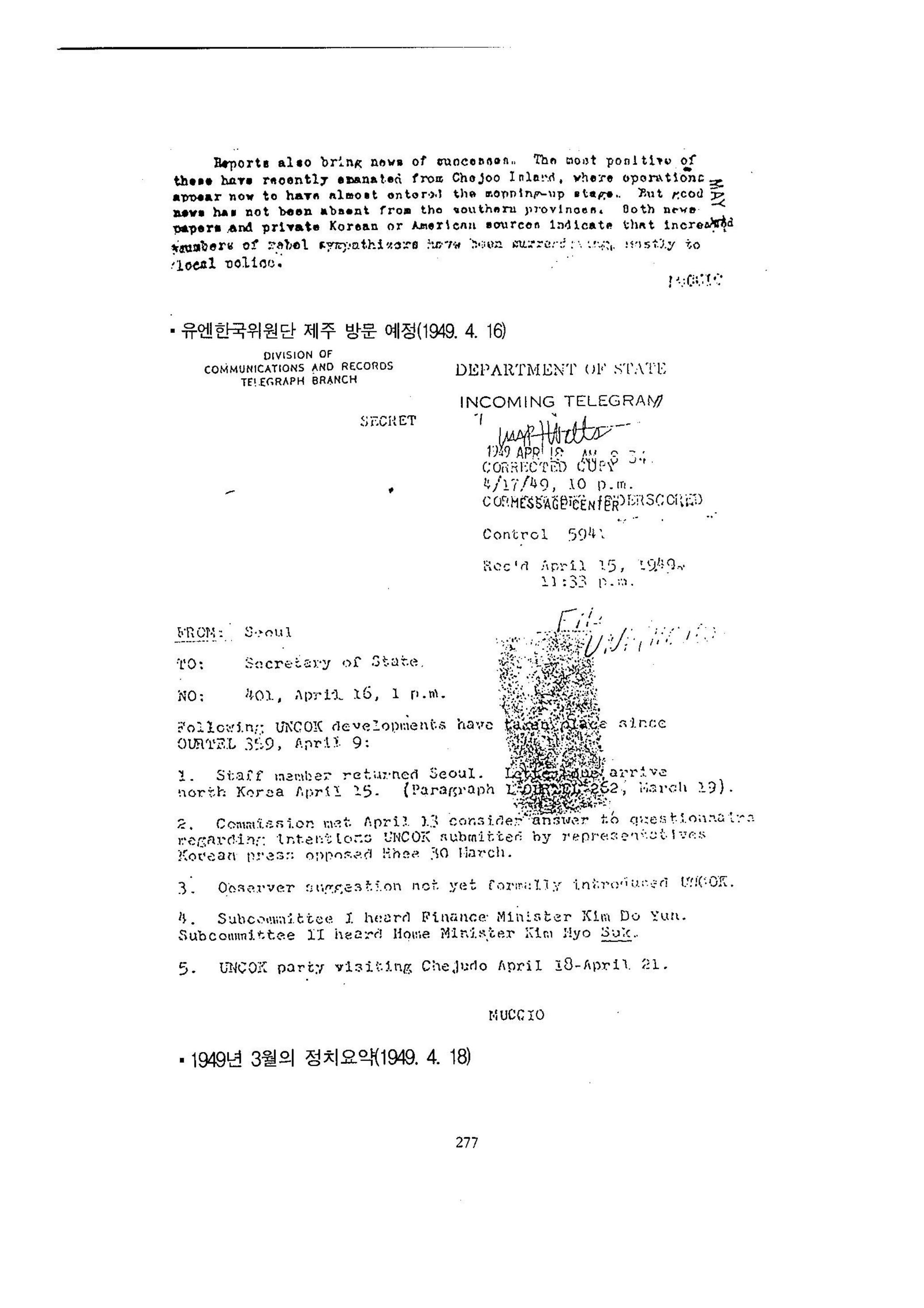
발신: 서울
수신: 국무장관
다음은 8월 29일의 주간 유엔한국임시위원단 활동을 요약한 것입니다.
제1부 회의
8월 20일의 제97차 본회의의 추가정보는 주무 위원단의 형태로 서울에 자리를 유지하기 위한 유엔한국임시위원단의 확고한 결정과 협상의 여지가 남아 있음을 보여줍니다. 서울의 대표들[리유(Liu), 발레(Valle), 패터슨(Patterson), 루나(R. Luna), 싱(Anup Singh), 폴 봉쿨(Paul-Boncour)]은 단지 보고서 채택 준비시기에 의장에게 부여된 한국 밖에서의 본회의 소집권한을 가지고 단지 기초위원회로서 유엔본부에 갈 것입니다. 리유는 총회가 보고서를 받는 시기부터 위원단이 휴회해야 한다고 지적했습니다. 폴 봉쿨은 유엔한국임시위원단의 존재는 보고서에 관한 총회 결정으로 끝날 것이라고 생각했습니다.
8월 24일의 제98차 본회의는 보고서 제2부의 개괄과 다뤄야 할 점에 주요 관심을 집중했습니다. 싱과 패터슨은 보고서 관찰을 통한 상황접근은 ⑴ 5‧10선거에 반대하는 정당들과의 합의를 이끌어낼 국회의 노력 부족 ⑵ 한국(남북한) 통일을 향한 국회 태도 ⑶ 현 정부의 안정 ⑷ 선거불만 ⑸ 제주도 상황을 포함해야 한다고 지적했습니다. (후략)
무쵸(Muccio)
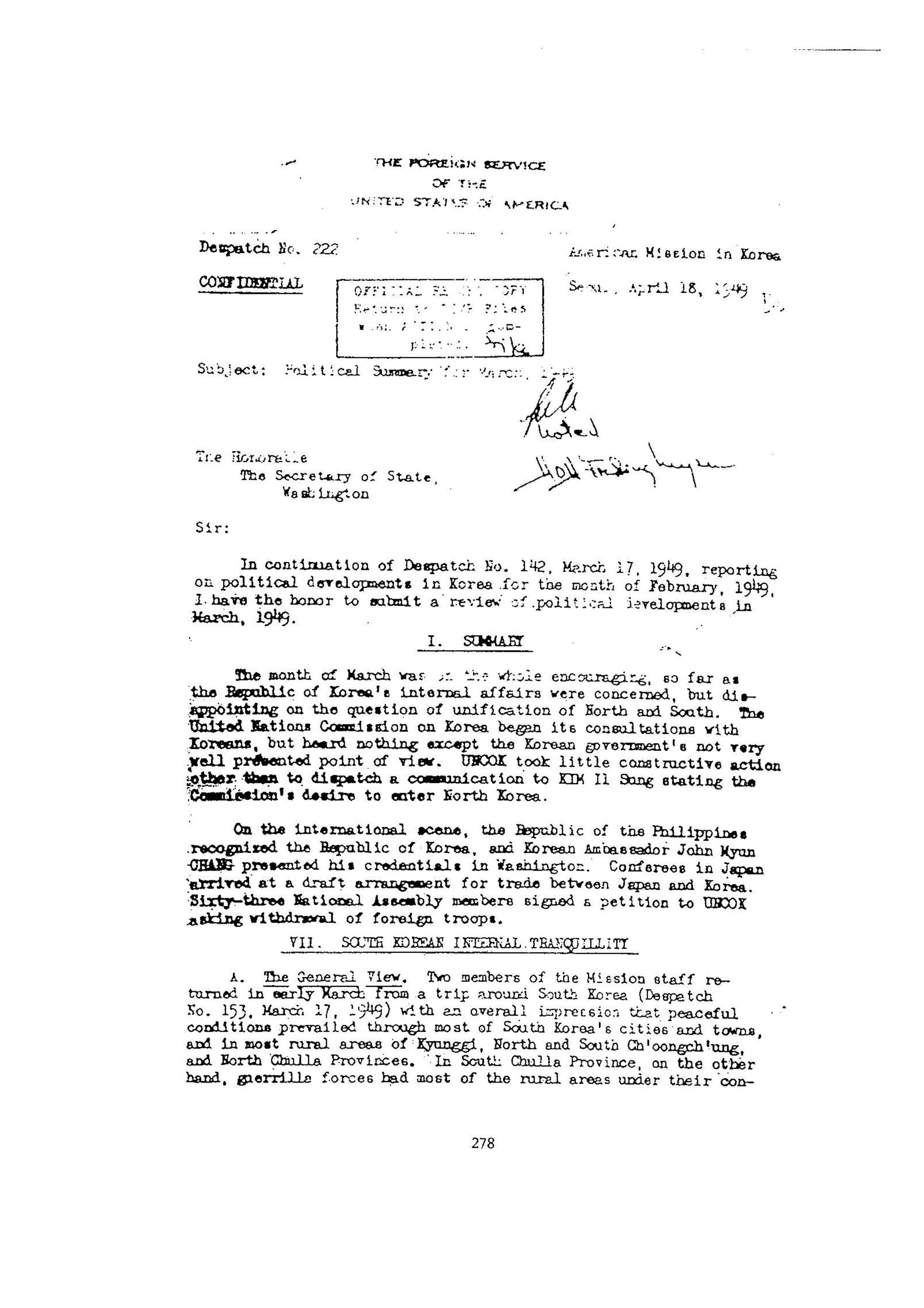
THE FOREIGN SERVICE
OF THE
UNITED STATES OF AMERICA
Despatch No. 222
American Mission in Korea
CONFIDENTIAL
OFFICIAL FILE COPY 0F7
Return to DIV Files
w on 7 [illegible] . AvD-
plain. [illegible]
Seoul, April 18, 1949
Subject: Political Summary for March, 1949
[illegible]
[illegible]
The Honorable
The Secretary of State,
Washington
Sir:
In continuation of Despatch No. 142, March 17, 1949, reporting on political developments in Korea for the month of February, 1949, I have the honor to submit a review of political developments in March, 1949.
I. SUMMARY
The month of March was on the whole encouraging, so far as the Republic of Korea's internal affairs were concerned, but disappointing on the question of unification of North and South. The United Nations Commission on Korea began its consultations with Koreans, but heard nothing except the Korean government's not very well presented point of view. UNCOK took little constructive action other than to dispatch a communication to KIM Il Sung stating the Commission's desire to enter North Korea.
On the international scene, the Republic of the Philippines recognized the Republic of Korea, and Korean Ambassador John Myun CHANG presented his credentials in Washington. Conferees in Japan arrived at a draft arrangement for trade between Japan and Korea. Sixty-three National Assembly members signed a petition to UNCOK asking withdrawal of foreign troops.
VII. SOUTH KOREAN INTERNAL TRANQUILLITY
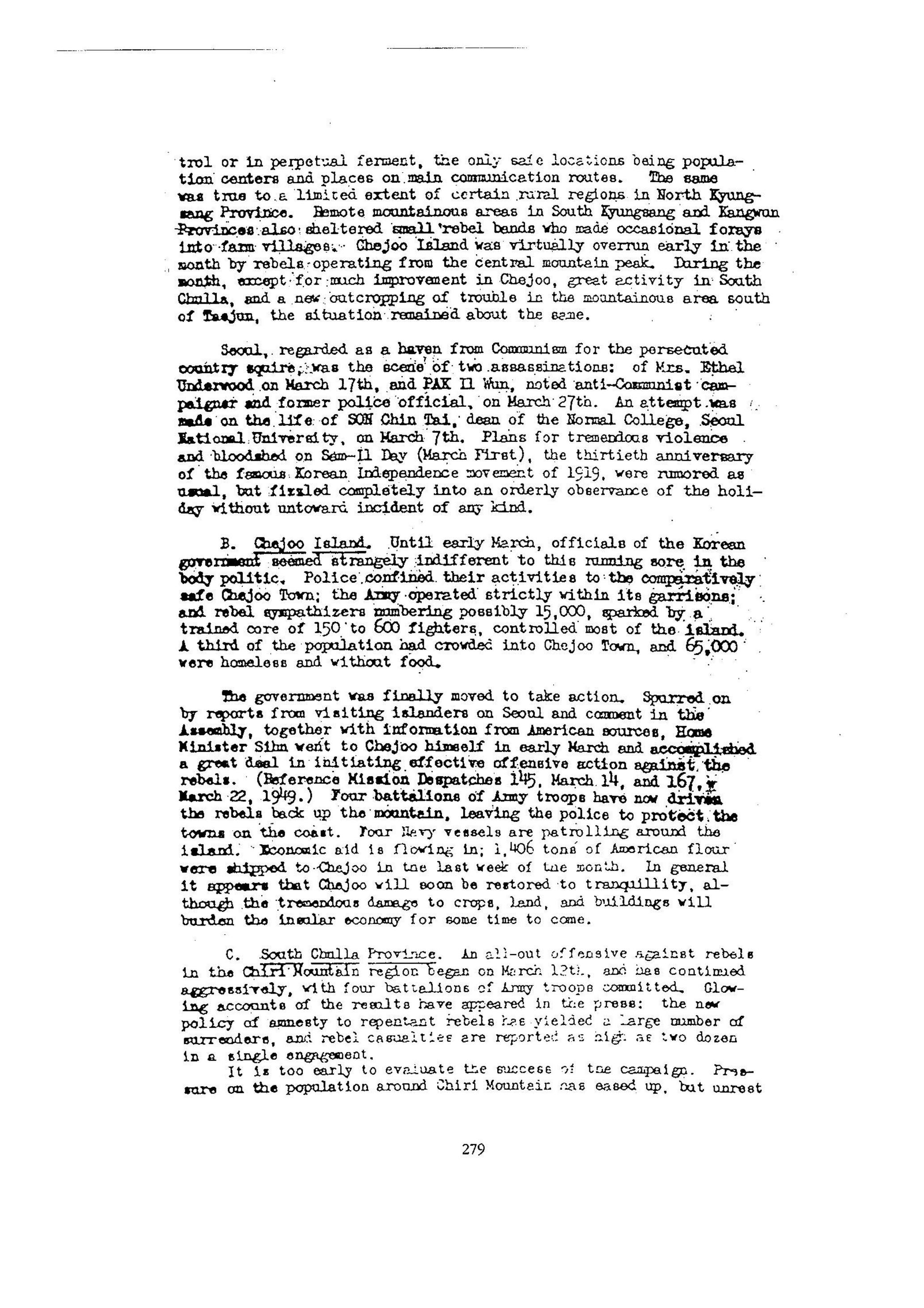
A. The General View. Two members of the Mission staff returned in early March from a trip around South Korea (Despatch No. 153, March 17, 1949) with an overall impression that peaceful conditions prevailed through most of South Korea's cities and towns, and in most rural areas of Kyunggi, North and South Ch'oongch'ung, and North Chulla Provinces. In South Chulla Province, on the other hand, guerrilla forces had most of the rural areas under their control or in perpetual ferment, the only safe locations being population centers and places on main communication routes. The same was true to a limited extent of certain rural regions in North Kyungsang Province. Remote mountainous areas in South Kyungsang and Kangwon Provinces also sheltered small rebel bands who made occasional forays into farm villages. Chejoo Island was virtually overrun early in the month by rebels operating from the central mountain peak. During the month, except for much improvement in Chejoo, great activity in South Cholla, and a new outcropping of trouble in the mountainous area south of Taajun, the situation remained about the same.
Seoul, regarded as a haven from Communism for the persecuted country squire, was the scene of two assassinations: of Mrs. Ethel Underwood on March 17th, and PAK Il Wun, noted anti-Communist campaigner and former police official, on March 27th. An attempt was made on the life of SOH Chin Tai, dean of the Normal College, Seoul National University, on March 7th. Plans for tremendous violence and bloodshed on Sam-Il Day (March First), the thirtieth anniversary of the famous Korean Independence movement of 1919, were rumored as usual, but fizzled completely into an orderly observance of the holiday without untoward incident of any kind.
B. Chejoo Island. Until early March, officials of the Korean government seemed strangely indifferent to this running sore in the body politic. Police confined their activities to the comparatively safe Chejoo Town; the Army operated strictly within its garrisons; and rebel sympathizers numbering possibly 15,000, sparked by a trained core of 150 to 600 fighters, controlled most of the island. A third of the population had crowded into Chejoo Town, and 65,000 were homeless and without food.
The government was finally moved to take action. Spurred on by reports from visiting islanders on Seoul and comment in the Assembly, together with information from American sources, Home Minister Sihn went to Chejoo himself in early March and accomplished a great deal in initiating effective offensive action against the rebels. (Reference Mission Despatches 145, March 14, and 167, March 22, 1949.) Four battalions of Army troops have now driven the rebels back up the mountain, leaving the police to protect the towns on the coast. Four Navy vessels are patrolling around the island. Economic aid is flowing in; 1,406 tons of American flour were shipped to Chejoo in the last week of the month. In general it appears that Chejoo will soon be restored to tranquillity, although the tremendous damage to crops, land, and buildings will burden the insular economy for some time to come.
C. South Cholla Province. An all-out offensive against rebels in the Chiri Mountain region began on March 12th, and has continued aggressively, with four battalions of Army troops committed. Glowing accounts of the results have appeared in the press: the new policy of amnesty to repentant rebels has yielded a large number of surrenders, and rebel casualties are reported as high as two dozen in a single engagement.
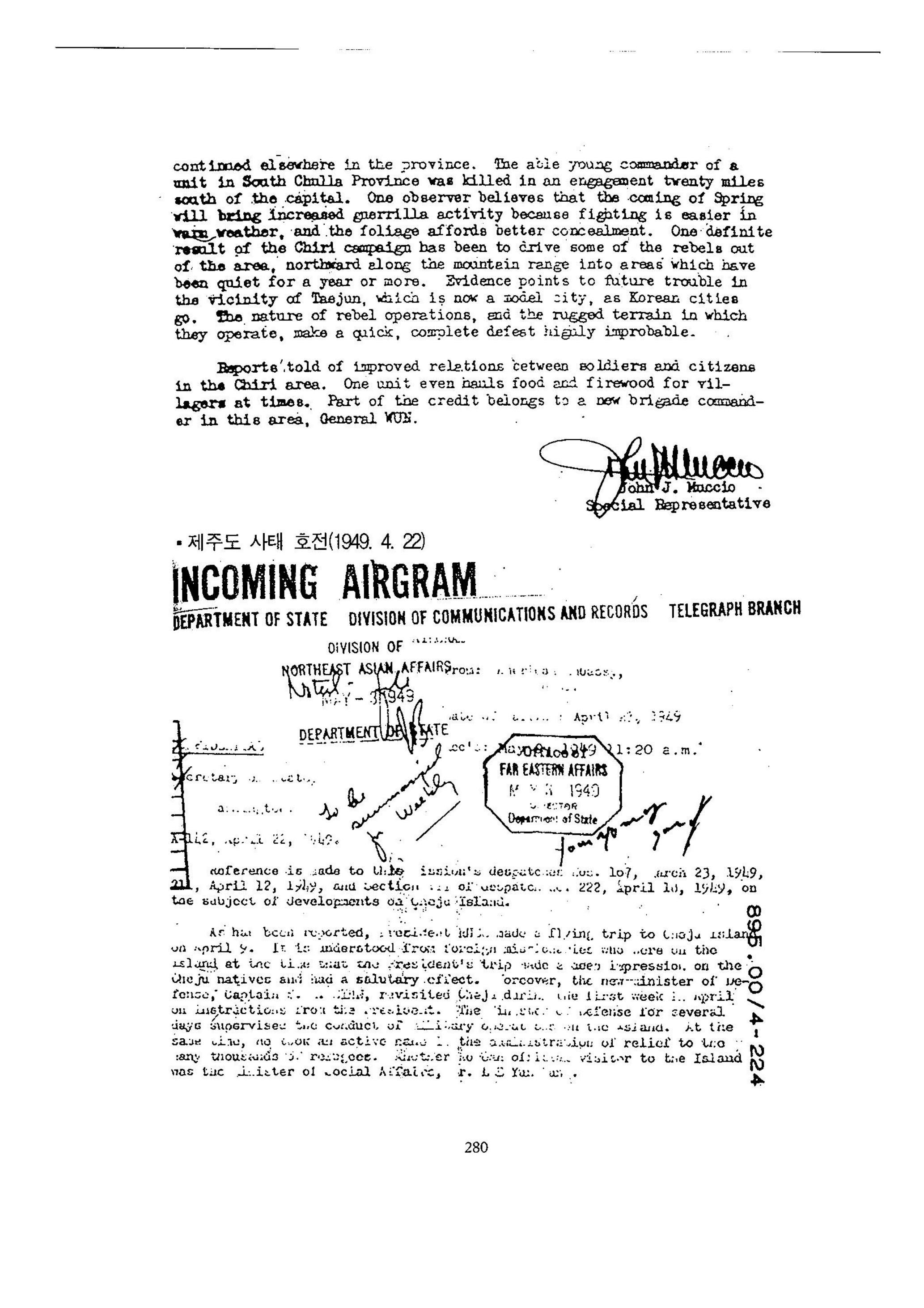
It is too early to evaluate the success of the campaign. Pressure on the population around Chiri Mountain has eased up, but unrest continued elsewhere in the province. The able young commander of a unit in South Chulla Province was killed in an engagement twenty miles south of the capital. One observer believes that the coming of Spring will bring increased guerrilla activity because fighting is easier in warm weather, and the foliage affords better concealment. One definite result of the Chiri campaign has been to drive some of the rebels out of the area, northward along the mountain range into areas which have been quiet for a year or more. Evidence points to future trouble in the vicinity of Taejun, which is now a model city, as Korean cities go. The nature of rebel operations, and the rugged terrain in which they operate, make a quick, complete defeat highly improbable.
Reports told of improved relations between soldiers and citizens in the Chiri area. One unit even hauls food and firewood for villagers at times. Part of the credit belongs to a new brigade commander in this area, General WUN.
John J. Muccio
Special Representative
출처:
제주4·3사건진상규명및희생자명예회복위원회 편,
『제주4·3사건자료집 11』 [미국자료편],
번역문 p.15
/ 원문 p.277–280 / No. 401.