주한미사절단
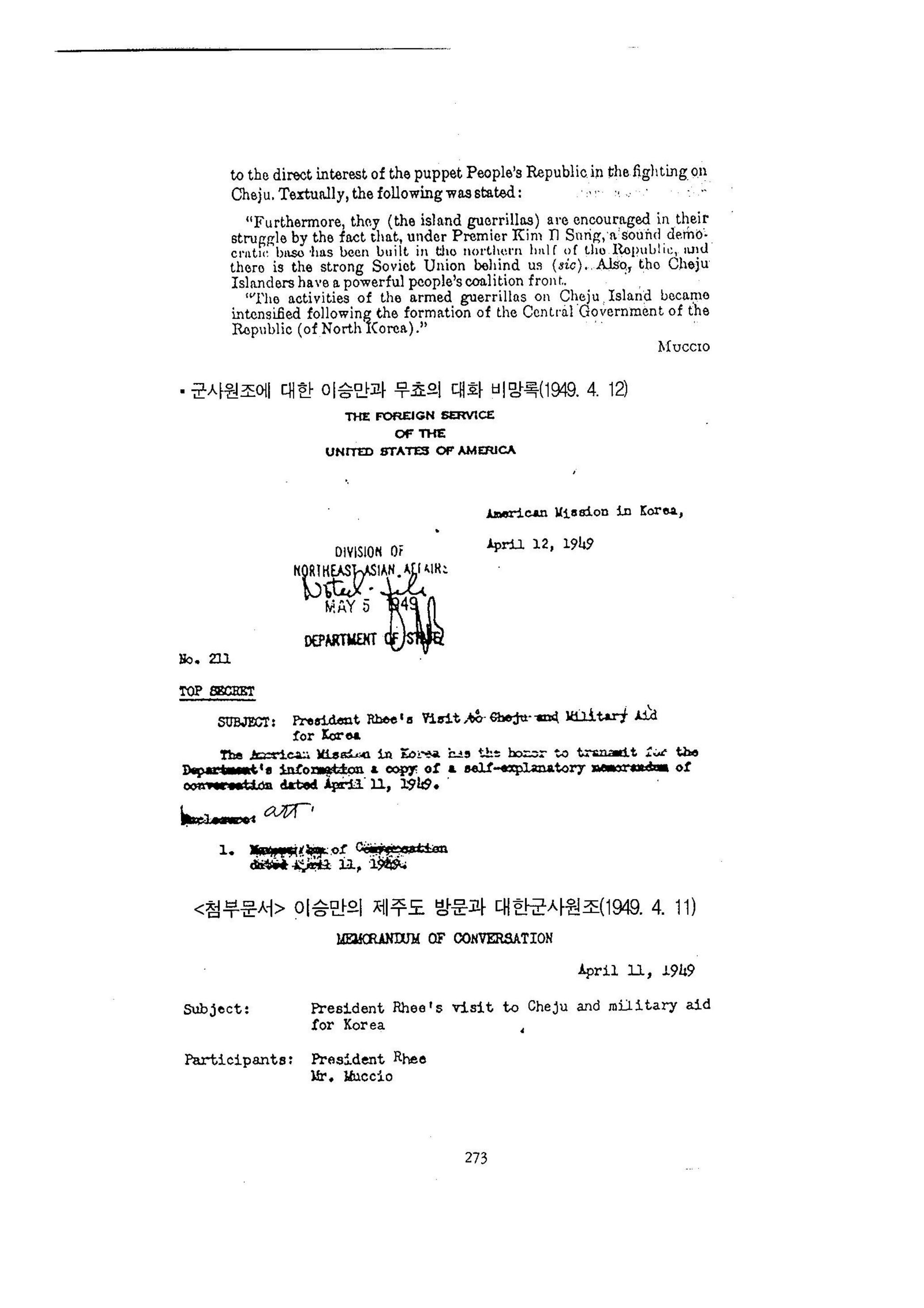
제목: 이 대통령의 제주도 방문과 대한군사원조
주한미사절단은 1949년 4월 11일자 상세한 대화 비망록 사본을 국무부 정보용으로 보내게 돼 영광입니다.
첨부문서: 1. 1949년 4월 11일자 대화 비망록
<첨부문서> 이승만의 제주도 방문과 대한군사원조 (1949. 4. 12. 보고)
주한미사절단의 1949년 4월 12일자 <급송문서> 제211호에 동봉
대화 비망록
1949년 4월 11일
제목: 이 대통령의 제주도 방문과 대한군사원조
참석자: 이 대통령, 무쵸(Muccio)
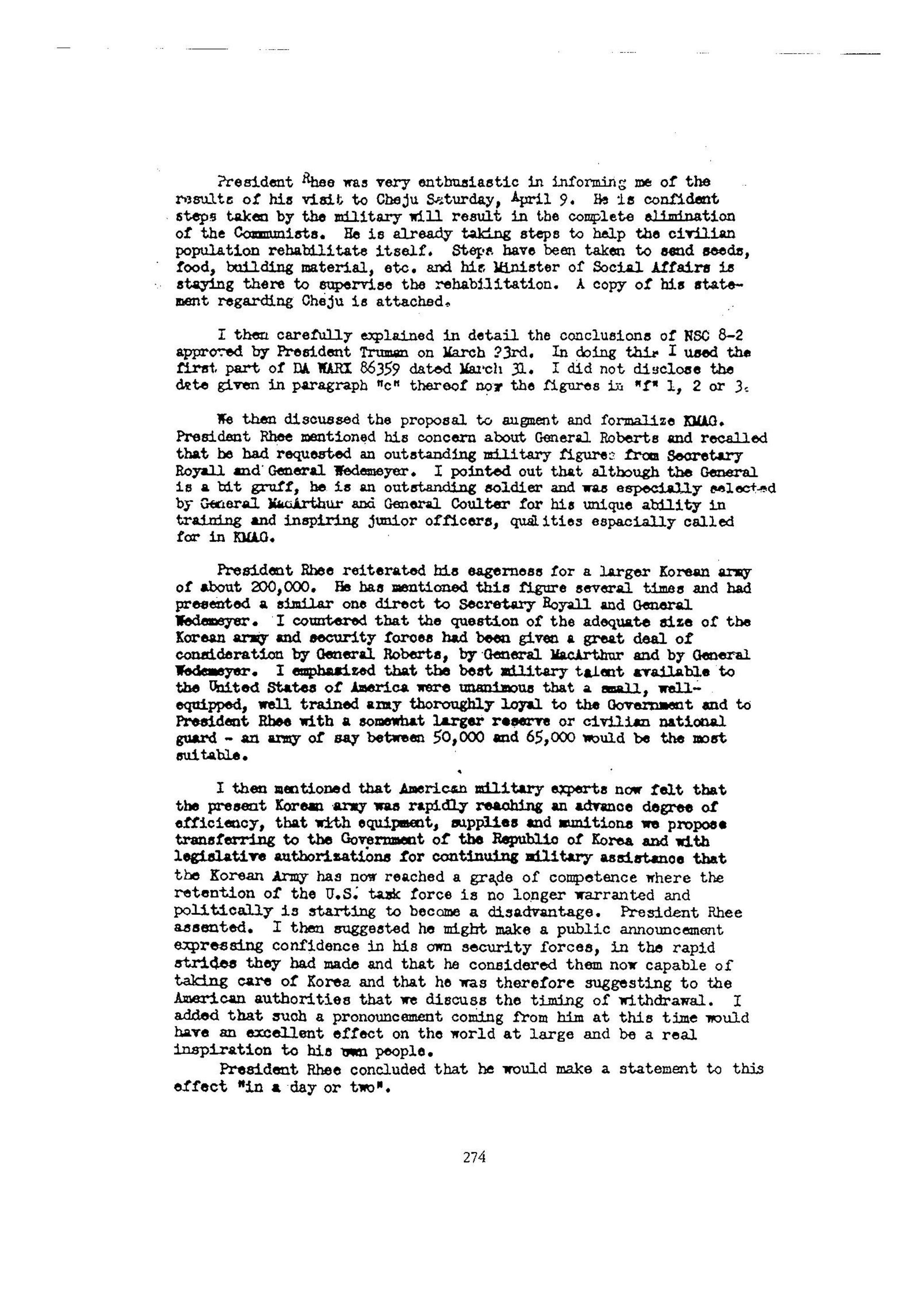
이 대통령은 4월 9일 토요일의 제주방문 결과를 본인에게 알려주게 된 데 대해 매우 열성적이었습니다. 그는 군대의 조처로 인해 공산주의자들이 완전히 섬멸될 것으로 확신했습니다. 그는 이미 원상 회복시키기 위해 민간인들을 원조할 조처를 취하고 있습니다. 종자와 식량, 건축자재 등을 보내는 조처가 취해지고 있고 사회부장관은 그곳에 복구를 감독하기 위해 체류 중에 있습니다. 제주와 관련한 이 대통령의 발언내용 사본이 첨부돼 있습니다.
그리고 나서 본인은 3월 23일 트루만 대통령이 승인한 국가안보회의 8-2(NSC 8-2) 결론을 주의깊고 상세하게 설명했습니다. 이렇게 하면서 본인은 3월 31일자 육군성 전문 WARX 86359의 첫 번째 부분을 이용했습니다. 본인은 거기 ‘c’ 항에 주어진 날짜나 ‘f’ 항 1, 2, 3의 수치를 밝히지 않았습니다.
우리는 이어 주한미군사고문단을 증원하고 정식으로 승인하는 제안을 논의했습니다. 이 대통령은 로버츠(W. L. Roberts) 장군에 대한 우려를 표명하고 로얄 장관과 웨드마이어 장군에게 훌륭한 군 인사를 요청했던 것을 상기시켰습니다. 본인은 로버츠 장군이 약간 퉁명할지라도 훌륭한 군인이며 하급 장교를 훈련시키고 사기를 고양하는 훌륭한 능력, 특히 주한미군사고문단이 요구하는 자질 때문에 맥아더(McArthur) 장군과 콜터(John B. Coulter) 장군에 의해 선택됐다고 지적했습니다.
이 대통령은 비교적 큰 20만 명 규모의 한국군에 대한 염원을 되풀이해서 말했습니다. 그는 여러 차례 이 수치를 언급하고 로얄 장관과 웨드마이어 장군에게 직접 비슷한 수치를 제시했었습니다. 본인은 한국군과 보안군의 충분한 규모에 대해 로버츠 장군과 맥아더 장군, 웨드마이어 장군이 상당히 진지하게 고려했다고 맞섰습니다. 본인은 미합중국에 유용한 최상의 군사자질은 정부와 이 대통령에게 철저하게 충성을 다하는 소규모이지만 장비가 잘 갖춰지고, 잘 훈련된 군 - 이 군은 비교적 규모가 큰 예비군이나 민간인 방위군, 즉 5만~6만 5,000명 규모의 군이 가장 알맞을 것입니다 - 과 일치한다고 강조했습니다.
본인은 이어 현재의 한국군이 급속도로 상당한 효율성 있는 수준에 이르렀고 우리가 대한민국에 이양하면서 제안한 보급품과 군수품, 지속적인 군사원조에 대한 법적 승인으로 한국군은 이제 미군 기동부대의 주둔이 더 이상 보장되지 않고 오히려 정치적으로 불리한 처지에 놓이기 시작하고 있을 정도로 상당한 능력을 보유하게 됐다고 미 군사 전문가들은 생각하고 있습니다.
이 대통령은 이에 동의했습니다. 본인은 보안군이 이룬 급속한 발전에 대해 자신감을 표명하고 그들이 이제 한국을 보위하고 있으며 그러므로 미국 당국에 철수시기 논의를 제안할 것을 대통령이 공개 발표하도록 제안했습니다.
본인은 이 시기에 이 대통령으로부터의 그와 같은 발표가 대체적으로 세계에 훌륭한 영향을 미칠 것이며 한국민들을 진짜 고무시킬 것이라고 덧붙였습니다.
이 대통령은 ‘1~2일 안에’ 이 결과에 대해 성명을 발표하겠다며 결론을 내렸습니다.
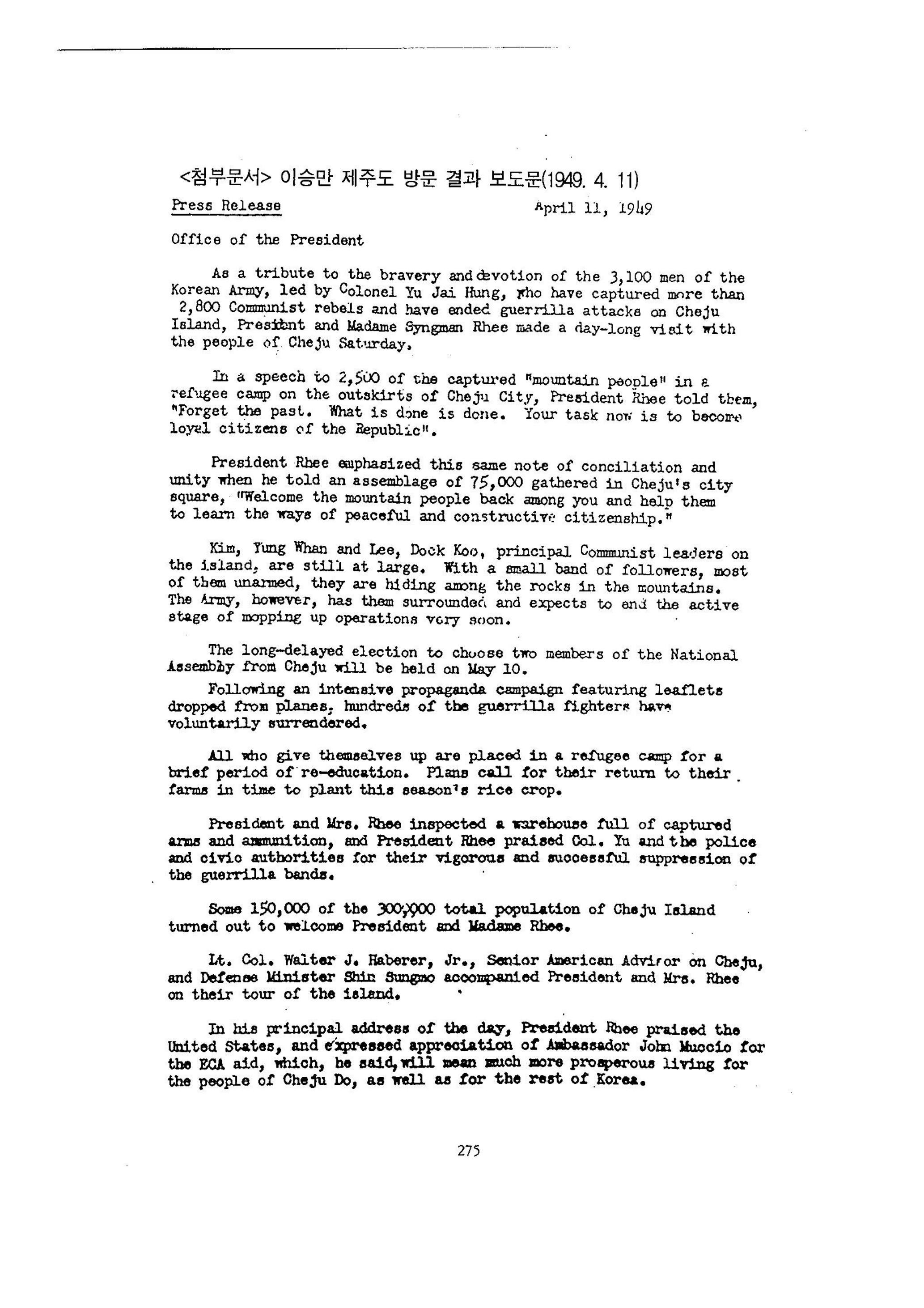
<첨부문서> 이승만 제주도 방문 결과 보도문 (1949. 4. 12. 보고)
1949년 4월 11일
언론보도
대통령실
제주도에서 2,800명 이상의 공산반도를 체포하고 게릴라 공격을 끝낸 유재흥 대령이 이끄는 3,100명의 한국군의 용맹과 헌신에 찬사를 보내면서 이승만 대통령 부부는 토요일 하루 일정으로 제주도민들을 방문했습니다.
제주읍 교외의 피난민 수용소내 체포된 2,500명의 ‘산사람’들에게 행한 연설에서 이 대통령은 “과거를 잊어라. 과거지사는 과거지사다. 여러분들의 임무는 이제 대한민국에 충성스러운 시민이 되는 것”이라고 말했습니다.
이 대통령은 제주읍 광장에 운집한 7만 5,000명의 군중들에게 말할 때도 “산사람들이 여러분 속으로 돌아온 것을 환영하라. 그리고 그들이 평화적이고 건설적인 시민으로 살아가는 방법을 배우는 것을 도와 주라”며 화합과 단결의 같은 이야기를 강조했습니다.
제주도의 주요 공산지도자인 김용관과 이덕구는 아직도 오리무중입니다. 소규모 추종자들을 거느린 그들 대부분은 무장하지 않고 산 속 바위틈에 숨어 있습니다. 그러나 군은 그들을 포위해 곧 소탕작전의 공세단계의 완료가 예상되고 있습니다.
제주도의 국회의원 2명을 선출하기 위한 오래 지연된 선거는 5월 10일에 실시될 예정입니다.
비행기에서 유인물을 살포하는 강력한 선무활동으로 수백명의 게릴라 전사들이 스스로 귀순했습니다.
스스로 귀순한 사람들은 모두 재교육을 위해 짧은 기간 동안 피난민 수용소에 유치됩니다. 이 계절 벼 식재를 위해 제때 그들이 밭으로 돌아가도록 하는 계획이 요구됩니다.
이 대통령 부부는 노획한 무기와 탄약으로 가득찬 창고를 시찰했으며 이 대통령은 게릴라 도당들에 대한 정력적이고 성공적인 진압에 대해 유 대령과 경찰 및 행정기관을 격려했습니다.
제주도의 전체 30만 주민 가운데 약 15만명이 이 대통령 부부를 환영하기 위해 나왔습니다.
제주도의 수석 미군고문관인 월터 하버러(Walter J. Haberer) 중령과 신성모 국방부장관은 이 대통령 부부의 제주도 시찰에 동행했습니다.
이 날의 주요 연설에서 이 대통령은 미국을 칭찬하고 경제협조처의 원조에 대해 존 무쵸 대사에게 감사를 표시했습니다. 그는 경제협조처 원조가 한국의 다른 지역뿐 아니라 제주도민들에게도 훨씬 발전적인 삶을 의미할 것이라고 말했습니다.
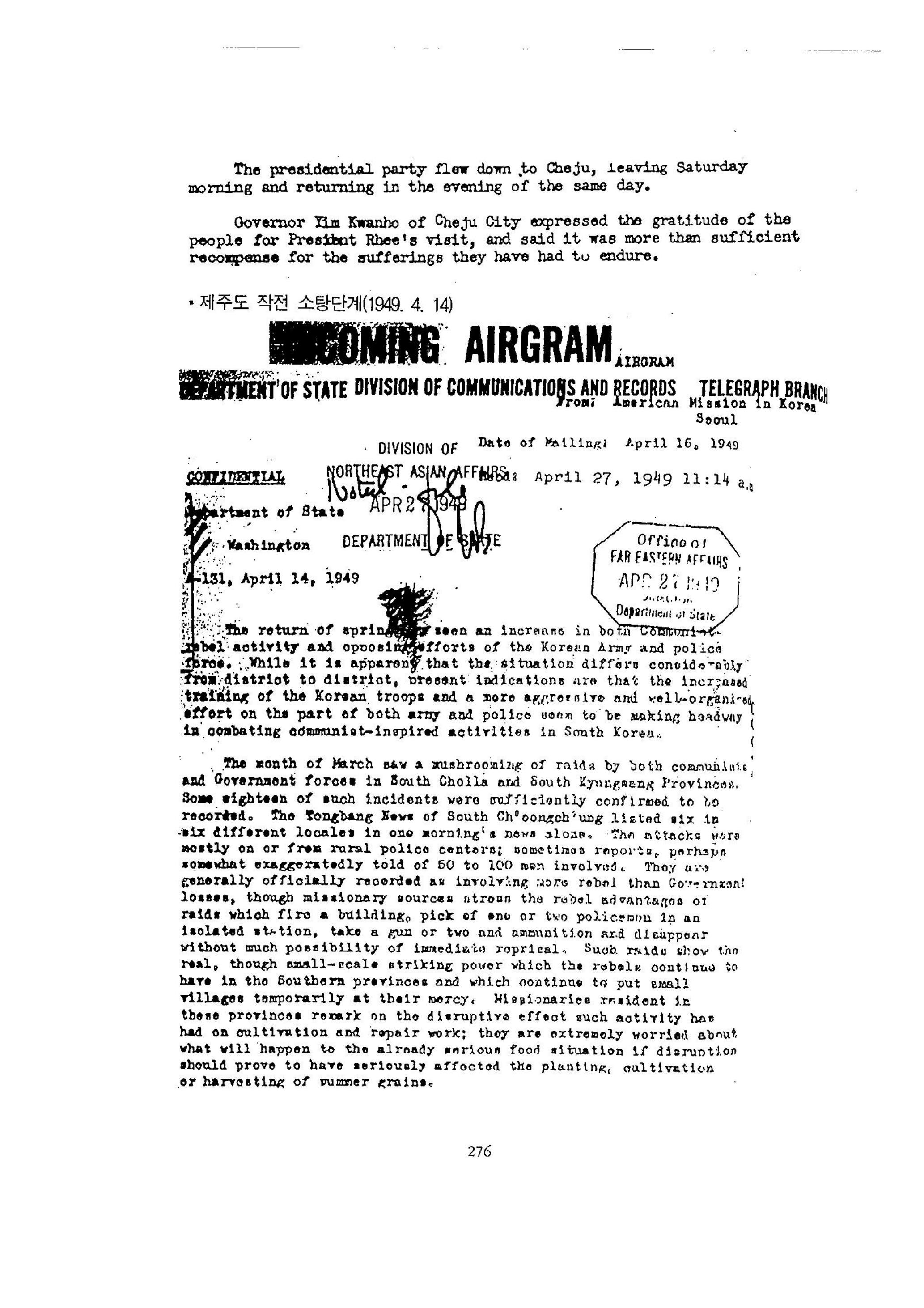
대통령 일행은 토요일 오전 제주도로 떠나 같은 날 오후 (제주도에서) 돌아왔습니다.
임관호 제주도지사는 이 대통령의 방문에 대해 도민들의 감사를 표명하고 이 대통령의 방문은 도민들이 겪어왔던 고통에 대한 충분한 보상 이상이라고 말했습니다.
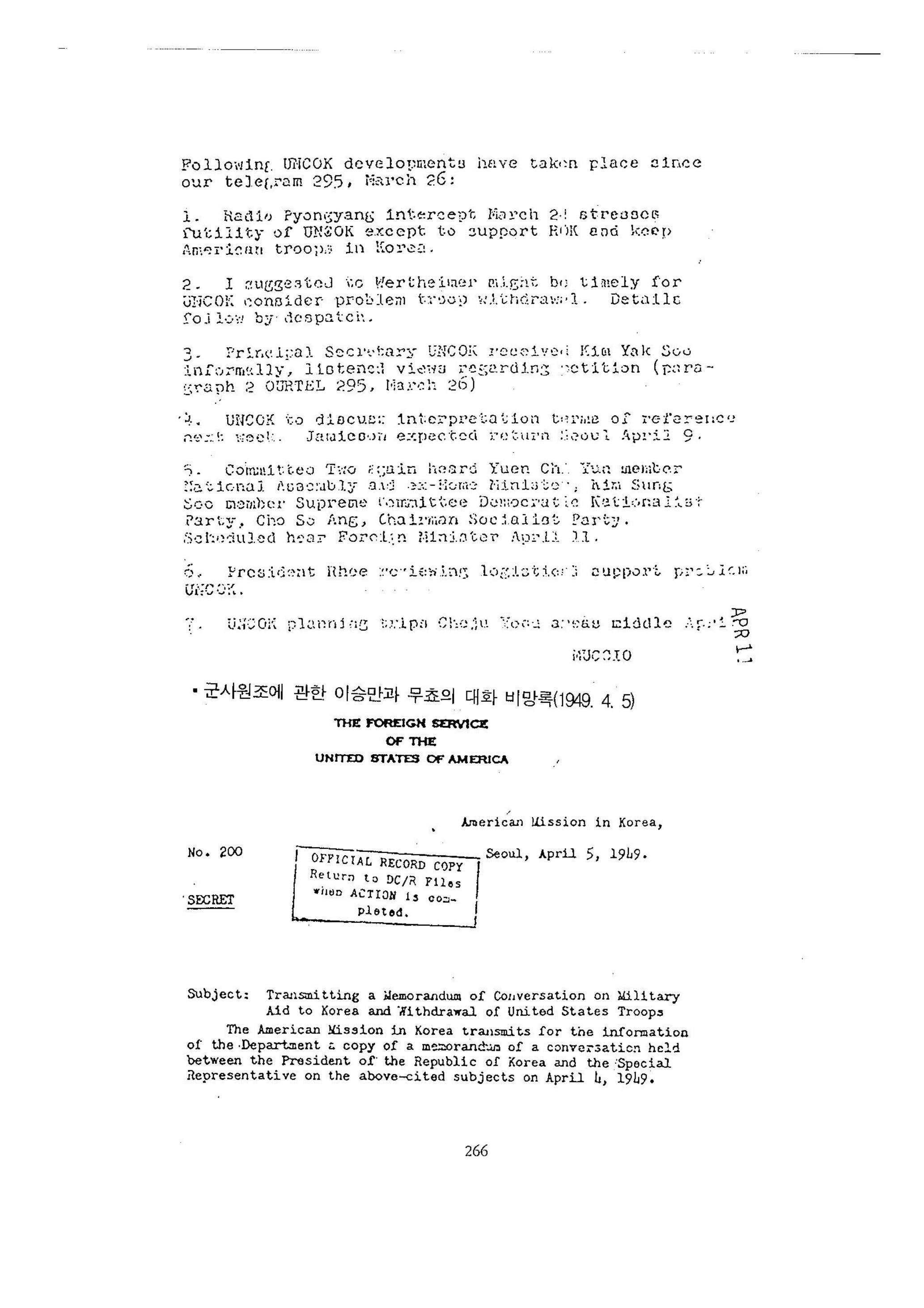
THE FOREIGN SERVICE
OF THE
UNITED STATES OF AMERICA
American Mission in Korea,
No. 200 OFFICIAL RECORD COPY Seoul, April 5, 1949.
Return to DC/R Files
SECRET when ACTION is com-
pleted.
Subject: Transmitting a Memorandum of Conversation on Military Aid to Korea and Withdrawal of United States Troops
The American Mission in Korea transmits for the information of the Department a copy of a memorandum of a conversation held between the President of the Republic of Korea and the Special Representative on the above-cited subjects on April 4, 1949.
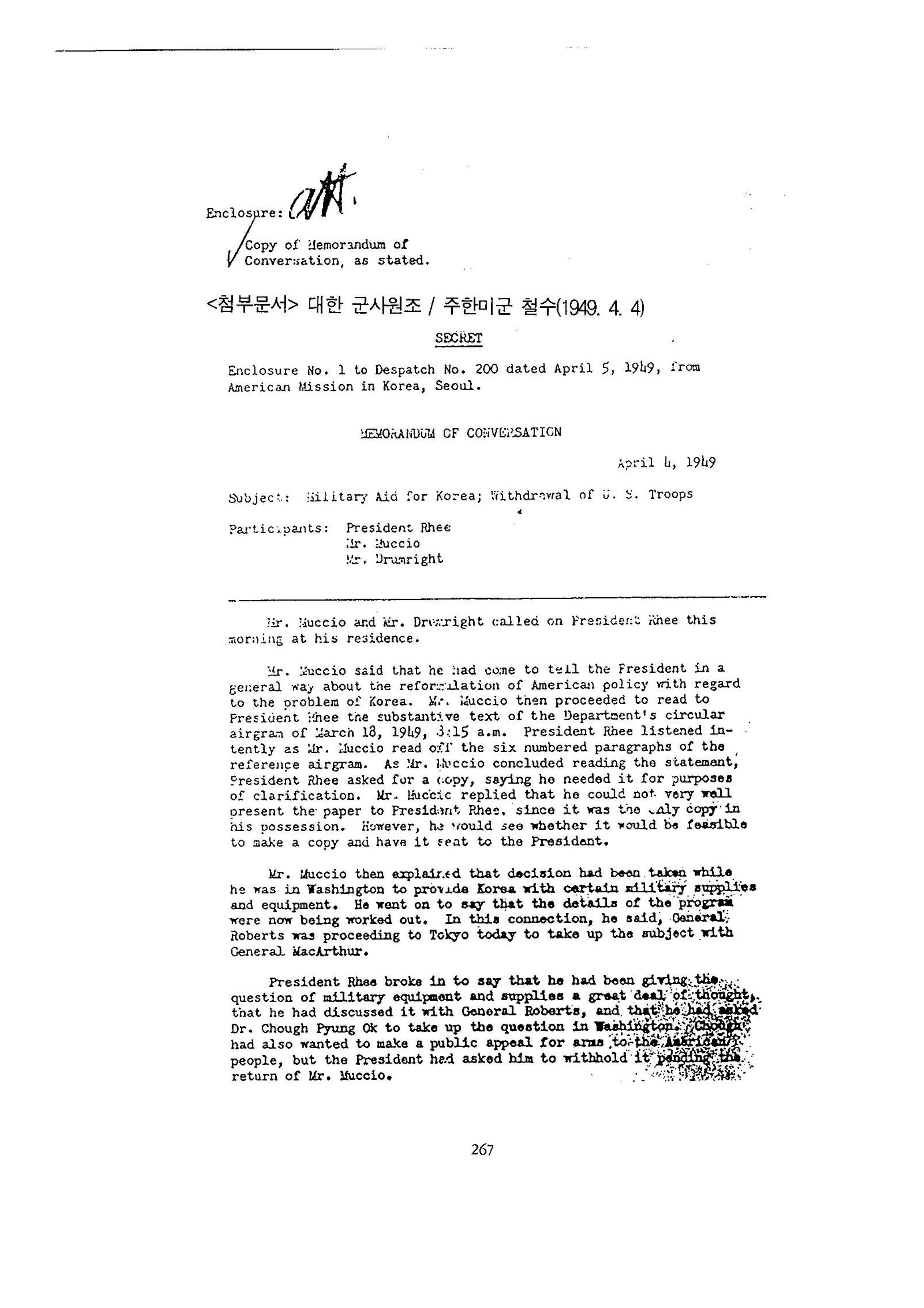
Enclosure: Copy of Memorandum of Conversation, as stated.
SECRET
Enclosure No. 1 to Despatch No. 200 dated April 5, 1949, from American Mission in Korea, Seoul.
MEMORANDUM OF CONVERSATION
April 4, 1949
Subject: Military Aid for Korea; Withdrawal of U. S. Troops
Participants: President Rhee
Mr. Muccio
Mr. Drumright
Mr. Muccio and Mr. Drumright called on President Rhee this morning at his residence.
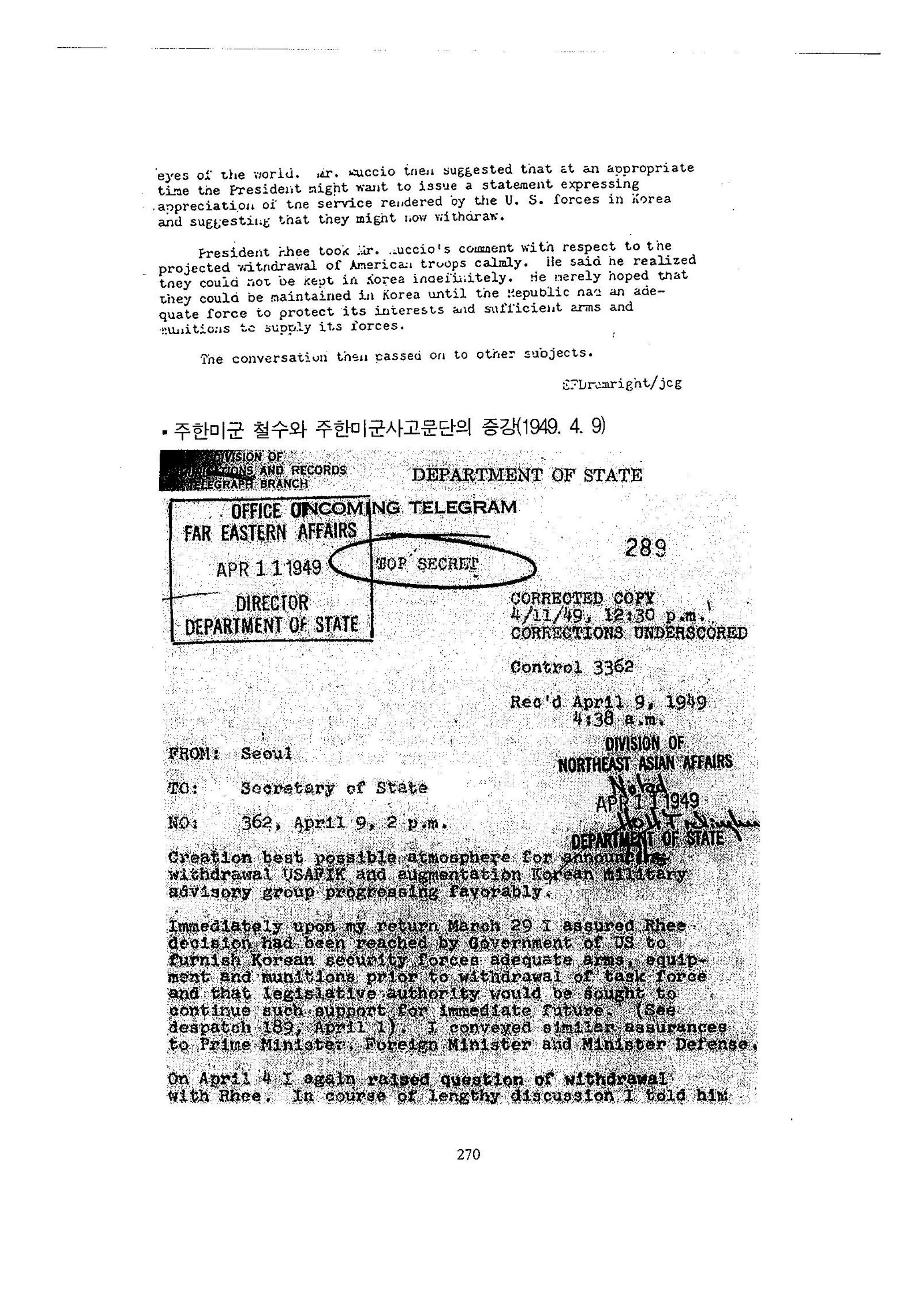
Mr. Muccio said that he had come to tell the President in a general way about the reformulation of American policy with regard to the problem of Korea. Mr. Muccio then proceeded to read to President Rhee the substantive text of the Department's circular airgram of March 18, 1949, 3:15 a.m. President Rhee listened intently as Mr. Muccio read off the six numbered paragraphs of the reference airgram. As Mr. Muccio concluded reading the statement, President Rhee asked for a copy, saying he needed it for purposes of clarification. Mr. Muccio replied that he could not very well present the paper to President Rhee, since it was the only copy in his possession. However, he would see whether it would be feasible to make a copy and have it sent to the President.
Mr. Muccio then explained that decision had been taken while he was in Washington to provide Korea with certain military supplies and equipment. He went on to say that the details of the program were now being worked out. In this connection, he said, General Roberts was proceeding to Tokyo today to take up the subject with General MacArthur.
President Rhee broke in to say that he had been giving the question of military equipment and supplies a great deal of thought, that he had discussed it with General Roberts, and that he had asked Dr. Chough Pyung Ok to take up the question in Washington. [illegible] had also wanted to make a public appeal for arms to the [illegible] people, but the President had asked him to withhold it pending the return of Mr. Muccio.
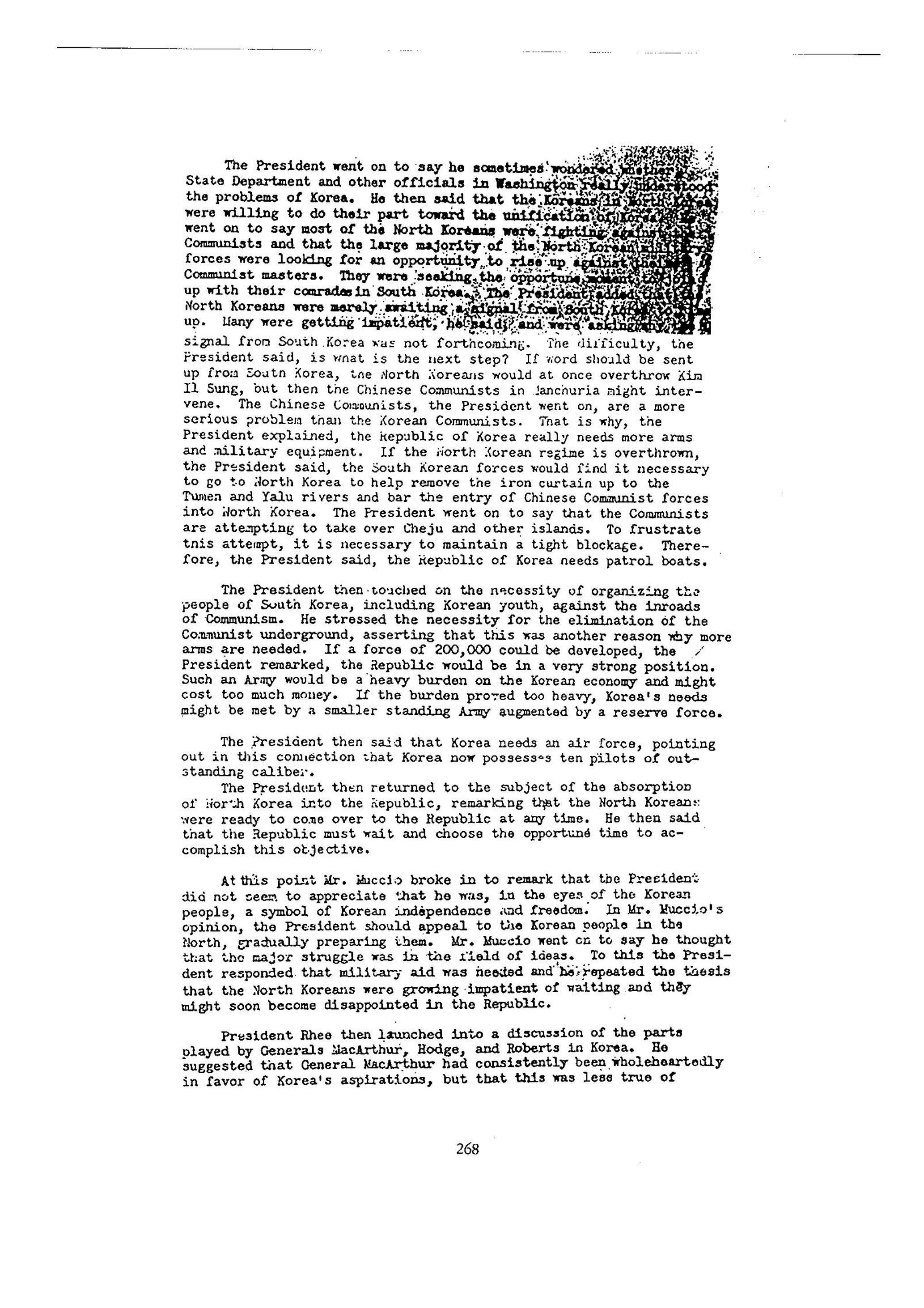
The President went on to say he sometimes wondered [illegible] State Department and other officials in Washington really [illegible] the problems of Korea. He then said that the Koreans [illegible] were willing to do their part toward the unification [illegible] went on to say most of the North Koreans were fighting [illegible] Communists and that the large majority of the North [illegible] forces were looking for an opportunity to rise up against [illegible] Communist masters. They were seeking the opportunity [illegible] up with their comrades in South Korea. The President [illegible] North Koreans were merely awaiting a signal from South [illegible] up. Many were getting impatient, helpaid, and were asking [illegible] signal from South Korea was not forthcoming. The difficulty, the President said, is what is the next step? If word should be sent up from South Korea, the North Koreans would at once overthrow Kim Il Sung, but then the Chinese Communists in Manchuria might intervene. The Chinese Communists, the President went on, are a more serious problem than the Korean Communists. That is why, the President explained, the Republic of Korea really needs more arms and military equipment. If the North Korean regime is overthrown, the President said, the South Korean forces would find it necessary to go to North Korea to help remove the iron curtain up to the Tumen and Yalu rivers and bar the entry of Chinese Communist forces into North Korea. The President went on to say that the Communists are attempting to take over Cheju and other islands. To frustrate this attempt, it is necessary to maintain a tight blockage. Therefore, the President said, the Republic of Korea needs patrol boats.
The President then touched on the necessity of organizing the people of South Korea, including Korean youth, against the inroads of Communism. He stressed the necessity for the elimination of the Communist underground, asserting that this was another reason why more arms are needed. If a force of 200,000 could be developed, the President remarked, the Republic would be in a very strong position. Such an Army would be a heavy burden on the Korean economy and might cost too much money. If the burden proved too heavy, Korea's needs might be met by a smaller standing Army augmented by a reserve force.
The President then said that Korea needs an air force, pointing out in this connection that Korea now possesses ten pilots of outstanding caliber.
The President then returned to the subject of the absorption of North Korea into the Republic, remarking that the North Koreans were ready to come over to the Republic at any time. He then said that the Republic must wait and choose the opportune time to accomplish this objective.
At this point Mr. Muccio broke in to remark that the President did not seem to appreciate that he was, in the eyes of the Korean people, a symbol of Korean independence and freedom. In Mr. Muccio's opinion, the President should appeal to the Korean people in the North, gradually preparing them. Mr. Muccio went on to say he thought that the major struggle was in the field of ideas. To this the President responded that military aid was needed and he repeated the thesis that the North Koreans were growing impatient of waiting and they might soon become disappointed in the Republic.
President Rhee then launched into a discussion of the parts played by Generals MacArthur, Hodge, and Roberts in Korea. He suggested that General MacArthur had consistently been wholeheartedly in favor of Korea's aspirations, but that this was less true of Generals Hodge and Roberts. In this connection, Mr. Muccio commented that American policy toward Korea had always been made in Washington and that Generals MacArthur, Hodge, and Roberts were but the implementers of that policy. Mr. Muccio then stressed the point that he had been busy for six weeks on Korean policy in Washington; that he had seen the President, the Secretary of State, the Secretary of the Army, General Wedemeyer, and the National Security Council on the subject. The lines of U. S. policy toward Korea had been redefined while he was in Washington. He could assure the President that the decision had been taken to grant continued U. S. economic and military aid to Korea.
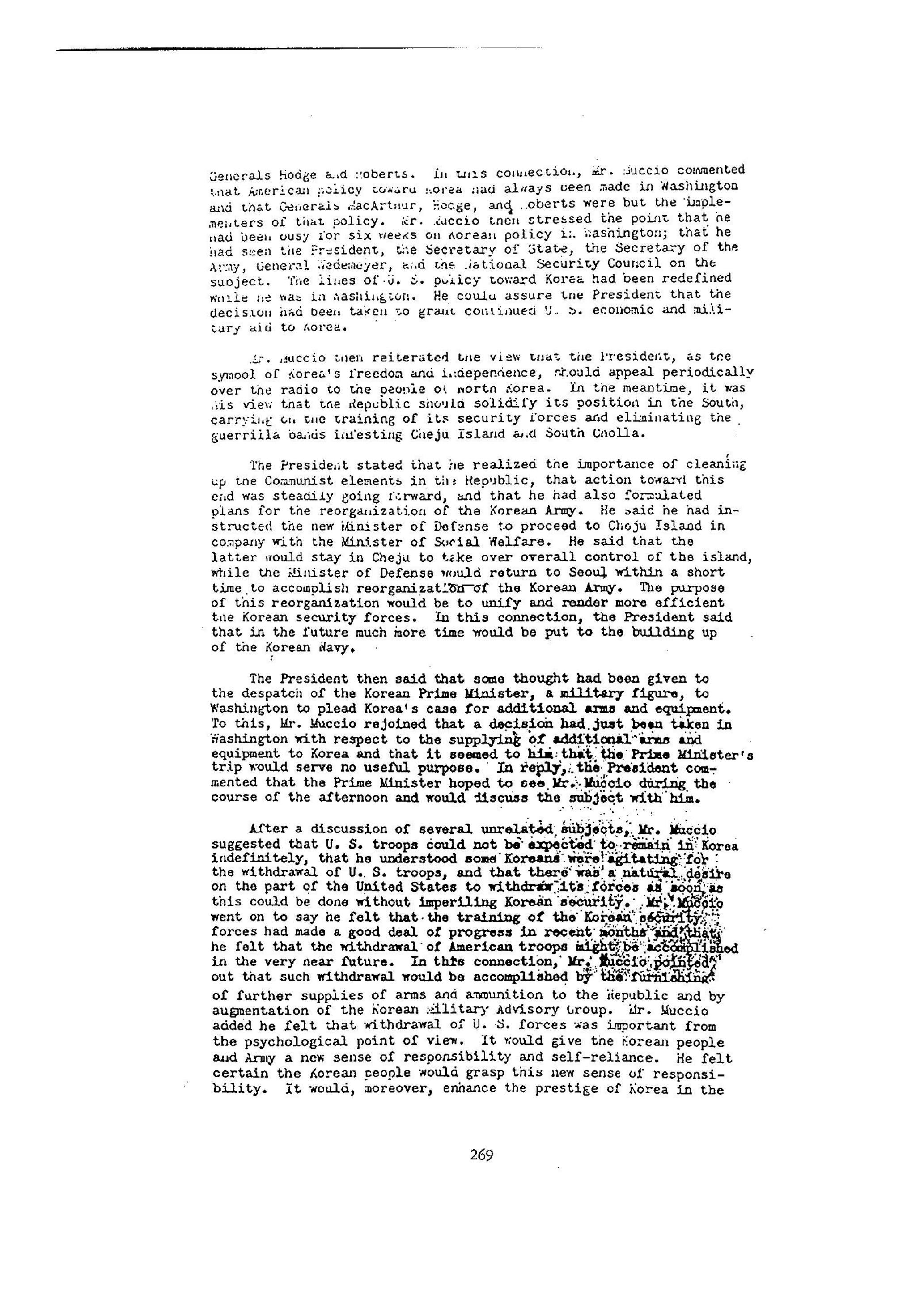
Mr. Muccio then reiterated the view that the President, as the symbol of Korea's freedom and independence, should appeal periodically over the radio to the people of north Korea. In the meantime, it was his view that the Republic should solidify its position in the South, carrying on the training of its security forces and eliminating the guerrilla bands infesting Cheju Island and South Cholla.
The President stated that he realized the importance of cleaning up the Communist elements in the Republic, that action toward this end was steadily going forward, and that he had also formulated plans for the reorganization of the Korean Army. He said he had instructed the new Minister of Defense to proceed to Choju Island in company with the Minister of Social Welfare. He said that the latter would stay in Cheju to take over overall control of the island, while the Minister of Defense would return to Seoul within a short time to accomplish reorganization of the Korean Army. The purpose of this reorganization would be to unify and render more efficient the Korean security forces. In this connection, the President said that in the future much more time would be put to the building up of the Korean Navy.
The President then said that some thought had been given to the despatch of the Korean Prime Minister, a military figure, to Washington to plead Korea's case for additional arms and equipment. To this, Mr. Muccio rejoined that a decision had just been taken in Washington with respect to the supplying of additional arms and equipment to Korea and that it seemed to him that the Prime Minister's trip would serve no useful purpose. In reply, the President commented that the Prime Minister hoped to see Mr. Muccio during the course of the afternoon and would discuss the subject with him.
After a discussion of several unrelated subjects, Mr. Muccio suggested that U. S. troops could not be expected to remain in Korea indefinitely, that he understood some Koreans were agitating for the withdrawal of U. S. troops, and that there was a natural desire on the part of the United States to withdraw its forces as soon as this could be done without imperiling Korean security. Mr. Muccio went on to say he felt that the training of the Korean security forces had made a good deal of progress in recent months and that he felt that the withdrawal of American troops might be accomplished in the very near future. In this connection, Mr. Muccio pointed out that such withdrawal would be accomplished by the furnishing of further supplies of arms and ammunition to the Republic and by augmentation of the Korean Military Advisory Group. Mr. Muccio added he felt that withdrawal of U. S. forces was important from the psychological point of view. It would give the Korean people and Army a new sense of responsibility and self-reliance. He felt certain the Korean people would grasp this new sense of responsibility. It would, moreover, enhance the prestige of Korea in the eyes of the world. Mr. Muccio then suggested that at an appropriate time the President might want to issue a statement expressing appreciation of the service rendered by the U. S. forces in Korea and suggesting that they might now withdraw.
President Rhee took Mr. Muccio's comment with respect to the projected withdrawal of American troops calmly. He said he realized they could not be kept in Korea indefinitely. He merely hoped that they could be maintained in Korea until the Republic had an adequate force to protect its interests and sufficient arms and munitions to supply its forces.
The conversation then passed on to other subjects.
EJDrumright/jcg
출처:
제주4·3사건진상규명및희생자명예회복위원회 편,
『제주4·3사건자료집 11』 [미국자료편],
번역문 p.81
/ 원문 p.266–276.