주한미대사관
제목: 1949년 6월 정치활동 요약
존경하는 국무장관 귀하
1949년 5월 한국의 정치발전 상황을 보고한 1949년 6월 13일의 <급송문서> 제346호에 이어 1949년 6월의 정치발전 상황의 개관을 제출하게 돼 영광입니다.
I. 개요
6월은 유엔한국위원단의 감시 아래 미점령군의 최종 철수와 철수에 따른 공백을 메우기 위한 한국 정부의 긴급조처로 장식됐습니다. 국제적으로 한국은 태평양방위조약을 통한 미군의 원조와 안전보장을 추구하였습니다. 국내적으로는 그들은 통일운동을 추진했으며 이와 동시에 경찰과 헌병을 이용해 파괴분자들을 제거하기 위한 과감한 조처를 취했습니다.
각료의 교체는 내각을 강화시킬 것으로 보입니다. 국회는 정부에 대한 최고의 영향력을 했습니다. 즉 짧은 시간 동안 가장 목소리 큰 야당 지도자들이 공산주의자로서 체포될 때까지 국회는 입법행위를 자신의 뜻대로 수행하였습니다.
(중략)
II. 국내 평온상태
A. 개요
한국이 고난을 겪고 있는 상황 아래서 한국내 긴장의 증거는 다음의 대조되는 두 인용문에 함축돼 있습니다. 즉 김효석 내무부장관은 6월 23일 “현재 많은 국민들은 마치 우리의 국가안보를 걱정하는 것처럼 길거리와 다방에서 공공치안에 관한 유언비어를 유포시키고 있다. 그러나 이런 유언비어들은 악랄한 반역자들을 날뛰게 한다. 그러므로 본인은 유언비어 유포에 모든 경찰서들이 특별한 관심을 기울이도록 명령했다”(동아일보 6월 23일).
독립신문은 6월 10일자 기사에서 “우리가 뭉쳐야 하는 이 시기에 우리는 자신들의 특별한 이익 때문에 서로 갈등을 빚고 있는 개인이나 단체들을 발견하고 있다. 만일 어떤 사람이 동의하지 않는다면 그는 빨갱이로 기소된다. 심지어 유명 우익인사라도 우익정당들을 비난하는 무엇인가를 말한다면 공산주의자로 내몰리기 쉽다. 우리의 현명하고 공정한 경찰이 이들 음모와 허위선전에 귀를 기울이지 않을 것이라고 믿는다. 그러나 이들 음모들은 너무나 교묘해 아주 현명한 사람들도 속이고 있다. 그러므로 우리는 우리의 경찰에게 이들 음모에 대항하여 지켜줄 것을 간절히 요청한다”고 보도했습니다.
B. 지방
대체적으로 지방의 치안상태는 5월보다 더 나쁘지 않은 것으로 보입니다. 제주에서는 상황이 개선됐고 전라남도에서도 개선될 것으로 보입니다. 전라남도의 신문은 지방소요가 농민들을 도시로, 특히 도청 소재지인 광주로 몰아내고 있다고 보도했습니다. 신문은 5월 한달 동안 6,075명이 광주로 이주했고 1,160명이 떠났다고 보도했습니다.
<해독불가>
제주도지사 김용하는 6월 14일 대사관 관리들에게 섬을 원상회복 시키기 위한 상당한 진전이 이뤄졌다고 말했습니다. 공산주의 지도자 이덕구가 바로 얼마전에 죽었습니다. 그러나 주민들은 아직 요새화된 마을에서 나가지 못하고 있습니다.
한국군과 서북청년단 모두 제주도 주민들을 고압적인 태도로 다루고 있다고 지사는 말했습니다(<급송문서> 제354호, 6월 16일). (후략)
대사관 영사 에버레트 드럼라이트(Everett F. Drumright)
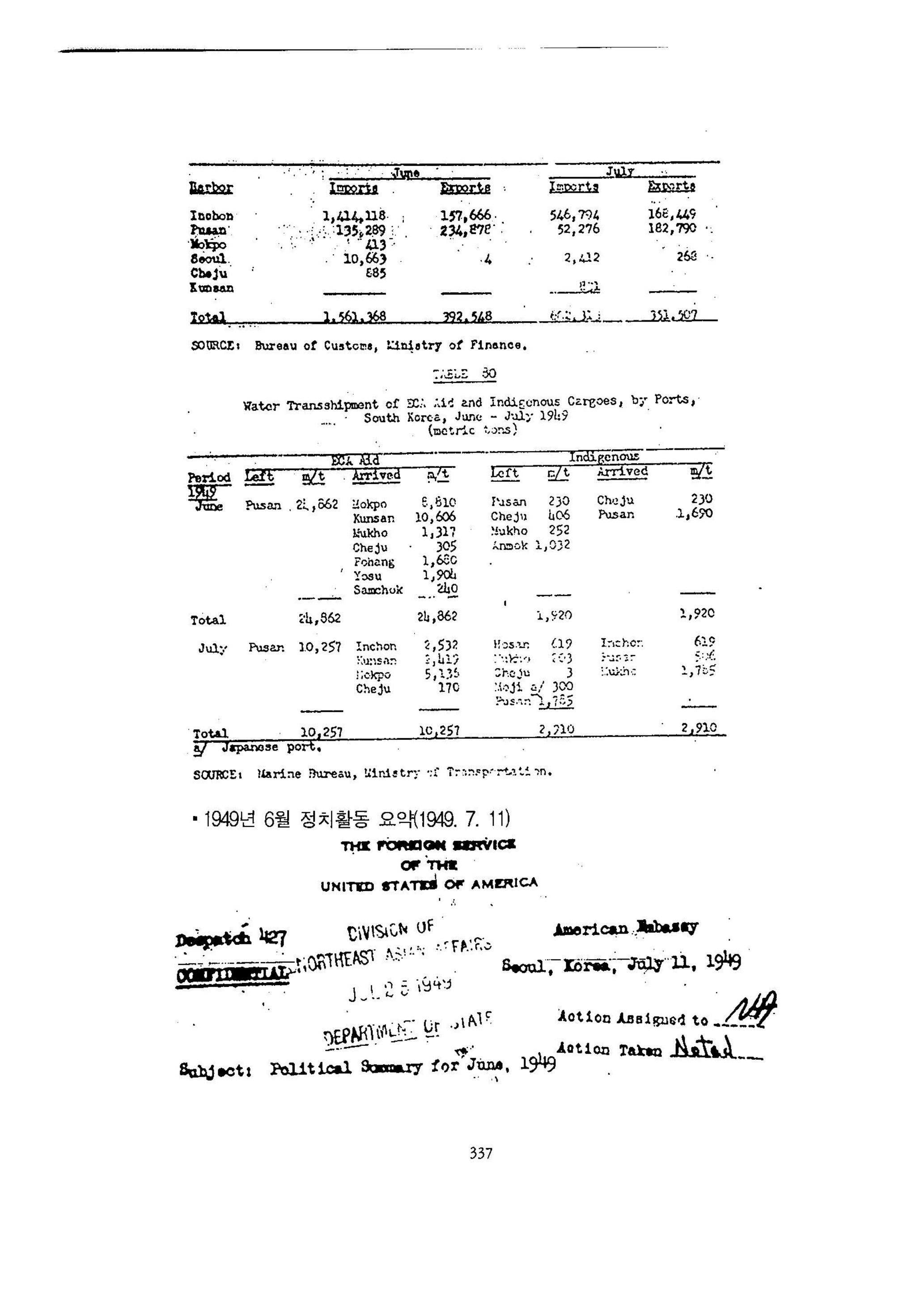
THE FOREIGN SERVICE
OF THE
UNITED STATES OF AMERICA
Despatch 427 DIVISION OF American Embassy
NORTHEAST ASIAN AFFAIRS Seoul, Korea, July 11, 1949
JUL 2 5 1949
DEPARTMENT OF STATE Action Assigned to /149
Subject: Political Summary for June, 1949 Action Taken Noted
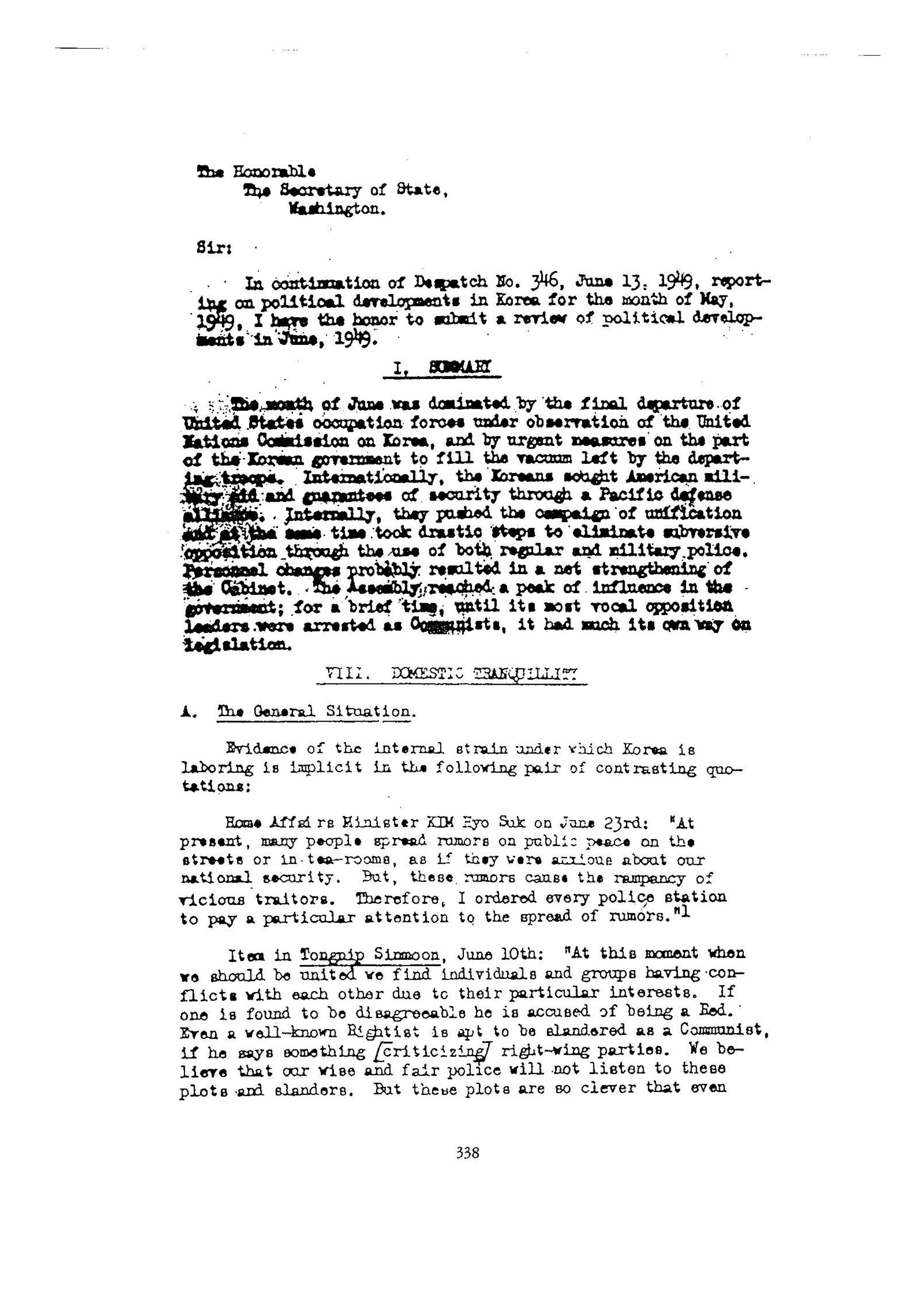
The Honorable
The Secretary of State,
Washington.
Sir:
In continuation of Despatch No. 346, June 13, 1949, reporting on political developments in Korea for the month of May, 1949, I have the honor to submit a review of political developments in June, 1949.
I. SUMMARY
The month of June was dominated by the final departure of United States occupation forces under observation of the United Nations Commission on Korea, and by urgent measures on the part of the Korean government to fill the vacuum left by the departing troops. Internationally, the Koreans sought American military aid and guarantees of security through a Pacific defense [illegible]. Internally, they pushed the campaign of unification [illegible] same time took drastic steps to eliminate subversive opposition through the use of both regular and military police. Personal changes probably resulted in a net strengthening of the Cabinet. The Assembly reached a peak of influence in the government; for a brief time, until its most vocal opposition leaders were arrested as Communists, it had much its own way on legislation.
VIII. DOMESTIC TRANQUILLITY
A. The General Situation.
Evidence of the internal strain under which Korea is laboring is implicit in the following pair of contrasting quotations:
Home Affairs Minister KIM Hyo Suk on June 23rd: "At present, many people spread rumors on public peace on the streets or in tea-rooms, as if they were anxious about our national security. But, these rumors cause the rampancy of vicious traitors. Therefore, I ordered every police station to pay a particular attention to the spread of rumors."1
Item in Tongnip Sinmoon, June 10th: "At this moment when we should be united we find individuals and groups having conflicts with each other due to their particular interests. If one is found to be disagreeable he is accused of being a Red. Even a well-known Rightist is apt to be slandered as a Communist, if he says something /criticizing/ right-wing parties. We believe that our wise and fair police will not listen to these plots and slanders. But these plots are so clever that even
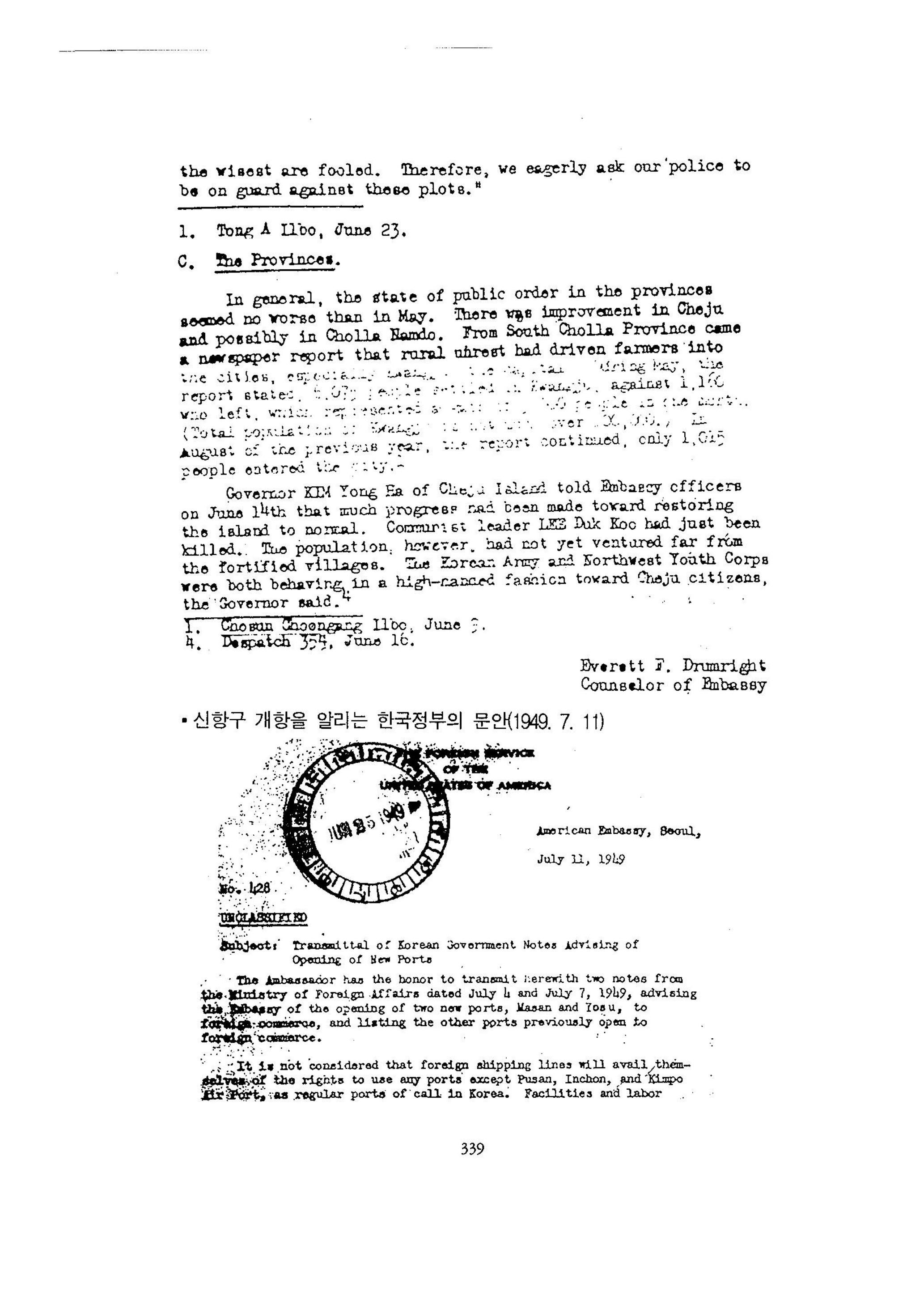
the wisest are fooled. Therefore, we eagerly ask our police to be on guard against these plots."
1. Tong A Ilbo, June 23.
C. The Provinces.
In general, the state of public order in the provinces seemed no worse than in May. There was improvement in Cheju and possibly in Cholla Namdo. From South Cholla Province came a newspaper report that rural unrest had driven farmers into the cities, especially during [illegible] driving May, the report stated, [illegible] people [illegible] against 1,100 who left, while [illegible] inserted a [illegible] as the north (Total population of [illegible] [illegible] over 30,000, [illegible] August of the previous year, but report continued, only 1,015 people entered the city.-
Governor KIM Yong Ba of Cheju Island told Embassy officers on June 14th that much progress had been made toward restoring the island to normal. Communist leader LEE Duk Koo had just been killed. The population, however, had not yet ventured far from the fortified villages. The Korean Army and Northwest Youth Corps were both behaving in a high-handed fashion toward Cheju citizens, the Governor said.
1. Chosun Inoongang Ilbo, June 3.
4. Despatch 354, June 16.
Everett F. Drumright
Counselor of Embassy
출처:
제주4·3사건진상규명및희생자명예회복위원회 편,
『제주4·3사건자료집 11』 [미국자료편],
번역문 p.149
/ 원문 p.337–339.