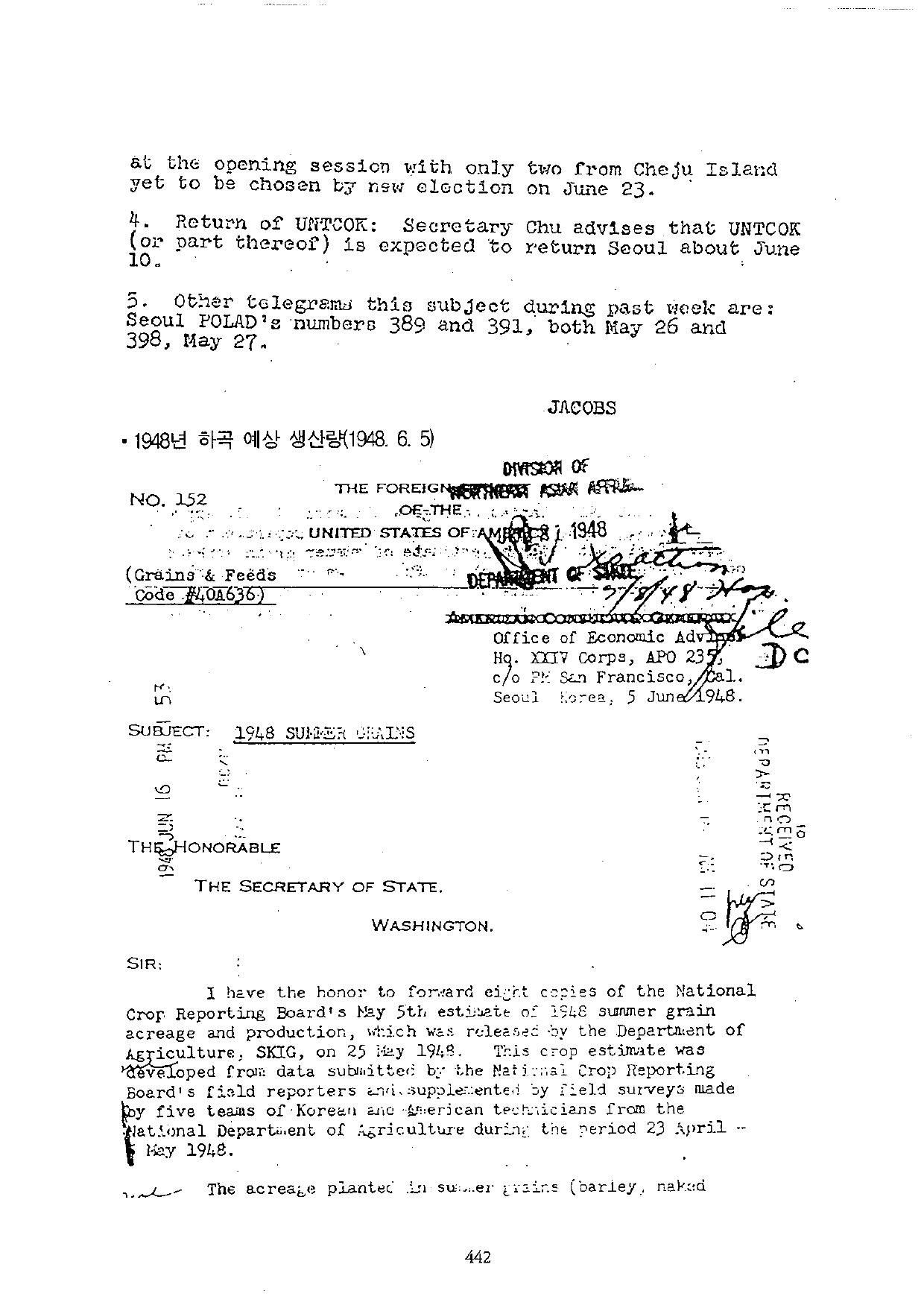
제24군단사령부 경제고문관실
존경하는 국무장관 귀하
1948년 5월 25일 남조선과도정부 농무부가 발표한 1948년도 하곡의 예상면적과 생산량에 대한 중앙농업통계보고위원회의 5월 5일자 사본 8부를 제출하게 돼 영광입니다.
이 예상생산량은 중앙농업통계보고위원회의 지방 보고원들이 제출한 자료를 통해 나왔고 1948년 4월 23일부터 5월 5일 사이 농무부의 한국인과 미국인 전문가로 구성된 5개팀이 만든 지방 조사보고서로 보충됐습니다.
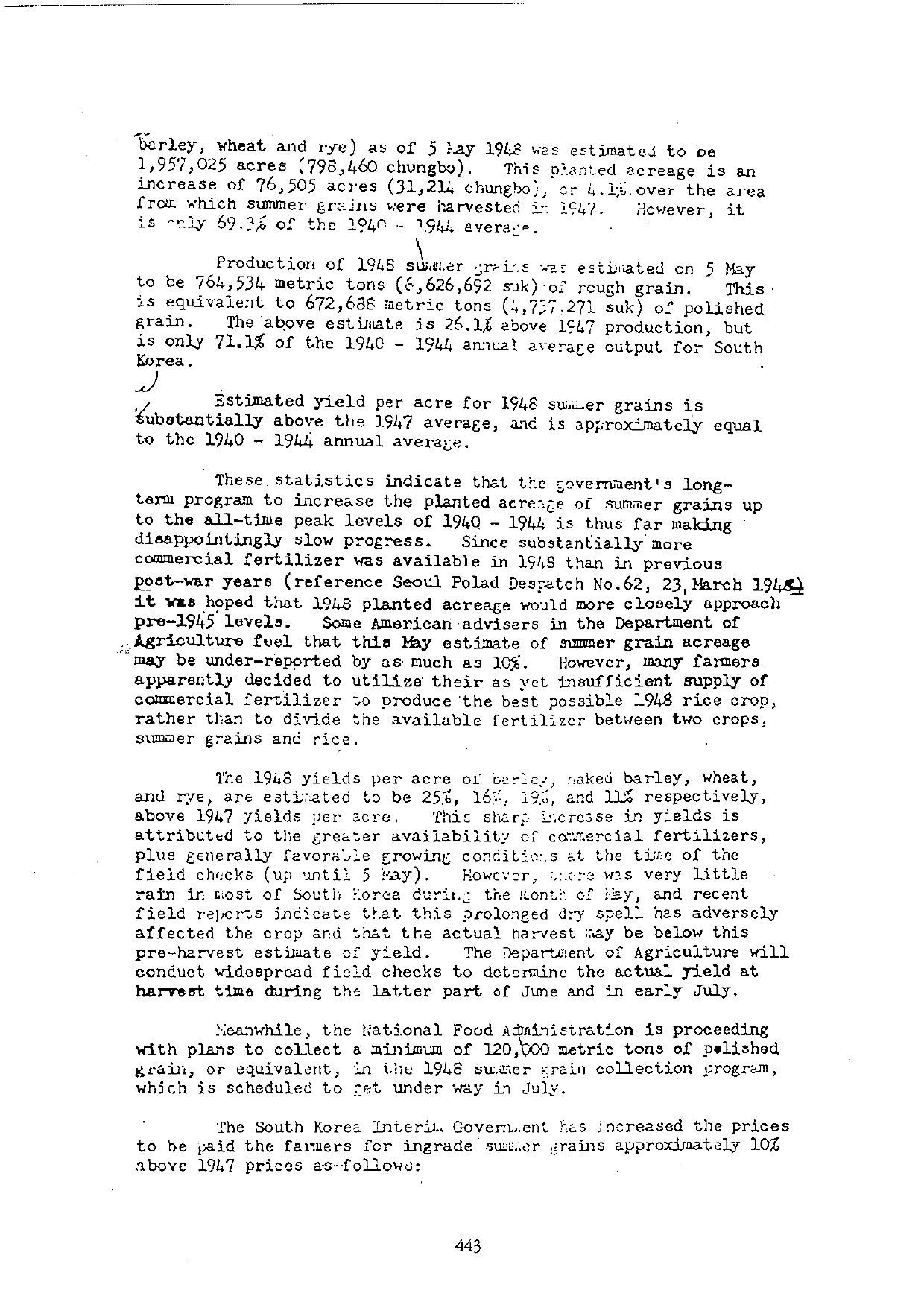
1948년 5월 5일 현재 하곡(대맥, 나맥, 소맥, 호맥) 재배면적은 195만 7,025에이커(79만 8,460정보)로 예상됩니다. 이 재배면적은 1947년 수확한 하곡의 재배면적에 비해 7만 6,505에이커(3만 1,214정보), 즉 4.1% 증가한 것입니다. 그러나 이것은 1940~1944년 평균의 69.3%에 불과합니다.
1948년 하곡 생산량은 5월 5일 현재 원곡물(原穀物)로 76만 4,534톤(662만 6,692석)으로 예상됩니다. 이것은 정곡 67만 2,688톤(473만 7,271석)과 같은 것입니다.
이것은 1947년 생산량에 비해 26.1% 증가한 것이지만 1940~1944년의 연간 평균 생산량의 71.1%에 지나지 않습니다.
1948년의 에이커당 예상 생산고는 실제 1947년 평균에 비해 높고 1940~1944년의 연평균과 거의 비슷합니다.
이들 통계는 하곡 재배면적을 1940~1944년의 최고 수준으로 끌어올리려는 정부의 장기계획이 실망스럽게도 훨씬 더딘 진전을 보이고 있다는 것을 가리킵니다. 사실상 종전 이전(1948년 3월 23일자 서울의 정치고문관 <급송문서> 제62호 참조)에 비해 1948년에 더욱 많은 상업용 비료가 활용됐기 때문에 1948년의 재배면적이 1945년 이전 수준에 근접할 것이라고 희망했습니다.
농무부의 일부 미국 고문관들은 올해 5월의 예상 하곡 재배면적은 10%나 적게 신고될 것으로 생각하고 있습니다.
그러나 많은 농민들은 하곡과 미곡 양쪽에 비료를 나눠 사용하기보다는 1948년 최대의 미곡 생산을 위해 불충분하지만 이용 가능한 상업용 비료를 사용하기로 한 것이 확실합니다.
1948년도 대맥, 나맥, 소맥, 호맥의 에이커당 생산고는 1947년보다 각각 25%, 16%, 19% 많은 것으로 추정됩니다. 생산고가 급증한 것은 대체적으로 현장조사 시기(5월 5일까지)에 좋은 생육 조건에다 보다 많이 사용할 수 있는 상업비료 덕분입니다. 그러나 5월에는 남한 대부분의 지역에 거의 비가 내리지 않았고 최근 현장보고서는 장기간에 걸친 한해가 작물에 불리하게 영향을 끼쳐 실제 수확은 생산고가 수확 전 예상보다 낮을 것입니다.
농무부는 6월 하순과 7월 초순의 수확시기에 실제 생산고를 결정하기 위한 광범한 현지 조사를 실시할 것입니다.
그동안 중앙식량행정처는 7월에 예정된 1948년도 하곡수집계획에 따라 최소 정곡 12만톤 또는 동등한 양의 곡식을 수집할 계획을 추진하고 있습니다.
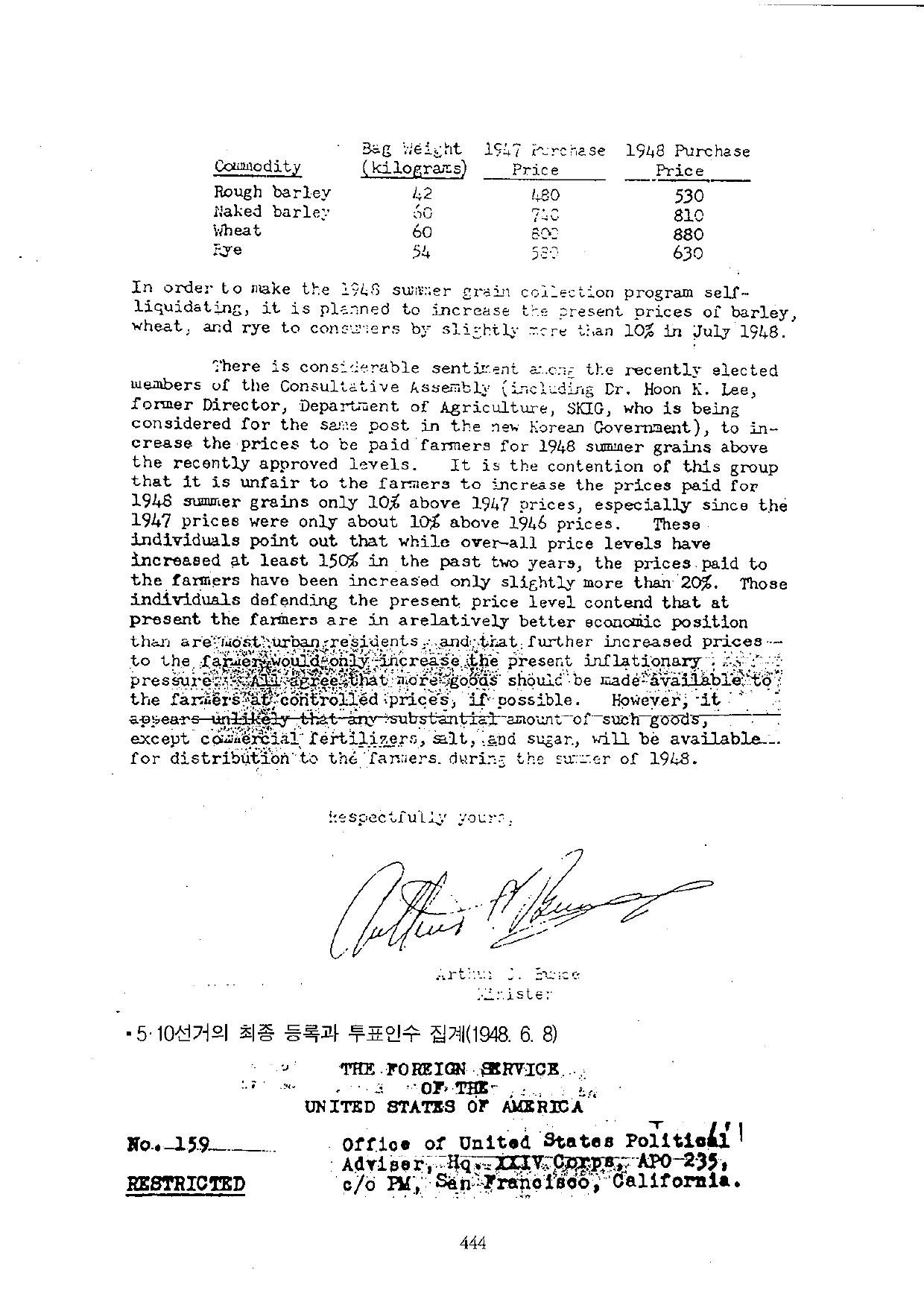
남조선과도정부는 다음과 같이 1947년 가격보다 약 10% 정도 하곡 등급 인상을 위해 농민들에게 지불할 가격을 높였습니다.
품명
가마니당
무게 (kg)
1947년 매입가
1948년 매입가
대맥
42
480
530
나맥
60
740
810
소맥
60
800
880
호맥
54
580
630
1948년도 하곡수집 계획을 현금화할 수 있도록 하기 위해 소비자들에게 1948년 7월에 10% 조금 넘게 소비자들에게 대맥과 소맥, 호맥의 현 시세를 인상할 계획을 세웠습니다.
최근 선출된 자문회의(남조선과도정부 전농무부장으로 신생 대한민국 정부에서 동일한 직책을 맡을 것으로 간주되는 이훈구 박사도 포함) 위원들 사이에서 1948년 하곡 수매대금을 최근에 승인된 수준이상으로 인상해서 농민들에게 지불하자는 공감대가 형성되고 있습니다. 이 자문회의는 48년 하곡에 대하여 47년 하곡값의 10%만 인상해서 지불한다는 것은 농민들에게 불공평하다고 주장하고 있습니다. 그 이유는 47년에 책정된 값이 46년 값에서 10만 인상된 것이기 때문이라고 했다. 이들 위원들은 지난 2년 동안 전체 물가가 최소 150% 인상됐으나 농민들에게 지불한 대금은 단지 약 20%만 인상됐음을 지적했습니다.
현재의 하곡수매값을 옹호하는 사람들은 현재 농민들이 대부분의 도시 거주자에 비해 비교적 나은 경제상황에 놓여 있고, 농민들에 더욱 많은 값을 지불하는 것은 단지 현재의 인플레이션 압력만을 증가시킬 뿐이라고 주장했습니다.
모든 위원들은 가능하다면 더욱 많은 상품들이 통제된 가격으로 농민들에게 가용해야 한다는데 의견의 일치를 보았습니다. 그러나 상업비료와 소금, 설탕 등을 제외한 상품이 실질적으로 조금도 1948년 여름에 농민들에게 배분될 것 같지 않습니다.
외교사절 아더 번스(Arthur C. Bunce)
NO. 152
DIVISION OF
THE FOREIGN [illegible] ASIAN AFFAIRS
[illegible] .OF THE [illegible]
[illegible] UNITED STATES OF AMERICA [illegible] 1948 [illegible]
[illegible] [illegible] [illegible]
(Grains & Feeds [illegible] [illegible] DEPARTMENT [illegible]
Code #40A636)
[illegible] ADMINISTRATION [illegible]
Office of Economic Advisor
Hq. XXIV Corps, APO 235, DC
c/o PM San Francisco, Cal.
Seoul Korea, 5 June 1948.
SUBJECT: 1948 SUMMER GRAINS
THE HONORABLE
THE SECRETARY OF STATE.
WASHINGTON.
SIR:
I have the honor to forward eight copies of the National Crop Reporting Board's May 5th estimate of 1948 summer grain acreage and production, which was released by the Department of Agriculture, SKIG, on 25 May 1948. This crop estimate was developed from data submitted by the National Crop Reporting Board's field reporters and supplemented by field surveys made by five teams of Korean and American technicians from the National Department of Agriculture during the period 23 April - May 1948.
The acreage planted in summer grains (barley, naked
--- p453 ---
Barley, wheat and rye) as of 5 hay 1948 was estimated to be 1,957,025 acres (798,460 chungbo). This planted acreage is an increase of 76,505 acres (31,214 chungbo), or 4.1% over the area from which summer grains were harvested in 1947. However, it is only 69.3% of the 1940 - 1944 average.
Production of 1948 summer grains was estimated on 5 May to be 764,534 metric tons (6,626,692 suk) of rough grain. This is equivalent to 672,688 metric tons (4,737,271 suk) of polished grain. The above estimate is 26.1% above 1947 production, but is only 71.1% of the 1940 - 1944 annual average output for South Korea.
Estimated yield per acre for 1948 summer grains is substantially above the 1947 average, and is approximately equal to the 1940 - 1944 annual average.
These statistics indicate that the government's long-term program to increase the planted acreage of summer grains up to the all-time peak levels of 1940 - 1944 is thus far making disappointingly slow progress. Since substantially more commercial fertilizer was available in 1948 than in previous post-war years (reference Seoul Polad Despatch No.62, 23, March 1948) it was hoped that 1948 planted acreage would more closely approach pre-1945 levels. Some American advisers in the Department of Agriculture feel that this May estimate of summer grain acreage may be under-reported by as much as 10%. However, many farmers apparently decided to utilize their as yet insufficient supply of commercial fertilizer to produce the best possible 1948 rice crop, rather than to divide the available fertilizer between two crops, summer grains and rice.
The 1948 yields per acre of barley, naked barley, wheat, and rye, are estimated to be 25%, 16%, 19%, and 11% respectively, above 1947 yields per acre. This sharp increase in yields is attributed to the greater availability of commercial fertilizers, plus generally favorable growing conditions at the time of the field checks (up until 5 May). However, there was very little rain in most of South Korea during the month of May, and recent field reports indicate that this prolonged dry spell has adversely affected the crop and that the actual harvest may be below this pre-harvest estimate of yield. The Department of Agriculture will conduct widespread field checks to determine the actual yield at harvest time during the latter part of June and in early July.
Meanwhile, the National Food Administration is proceeding with plans to collect a minimum of 120,000 metric tons of polished grain, or equivalent, in the 1948 summer grain collection program, which is scheduled to get under way in July.
The South Korea Interim Government has increased the prices to be paid the farmers for ingrade summer grains approximately 10% above 1947 prices as-follows:
--- p454 ---
Commodity Bag Weight (kilograms) 1947 Purchase Price 1948 Purchase Price
Rough barley 42 480 530
Naked barley 60 740 810
Wheat 60 800 880
Rye 54 520 630
In order to make the 1948 summer grain collection program self-liquidating, it is planned to increase the present prices of barley, wheat, and rye to consumers by slightly more than 10% in July 1948.
There is considerable sentiment among the recently elected members of the Consultative Assembly (including Dr. Hoon K. Lee, former Director, Department of Agriculture, SKIG, who is being considered for the same post in the new Korean Government), to increase the prices to be paid farmers for 1948 summer grains above the recently approved levels. It is the contention of this group that it is unfair to the farmers to increase the prices paid for 1948 summer grains only 10% above 1947 prices, especially since the 1947 prices were only about 10% above 1946 prices. These individuals point out that while over-all price levels have increased at least 150% in the past two years, the prices paid to the farmers have been increased only slightly more than 20%. Those individuals defending the present price level contend that at present the farmers are in arelatively better economic position than are most urban residents, and that further increased prices -- to the farmers would only increase the present inflationary [illegible] pressure and agree that more goods should be made available to the farmers at controlled prices, if possible. However, it appears unlikely that any substantial amount of such goods, except commercial fertilizers, salt, and sugar, will be available for distribution to the farmers during the summer of 1948.
Respectfully yours,
Arthur J. Bunce
Minister
출처:
제주4·3사건진상규명및희생자명예회복위원회 편,
『제주4·3사건자료집 9』 [미국자료편],
번역문 p.201
/ 원문 p.442–444 / No. 152.