1949년 9월 정치관계 요약
주한미대사관
제목: 1949년 9월 정치관계 요약
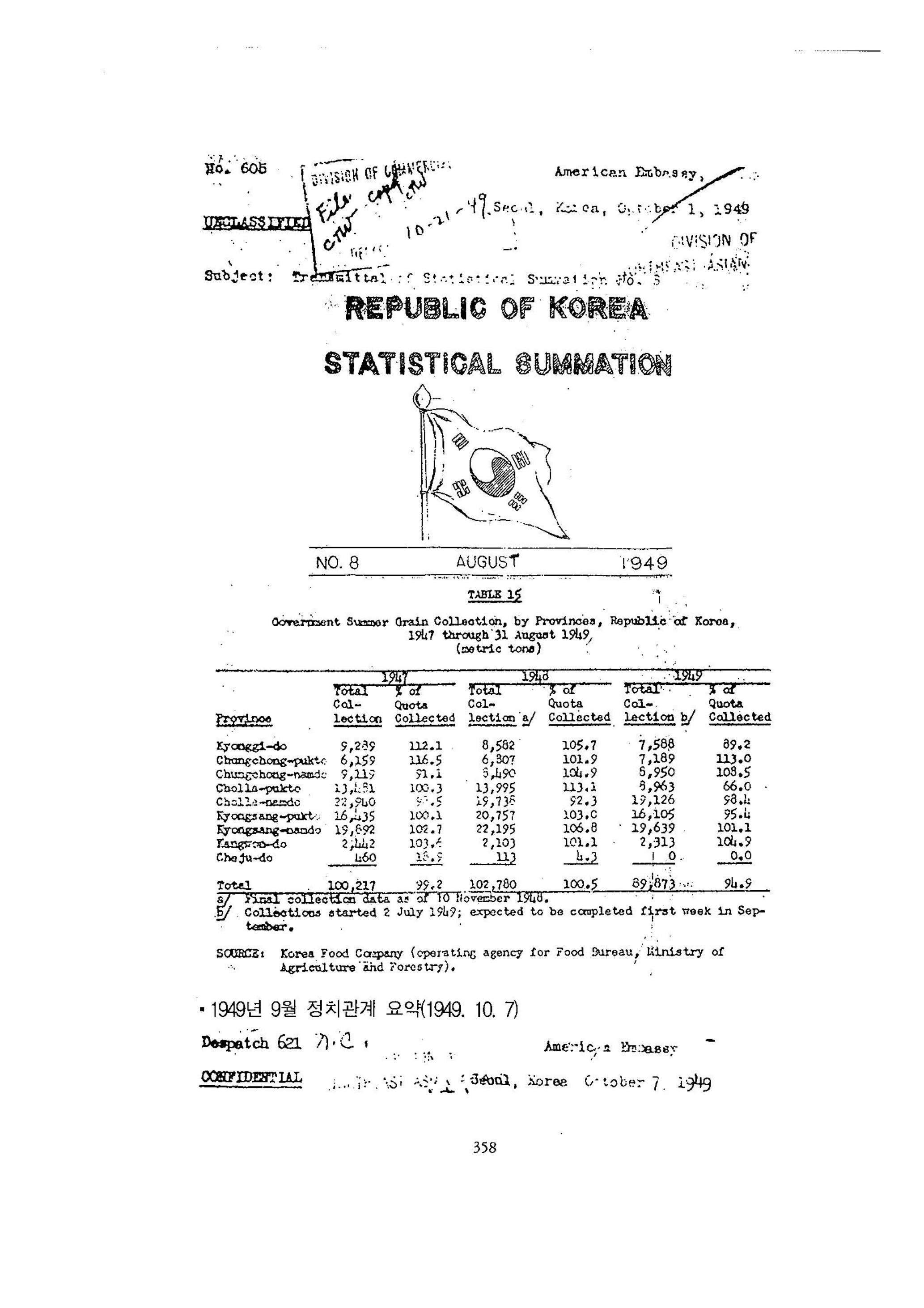
대사는 1949년 9월 13일의 <급송문서> 제562호에 계속해 1949년 9월 대한민국의 정치관계 요약을 보내게 돼 영광입니다. 9월의 상황발전은 다음과 같이 간결하게 요약됩니다. 즉 9월 한달 동안 남부지방에서 게릴라와 보안군 양쪽의 활동이 강화됐지만 대한민국 내정의 추이는 주요 변화가 없습니다. 국제적으로는 대한민국을 승인한 국가수가 22개국에 이릅니다. 이 대통령은 제안된 태평양조약과 관련해 기자회견에서 몇 가지 논평을 했지만 입장은 변하지 않았습니다.
대한민국에 임대한 미국 소유의 증기선이 사라진 것은 워싱턴에서 모스크바까지 즉각 주목을 끌었습니다. 이 선박은 미국인 고문관 2명이 승선해 남한행을 승인해줄 것을 요청하고 있습니다. 미국 상원의원 5명이 9월 8일부터 10일까지 한국을 방문했습니다. 조병옥이 제4차 유엔총회에 한국측 수석대표로 임명됐습니다. 국내적으로는 9월 12일 소집된 국회는 세금법안을 포함해 통과시키고 법원조직법안에 대한 대통령의 거부를 무효로 만들었습니다. 전 장관인 루이스 임(무죄로 판명됨)과 조봉암, 전 재산관리관인 임병혁, 에델 언더우드(Ethel Underwood) 여사와 김호익 경찰간부의 살인혐의자들, 2명의 국회의원 등 몇몇 주요 인물에 대한 재판이 9월에 있었습니다. 국민회는 공식적으로 준정부조직이 돼가고 있다고 선언했으나 비정치기구입니다.
남부지방에서는 게릴라의 습격이 계속됐고 400여 명의 재소자들이 목포형무소를 탈출했습니다. 경찰이 공산주의 혐의자들을 더욱 많이 체포한 반면 보안군은 전면적인 게릴라 소탕작전을 수행하고 있습니다. 고문과 영장없는 체포에 대한 시민들의 항의로 상황을 개선하겠다는 공식발언을 이끌어냈습니다. 북한에서는 최고인민회의가 이틀 동안 소집됐습니다. 제안된 북한이 후원하는 ‘총선거’는 잊혀지는 것으로 보입니다.
첨부문서: 1949년 9월의 정치요약
<첨부문서> 목포형무소 폭동 (1949. 10. 7. 보고)
목포형무소 폭동
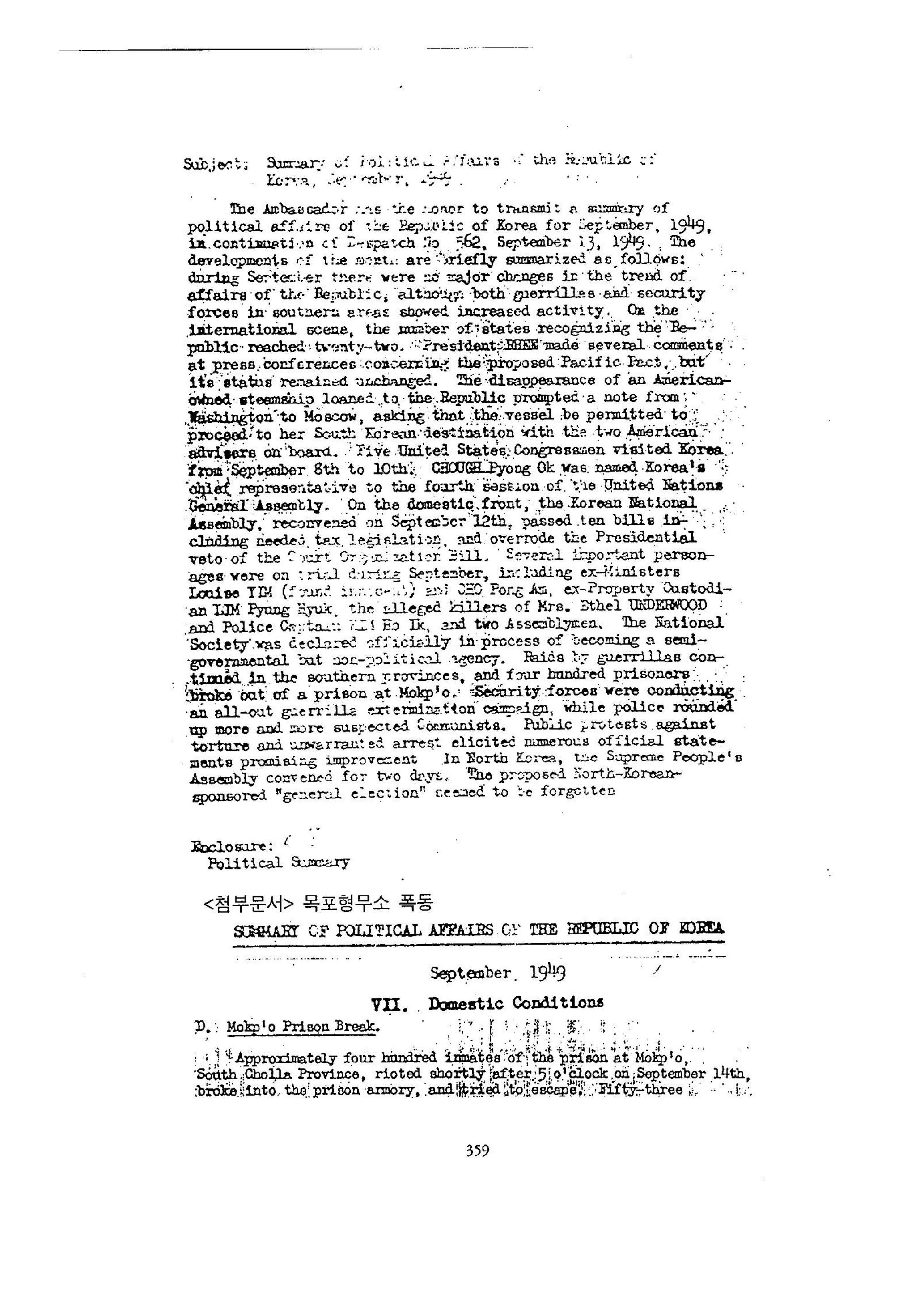
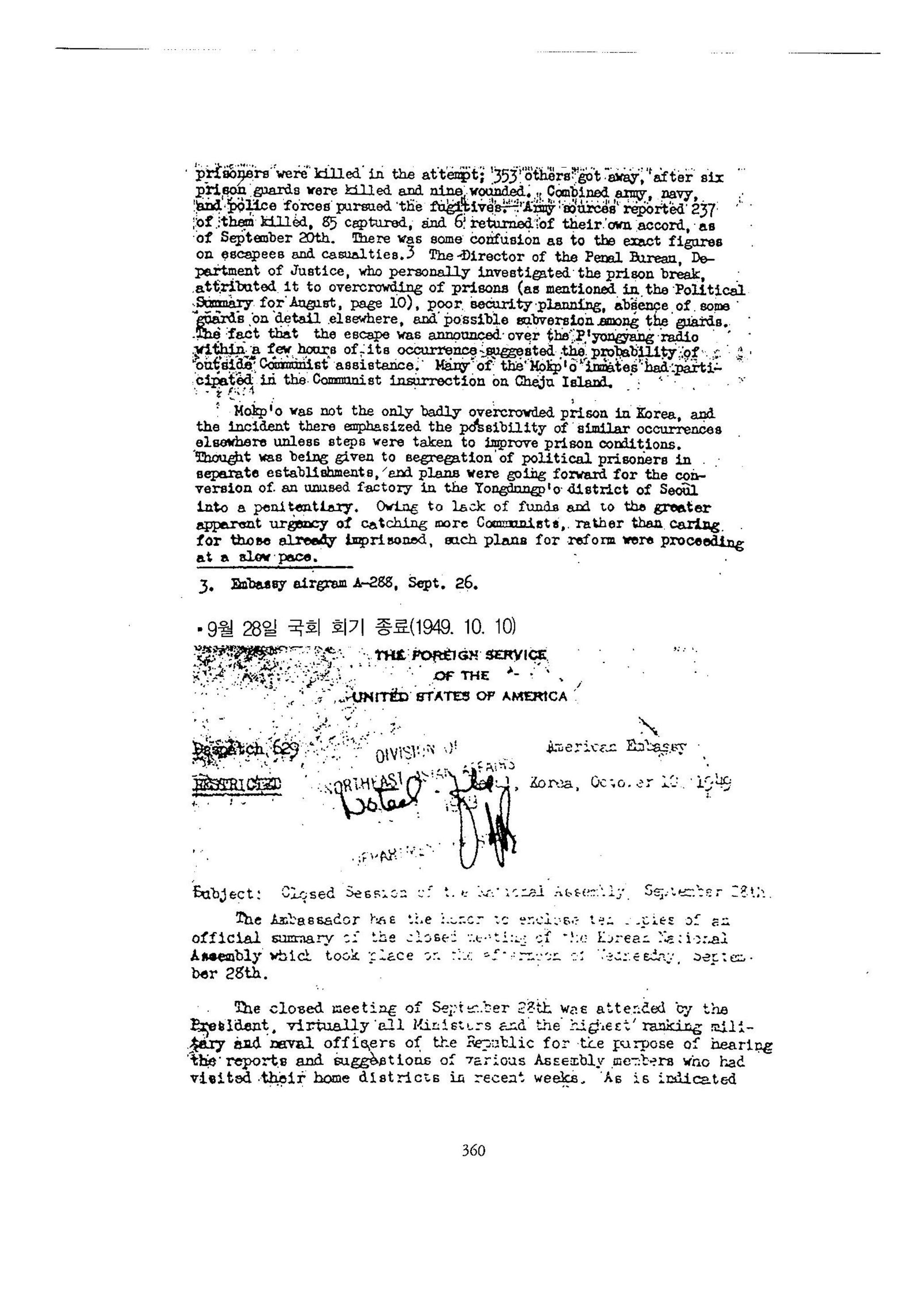
전라남도 목포형무소 재소자 400여 명이 9월 14일 오전 5시 직후에 폭동을 일으켰습니다. 형무소 무기고를 습격하고, 탈출을 시도했습니다. 53명의 재소자가 이 과정에서 숨졌습니다. 6명의 형무소 경비병들을 죽이고 9명의 경비병에게 부상을 입힌 뒤 353명의 재소자들이 도주했습니다. 육해군과 경찰은 합동작전을 펼쳐 탈주자들을 추적했습니다. 군 소식통은 9월 20일 현재 이들 가운데 237명이 죽고 85명은 체포됐으며 6명은 스스로 돌아왔다고 보고했습니다. 탈주자와 사상자에 대한 정확한 집계에는 일부 혼란이 있었습니다(대사관 <항공우편> A-288, 9월 26일). 사법부 형정국장(刑政局長)은 개인적으로 형무소 폭동사건을 조사해 원인을 형무소의 과밀(8월의 정치요약에서 언급했듯이), 빈약한 보안기획, 일부 지역의 경비병 부재, 경비병들 사이의 파괴 가능성 탓으로 돌렸습니다.
폭동이 일어난 지 몇 시간도 채 지나지 않아 평양라디오방송이 탈주를 발표한 사실은 외부 공산주의자의 지원 가능성이 농후함을 암시했습니다. 목포형무소의 재소자들 가운데 상당수가 제주도의 공산반란에 가담한 바 있습니다.
목포형무소는 한국의 유일한 초과밀 형무소가 아니며 형무소 조건에 대한 개선조처가 이뤄지지 않는 한 어디서든지 유사한 폭동이 발생할 가능성을 보여준 사건으로 정치범들을 분리해 수용해야 한다는 생각을 갖게 했습니다. 이에 따라 서울 영등포 지역의 사용하지 않는 공장을 교도시설로 개조할 계획을 추진하고 있습니다. 자금이 부족하고 이미 투옥된 재소자들을 돌보는 것보다 보다 많은 공산주의자들을 체포해야 하는 절박성이 더 크기 때문에 이와 같은 개혁계획은 느리게 진행되고 있습니다. (후략)
Despatch 621 7).C :
CONFIDENTIAL
America Embassy
[illegible] Seoul, Korea October 7, 1949
Subject: Summary of Political Affairs of the Republic of Korea, September, 1949
The Ambassador has the honor to transmit a summary of political affairs of the Republic of Korea for September, 1949, in continuation of Despatch No. 562, September 13, 1949. The developments of the month are briefly summarized as follows: during September there were no major changes in the trend of affairs of the Republic, although both guerrillas and security forces in southern areas showed increased activity. On the international scene, the number of states recognizing the Re- public reached twenty-two. President RHEE made several comments at press conferences concerning the proposed Pacific Pact, but its status remained unchanged. The disappearance of an American-owned steamship loaned to the Republic prompted a note from Washington to Moscow, asking that the vessel be permitted to proceed to her South Korean destination with the two American advisers on board. Five United States Congressmen visited Korea. From September 8th to 10th, CHOUGE Pyong Ok was named Korea's chief representative to the fourth session of the United Nations General Assembly. On the domestic front, the Korean National Assembly, reconvened on September 12th, passed ten bills in- cluding needed tax legislation, and overrode the Presidential veto of the Court Organization Bill. Several important person- ages were on trial during September, including ex-Ministers Louise YIM (Fund innoce[illegible]) and CEO Pong Am, ex-Property Custodi- an IIM Pyung Hyuk, the alleged killers of Mrs. Ethel UNDERWOOD and Police Captain KII Bo Ik, and two Assemblymen. The National Society was declared officially in process of becoming a semi- governmental but non-political agency. Raids by guerrillas con- tinued in the southern provinces, and four hundred prisoners broke out of a prison at Mokp'o. Security forces were conducting an all-out guerrilla extermination campaign, while police rounded up more and more suspected Communists. Public protests against torture and unwarranted arrest elicited numerous official state- ments promising improvement. In North Korea, the Supreme People's Assembly convened for two days. The proposed North-Korean- sponsored "general election" seemed to be forgotten
Enclosure: Political SUMMARY OF POLITICAL AFFAIRS OF THE REPUBLIC OF KOREA
September, 1949
VII. Domestic Conditions
D. Mokp'o Prison Break.
Approximately four hundred inmates of the prison at Mokp'o, South Cholla Province, rioted shortly after 5 o'clock on September 14th, broke into the prison armory, and [illegible] to escape. Fifty-three [illegible] prisoners were killed in the attempt; 353 others got away, after six
prison guards were killed and nine wounded. Combined army, navy,
and police forces pursued the fugitives. Army sources reported 237
of them killed, 85 captured, and 6 returned of their own accord, as
of September 20th. There was some confusion as to the exact figures
on escapees and casualties.3 The Director of the Penal Bureau, De-
partment of Justice, who personally investigated the prison break,
attributed it to overcrowding of prisons (as mentioned in the Political
Summary for August, page 10), poor security planning, absence of some
guards on detail elsewhere, and possible subversion among the guards.
The fact that the escape was announced over the P'yongyang radio
within a few hours of its occurrence suggested the probability of
outside Communist assistance. Many of the Mokp'o inmates had parti-
cipated in the Communist insurrection on Cheju Island.
Mokp'o was not the only badly overcrowded prison in Korea, and
the incident there emphasized the possibility of similar occurrences
elsewhere unless steps were taken to improve prison conditions.
Thought was being given to segregation of political prisoners in
separate establishments, and plans were going forward for the con-
version of an unused factory in the Yongdungp'o district of Seoul
into a penitentiary. Owing to lack of funds and to the greater
apparent urgency of catching more Communists, rather than caring
for those already imprisoned, such plans for reform were proceeding
at a slow pace.
3. Embassy airgram A-288, Sept. 26.
출처:
제주4·3사건진상규명및희생자명예회복위원회 편,
『제주4·3사건자료집 11』 [미국자료편],
번역문 p.169
/ 원문 p.358–360 / No. 621.