수신: 전관구 청장
발신: 경무부장
1. 1948년 8월 5일 열린 전관구 정보과장 회의에서 논의됐듯이 남로당이 대규모 폭동을 일으키기 위한 계획을 추진하고 있는 것이 확실하다. 앞으로 몇 주 동안 지속적인 평화상태를 유지하는 일이야말로 국립경찰의 책임이며 우리의 지난 노력의 결과를 요약해서 설명하고 강조할 수 있는 기회다. 그러므로 귀관들은 귀관들의 지역 내에서 ‘평화와 질서’를 조정하고 유지하는데 있어서 예기치 못한 상황을 적절하게 통제하거나 혹은 귀관들의 부하들에게 용기를 주거나 격려할 필요가 있을 때만 아래의 조치들을 강구하도록 한다.
포고문의 발표
포고는 새로운 정부수립에 따른 국내외의 복잡한 사안을 알리거나 국민들의 감정을 누그러뜨리고, 평화와 질서를 유지하며 불법행위를 엄단할 목적으로 파괴분자들에게 경고할 필요가 있을 때 관구청장의 이름으로 발표되어야 한다.
보고
8월 13일부터 18일 사이 그리고 8월 23일부터 28일 사이 각 관구의 경찰서 활동을 상세하게 보고할 것. 이런 보고는 낮 12시와 오후 6시, 자정에 무선으로 할 것.
정보
정보업무는 전체 기간 동안 강조되어야 하며, 통보사항은 모든 부서에 가능한 한 신속하고 전파되어야 한다.
인사
경찰 개개인은 자신의 능력을 최대한 발휘하여 임무를 수행하도록 독려되어야 한다. 청장은 그들에게 자신의 업무에 수행에 있어서 열심히 하도록 진작해야 하며, 드높은 사기를 갖도록 하며, 새로운 정부가 수립되더라도 자신들의 지위는 보장받는다는 확신을 갖도록 해야 한다.
통신
현재 있는 전화와 무선시설을 최대한도로 사용해야 한다. 이 시설을 지속적으로 점검하고 긴급수리 문제가 발생할 때에는 신속히 처리해야 한다.
정보작전
정보와 경계대책은 아래 밑줄 친 단계에 따른다.
제1단계(정부수립 뒤 즉각 조처)
기간: 1948년 8월 7일~12일
이 기간동안 전체 경찰력의 절반이 동원될 것이다.
제2단계(이른바 해방기간)
기간: 1948년 8월 13일~19일
이 기간 모든 가용한 경찰력이 동원될 것이다.
제3단계(북한선거 기간)
기간: 1948년 8월 20일~26일
8월 20일부터 23일까지는 전체 경찰력의 절반이 동원될 것이며 24일, 25일, 26일에는 모든 가능한 경찰력이 임무를 수행하게 될 것이다.
주요정보 업무
1. 정부 지도자와 각료들에 대한 안전.
2. 국군 창설을 앞두고 민족청년단과 대동청년단, 경비대 사이의 갈등 조사.
3. 국립경찰 내부의 남로당 세포조직에 대한 조사 및 사건폭로를 목적으로 한 일반 산업체에서의 남로당 경찰 활동확대에 대한 조사.
4. 폭도들의 움직임에 대한 지속적인 조사.
5. 북한 선거 지지자들의 지하 움직임에 대한 조사.
6. 여름방학 기간 민주학생동맹(Democratic Student's Union) 소속 학생들의 움직임에 대한 조사.
7. 특수분자들의 집회, 결사 및 움직임에 대한 조사와 경계.
8. 해안에서 비밀리에 파견된 파괴분자들의 침입에 관한 정보활동.
경무부가 제공한 4월 3일부터 7월 5일까지의 제주도 소요에 대한 통계
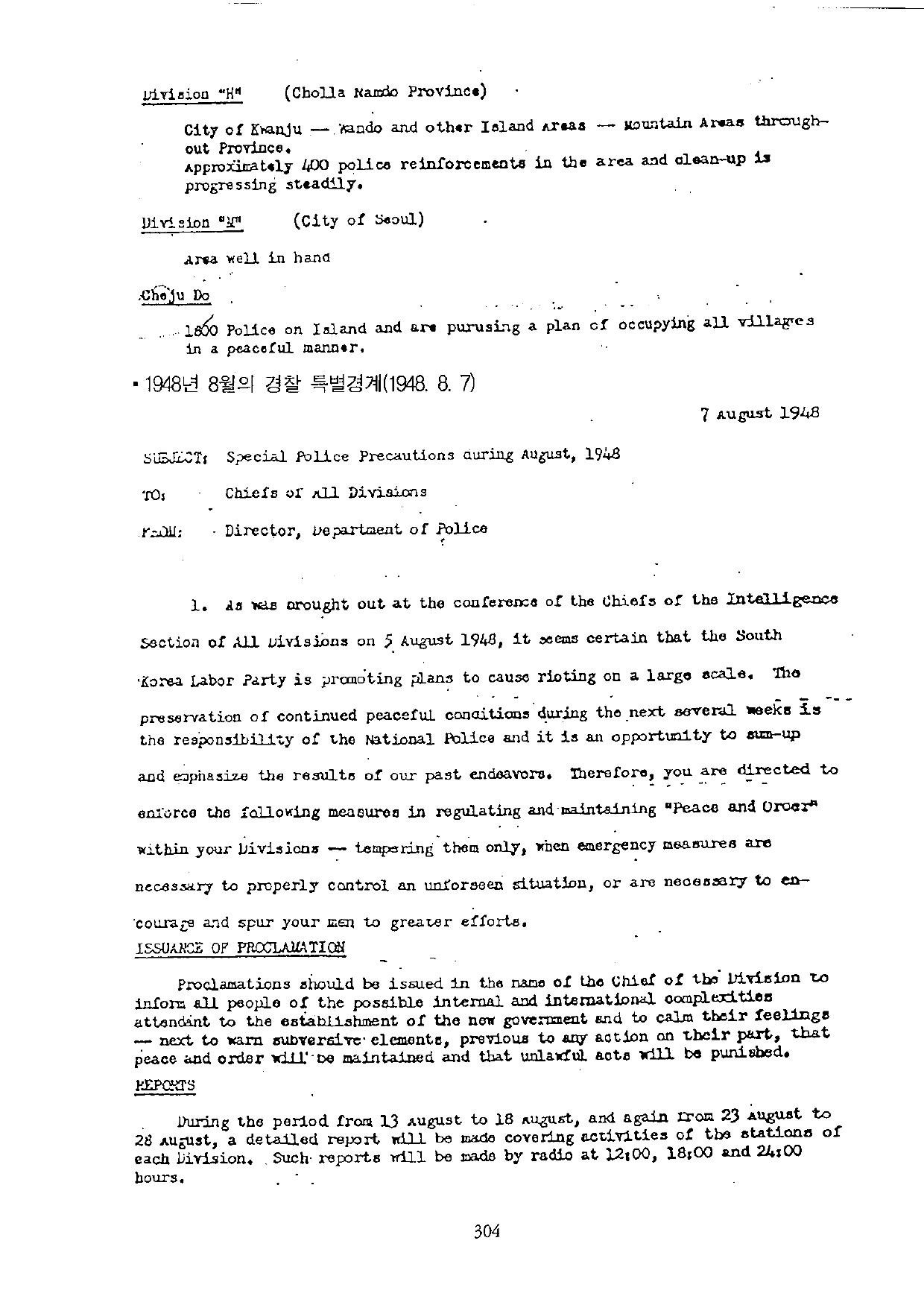
7 August 1948
SUBJECT: Special Police Precautions during August, 1948
TO: Chiefs of All Divisions
FROM: Director, Department of Police
1. As was brought out at the conference of the Chiefs of the Intelligence Section of All Divisions on 5 August 1948, it seems certain that the South Korea Labor Party is promoting plans to cause rioting on a large scale. The preservation of continued peaceful conditions during the next several weeks is the responsibility of the National Police and it is an opportunity to sum-up and emphasize the results of our past endeavors. Therefore, you are directed to enforce the following measures in regulating and maintaining "Peace and Order" within your Divisions — tempering them only, when emergency measures are necessary to properly control an unforseen situation, or are necessary to encourage and spur your men to greater efforts.
ISSUANCE OF PROCLAMATION
Proclamations should be issued in the name of the Chief of the Division to inform all people of the possible internal and international complexities attendant to the establishment of the new government and to calm their feelings — next to warn subversive elements, previous to any action on their part, that peace and order will be maintained and that unlawful acts will be punished.
REPORTS
During the period from 13 August to 18 August, and again from 23 August to 28 August, a detailed report will be made covering activities of the stations of each Division. Such reports will be made by radio at 12:00, 18:00 and 24:00 hours.
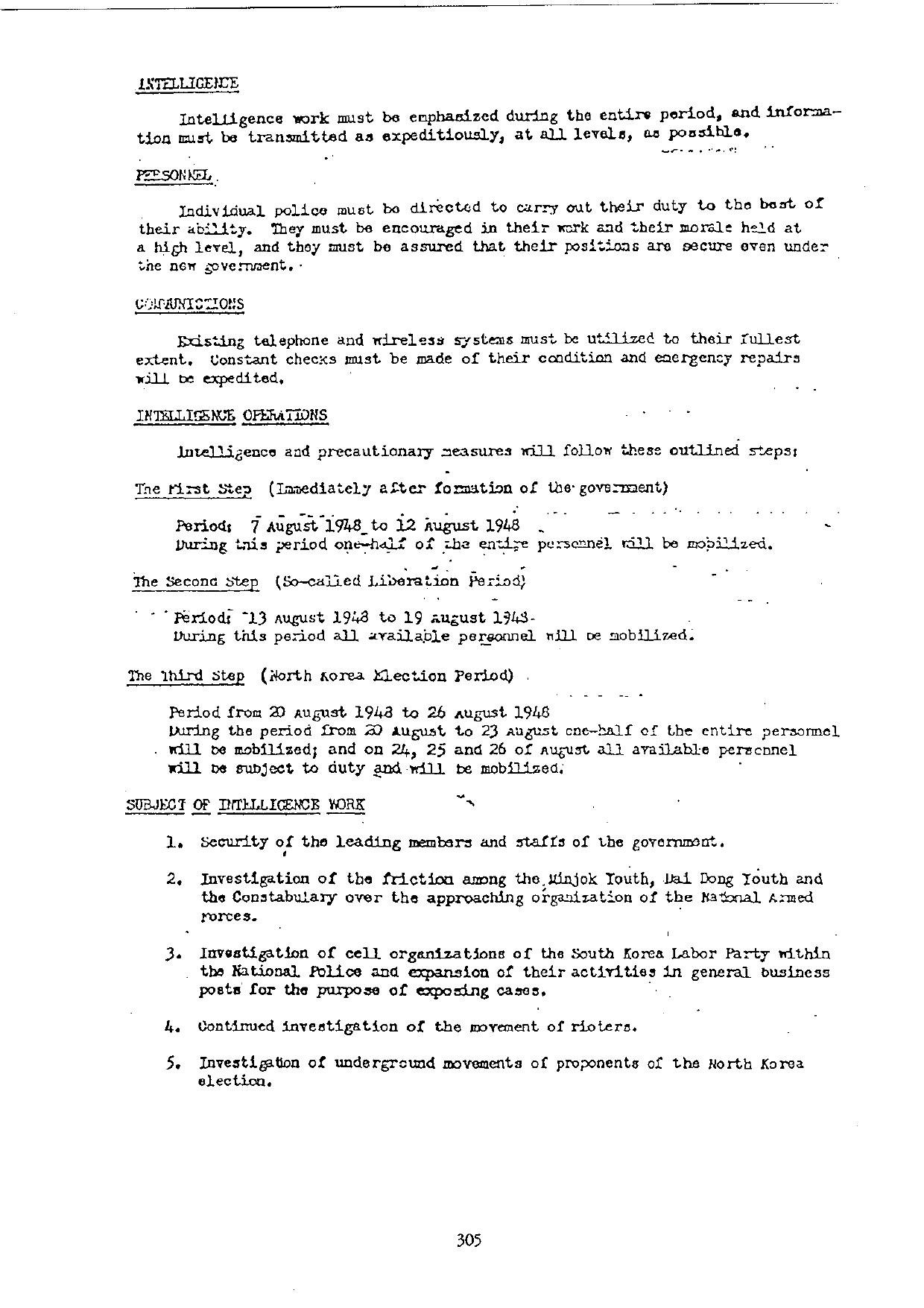
INTELLIGENCE
Intelligence work must be emphasized during the entire period, and information must be transmitted as expeditiously, at all levels, as possible.
PERSONNEL
Individual police must be directed to carry out their duty to the best of their ability. They must be encouraged in their work and their morale held at a high level, and they must be assured that their positions are secure even under the new government.
COMMUNICATIONS
Existing telephone and wireless systems must be utilized to their fullest extent. Constant checks must be made of their condition and emergency repairs will be expedited.
INTELLIGENCE OPERATIONS
Intelligence and precautionary measures will follow these outlined steps:
The First Step (Immediately after formation of the government)
Period: 7 August 1948 to 12 August 1948
During this period one-half of the entire personnel will be mobilized.
The Second Step (So-called Liberation Period)
Period: 13 August 1948 to 19 August 1948-
During this period all available personnel will be mobilized.
The Third Step (North Korea Election Period)
Period from 20 August 1948 to 26 August 1948
During the period from 20 August to 23 August one-half of the entire personnel will be mobilized; and on 24, 25 and 26 of August all available personnel will be subject to duty and will be mobilized.
SUBJECT OF INTELLIGENCE WORK
1. Security of the leading members and staffs of the government.
2. Investigation of the friction among the Minjok Youth, Dai Dong Youth and the Constabulary over the approaching organization of the National Armed Forces.
3. Investigation of cell organizations of the South Korea Labor Party within the National Police and expansion of their activities in general business posts for the purpose of exposing cases.
4. Continued investigation of the movement of rioters.
5. Investigation of underground movements of proponents of the North Korea election.
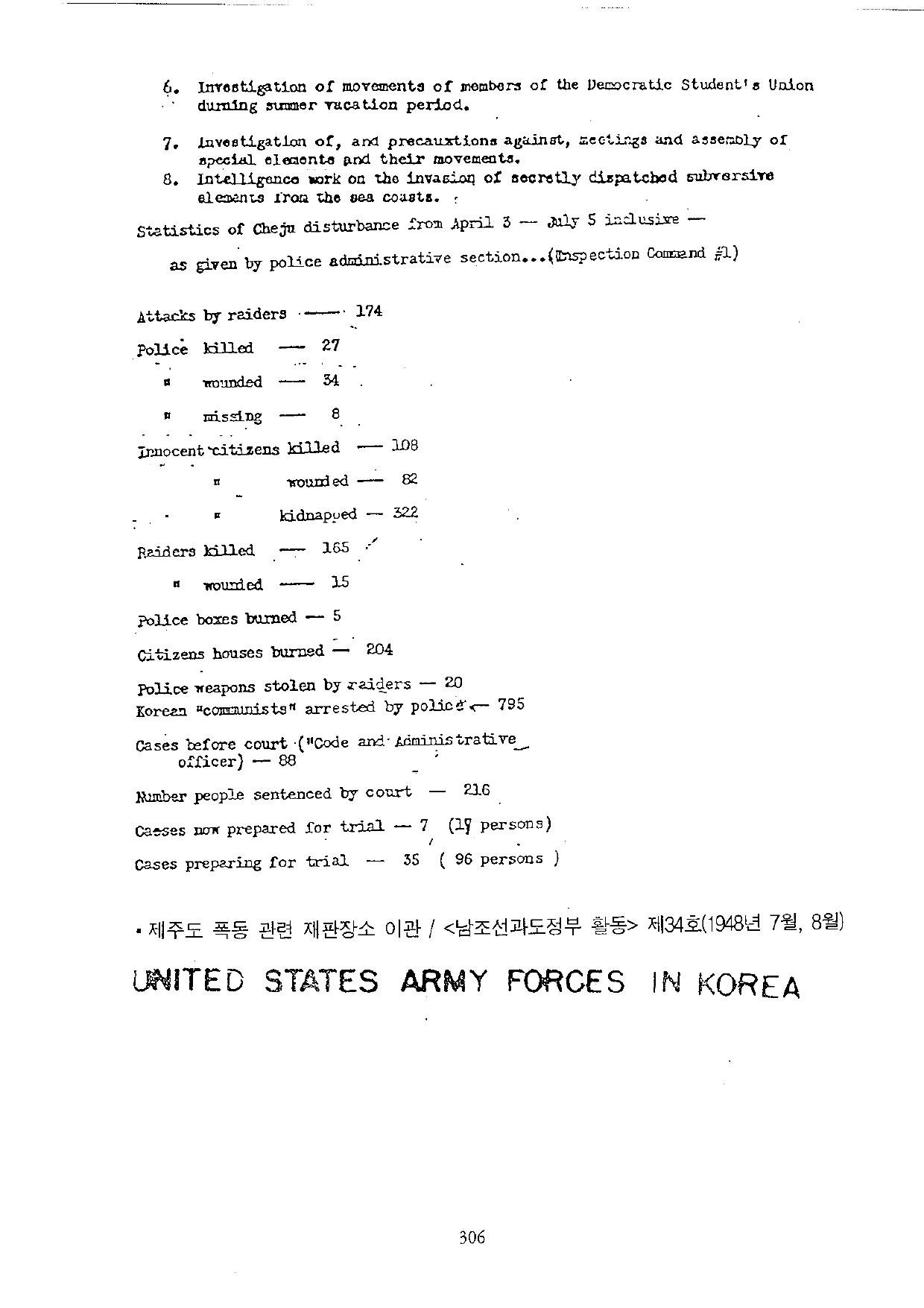
6. Investigation of movements of members of the Democratic Student's Union durning summer vacation period.
7. Investigation of, and precautions against, meetings and assembly of special elements and their movements.
8. Intelligence work on the invasion of secretly dispatched subversive elements from the sea coasts. ;
Statistics of Cheju disturbance from April 3 — July 5 inclusive —
as given by police administrative section...(Inspection Command #1)
Attacks by raiders ——— 174
Police killed — 27
" wounded — 34
" missing — 8
Innocent citizens killed — 108
" wounded — 82
" kidnapped — 322
Raiders killed — 165
" wounded —— 15
Police boxes burned — 5
Citizens houses burned — 204
Police weapons stolen by raiders — 20
Korean "communists" arrested by police — 795
Cases before court ("Code and Administrative officer) — 88
Number people sentenced by court — 216
Cases now prepared for trial — 7 (17 persons)
Cases preparing for trial — 35 ( 96 persons )
• 제주도 폭동 관련 재판장소 이관 / <남조선과도정부 활동> 제34호(1948년 7월, 8월)
UNITED STATES ARMY FORCES IN KOREA
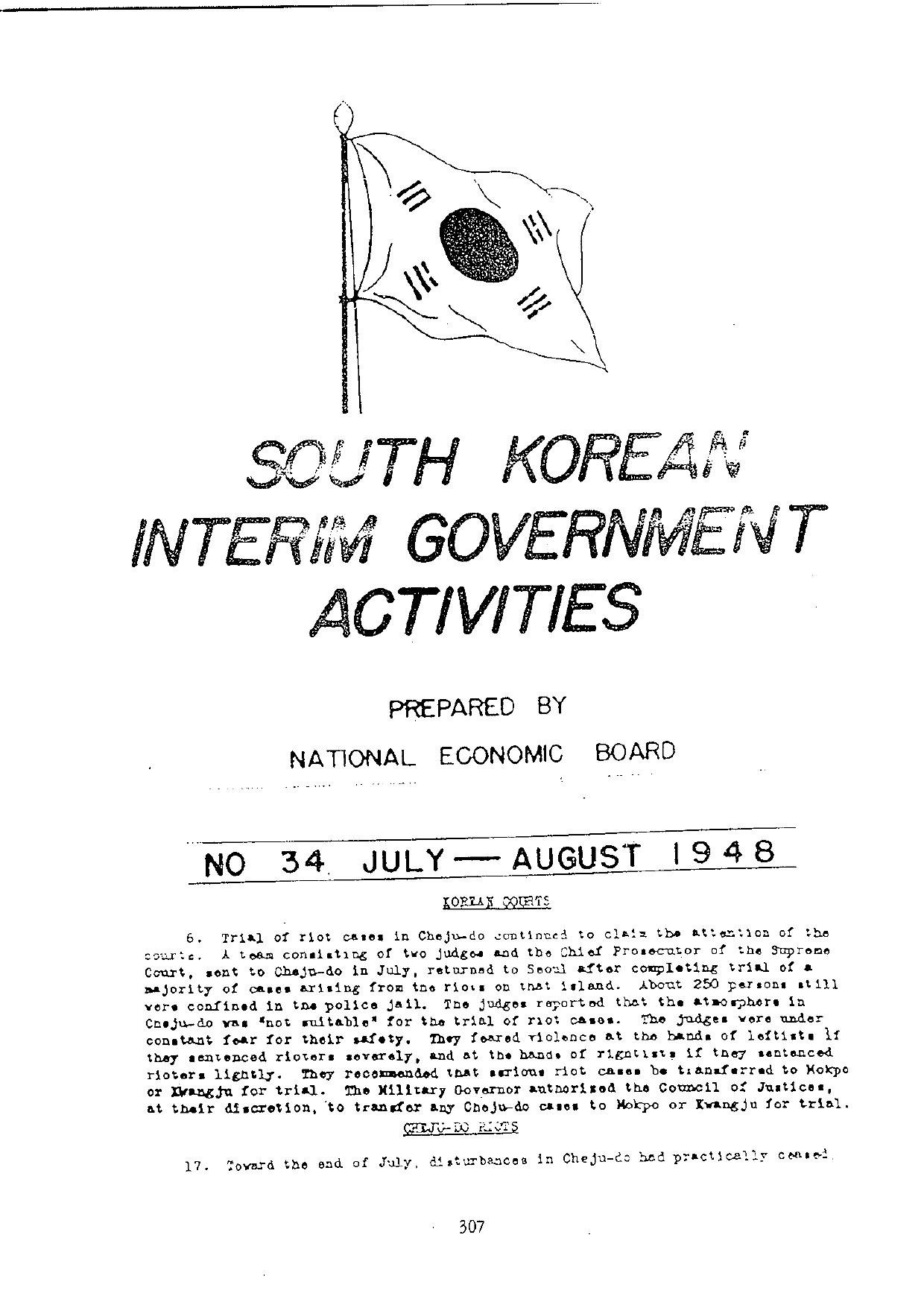
SOUTH KOREAN INTERIM GOVERNMENT ACTIVITIES
PREPARED BY
NATIONAL ECONOMIC BOARD
NO 34 JULY — AUGUST 1948
KOREAN COURTS
6. Trial of riot cases in Cheju-do continued to claim the attention of the courts. A team consisting of two judges and the Chief Prosecutor of the Supreme Court, sent to Cheju-do in July, returned to Seoul after completing trial of a majority of cases arising from the riots on that island. About 250 persons still were confined in the police jail. The judges reported that the atmosphere in Cheju-do was "not suitable" for the trial of riot cases. The judges were under constant fear for their safety. They feared violence at the hands of leftists if they sentenced rioters lightly. They recommended that serious riot cases be transferred to Mokpo or Kwangju for trial. The Military Governor authorized the Council of Justices, at their discretion, to transfer any Cheju-do cases to Mokpo or Kwangju for trial.
CHEJU-DO RIOTS
17. Toward the end of July, disturbances in Cheju-do had practically ceased.
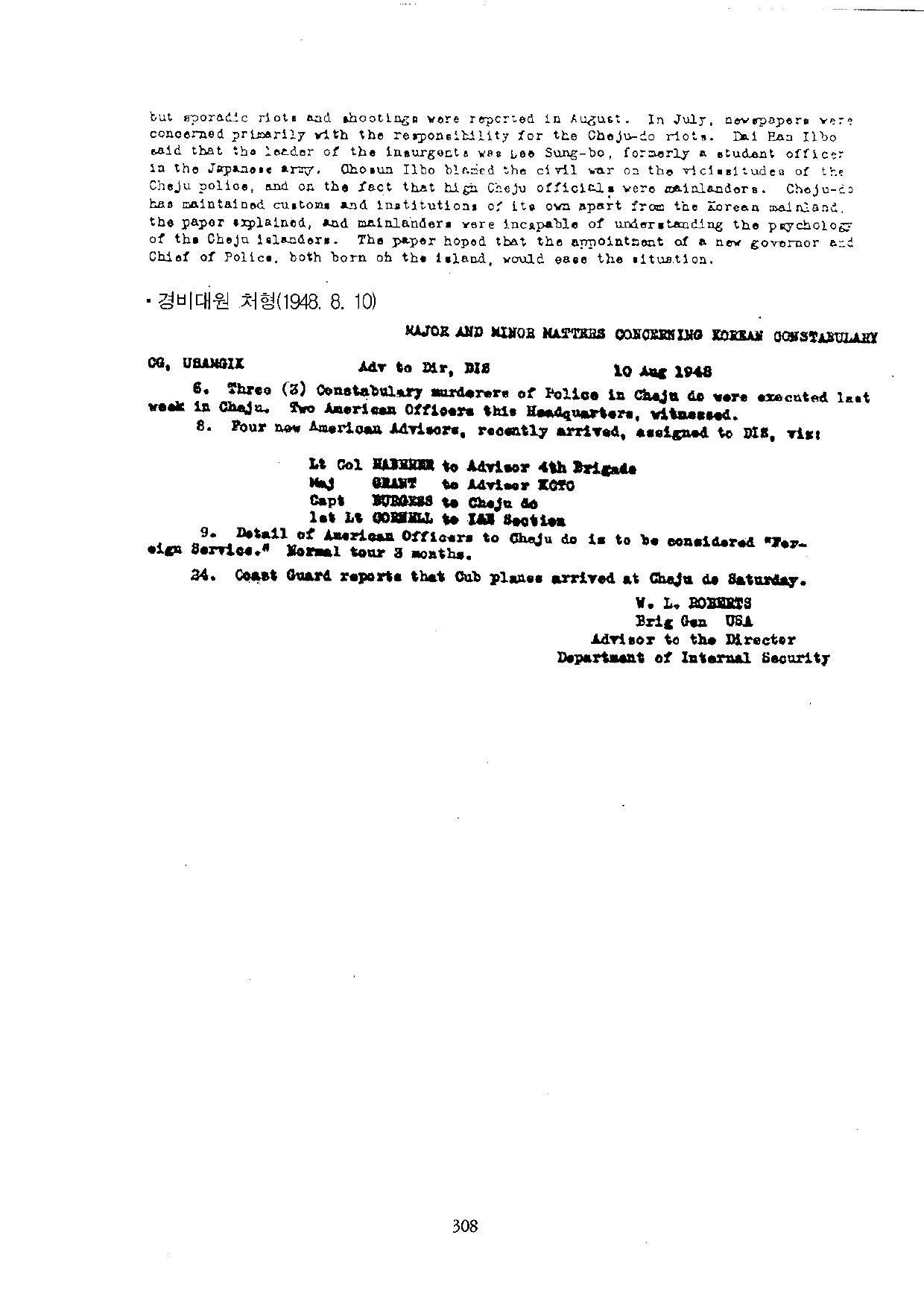
but sporadic riots and shootings wore reported in August. In July, newspapers were concerned primarily with the responsibility for the Cheju-do riots. Dai Han Ilbo said that the leader of the insurgents was Lee Sung-bo, formerly a student officer in the Japanese army. Chosun Ilbo blamed the civil war on the vicissitudes of the Cheju police, and on the fact that high Cheju officials were mainlanders. Cheju-do has maintained customs and institutions of its own apart from the Korean mainland. the paper explained, and mainlanders were incapable of understanding the psychology of the Cheju islanders. The paper hoped that the appointment of a new governor and Chief of Police, both born on the island, would ease the situation.
출처:
제주4·3사건진상규명및희생자명예회복위원회 편,
『제주4·3사건자료집 9』 [미국자료편],
번역문 p.64
/ 원문 p.304–308.