제주분견대(Cheju Task Force)
1947년 1월 4일 11시 45분
병력의 절반을 실은 C-47 한 대가 연료와 비상식량을 싣고 부산을 출발하였다. 나머지 비행기편은 훗날로 연기되었다. 비행기는 13시 30분에 제주비행장에 착륙하였다. 비행장은 평탄하였으며 항공기 4기를 수용할 수 있으며 교차하는 두 개의 활주로를 보유하고 있다. 비행기를 매다는 시설은 없다. 날씨는 대체로 흐리고 비가 왔다. 비행장은 일본인들이 사용하였으며 광범한 요새화의 흔적들이 역력하다. 연결된 많은 토치카가 증거이다.
도로상태는 열악하다. 제주읍은 비행장에서 동쪽으로 3마일 상에 있다. 제주읍은 인구 3만이며, 그들 중에는 아무런 문제도 일으키지 않는 소수의 공산주의자들이 있다. 제주섬은 본토보다 훨씬 깨끗하며 더 낙후되어 있다. 주요 항구는 제주읍에 있고 LST(군대‧전차 등의 상륙에 쓰이는 함정)를 수용할 능력이 있다.
제주도는 대체로 사화산으로 생성된 산호재(coral ash)이다. 제주도는 약 6,100피트 산의 중심에까지 이르는 넓은 해안 평야로 구성되어 있다. 인구는 약 30만이며 본토와 거의 접촉이 없는 한국인들로 구성되어 있다. 주민들은 옅은 피부색을 갖고 있는 듯 하며, 가장 주목할 만한 점은 일년 내내 산호해안을 물질하는 억센 여성들이다. 그들은 본토의 사람들보다 더 수줍음을 탄다.
1947년 1월 4일 16시 40분
(중략)
근무 당번표가 작성되었으며 일일 병력수와 배급 보고서를 제59군정중대에 제출하였다. 이곳의 군정중대는 통신대 라디오 399 한 대를 보유하고 있는데 이것으로 20연대 본부와 연락을 취하고 있다.
군정중대는 스타우트(Stout) 소령의 지휘 하에 장교 11명 사병 63명으로 구성되어 있다. 전 중대원이 제주읍에 주둔하고 있다. 그들은 대략 지프 8대 트럭 몇 대를 보유하고 있다. 일주일에 두 번 정도 읍에서 영화가 상영되며 체육활동을 위한 기구는 도에 주둔하는 보병대에서 이용 가능하다.
도의 경찰병력은 약 100명 정도이며 경비대 50명은 섬의 남쪽에 위치한 모슬포에 본부를 두고 있다.
1947년 1월 5일
사격연습장이 설치되었으며 스타우트 소령과 공안담당 장교 패트릿지(Patridge) 대위는 사격을 허락하였다. 사격장 표준처리절차(range SOP)는 사격장 경비를 맡고 있는 한국 경찰 소속 연락 담당자들과 함께 세웠다. 536 무전기 두 대가 안전확보를 위하여 사용되었다. 한국 경찰은 훗날 이 사격장을 사용할 것이다.
사격금지 조치가 즉각 발효되었으며 지침이 임무와 관련된 모든 인원에게 하달되었다. 보급계의 목록이 작성되었으며 가용한 식량에 대한 긴급한 조사가 이루어졌다. 가장 부족한 것은 신선한 고기, 돼지고기를 정제한 라드, 설탕, 커피 등으로 파악되었다. 이들 품목을 보존하기 위하여 조치가 취해졌으며 실행되고 있다.
일주일 동안 시행할 잠정 훈련계획을 수립하였다. 몇 가지 검사를 포함하여 컨디션 조절과 연습사격 등의 훈련을 실시한다.
1947년 1월 6일
09시 30분까지 훈련과 검열 실시. 오전 중 연습사격, 사격명령 등 훈련 실시. (중략)
병영에서 10마일 정도 떨어진 곳에 500야드의 백사장으로 이루어진 아름다운 해수욕장이 있다. 대부분 섬의 남쪽 지역에 분포한 오렌지 나무가 이곳에도 상당히 많이 있다. 있다. 고구마가 주요 곡식이며 쌀은 보조 양식이다. 가옥은 모두 돌로 지어져 있고 담장은 모든 곳에 있는데 역시 돌로 지어져 있다. 생선과 해초를 잡기 위한 물질은 일년 내내 광범위하게 행해진다. 고기잡이는 주로 해안가에서 행해지지만 밤에는 배를 타고 밖으로 나간다. 써커스가 읍내에 들어와서 많은 한국인 관중을 끌어들인다. 최초의 한국인 3명이 나왔다는 이야기가 전해지는 큰 구멍 세 개가 사당의 땅바닥에 있다. 이것은 땅의 구멍에서 조상들이 유래되었다는 세계 유일의 장소이다. 제주에는 많은 꿩이 있으며 사슴, 여우, 스라소니 등도 있는데 밤에는 경비병들 근처에까지 접근한다. 확인 후에 사살하도록 경비병들에게 지시하였다. (중략)
1947년 1월 7일
사격연습 실시. 부산에서 보급품 및 1개 소총분대 도착. 사격요령 강의. 한라산에 눈, 해안에는 비. (중략)
1947년 1월 8일
무기검열 실시. 행군을 위한 반환점 설치. 행군 실시. 지형은 탱크에 부적합. 해안은 많은 돌과 조수간만의 차이가 심하여 수륙양동작전에 부적합. (중략)
1947년 1월 9일
사격장의 모든 타겟이 없어짐. 마을을 조사하여 대부분을 회수. 읍장이 조사에 협조. 주민들은 모두 우호적. 사격연습 실시. (중략)
1947년 1월 10일
집중호우로 훈련 실시 못함. 총기 검열. 오후에 자동소총, 방어전술 등의 강의 실시. G-1소속 홀(Hall) 소령의 검열을 받음. (중략)
1947년 1월 12일
집중호우로 행군훈련 연기. 오전 중 파견업무 및 모래판 위의 전술 전개 훈련. 다음주 중에 실시할 야간공격 준비. (중략)
제주도 사람들은 모든 것을 머리에 이고 나르는 대신 등에 지고 운반한다. 상점은 청결하지만 본토와 비하여 상품이 매우 제한적이다. 울타리가 둘러져 있는 시장이 읍내에 있는데 그 곳에서 대부분의 상행위가 이루어진다. 시장에는 많은 미국산 사탕을 제외하고는 외국산 물품은 없다. 제주읍 뒤의 오름에 있는 삼성혈을 모신 사당이 자리잡고 있다. 그것은 제주도의 한국인들에게 숭배의 장소이며 거대한 기념식은 사당의 방문과 더불어 거행된다.
항구는 작아서 LST보다 큰 선박은 사용할 수 없다. 소형 정박소가 그 곳에 있으며 한국의 선박들은 매우 작다.
제6사단의 부감찰관인 아이샘(Isham) 대령이 제주도에 근무하는 군 인원들의 불편사항을 청취하기 위하여 제주도에 도착할 것이라는 전화통지문을 제20연대로부터 받았다. 그는 1월 13일~16일 사이에 올 것으로 예상된다. (중략)
1947년 1월 13일
아침에 경찰에서 전화가 걸려와서 사병들은 군장과 무기를 소지한 채 밖으로 나와서 행군대형으로 정열한 다음 제주읍에서 조천리로 통하는 해안도로를 따라 동쪽으로 향하였다. 이 지역의 해안선은 보호되어 있지 않았으며 거칠었다. (중략) 조천리는 정박시설이 없고 다만 소형 어선들이 들어올 수 있는 작은 항구 마을이다. 소형 대피 호수들이 주위에 널려 있으며 오리들이 많이 있다. 이 곳의 주민들은 모두 매우 우호적인 것 같다. 약 20마일의 행군훈련 실시. (중략)
1947년 1월 14일
밀집 대형훈련, 신체훈련, 수색과 순찰교육 실시. 부감찰관 아이샘(Isham) 대령의 도착이 연기되었으며 후에 도착 사항이 다시 고지될 것이라는 연락을 받음. 오늘 전함이 근해를 순시하고 떠남. 고기, 사과, 오렌지, 설탕, 감자 등 보급물품 도착. (중략)
1947년 1월 15일
C-47수송기 10시 30분에 도착. 13시에 하역작업 실시. (중략)
1947년 1월 16일
C. P. 설치. 방어 훈련 실시. 참호와 자동소총 발사대 설치. 6개의 지점에 공격을 저지하기 위한 방어진지를 구축. (중략)
1947년 1월 17일
장비 보수와 정비. 호우로 인하여 훈련 불가.
1947년 1월 18일
밀집대형 훈련, 신체훈련, 무기검열.
1947년 1월 19일
파견업무 수행. (중략)
1947년 1월 20일
공격훈련 실시. (중략)
1947년 1월 21일
밀집대형 훈련, 분대공격 훈련, 공격기법 교육. (중략)
1947년 1월 22일
근접 전진대형 훈련. 행군 도중 적과의 교전 요령 훈련. C-47과 C-45가 도착. C-47은 정기적인 운행이었고 C-45는 비행장을 검열한 공군장교와 제20연대장 스탠턴(Stanton) 대령과 사단 작전참모 레디한(Redihan) 대령을 태우고 왔는데 두 사람은 우리들의 지역과 상황을 검열할 것이다. (중략)
1947년 1월 23일
날씨가 흐리고 비가 와서 실내교육을 실시함. (중략)
1947년 1월 24일
좋지 않은 날씨 때문에 오전 중 실내교육 실시. (중략)
1947년 1월 25일
자동화기 교육 실시. (중략)
1947년 1월 26일
일요일
1947년 1월 27일
오전 중 구급, 수색, 정찰에 대한 교육 실시. 오후 독도법, 자동화기 교육 실시. 어제부터 계속 눈이 내림. (중략)
1947년 1월 28일
눈이 내림. 자동화기 분대 훈련, 소총소대 방어훈련 실시. (중략)
1947년 1월 29일
자동화기 분대 및 소총소대 방어훈련 계속. (중략)
1947년 1월 30일
군정중대와 함께 좌표가 만들어졌으며 한국군 사격장 경계병 4명이 사격장에 파견되어 자동화기 분대의 사격준비에 협조함. 모든 필요한 사격장 안전조치를 취함. 09시에 사격 시작. 10시에 공군 연락장교는 두 대의 C-47이 12시 40분에 교대병력을 싣고 착륙예정이라고 통보. 11시 30분에 사격완료, 떠날 준비 완료.
12시 45분에 비행기는 사고 없이 42명의 병사를 싣고 도착. 우리는 14시 18분에 부산으로 출발, 15시 12분에 부산 도착.
제주분견대
사격장 진행절차
1. 사격한 무기: M-1, B.A.R., and L.M.G.
2. 사격부대: 제6사단 제1연대의 자동화기소대로 배속된 제1소대
3. 좌표: 947-1142
4. 사격방향: 330도
5. 거리: 300-500야드
6. 영향을 받는 지역: 947-11531
7. 좌표는 한국 경찰과 함께 만들어졌으며 주민들은 사전 경고를 받았다. 59군정 중대장 스타우트(Stout) 소령과 공안장교 패트릿지(Patridge) 대위가 사격을 허가하였다. 사격장 제한구역이 명확히 표시되었다. 한국 경찰 4명이 사격장 경비병으로 위치하였다. 해당 지역은 철거되기 전에 철저히 검열되었다. 536 무전기 3대가 통제를 위하여 사용되었고 사격선에 호루라기 한 개와 타겟의 보호피트에 한 개 등이 동원되었다. 약 6개의 사격장용 안경이 2명의 장교와 안전 하사관들에 의하여 사용되었다. 모든 무기에 안전조치가 취해졌다. 응급요원 2명과 트럭 1대가 사격하는 동안 대기하고 있었다. 엄격한 사격장 규정이 항상 적용되었다.
8. 책임장교: 코터(E. P. Koetter) 소위, 제1연대 제2대대 본부 소속
지휘관 소위 엘든 코터(Eldon P. Koetter)
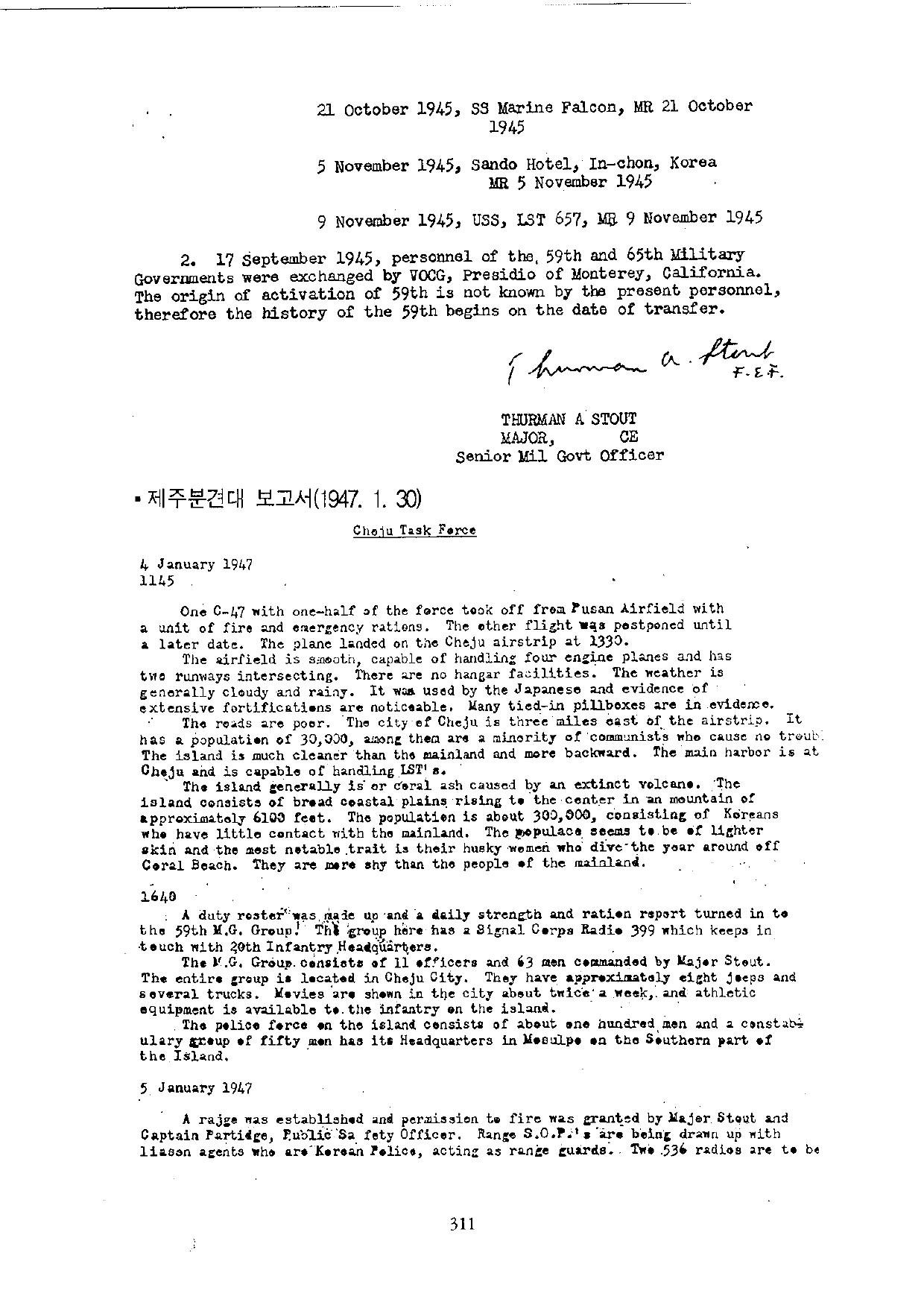
Cheju Task Force
4 January 1947
1145
One C-47 with one-half of the force took off from Pusan Airfield with a unit of fire and emergency rations. The other flight was postponed until a later date. The plane landed on the Cheju airstrip at 1330.
The airfield is smooth, capable of handling four engine planes and has two runways intersecting. There are no hangar facilities. The weather is generally cloudy and rainy. It was used by the Japanese and evidence of extensive fortifications are noticeable. Many tied-in pillboxes are in evidence.
The roads are poor. The city of Cheju is three miles east of the airstrip. It has a population of 30,000, among them are a minority of communists who cause no trouble. The island is much cleaner than the mainland and more backward. The main harbor is at Cheju and is capable of handling LST's.
The island generally is or coral ash caused by an extinct volcano. The island consists of broad coastal plains rising to the center in an mountain of approximately 6100 feet. The population is about 300,000, consisting of Koreans who have little contact with the mainland. The populace seems to be of lighter skin and the most notable trait is their husky women who dive the year around off Coral Beach. They are more shy than the people of the mainland.
1640
A duty roster was made up and a daily strength and ration report turned in to the 59th M.G. Group. The group here has a Signal Corps Radio 399 which keeps in touch with 29th Infantry Headquarters.
The M.G. Group consists of 11 officers and 63 men commanded by Major Stout. The entire group is located in Cheju City. They have approximately eight jeeps and several trucks. Movies are shown in the city about twice a week, and athletic equipment is available to the infantry on the island.
The police force on the island consists of about one hundred men and a constabulary group of fifty men has its Headquarters in Mesulpo on the Southern part of the Island.
5 January 1947
A rajge was established and permission to fire was granted by Major Stout and Captain Partidge, Public Sa fety Officer. Range S.O.P.'s are being drawn up with liason agents who are Korean Police, acting as range guards. Two 536 radios are to be
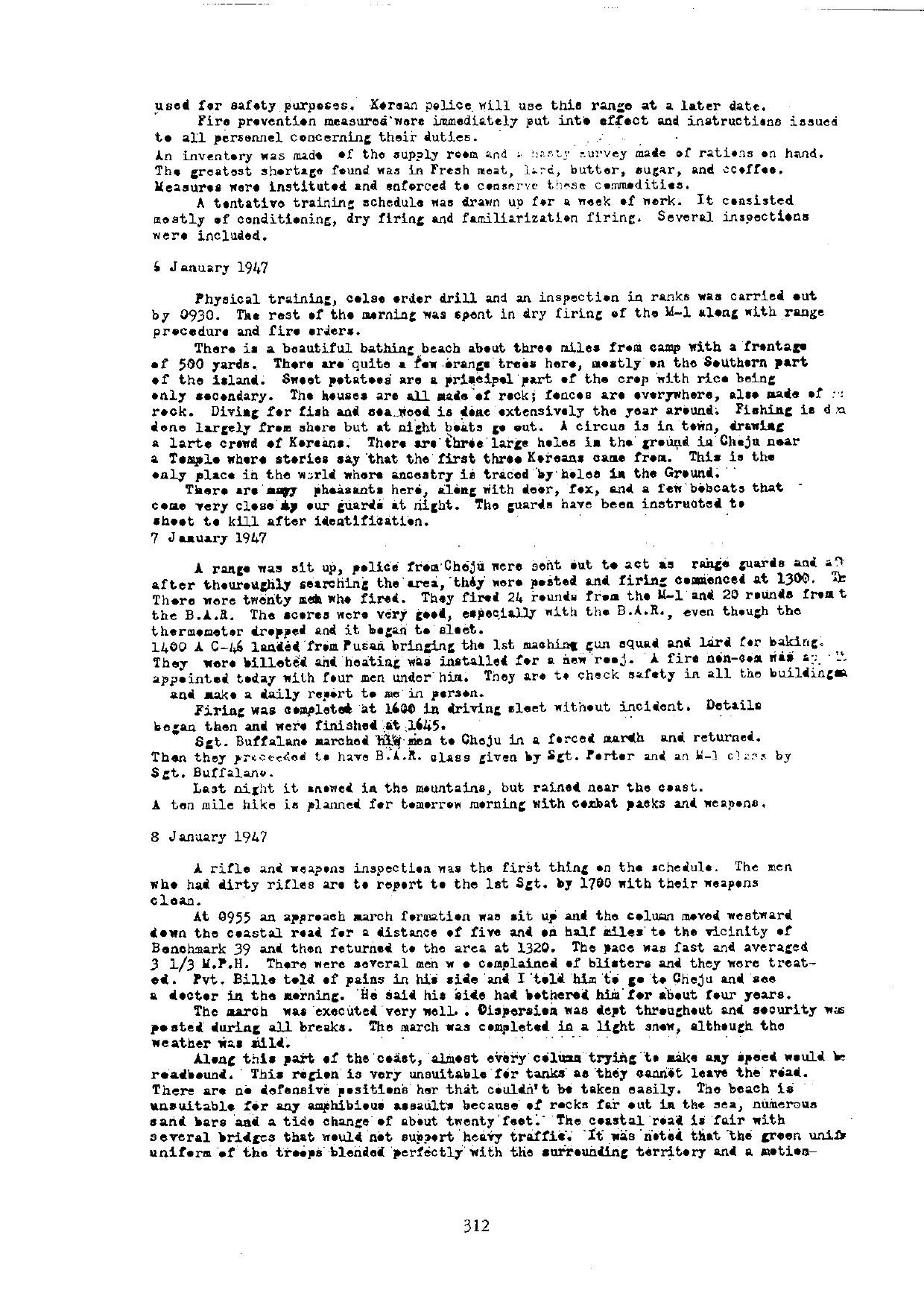
used for safety purposes. Korean police will use this range at a later date.
Fire prevention measured were immediately put into effect and instructions issued to all personnel concerning their duties.
An inventory was made of the supply room and a hasty survey made of rations on hand. The greatest shortage found was in Fresh meat, lard, butter, sugar, and coffee. Measures were instituted and enforced to conserve these commodities.
A tentative training schedule was drawn up for a week of work. It consisted mostly of conditioning, dry firing and familiarization firing. Several inspections were included.
6 January 1947
Physical training, close order drill and an inspection in ranks was carried out by 0930. The rest of the morning was spent in dry firing of the M-1 along with range procedure and fire orders.
There is a beautiful bathing beach about three miles from camp with a frontage of 500 yards. There are quite a few orange trees here, mostly on the Southern part of the island. Sweet potatoes are a principal part of the crop with rice being only secondary. The houses are all made of rock; fences are everywhere, also made of rock. Diving for fish and sea wood is done extensively the year around. Fishing is done largely from shore but at night boats go out. A circus is in town, drawing a larte crowd of Koreans. There are three large holes in the ground in Cheju near a Temple where stories say that the first three Koreans came from. This is the only place in the world where ancestry is traced by holes in the Ground.
There are many pheasants here, along with deer, fox, and a few bobcats that come very close by our guards at night. The guards have been instructed to shoot to kill after identification.
7 January 1947
A range was sit up, police from Cheju were sent out to act as range guards and a[illegible] after thouroughly searching the area, they were posted and firing commenced at 1300. [illegible] There were twenty men who fired. They fired 24 rounds from the M-1 and 20 rounds from t the B.A.R. The scores were very good, especially with the B.A.R., even though the thermometer dropped and it began to sleet.
1400 A C-46 landed from Pusan bringing the 1st machine gun squad and lard for baking. They were billeted and heating was installed for a new reej. A fire non-com was a[illegible] appointed today with four men under him. They are to check safety in all the buildings and make a daily report to me in person.
Firing was completed at 1600 in driving sleet without incident. Details began then and were finished at 1645.
Sgt. Buffalano marched his men to Cheju in a forced march and returned. Then they proceeded to have B.A.R. class given by Sgt. Porter and an M-1 class by Sgt. Buffalano.
Last night it snowed in the mountains, but rained near the coast. A ten mile hike is planned for tomorrow morning with combat packs and weapons.
8 January 1947
A rifle and weapons inspection was the first thing on the schedule. The men who had dirty rifles are to report to the 1st Sgt. by 1700 with their weapons clean.
At 0955 an approach march formation was sit up and the column moved westward down the coastal road for a distance of five and on half miles to the vicinity of Benchmark 39 and then returned to the area at 1320. The pace was fast and averaged 3 1/3 M.P.H. There were several men w e complained of blisters and they wore treated. Pvt. Bille told of pains in his side and I told him to go to Cheju and see a doctor in the morning. He said his side had bothered him for about four years.
The march was executed very well. . Dispersion was dept throughout and security was posted during all breaks. The march was completed in a light snow, although the weather was mild.
Along this part of the coast, almost every column trying to make any speed would be roadbound. This region is very unsuitable for tanks as they cannot leave the road. There are no defensive positions her that couldn't be taken easily. The beach is unsuitable for any amphibious assaults because of rocks far out in the sea, numerous sand bars and a tide change of about twenty feet. The coastal road is fair with several bridges that would not support heavy traffic. It was noted that the green unifo uniform of the troops blended perfectly with the surrounding territory and a motion-
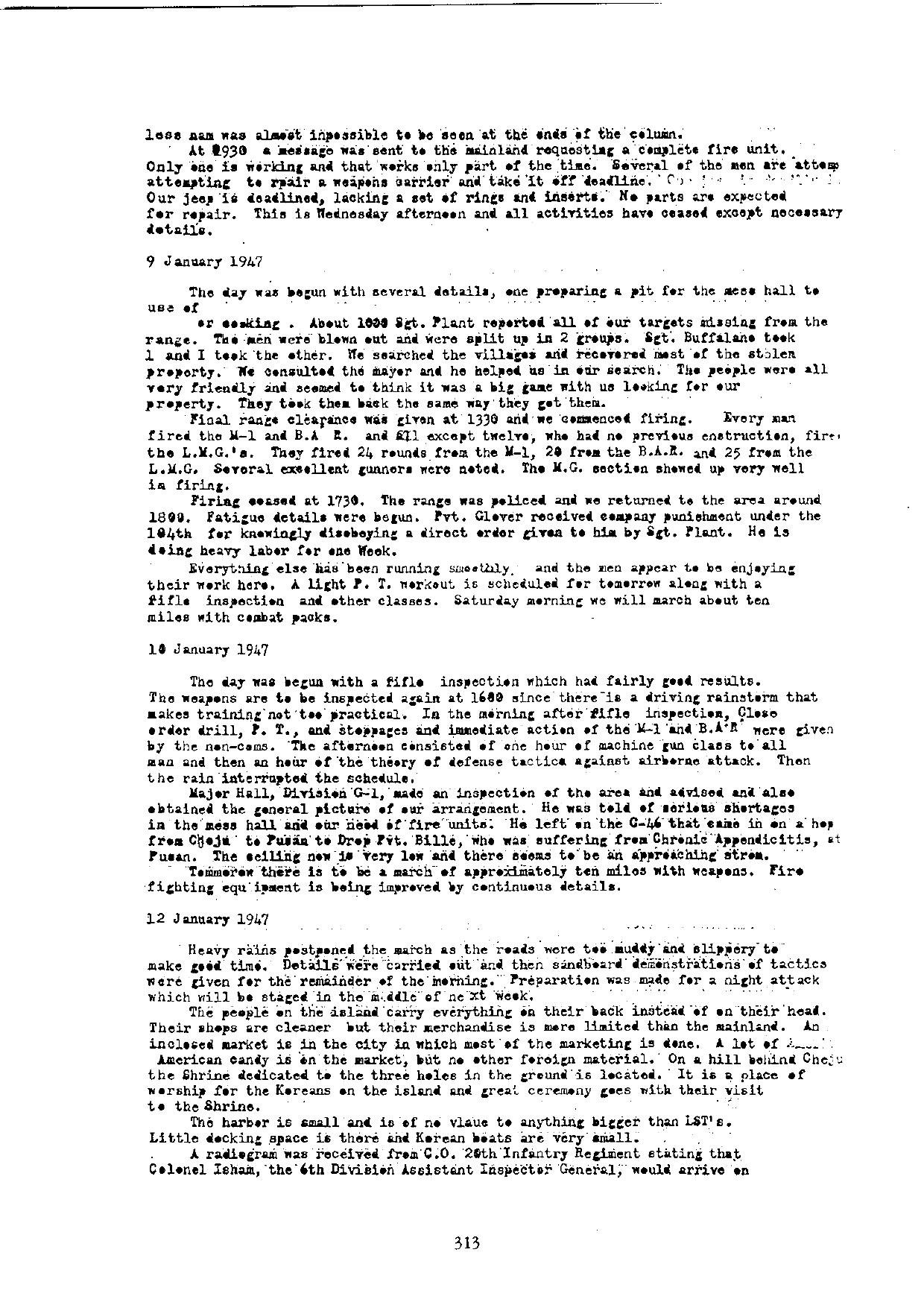
less nam was almost impossible to be seen at the ends of the column.
At 2930 a message was sent to the mainland requesting a complete fire unit. Only one is working and that works only part of the time. Several of the men are attemp attempting to repair a weapons carrier and take it off deadline. Co· [illegible] Our jeep is deadlined, lacking a set of rings and inserts. No parts are expected for repair. This is Wednesday afternoon and all activities have ceased except necessary details.
9 January 1947
The day was begun with several details, one preparing a pit for the mess hall to use of
or seeding . About 1020 Sgt. Plant reported all of our targets missing from the range. The men were blown out and were split up in 2 groups. Sgt. Buffalano took l and I took the other. We searched the villages and recovered most of the stolen property. We consulted the mayor and he helped us in our search. The people were all very friendly and seemed to think it was a big game with us looking for our property. They took them back the same way they get them.
Final range clearance was given at 1330 and we commenced firing. Every man fired the M-1 and B.A. R. and 21l except twelve, who had no previous construction, fire the L.M.G.'s. They fired 24 rounds from the M-1, 20 from the B.A.R. and 25 from the L.M.G. Several excellent gunners were noted. The M.G. section showed up very well in firing.
Firing ceased at 1730. The range was policed and we returned to the area around 1800. Fatigue details were begun. Pvt. Glover received company punishment under the 104th for knowingly disobeying a direct order given to him by Sgt. Plant. He is doing heavy labor for one Week.
Everything else has been running smoothly. and the men appear to be enjoying their work here. A light P. T. workout is scheduled for tomorrow along with a rifle inspection and other classes. Saturday morning we will march about ten miles with combat packs.
10 January 1947
The day was begun with a fifle inspection which had fairly good results. The weapons are to be inspected again at 1600 since there is a driving rainstorm that makes training not too practical. In the morning after fifle inspection, Close order drill, P. T., and steppages and immediate action of the M-1 and B.A'R were given by the non-coms. The afternoon consisted of one hour of machine gun class to all man and then an hour of the theory of defense tactics against airborne attack. Then the rain interrupted the schedule.
Major Hall, Division G-1, made an inspection of the area and advised and also obtained the general picture of our arrangement. He was told of serious shortages in the mess hall and our need of fire units. He left on the C-46 that came in on a hop from Cheja to Pusan to Drop Pvt. Bille, who was suffering from Chronic Appendicitis, at Pusan. The ceiling new is very low and there seems to be an approaching strom.
Tomorrow there is to be a march of approximately ten miles with weapons. Fire fighting equipment is being improved by continuous details.
12 January 1947
Heavy rains postponed the march as the roads were too muddy and slippery to make good time. Details were carried out and then sandboard demonstrations of tactics were given for the remainder of the morning. Preparation was made for a night attack which will be staged in the middle of next week.
The people on the island carry everything on their back instead of on their head. Their shops are cleaner but their merchandise is more limited than the mainland. An inclosed market is in the city in which most of the marketing is done. A lot of [illegible]
American candy is on the market, but no other foreign material. On a hill behind Cheju the Shrine dedicated to the three holes in the ground is located. It is a place of worship for the Koreans on the island and great ceremony goes with their visit to the Shrine.
The harbor is small and is of no vlaue to anything bigger than LST's. Little docking space is there and Korean boats are very small.
A radiogram was received from C.O. 20th Infantry Regiment stating that Colonel Isham, the 6th Division Assistant Inspector General, would arrive on
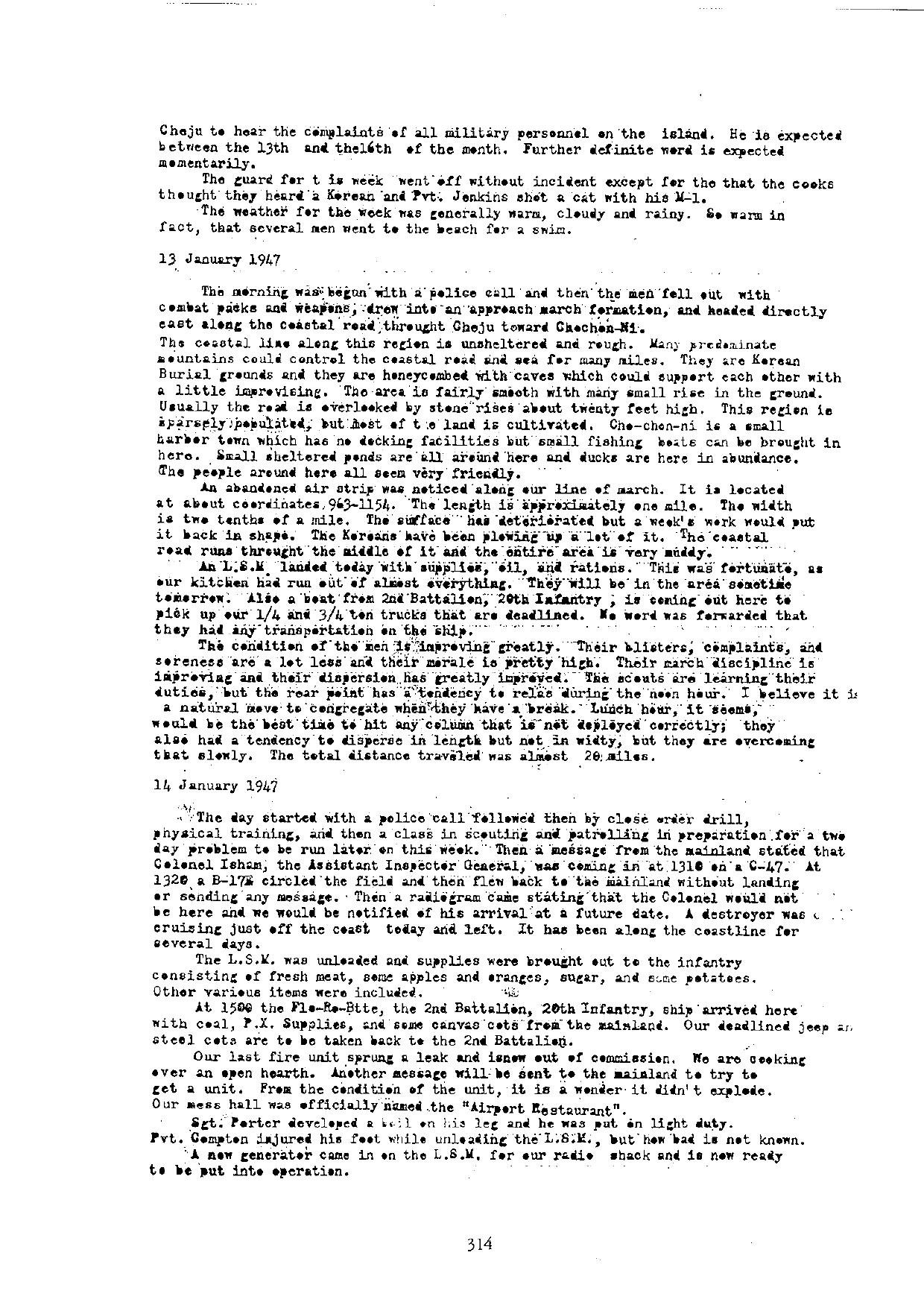
Cheju to hear the complaints of all military personnel on the island. He is expected between the 13th and the16th of the month. Further definite word is expected momentarily.
The guard for t is week went off without incident except for the that the cooks thought they heard a Korean and Pvt. Jenkins shot a cat with his M-1.
The weather for the week was generally warm, cloudy and rainy. So warm in fact, that several men went to the beach for a swim.
13 January 1947
The morning was begun with a police call and then the men fell out with combat packs and weapons, drew into an approach march formation, and headed directly east along the coastal road through Cheju toward Chochon-Ni.
The coastal line along this region is unsheltered and rough. Many predominate mountains could control the coastal road and sea for many miles. They are Korean Burial grounds and they are honeycombed with caves which could support each other with a little improvising. The area is fairly smooth with many small rise in the ground. Usually the road is overlooked by stone rises about twenty feet high. This region is sparsely populated, but most of t e land is cultivated. Che-chon-ni is a small harbor town which has no docking facilities but small fishing boats can be brought in here. Small sheltered ponds are all around here and ducks are here in abundance. The people around here all seem very friendly.
An abandoned air strip was noticed along our line of march. It is located at about coordinates 963-1154. The length is approximately one mile. The width is two tenths of a mile. The surface has deteriorated but a week's work would put it back in shape. The Koreans have been plowing up a lot of it. The coastal road runs through the middle of it and the entire area is very muddy.
An L.S.M. landed today with supplies, oil, and rations. This was fortunate, as our kitchen had run out of almost everything. They will be in the area sometime tomorrow. Also a boat from 2nd Battalion, 20th Infantry, is coming out here to pick up our 1/4 and 3/4 ton trucks that are deadlined. No word was forwarded that they had any transportation on the ship.
The condition of the men is improving greatly. Their blisters, complaints, and soreness are a lot less and their morale is pretty high. Their march discipline is improving and their dispersion has greatly improved. The scouts are learning their duties, but the rear point has a tendency to relax during the noon hour. I believe it is a natural move to congregate when they have a break. Lunch hour, it seems, would be the best time to hit any column that is not deployed correctly; they also had a tendency to disperse in length but not in width, but they are overcoming that slowly. The total distance traveled was almost 26 miles.
14 January 1947
The day started with a police call followed then by close order drill, physical training, and then a class in scouting and patrolling in preparation for a two day problem to be run later on this week. Then a message from the mainland stated that Colonel Isham, the Assistant Inspector General, was coming in at 1310 on a C-47. At 1320 a B-17E circled the field and then flew back to the mainland without landing or sending any message. Then a radiogram came stating that the Colonel would not be here and we would be notified of his arrival at a future date. A destroyer was cruising just off the coast today and left. It has been along the coastline for several days.
The L.S.K. was unloaded and supplies were brought out to the infantry consisting of fresh meat, some apples and oranges, sugar, and some potatoes. Other various items were included.
At 1500 the Fle-Re-Btte, the 2nd Battalion, 20th Infantry, ship arrived here with coal, P.X. Supplies, and some canvas cots from the mainland. Our deadlined jeep and steel cots are to be taken back to the 2nd Battalion.
Our last fire unit sprung a leak and is now out of commission. We are seeking ever an open hearth. Another message will be sent to the mainland to try to get a unit. From the condition of the unit, it is a wonder it didn't explode. Our mess hall was officially named the "Airport Restaurant".
Sgt. Porter developed a boil on his leg and he was put on light duty.
Pvt. Compton injured his feet while unloading the L.S.M., but how bad is not known.
A new generator came in on the L.S.M. for our radio shack and is now ready to be put into operation.
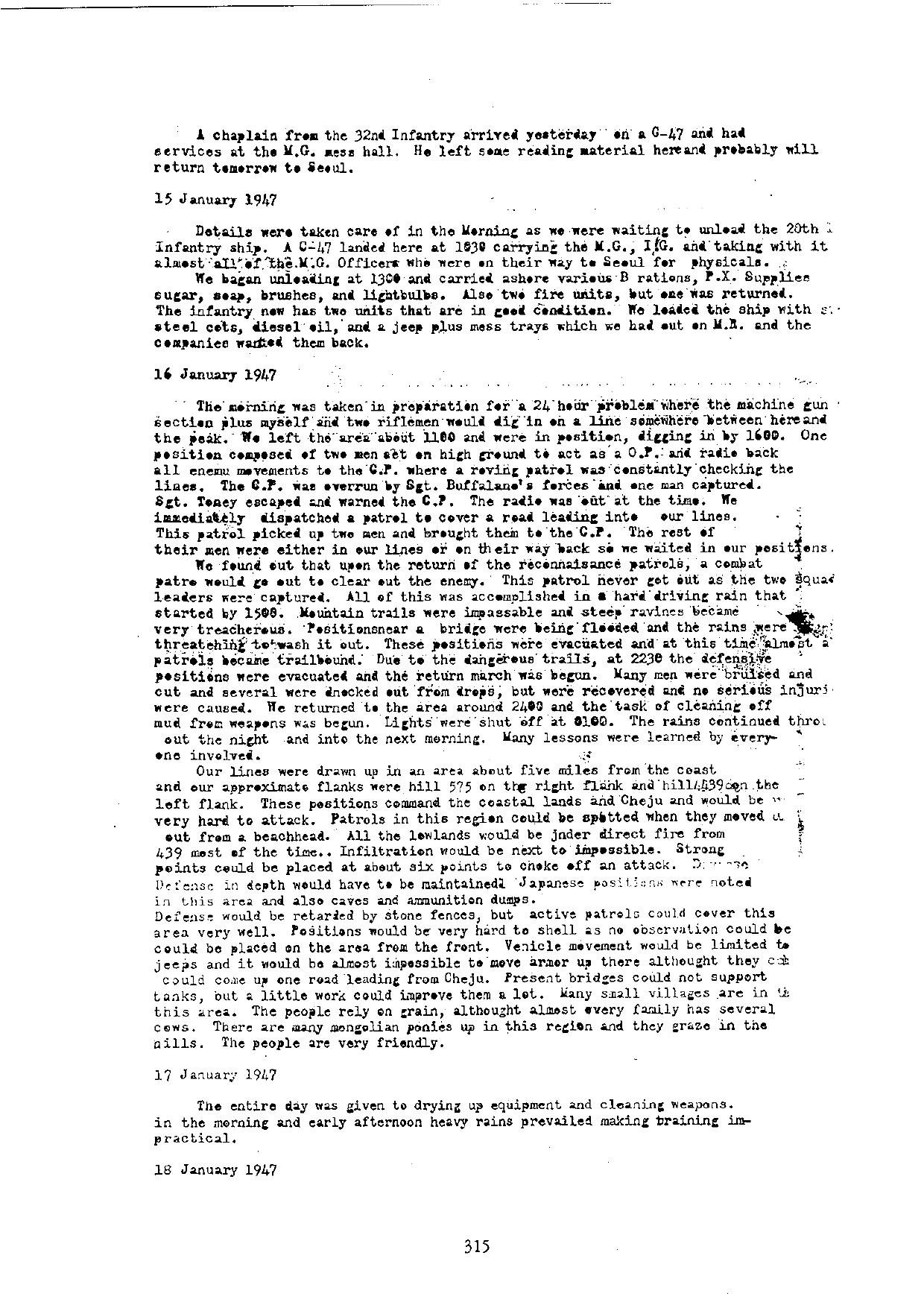
A chaplain from the 32nd Infantry arrived yesterday on a G-47 and had services at the M.G. mess hall. He left some reading material here and probably will return tomorrow to Seoul.
15 January 1947
Details were taken care of in the Morning as we were waiting to unlead the 20th Infantry ship. A C-47 landed here at 1030 carrying the M.G., IG. and taking with it almost all of the M.G. Officers who were on their way to Seoul for physicals.
We bagan unleading at 1300 and carried ashore various B rations, P.X. Supplies sugar, soap, brushes, and lightbulbs. Also two fire units, but one was returned. The infantry new has two units that are in good condition. We leaded the ship with steel cots, diesel oil, and a jeep plus mess trays which we had out on M.R. and the companies wanted them back.
16 January 1947
The morning was taken in preparation for a 24 hour problem where the machine gun section plus myself and two riflemen would dig in on a line somewhere between here and the peak. We left the area about 1100 and were in position, digging in by 1600. One position composed of two men set on high ground to act as a O.P. and radio back all enemu movements to the C.P. where a roving patrol was constantly checking the lines. The C.P. was overrun by Sgt. Buffalane's forces and one man captured. Sgt. Toney escaped and warned the C.P. The radio was out at the time. We immediately dispatched a patrol to cover a road leading into our lines. This patrol picked up two men and brought them to the C.P. The rest of their men were either in our lines or on their way back so we waited in our positions.
We found out that upon the return of the reconnaissance patrols, a combat patre would go out to clear out the enemy. This patrol never got out as the two squad leaders were captured. All of this was accomplished in a hard driving rain that started by 1500. Mountain trails were impassable and steep ravines became very treacherous. Positionsnear a bridge were being flooded and the rains were [illegible] threatening to wash it out. These positions were evacuated and at this time almost a patrols became trailbound. Due to the dangerous trails, at 2230 the defensive positions were evacuated and the return march was begun. Many men were bruised and cut and several were knocked out from drops, but were recovered and no serious injuries were caused. We returned to the area around 2400 and the task of cleaning off mud from weapons was begun. Lights were shut off at 0100. The rains continued through out the night and into the next morning. Many lessons were learned by everyone involved.
Our lines were drawn up in an area about five miles from the coast and our approximate flanks were hill 575 on the right flank and hill 539 on the left flank. These positions command the coastal lands and Cheju and would be very hard to attack. Patrols in this region could be spotted when they moved out from a beachhead. All the lowlands would be under direct fire from 439 most of the time.. Infiltration would be next to impossible. Strong points could be placed at about six points to choke off an attack. Defense in depth would have to be maintained. Japanese positions were noted in this area and also caves and ammunition dumps. Defense would be retarded by stone fences, but active patrols could cover this area very well. Positions would be very hard to shell as no observation could be could be placed on the area from the front. Vehicle movement would be limited to jeeps and it would be almost impossible to move armor up there although they could come up one road leading from Cheju. Present bridges could not support tanks, but a little work could improve them a lot. Many small villages are in this area. The people rely on grain, although almost every family has several cows. There are many mongolian ponies up in this region and they graze in the hills. The people are very friendly.
17 January 1947
The entire day was given to drying up equipment and cleaning weapons. in the morning and early afternoon heavy rains prevailed making training impractical.
18 January 1947
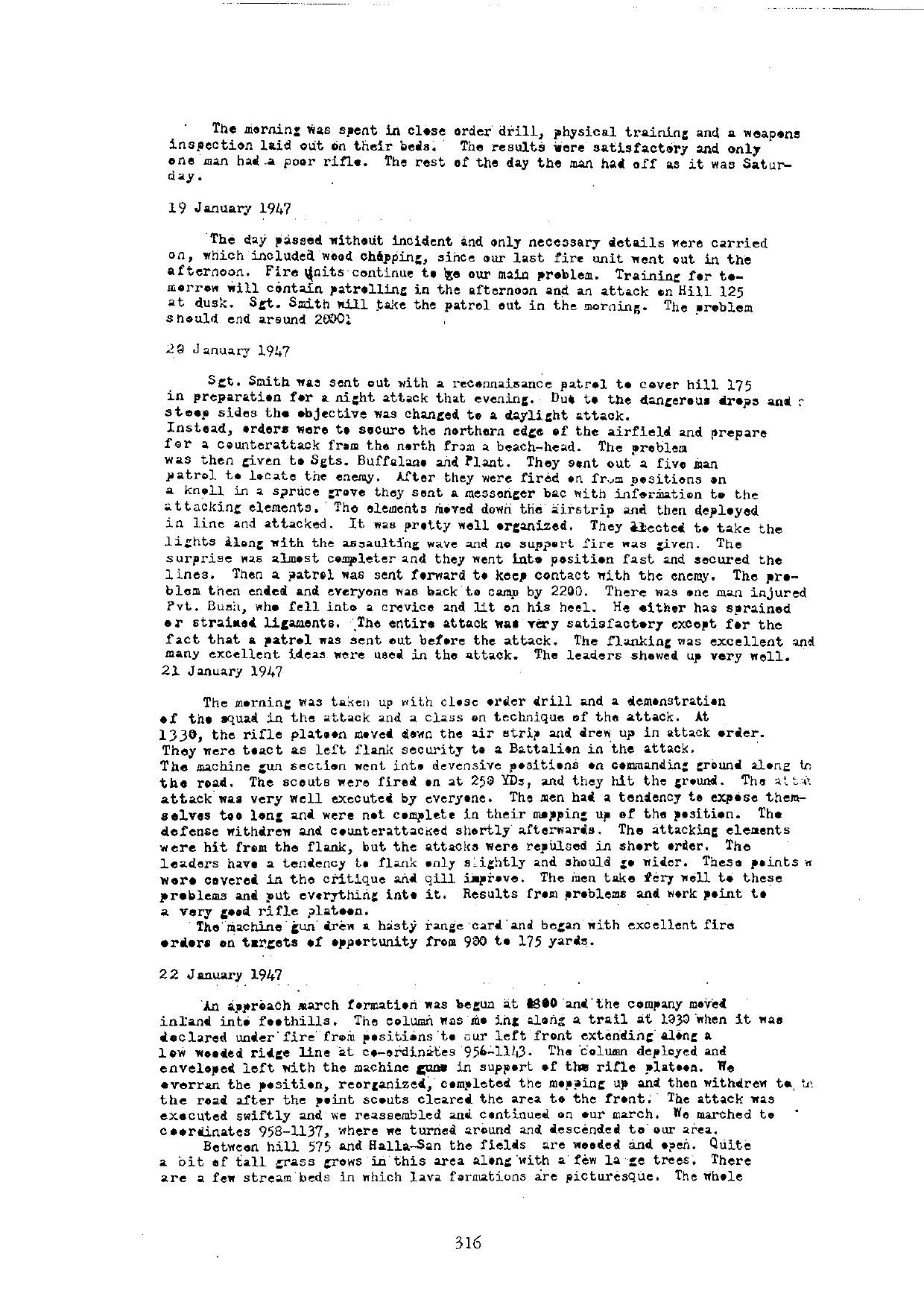
The morning was spent in close order drill, physical training and a weapons inspection laid out on their beds. The results were satisfactory and only one man had a poor rifle. The rest of the day the man had off as it was Saturday.
19 January 1947
The day passed without incident and only necessary details were carried on, which included wood chopping, since our last fire unit went out in the afternoon. Fire units continue to be our main problem. Training for tomorrow will contain patrolling in the afternoon and an attack on Hill 125 at dusk. Sgt. Smith will take the patrol out in the morning. The problem should end around 2000.
29 January 1947
Sgt. Smith was sent out with a reconnaissance patrol to cover hill 175 in preparation for a night attack that evening. Due to the dangerous drops and c steep sides the objective was changed to a daylight attack. Instead, orders were to secure the northern edge of the airfield and prepare for a counterattack from the north from a beach-head. The problem was then given to Sgts. Buffalane and Plant. They sent out a five man patrol to locate the enemy. After they were fired on from positions on a knoll in a spruce grove they sent a messenger bac with information to the attacking elements. The elements moved down the airstrip and then deployed in line and attacked. It was pretty well organized. They elected to take the lights along with the assaulting wave and no support fire was given. The surprise was almost completer and they went into position fast and secured the lines. Then a patrol was sent forward to keep contact with the enemy. The problem then ended and everyone was back to camp by 2200. There was one man injured Pvt. Bush, who fell into a crevice and lit on his heel. He either has sprained or strained ligaments. The entire attack was very satisfactory except for the fact that a patrol was sent out before the attack. The flanking was excellent and many excellent ideas were used in the attack. The leaders showed up very well. 21 January 1947
The morning was taken up with close order drill and a demonstration of the squad in the attack and a class on technique of the attack. At 1330, the rifle platoon moved down the air strip and drew up in attack order. They were toact as left flank security to a Battalion in the attack. The machine gun section went into devensive positions on commanding ground along to the road. The scouts were fired on at 250 YDs, and they hit the ground. The attack was very well executed by everyone. The men had a tendency to expose themselves too long and were not complete in their mapping up of the position. The defense withdrew and counterattacked shortly afterwards. The attacking elements were hit from the flank, but the attacks were repulsed in short order. The leaders have a tendency to flank only slightly and should go wider. These points w were covered in the critique and gill improve. The men take very well to these problems and put everything into it. Results from problems and work point to a very good rifle platoon.
The machine gun drew a hasty range card and began with excellent fire orders on targets of opportunity from 900 to 175 yards.
22 January 1947
An approach march formation was begun at 0800 and the company moved inland into foothills. The column was me ing along a trail at 1030 when it was declared under fire from positions to our left front extending along a low wooded ridge line at co-ordinates 956-1143. The column deployed and enveloped left with the machine guns in support of the rifle platoon. He overran the position, reorganized, completed the mopping up and then withdrew to to the road after the point scouts cleared the area to the front. The attack was executed swiftly and we reassembled and continued on our march. We marched to coordinates 958-1137, where we turned around and descended to our area.
Between hill 575 and Halla-San the fields are wooded and open. Quite a bit of tall grass grows in this area along with a few la ge trees. There are a few stream beds in which lava formations are picturesque. The whole
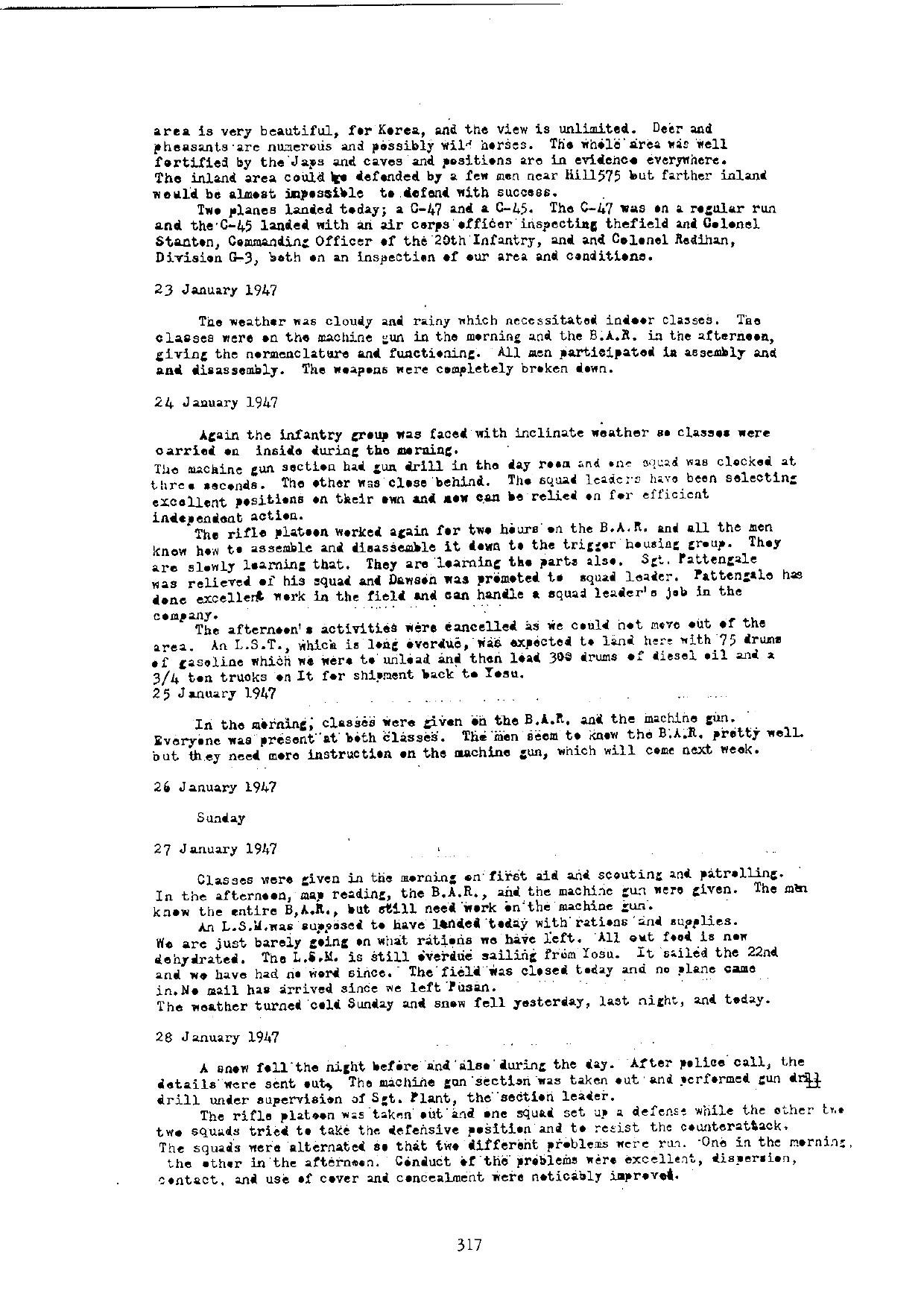
area is very beautiful, for Korea, and the view is unlimited. Deer and pheasants are numerous and possibly wild horses. The whole area was well fortified by the Japs and caves and positions are in evidence everywhere. The inland area could be defended by a few men near Hill575 but farther inland would be almost impossible to defend with success.
Two planes landed today; a C-47 and a C-45. The C-47 was on a regular run and the C-45 landed with an air corps officer inspecting thefield and Colonel Stanton, Commanding Officer of the 20th Infantry, and and Colonel Radihan, Division G-3, both on an inspection of our area and conditions.
23 January 1947
The weather was cloudy and rainy which necessitated indoor classes. The classes were on the machine gun in the morning and the B.A.R. in the afternoon, giving the nomenclature and functioning. All men participated in assembly and and disassembly. The weapons were completely broken down.
24 January 1947
Again the infantry group was faced with inclinate weather so classes were carried on inside during the morning.
The machine gun section had gun drill in the day room and one squad was clocked at three seconds. The other was close behind. The squad leaders have been selecting excellent positions on their own and now can be relied on for efficient independent action.
The rifle platoon worked again for two hours on the B.A.R. and all the men know how to assemble and disassemble it down to the trigger housing group. They are slowly learning that. They are learning the parts also. Sgt. Pattengale was relieved of his squad and Dawson was promoted to squad leader. Pattengale has done excellent work in the field and can handle a squad leader's job in the company.
The afternoon's activities were cancelled as we could not move out of the area. An L.S.T., which is long overdue, was expected to land here with 75 drums of gasoline which we were to unload and then lead 300 drums of diesel oil and a 3/4 ton trucks on It for shipment back to Yosu.
25 January 1947
In the morning, classes were given on the B.A.R. and the machine gun. Everyone was present at both classes. The men seem to know the B.A.R. pretty well but they need more instruction on the machine gun, which will come next week.
26 January 1947
Sunday
27 January 1947
Classes were given in the morning on first aid and scouting and patrolling. In the afternoon, map reading, the B.A.R., and the machine gun were given. The men knew the entire B,A.R., but still need work on the machine gun.
An L.S.M.was supposed to have landed today with rations and supplies. We are just barely going on what rations we have left. All out food is now dehydrated. The L.S.M. is still overdue sailing from Yosu. It sailed the 22nd and we have had no word since. The field was closed today and no plane came in. No mail has arrived since we left Pusan.
The weather turned cold Sunday and snow fell yesterday, last night, and today.
28 January 1947
A snow fell the night before and also during the day. After police call, the details were sent out, The machine gun section was taken out and performed gun drill under supervision of Sgt. Plant, the section leader.
The rifle platoon was taken out and one squad set up a defense while the other two squads tried to take the defensive position and to resist the counterattack. The squads were alternated so that two different problems were run. One in the morning, the other in the afternoon. Conduct of the problems were excellent, dispersion, contact, and use of cover and concealment were noticably improved.
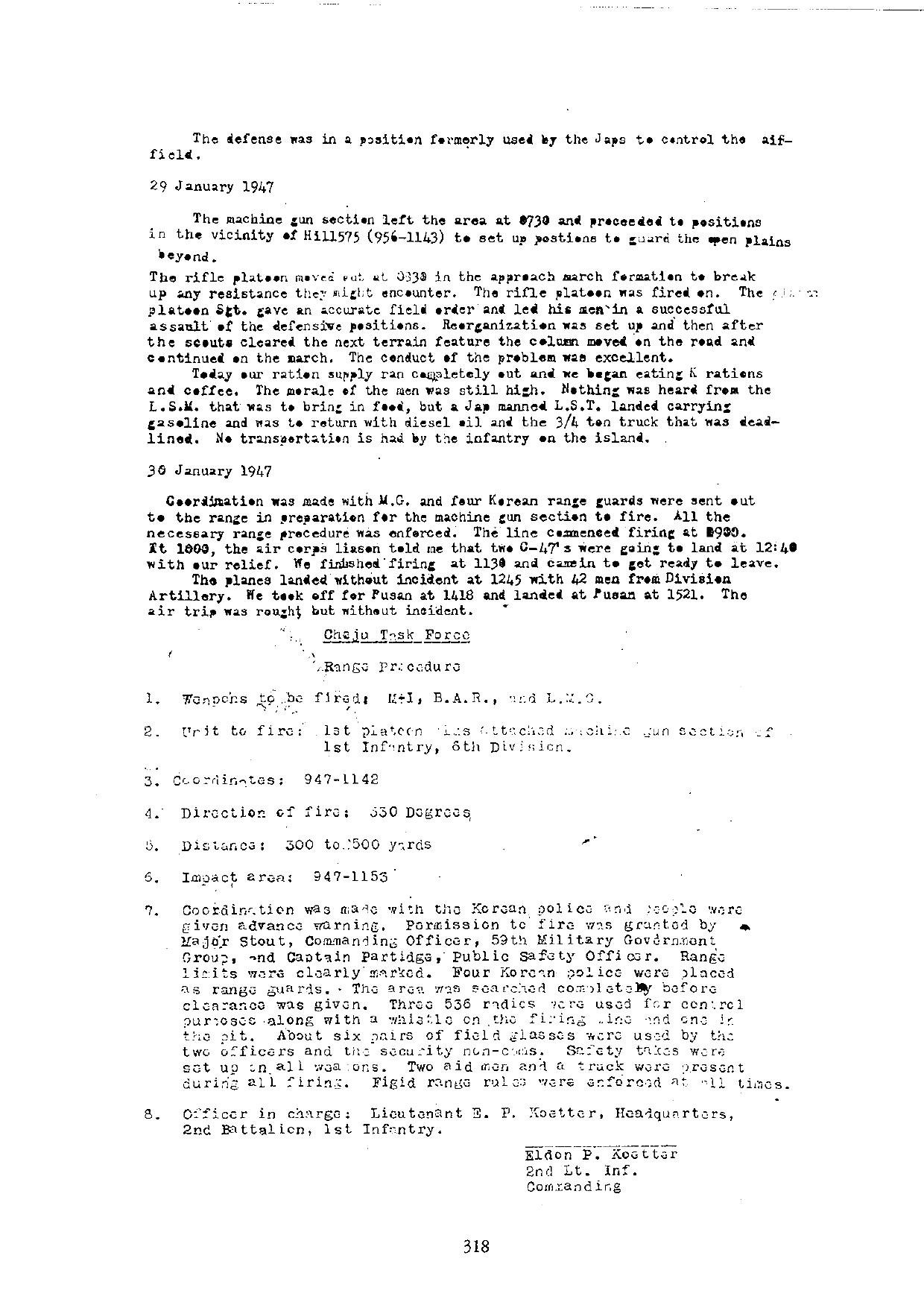
The defense was in a position formerly used by the Japs to control the airfield.
29 January 1947
The machine gun section left the area at 0730 and preceded to positions in the vicinity of Hill575 (956-1143) to set up positions to guard the open plains beyond.
The rifle platoon moved out at 0339 in the approach march formation to break up any resistance they might encounter. The rifle platoon was fired on. The platoon Sgt. gave an accurate field order and led his men in a successful assault of the defensive positions. Reorganization was set up and then after the scouts cleared the next terrain feature the column moved on the road and continued on the march. The conduct of the problem was excellent.
Today our ration supply ran completely out and we began eating K rations and coffee. The morale of the men was still high. Nothing was heard from the L.S.M. that was to bring in feed, but a Jap manned L.S.T. landed carrying gasoline and was to return with diesel oil and the 3/4 ton truck that was deadlined. No transportation is had by the infantry on the island.
30 January 1947
Coordination was made with M.G. and four Korean range guards were sent out to the range in preparation for the machine gun section to fire. All the necessary range procedure was enforced. The line commenced firing at 0900. It 1000, the air corps liason told me that two C-47's were going to land at 12:40 with our relief. We finished firing at 1130 and came in to get ready to leave.
The planes landed without incident at 1245 with 42 men from Division Artillery. We took off for Pusan at 1418 and landed at Pusan at 1521. The air trip was rough; but without incident.
Cheju Task Force
Range Procedure
1. Weapons to be fired: M+1, B.A.R., and L.M.G.
2. Unit to fire: 1st platoon has attached machine gun section of 1st Infantry, 6th Division.
3. Coordinates: 947-1142
4. Direction of fire: 330 Degrees
5. Distance: 300 to 500 yards
6. Impact area: 947-1153
7. Coordination was made with the Korean police and people were given advance warning. Permission to fire was granted by Major Stout, Commanding Officer, 59th Military Government Group, and Captain Partidge, Public Safety Officer. Range limits were clearly marked. Four Korean police were placed as range guards. The area was searched completely before clearance was given. Three 536 radios were used for control purposes along with a whistle on the firing line and one in the pit. About six pairs of field glasses were used by the two officers and the security non-coms. Safety takes were set up on all weapons. Two aid men and a truck were present during all firing. Rigid range rules were enforced at all times.
8. Officer in charge: Lieutenant E. P. Koetter, Headquarters, 2nd Battalion, 1st Infantry.
Eldon P. Koetter
2nd Lt. Inf.
Commanding
출처:
제주4·3사건진상규명및희생자명예회복위원회 편,
『제주4·3사건자료집 9』 [미국자료편]
/ 원문 p.311–318.