(정보요약 제2491호)
한국
군사, 정치, 경제, 사회정세, 신문논평, 민정, 기타
군사적 동향
1. 최근 상황:
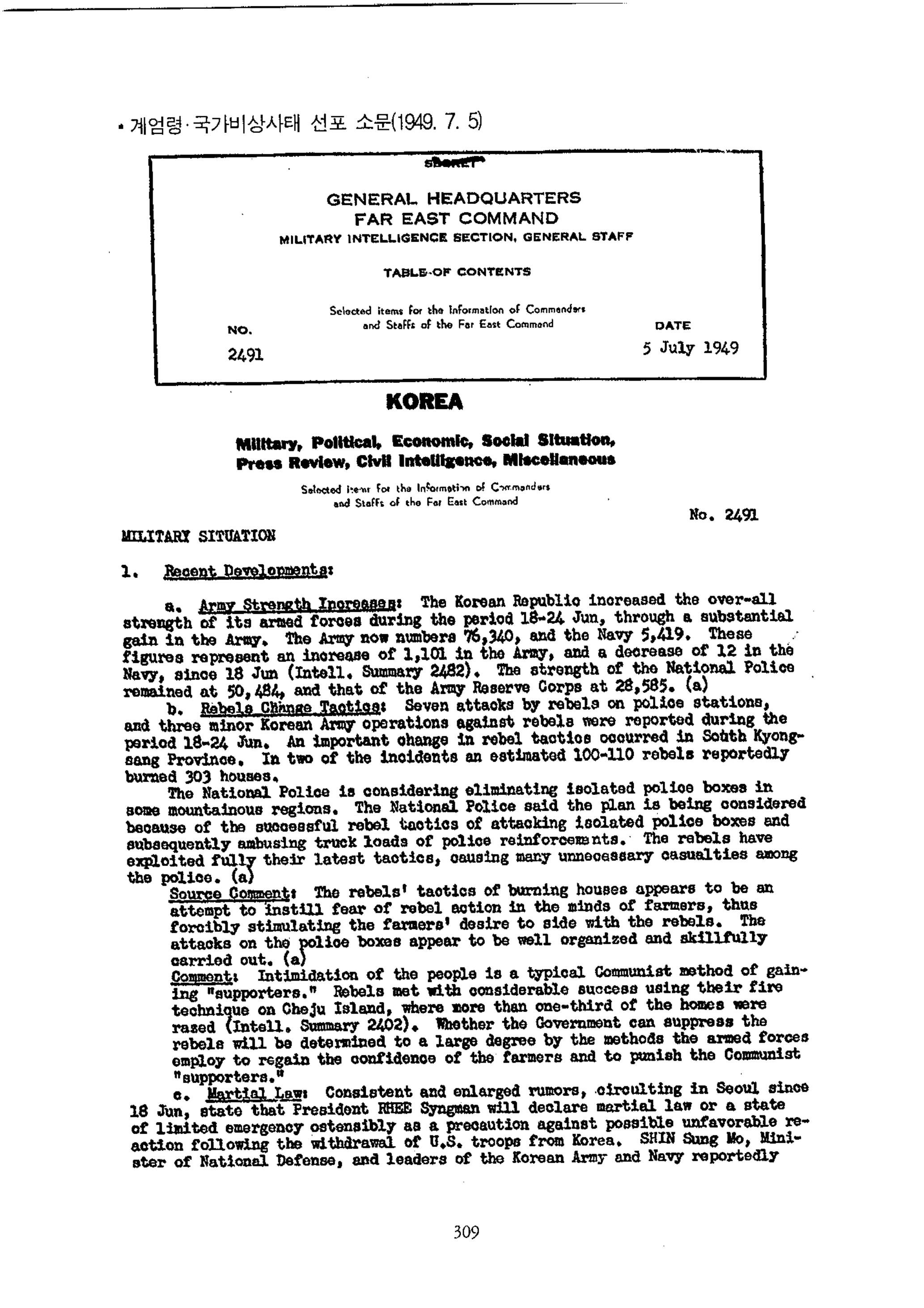
a) 병력증강: 한국정부는 6월 18일에서 24일까지 육군에서 실질적인 증원을 통하여 병력의 전반적인 규모를 증강하였다. 육군은 현재 7만 6,340명이고 해군은 5,419명이다. 이 숫자는 6월 18일 이래로 육군은 1,101명 증가되었고 해군은 12명 감소한 것을 나타낸다. (<정보요약> 제2482호) 경찰 병력은 5만 484명에 머물러 있고 예비군(Army Reserve Corps) 규모도 2만 8,585명이다.
b) 폭도들의 전략 변화: 6월 18일에서 6월 24일까지 7건의 폭도들의 경찰서 공격건과 3건의 소규모 폭도 토벌 작전이 보고되었다. 폭도들의 전술의 중요한 변화가 경상남도에서 일어났다. 2차례의 사건에서 약 100명~110명의 폭도들이 민가 303채에 불을 질렀다는 보고다.
경찰은 산악지역에 고립되어 있는 경찰지서 폐쇄를 고려중이다. 경찰은 폭도들의 고립된 경찰지서에 대한 성공적인 공격과 빈번한 경찰 증원병력 수송트럭에 대한 매복공격을 이유로 그 계획(고립경찰지서 폐쇄)을 시행할 것을 고려 중이다. 폭도들은 경찰에게 많은 불필요한 사상자를 발생시키는 최신 전략을 충분히 이용했다.
자료 논평: 폭도들의 민가방화 전술은 농부들의 마음속에 폭도들에 대한 공포심을 주입시켜 농부들을 강제로 폭도들 편에 서도록 하려는 시도로 보인다. 경찰지서에 대한 공격은 잘 조직되었고 능숙하게 수행되었던 것으로 보인다.
논평: 대민협박은 공산주의자들의 지지자를 얻어내는 전형적인 방법이다. 폭도들은 제주도에서 방화를 이용하여 1/3 이상의 집들을 파괴하는 상당한 성공을 거두었다. 정부가 폭도들을 진압할 수 있을 지 없을 지 여부는 주로 군대가 농부들의 신뢰감을 다시 얻고 공산주의 협력자들을 처벌하는 방법에 달려있다.
c) 계엄령: 이승만 대통령이 미군의 철수로 발생할 수 있는 불순한 행동들에 대처하기 위한 예방조치로써 계엄령이나 제한적인 국가비상사태를 선포할 것이라는 끊임없이 확대된 소문들이 6월 18일 이래로 서울에서 돌고 있다. 신성모 국방부장관과 육‧해군의 지도자들은 남한 정부와 북한의 ‘조선민주주의 인민공화국’과의 연합을 주장한 좌익익사들과 중도인사들을 숙청하기 위하여 전면적인 계엄령을 선포하기를 원했다. 김효석(Kim Hyo Suk) 내무부장관과 경찰은 경찰이 현재의 힘을 잃게 될 것이라는 이유로 계엄령 선포에 반대했다. 신성모는 이승만 대통령이 의도한 육‧해군과 동일한 권한을 경찰에게 주는 특별행정명령(special executive order)에 동의하였다. 대통령은 계엄령을 선포하거나 경찰에게 군과 동일한 권한을 주는 것을 고려 중이다. 보고에 의하면 계엄령은 마지막으로 남은 미군부대의 철수와 동시에 선포될 것이라 한다. 그러나 계엄령 선포 일자가 내각의 의견분열로 차후로 연기되었다(B-3).
자료 논평: 위의 이승만 대통령의 행동들은 실현 불가능한 일이다. 만일 그 같은 행동들이 일어난다면 그것은 행정부에 대한 심각한 적개심을 야기할 것이다.
논평: 미군사고문관을 제외한 남한의 모든 미군부대는 6월 29일 12시에 한국에서 철수했다.
SECRET
GENERAL HEADQUARTERS
FAR EAST COMMAND
MILITARY INTELLIGENCE SECTION, GENERAL STAFF
TABLE-OF CONTENTS
Selected items for the Information of Commanders
NO. and Staffs of the Far East Command DATE
2491 5 July 1949
**KOREA**
**Military, Political, Economic, Social Situation, Press Review, Civil Intelligence, Miscellaneous**
Selected items for the Information of Commanders
and Staffs of the Far East Command
No. 2491
MILITARY SITUATION
1. Recent Developments:
a. Army Strength Increases: The Korean Republic increased the over-all strength of its armed forces during the period 18-24 Jun, through a substantial gain in the Army. The Army now numbers 76,340, and the Navy 5,419. These figures represent an increase of 1,101 in the Army, and a decrease of 12 in the Navy, since 18 Jun (Intell. Summary 2482). The strength of the National Police remained at 50,484, and that of the Army Reserve Corps at 28,585. (a)
b. Rebels Change Tactics: Seven attacks by rebels on police stations, and three minor Korean Army operations against rebels were reported during the period 18-24 Jun. An important change in rebel tactics occurred in South Kyongsang Province. In two of the incidents an estimated 100-110 rebels reportedly burned 303 houses.
The National Police is considering eliminating isolated police boxes in some mountainous regions. The National Police said the plan is being considered because of the successful rebel tactics of attacking isolated police boxes and subsequently ambusing truck loads of police reinforcements. The rebels have exploited fully their latest tactics, causing many unnecessary casualties among the police. (a)
Source Comment: The rebels' tactics of burning houses appears to be an attempt to instill fear of rebel action in the minds of farmers, thus forcibly stimulating the farmers' desire to side with the rebels. The attacks on the police boxes appear to be well organized and skillfully carried out. (a)
Comment: Intimidation of the people is a typical Communist method of gaining "supporters." Rebels met with considerable success using their fire technique on Cheju Island, where more than one-third of the homes were razed (Intell. Summary 2402). Whether the Government can suppress the rebels will be determined to a large degree by the methods the armed forces employ to regain the confidence of the farmers and to punish the Communist "supporters."
c. Martial Law: Consistent and enlarged rumors, circuiting in Seoul since 18 Jun, state that President RHEE Syngman will declare martial law or a state of limited emergency ostensibly as a precaution against possible unfavorable reaction following the withdrawal of U.S. troops from Korea. SHIN Sung Mo, Minister of National Defense, and leaders of the Korean Army and Navy reportedly
--- p319 ---
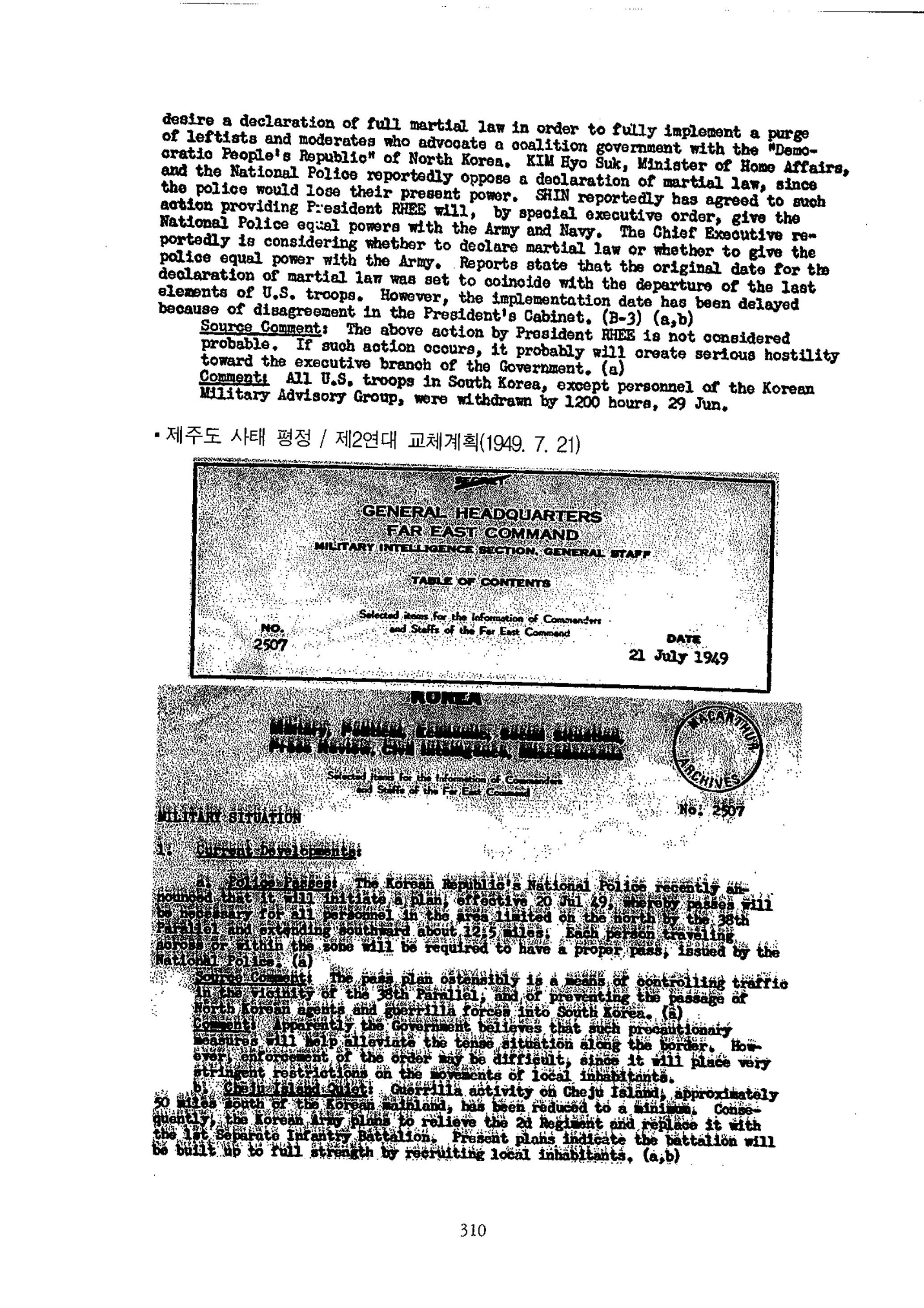
desire a declaration of full martial law in order to fully implement a purge of leftists and moderates who advocate a coalition government with the "Democratic People's Republic" of North Korea. KIM Hyo Suk, Minister of Home Affairs, and the National Police reportedly oppose a declaration of martial law, since the police would lose their present power. SHIN reportedly has agreed to such action providing President RHEE will, by special executive order, give the National Police equal powers with the Army and Navy. The Chief Executive reportedly is considering whether to declare martial law or whether to give the police equal power with the Army. Reports state that the original date for the declaration of martial law was set to coincide with the departure of the last elements of U.S. troops. However, the implementation date has been delayed because of disagreement in the President's Cabinet. (B-3) (a,b)
Source Comment: The above action by President RHEE is not considered probable. If such action occurs, it probably will create serious hostility toward the executive branch of the Government. (a)
Comment: All U.S. troops in South Korea, except personnel of the Korean Military Advisory Group, were withdrawn by 1200 hours, 29 Jun.
출처:
제주4·3사건진상규명및희생자명예회복위원회 편,
『제주4·3사건자료집 10』 [미국자료편],
번역문 p.120
/ 원문 p.309–310 / No. 2491.