제목: 남한에서 공산주의자들의 역량(Communist Capabilities in South Korea)
작성자: CIA(Central Intelligence Agency)
남한에서 공산주의자들의 역량
요약
남한에서 공산주의자들의 역량은 현재 낮은 수준에 있으며 남한 정부가 계속해서 증가 일로에 있는 현재의 안정된 추세를 지속한다면 그 역량이 더 감소될 것이다.
남한에서 공산주의자들의 조직망은 사회의 모든 분야에 통제 장치를 마련하기 위한 것이며 만일 심각한 경제위기가 대중의 불만을 불러일으켜 좌익에게 유리한 상황이 되면 모든 계층에서 광범위하게 새로운 당원을 배양하기 위한 것이다. 공산주의 전선 조직에 등록된 한국인의 총 숫자는 인구 2,000만명 중 10%를 상회하는 반면 여러 가지 정도로 공산주의 계획을 돕기 위하여 지속적으로 위험을 무릅쓰고 경찰 작전에 맞선 남한 사람들의 숫자는 60만 명을 상회한다. 공산주의의 통제와 지휘하에 있는 지하 전투조직은 남한의 산악지역에 산재해 있으며 내부 안보에 지속적인 위협이 되고 있다.
남한의 공산주의자들은 북한에 있는 소련 당국의 직접적인 통제를 받고 있다. 모스크바 노선에 대한 그들의 충성은 한국 민족주의자들의 불신과 적개심을 불러일으키고 있으며, 공산주의 지도자들에 대한 정기적인 대량 체포는 그들로 하여금 당의 (지휘)통로를 재건설하는 것과 지하 무장력의 강화에 조직의 노력을 집중하도록 만들었다. 1948년 8월 출범 이래 남한 정부에 의하여 취해진 반공산주의 프로그램은 수많은 공산주의 지도자들을 북한으로 도피하게 만들었다.
공산주의자들은 노동력을 장악하는 데 실패하였으며 1946년 9월과 같은 총파업을 일으킬 수 있었던 (막강한) 능력을 상실하였다. 그러나 그들은 1948년 2월에 있었던 선거반대 운동에서 보여주었던 바와 같이 협동 사보타지의 기법을 향상시켜왔다. 그들은 청년단체, 정당, 군경부대, 정부의 각 부서에 침투하는 데 상당한 노력을 기울여 왔으며 약간의 성공을 거두었다.
현재 공산주의자들은 선동 목적은 남한 내부에 혼란, 공포 패배주의를 만들어 내는 것이다. 북한의 끊임없는 남침위협과 고립된 부락민들의 선동에 대한 손쉬운 감염 등은 지방에서 이러한 결과를 유발시키려는 공산주의자들에게 이용될 수 있다. 그러나 공산주의자들은 미국이 모든 미군을 철수시켜 갓 태어난 남한을 극동에서 공산주의 연합세력에 홀로 직면하게 하려고 했던 1948년 가을 당시에 확보했던 유리한 고지를 상실하였다. 한국에 호의적인 유엔의 조치, ECA의 지도하에 계속적인 미국 원조에 대한 기대, 게릴라를 진압할 방위부대의 상당한 성공 등은 남한의 국민들과 관리들 사이에 장래에 대한 자신감을 회복시켰다.
남한 공산세력의 임무는 ①정치적 경제적 혼란을 조장하여 정부에 대한 대중적 지지를 저해하고 ②남한정부의 군사력을 약화시키며 ③공산주의 지배가 불가피하다는 확신을 확산시켜 ④기회주의자들의 북한과의 ‘연대’를 위한 유리한 심리적인 분위기를 조장함으로써 궁극적으로 남한을 인민공화국에 흡수시키려는 소련의 계획을 수행하도록 돕는 것이다.
현재 남한 공산주의의 규모는 이러한 임무를 수행하는 데 충분히 지속적이고 전국적인 운동을 펼칠 만큼 막강하지 못한 것으로 보인다. 그러나 그들의 미래의 잠재력의 한계는 정부와 국민들이 공산주의에 대항하여 연합전선을 형성하는 데 있어서 그들의 개인적 정당성 차이를 극복하는 능력과 정부의 농민과 도시노동자의 최저 생활수준을 확보하는 능력에 절대적으로 달려있다.
1. 남로당의 규모와 조직
(중략)
(3) 군사단체
공산당의 통제와 지휘를 받는 지하 군사조직 즉, 소련의 장기계획에 가장 중요한 도구는 전체적으로 인민해방군(People's Liberation Army) 혹은 행동전위대(Action Vanguard Corps)라고 알려진 독립 게릴라 부대로 구성된 전투 조직이다. 남로당 도 중앙위원회와 나란히 군사부(Military Bureau)는 각 도의 각종 병력의 조직과 활동에 책임을 진다. 몇몇 도에서는 최소한 각 도시와 마을이 도 군사부에 예속되어 있으며 군사부에서 내리는 모든 지침은 신속히 지역 단위에까지 전달된다. 도 군사부 위에 중앙집권화된 권위를 가진 협력 부서는 확인되지 않았으며 남로당이 어느 정도까지 게릴라들에게 구체적인 지시를 내리는지 알려져 있지 않다. 그러나 일반적으로 남한 공산주의 활동의 경우처럼 중요한 명령은 평양에서 내려오며 매일 38선을 건너는 요원들을 통하여 남한에 전달된다. 훈련된 조직가들은 게릴라 전술교육과 활동계획을 돕기 위하여 북한으로부터 파견된다.
게릴라 규모는 활동에 따라 변동이 심하다. 남한 조직은 북한에서 침투한 특수부대들에 의하여 지속적으로 강화되고 있다. 정기적인 경찰작전 기간동안에 발생한 사상자들은 게릴라 숫자를 감소시키는 요인이며 비활동 시기에 대부분의 비당원 게릴라들은 귀가하여 정상생활의 외형적인 모습을 회복한다. 활동기에 게릴라들은 강제미곡수매와 같은 인기 없는 정부의 조치나 경찰의 잔학성에 흥분한 비공산주의자들 가운데서 현지 병력보충을 하는 경향이 있다.
제주도는 오랫동안 게릴라 병력과 활동의 중심이 되어 왔다. 경찰의 잔학행위, 관리의 부패, 섬 주민의 배타성 등이 훈련된 공산주의자들이 만성적인 반란을 일으켰던 불만의 요인이었다. 최근 마을 주민에 대한 게릴라들의 무차별적인 공격은 이전에는 게릴라에 동정적인 시민들이 산간지역을 일소하는 정부군을 지원하는 원인이 되었으며, 그 이후 제주도 게릴라의 최초의 대량 항복이 보고된 바 있다.
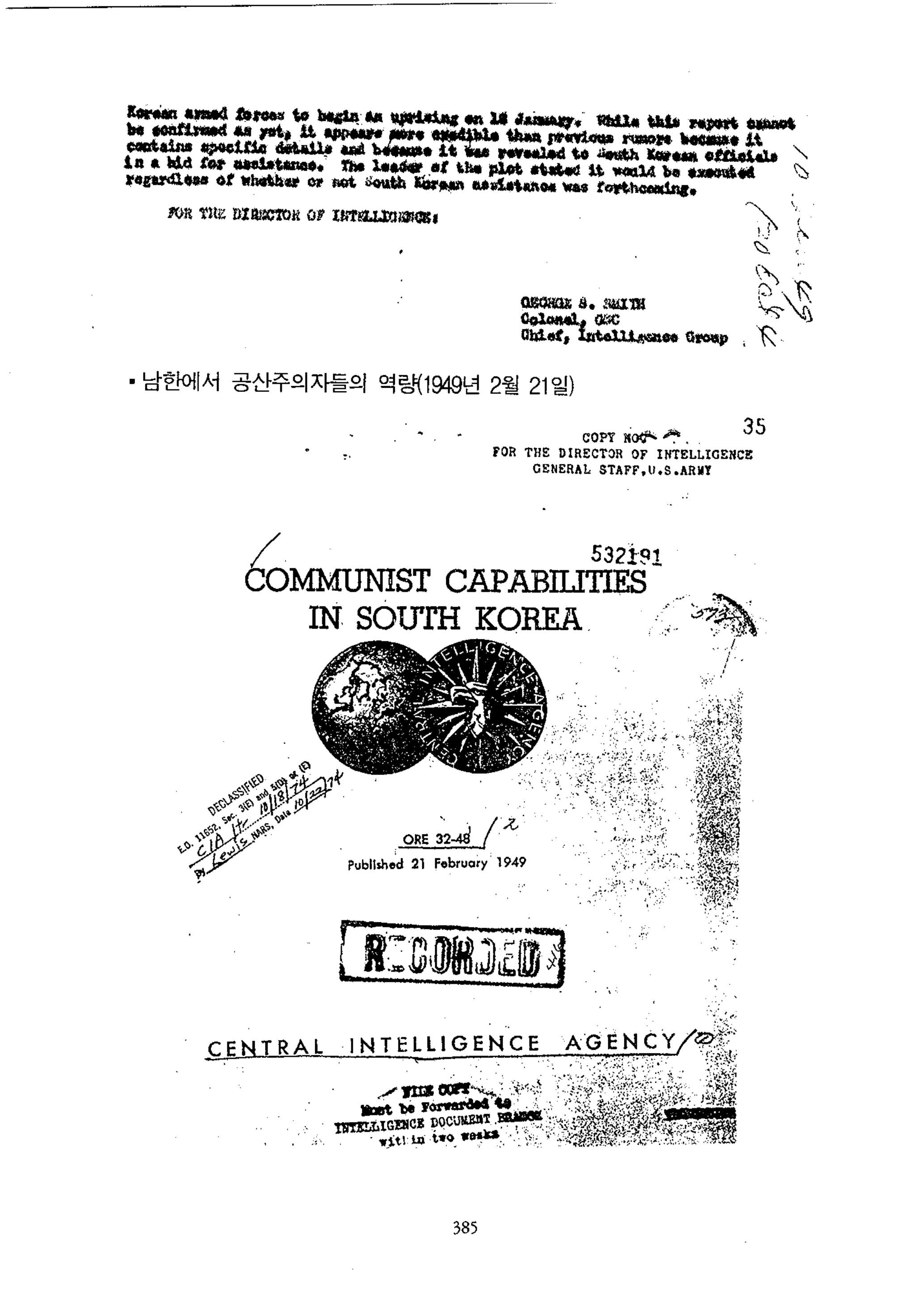
COPY NO. [illegible]
FOR THE DIRECTOR OF INTELLIGENCE
GENERAL STAFF, U.S. ARMY
532191
COMMUNIST CAPABILITIES
IN SOUTH KOREA
ORE 32-48
Published 21 February 1949
RECORDED
CENTRAL INTELLIGENCE AGENCY
THIS COPY [illegible]
Must be Forwarded to
INTELLIGENCE DOCUMENT BRANCH
within two weeks
COMMUNIST CAPABILITIES IN SOUTH KOREA
SUMMARY
Communist capabilities in South Korea are now at a low level and probably will be further reduced if the Republic continues its present trend toward increased stability.
The network of Communist organizations in South Korea is designed to provide control mechanisms for every segment of society and is sufficiently broad to draw new members from all classes should a severe economic crisis cause popular discontent and a swing to the left. The number of South Koreans who have consistently braved various degrees of police action to assist the Communist program may exceed 600,000, while the total number of Koreans enrolled in Communist front organizations may exceed 10 percent of the 20 million population. Underground combat organizations under Communist control and leadership are scattered throughout the mountain areas of South Korea and present a continuing threat to internal security.
The Communists in South Korea are under the direct control of Soviet agents in North Korea. Their adherence to the Moscow line has incurred the hostility and distrust of Korean nationalists, and periodic mass arrests of Communist leaders have forced them to concentrate organizational efforts on rebuilding party channels and strengthening the underground forces. The anti-Communist program undertaken by the Republic of Korea, since its inauguration in August 1948, has forced many Communist leaders to flee to the North.
The Communists have failed to control labor and have lost the ability they possessed in September 1946 to call a general strike. They have, however, improved their technique of coordinated sabotage as demonstrated in the anti-election campaign of February 1948. They have devoted considerable effort, with some success, to infiltrating youth groups, political parties, the security forces, and the government on all levels.
Current Communist propaganda is aimed at creating confusion, fear, and defeatism in the South. The constant threat of invasion from the North and the susceptibility of the isolated villagers to propaganda can be exploited by the Communists to produce these results in local areas. But the Communists have lost the advantage they possessed in the fall of 1948 when it appeared to the Koreans that the US was about to withdraw all troops, leaving the infant Republic to face alone the combined forces of Communism in the Far East. Favorable UN action on Korea, the expectancy of continued US aid under ECA, and the moderate success of security forces in suppressing the guerrillas have restored confidence in their future among the people and officials of South Korea.
The mission of the Communist forces in South Korea is to assist in carrying out the Soviet plan for the eventual absorption of South Korea into the Korean Democratic Peoples Republic by undermining popular government support through the creation
Note: The intelligence organizations of the Departments of State, Army, Navy, and the Air Force have concurred in this report. The information herein is as of 10 February 1949.
of political and economic chaos, dissipating the military strength of the Republic, and developing the conviction that Communist domination is inevitable, thereby achieving a favorable psychological climate for opportunist "coalition" with the north.
The present Communist strength in South Korea does not appear great enough to support a sustained, country-wide campaign that would accomplish this mission. The limitation of their future potential, however, depends primarily on the ability of gov-
--- p400 ---
ernment officials and the people to resolve their personal or party differences in presenting a united front to the Communists, and on the ability of the government to insure a minimum standard of living for both the farmer and the urban worker.
COMMUNIST CAPABILITIES IN SOUTH KOREA
1. SIZE AND ORGANIZATION OF THE SOUTH KOREAN COMMUNIST PARTY.
(3) *Militant Groups.*
Underground militant organizations under Communist control and leadership, the most important tools for the USSR's long-range program, are combat groups known collectively as the People's Liberation Army or the Action Vanguard Corps, consisting of separate guerrilla units. A Military Bureau, parallel with the Provincial Central Committee of the SKLP, is responsible for the organization and activities of the various forces within each province. In some provinces, at least, each town and village is in turn directly subordinate to the Provincial Bureau, and all directives emanating from the Bureau are rapidly disseminated to the local units. The existence of a centralized coordinating authority higher than the Provincial Bureaus has not been confirmed, nor is it known to what extent the SKLP issues specific directives to the guerrillas. However, as in South Korean Communist activities in general, it is known that important orders originate in Pyongyang and are transmitted to South Korea through agents who cross the 38th parallel daily. Trained organizers are dispatched from the North to assist in planning activities and in teaching guerrilla tactics.
Guerrilla strength fluctuates widely, depending on activities. South Korean groups are being steadily reinforced by special units infiltrating from the North. Casualties during periodic police actions serve to reduce their numbers, and, during periods of inactivity, many non-party guerrillas return to their homes and resume an outward appearance of normal life. During active periods, the guerrillas are likely to gain spot recruits among non-Communists who may be aroused by police brutality or unpopular government measures such as forced rice collections.
The island of Cheju-Do has long been a center of guerrilla strength and activity. Police brutality, the venality of public officials, and the historic clannishness of the islanders contribute to the discontent which trained Communists have fanned into chronic revolt. Recently, indiscriminate guerrilla activity against villages has caused many formerly sympathetic civilians to assist security forces in combing the hills, and the first mass surrenders of guerrillas on Cheju-Do have since been reported.
출처:
제주4·3사건진상규명및희생자명예회복위원회 편,
『제주4·3사건자료집 10』 [미국자료편],
번역문 p.195
/ 원문 p.387–389.