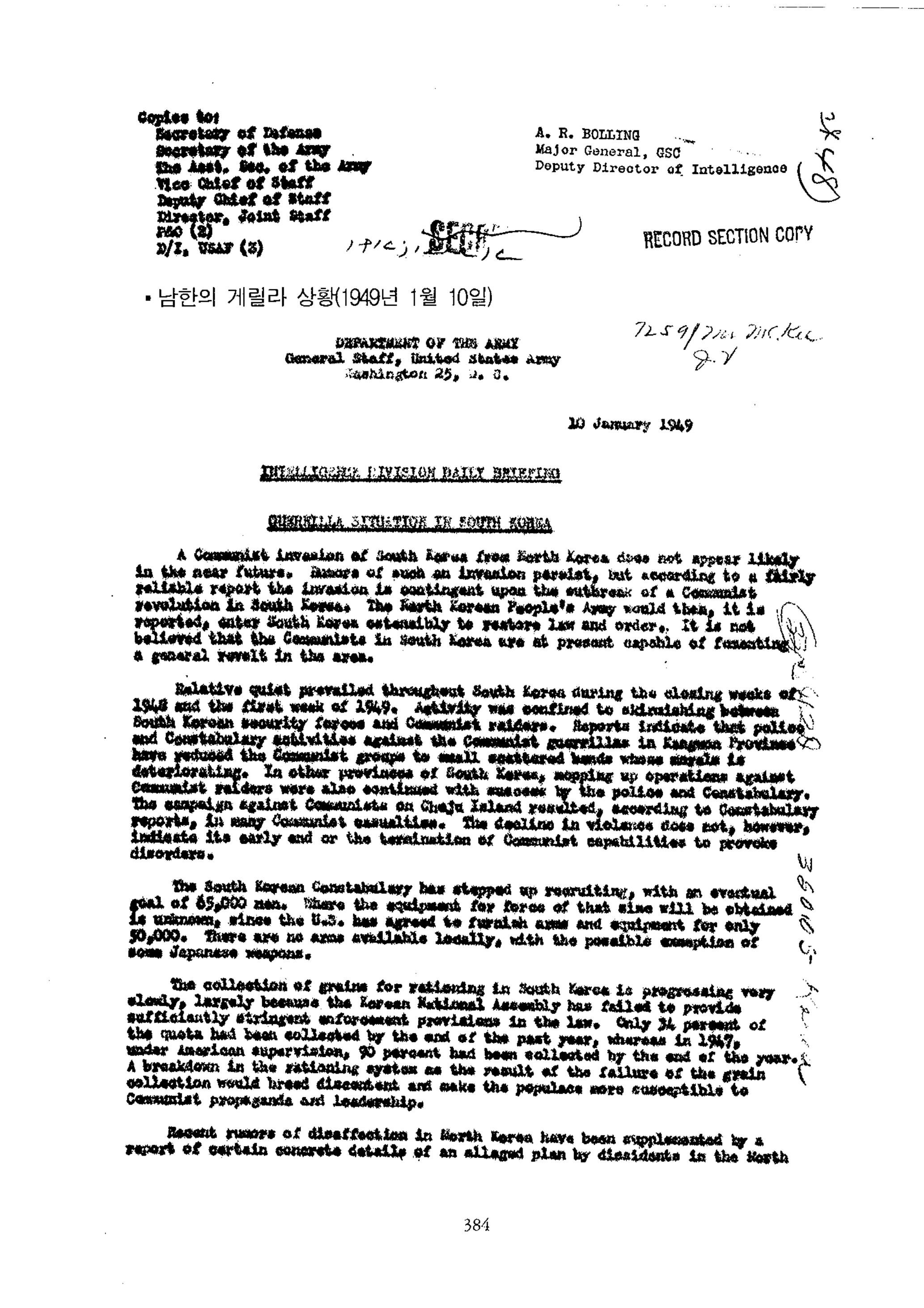
미육군성 육군 참모부 정보국 일일보고
남한의 게릴라 상황
북한 공산주의자들이 남한을 침략할 가능성은 가까운 장래에는 별로 없는 것처럼 보인다. 그러한 침략의 소문이 지속되고 있으나 신뢰할만한 보고에 의하면 침략은 남한에서의 공산주의 혁명의 발발을 전제로 한다. 보고에 의하면 북조선 인민군대는 혁명 이후에 법과 질서를 회복하기 위하여 남한에 진주하기로 되어 있다. 남한의 공산주의자들이 현재 남한에서 대대적인 혁명을 일으킬 능력이 있다고 판단되지 않는다.
1948년 마지막 몇 주와 1949년 초 몇 주 동안 남한 전역에 걸쳐 비교적 고요함이 지속되고 있다. 활동은 남한 방위군과 공산게릴라 사이에 제한되었다. 보고서는 강원도의 공산게릴라에 대한 경찰과 경비대의 진압활동은 공산세력들을 사기가 저하된 소규모 집단으로 감소시켰다고 적고 있다. 남한의 다른 지역에서도 공산폭도 소탕작전은 경찰과 경비대에 의하여 성공적으로 계속되고 있다. 경비대의 보고에 의하면 제주도의 공산당 토벌작전은 많은 공산주의자 사상자를 내었다. 그러나 폭력의 감소는 폭력의 조기 종결이나 소요를 일으킬 공산주의자들의 능력의 종말을 의미하지는 않는다.
남한 경비대는 6만 5,000명을 목표로 충원을 가속화시키고 있다. 미국은 오직 5만명을 위한 무기와 장비만을 제공하기로 약속하였기 때문에 그러한 규모의 병력에게 줄 장비를 어디에서 구할지 미지수이다. 약간의 일제무기를 제외하고는 지방에서 가용한 무기는 없다.
남한에서 배급을 위한 곡식수집은 매우 느리게 진척되고 있는데 그 이유는 남한 국회가 법적으로 충분히 엄격한 강제조항을 마련하지 않았기 때문이다. 작년 말까지 할당량의 34%만이 수집되었다. 반면에 1947년에는 미국인 감독하에 90%가 그 해 말까지 수집되었다. 곡식수집 실패의 결과로 배급제도의 붕괴는 불만을 고조시킬 것이며 사람들로 하여금 공산주의자들의 선동과 지도력에 더욱더 흔들리게 만들 것이다.
북한 내부의 반란에 대한 최근의 소문은 북한군 내부의 불만세력이 1월 18일에 봉기를 일으킬 것이라는 소위 계획에 대한 상당히 믿을만한 상세한 보고에 의하여 뒷받침되고 있다. 아직 이 보고서에 대한 정확성을 확인할 수 없지만 이전의 소문보다 더 믿을만한 것으로 보인다. 그 이유는 그 보고서가 매우 상세한 사항을 담고 있으며 도움을 얻으려는 노력으로 남한 관리들에게 그 계획을 드러냈다는 것이었다. 반란의 지도자들은 남한의 원조가 있든 없든 반란은 실행될 것이라고 말하였다.
정보국장님께:
정보국 소속 조지 스미스(George S. Smith) 대령
DEPARTMENT OF THE ARMY
General Staff, United States Army
Washington 25, D. C.
7259/Dir Dickel
9.7
10 January 1949
INTELLIGENCE DIVISION DAILY BRIEFING
GUERRILLA SITUATION IN SOUTH KOREA
A Communist invasion of South Korea from North Korea does not appear likely in the near future. Rumors of such an invasion persist, but according to a fairly reliable report the invasion is contingent upon the outbreak of a Communist revolution in South Korea. The North Korean People's Army would then, it is reported, enter South Korea ostensibly to restore law and order. It is not believed that the Communists in South Korea are at present capable of fomenting a general revolt in the area.
Relative quiet prevailed throughout South Korea during the closing weeks of 1948 and the first week of 1949. Activity was confined to skirmishing between South Korean security forces and Communist raiders. Reports indicate that police and Constabulary activities against the Communist guerrillas in Kangwon Province have reduced the Communist groups to small, scattered bands whose morale is deteriorating. In other provinces of South Korea, mopping up operations against Communist raiders were also continued with success by the police and Constabulary. The campaign against Communists on Cheju Island resulted, according to Constabulary reports, in many Communist casualties. The decline in violence does not, however, indicate its early end or the termination of Communist capabilities to provoke disorders.
The South Korean Constabulary has stepped up recruiting, with an eventual goal of 65,000 men. Where the equipment for force of that size will be obtained is unknown, since the U.S. has agreed to furnish arms and equipment for only 50,000. There are no arms available locally, with the possible exception of some Japanese weapons.
The collection of grains for rationing in South Korea is progressing very slowly, largely because the Korean National Assembly has failed to provide sufficiently stringent enforcement provisions in the law. Only 34 percent of the quota had been collected by the end of the past year, whereas in 1947, under American supervision, 90 percent had been collected by the end of the year. A breakdown in the rationing system as the result of the failure of the grain collection would breed discontent and make the populace more susceptible to Communist propaganda and leadership.
Recent rumors of disaffection in North Korea have been supplemented by a report of certain concrete details of an alleged plan by dissidents in the North Korean armed forces to begin an uprising on 14 January. While this report cannot be confirmed as yet, it appears more credible than previous rumors because it contains specific details and because it was revealed to South Korean officials in a bid for assistance. The leader of the plot stated it would be executed regardless of whether or not South Korean assistance was forthcoming.
FOR THE DIRECTOR OF INTELLIGENCE:
GEORGE S. SMITH
Colonel, GSC
Chief, Intelligence Group
출처:
제주4·3사건진상규명및희생자명예회복위원회 편,
『제주4·3사건자료집 10』 [미국자료편],
번역문 p.194–87
/ 원문 p.386–387.