미의회기록(Congressional Record), 제95권, A5392-94
대한민국 창건 1주년을 맞이해 이승만이 준비한 연설. 정부수립 당시 정치적으로는 여순반란과 제주도와 지리산의 유격전, 38선 지역에서의 충돌로 인한 내부위협과 경제적으로는 분단으로 인한 피폐함에도 불구하고 국가의 안정을 이루는 데 성공했다. 국제관계에 있어서는 미국, 영국 등 자유진영 국가들과 수교를 맺어 공산주의에 대항하는 동맹체제의 기반을 다졌으며, 국내정책의 측면에서 농지개혁과 민주적 선거를 수행해 대의민주주의의 성장을 가져왔다. 무엇보다도 공산주의에 대항하는 극동지역의 교두보로서의 역할을 충실히 수행할 것을 강조한다.
제주관련 발언: “남한의 정부가 수립되었을 당시 30만 명의 인구를 가진 제주도는 대부분 잔인한 공산폭도들의 손아귀에 있었다. 1948년 5월 10일의 선거가 섬의 세 선거구 중 오직 한 선거구에서만 치러질 수 있었다. 그러나 지난 봄까지 공산주의 세력은 제거되었으며 선거는 평화롭게 치러졌다.”
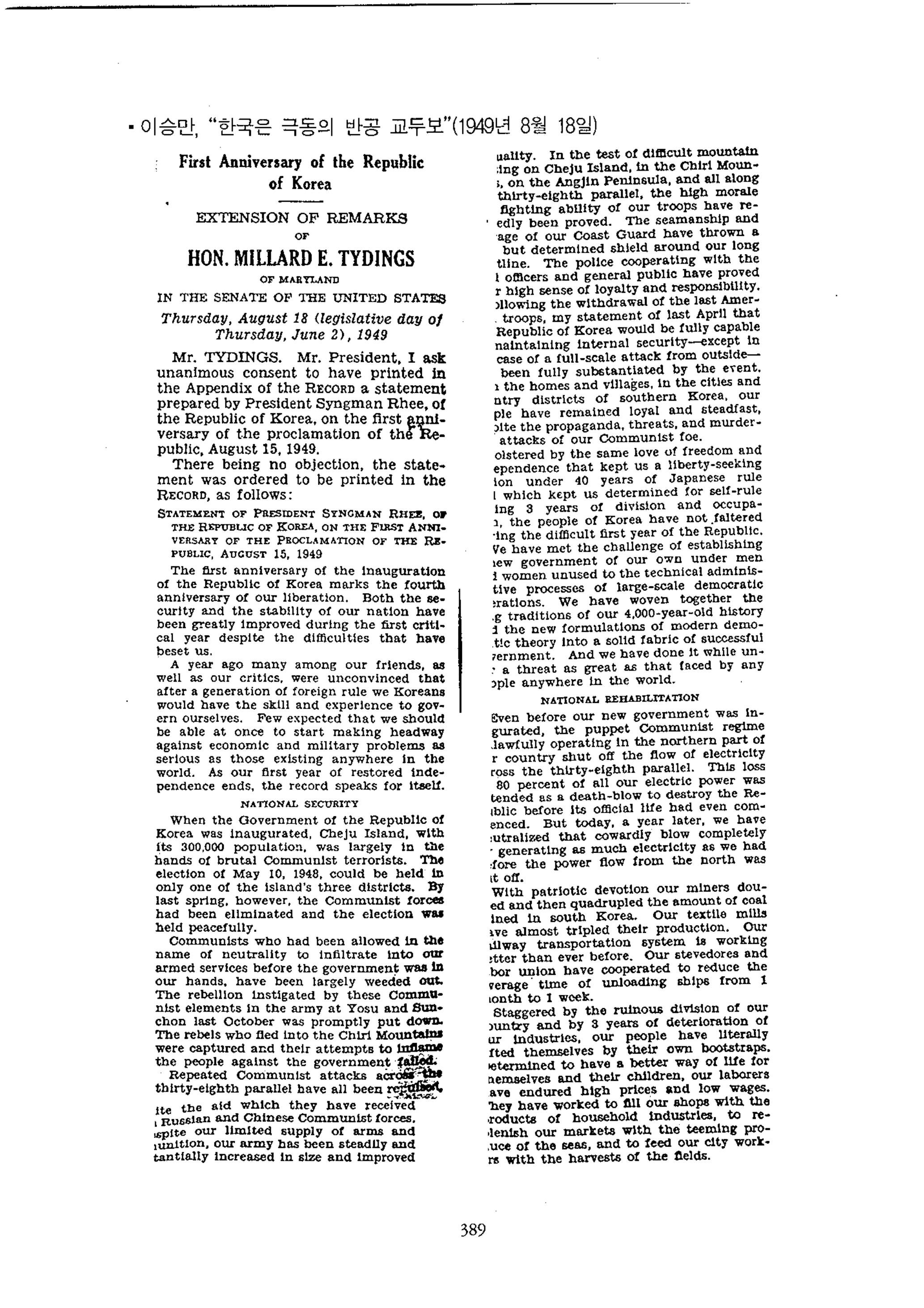
First Anniversary of the Republic of Korea
EXTENSION OF REMARKS
OF
HON. MILLARD E. TYDINGS
OF MARYLAND
IN THE SENATE OF THE UNITED STATES
*Thursday, August 18 (legislative day of Thursday, June 2), 1949*
Mr. TYDINGS. Mr. President, I ask unanimous consent to have printed in the Appendix of the RECORD a statement prepared by President Syngman Rhee, of the Republic of Korea, on the first anniversary of the proclamation of the Republic, August 15, 1949.
There being no objection, the statement was ordered to be printed in the RECORD, as follows:
STATEMENT OF PRESIDENT SYNGMAN RHEE, OF THE REPUBLIC OF KOREA, ON THE FIRST ANNIVERSARY OF THE PROCLAMATION OF THE REPUBLIC, AUGUST 15, 1949
The first anniversary of the inauguration of the Republic of Korea marks the fourth anniversary of our liberation. Both the security and the stability of our nation have been greatly improved during the first critical year despite the difficulties that have beset us.
A year ago many among our friends, as well as our critics, were unconvinced that after a generation of foreign rule we Koreans would have the skill and experience to govern ourselves. Few expected that we should be able at once to start making headway against economic and military problems as serious as those existing anywhere in the world. As our first year of restored independence ends, the record speaks for itself.
NATIONAL SECURITY
When the Government of the Republic of Korea was inaugurated, Cheju Island, with its 300,000 population, was largely in the hands of brutal Communist terrorists. The election of May 10, 1948, could be held in only one of the island's three districts. By last spring, however, the Communist forces had been eliminated and the election was held peacefully.
Communists who had been allowed in the name of neutrality to infiltrate into our armed services before the government was in our hands, have been largely weeded out. The rebellion instigated by these Communist elements in the army at Yosu and Sunchon last October was promptly put down. The rebels who fled into the Chiri Mountains were captured and their attempts to inflame the people against the government failed.
Repeated Communist attacks acros[s] [the] thirty-eighth parallel have all been re[pulsed], [despi]te the aid which they have received [from] Russian and Chinese Communist forces. [De]spite our limited supply of arms and [am]unition, our army has been steadily and [subs]tantially increased in size and improved
uality. In the test of difficult mountain [fight]ing on Cheju Island, in the Chiri Moun[tain]s, on the Angjin Peninsula, and all along thirty-eighth parallel, the high morale fighting ability of our troops have re[peat]edly been proved. The seamanship and [cour]age of our Coast Guard have thrown a but determined shield around our long [coas]tline. The police cooperating with the [loca]l officers and general public have proved [thei]r high sense of loyalty and responsibility. [Fol]lowing the withdrawal of the last Amer[ican] troops, my statement of last April that Republic of Korea would be fully capable [mai]ntaining internal security—except in case of a full-scale attack from outside— been fully substantiated by the event. [In] the homes and villages, in the cities and [cou]ntry districts of southern Korea, our [peo]ple have remained loyal and steadfast, [desp]ite the propaganda, threats, and murder[ous] attacks of our Communist foe.
[B]olstered by the same love of freedom and [ind]ependence that kept us a liberty-seeking [nat]ion under 40 years of Japanese rule [and] which kept us determined for self-rule [dur]ing 3 years of division and occupa[tio]n, the people of Korea have not faltered [dur]ing the difficult first year of the Republic. [W]e have met the challenge of establishing [a n]ew government of our own under men [and] women unused to the technical adminis[tra]tive processes of large-scale democratic [ope]rations. We have woven together the [lon]g traditions of our 4,000-year-old history [an]d the new formulations of modern demo[cra]tic theory into a solid fabric of successful [gov]ernment. And we have done it while un[de]r a threat as great as that faced by any [pe]ople anywhere in the world.
NATIONAL REHABILITATION
Even before our new government was inaugurated, the puppet Communist regime lawfully operating in the northern part of [ou]r country shut off the flow of electricity [ac]ross the thirty-eighth parallel. This loss [of] 80 percent of all our electric power was [in]tended as a death-blow to destroy the Re[pu]blic before its official life had even com[m]enced. But today, a year later, we have [ne]utralized that cowardly blow completely [by] generating as much electricity as we had [be]fore the power flow from the north was [cu]t off.
With patriotic devotion our miners dou[bl]ed and then quadrupled the amount of coal [m]ined in south Korea. Our textile mills [ha]ve almost tripled their production. Our [ra]ilway transportation system is working [be]tter than ever before. Our stevedores and [la]bor union have cooperated to reduce the [av]erage time of unloading ships from 1 [m]onth to 1 week.
Staggered by the ruinous division of our [co]untry and by 3 years of deterioration of [o]ur industries, our people have literally [lif]ted themselves by their own bootstraps. [D]etermined to have a better way of life for [th]emselves and their children, our laborers [h]ave endured high prices and low wages. [T]hey have worked to fill our shops with the [p]roducts of household industries, to re[p]lenish our markets with the teeming pro[d]uce of the seas, and to feed our city worke[r]s with the harvests of the fields.
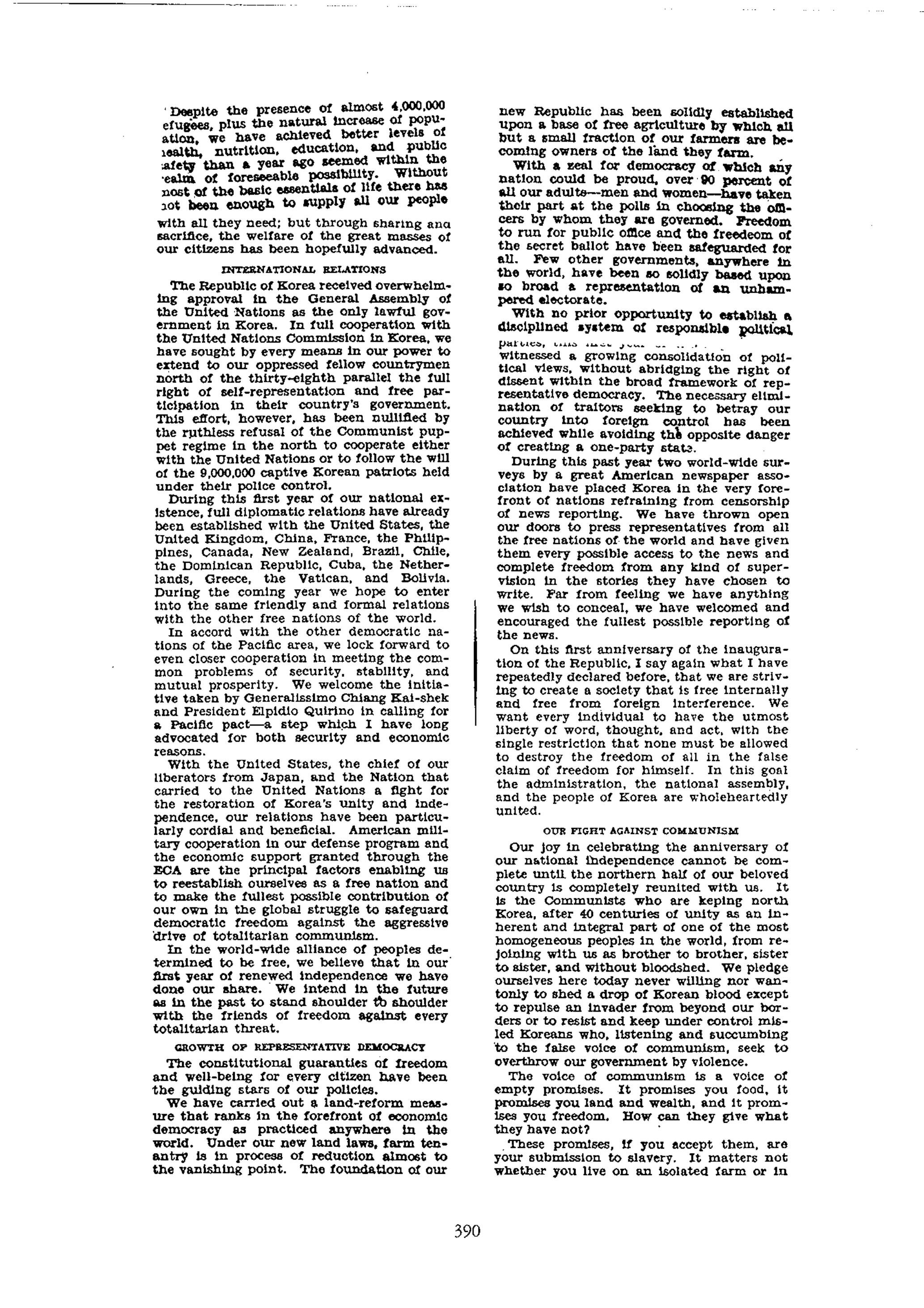
Despite the presence of almost 4,000,000 efugees, plus the natural increase of population, we have achieved better levels of health, nutrition, education, and public safety than a year ago seemed within the realm of foreseeable possibility. Without most of the basic essentials of life there has not been enough to supply all our people with all they need; but through sharing and sacrifice, the welfare of the great masses of our citizens has been hopefully advanced.
INTERNATIONAL RELATIONS
The Republic of Korea received overwhelming approval in the General Assembly of the United Nations as the only lawful government in Korea. In full cooperation with the United Nations Commission in Korea, we have sought by every means in our power to extend to our oppressed fellow countrymen north of the thirty-eighth parallel the full right of self-representation and free participation in their country's government. This effort, however, has been nullified by the ruthless refusal of the Communist puppet regime in the north to cooperate either with the United Nations or to follow the will of the 9,000,000 captive Korean patriots held under their police control.
During this first year of our national existence, full diplomatic relations have already been established with the United States, the United Kingdom, China, France, the Philippines, Canada, New Zealand, Brazil, Chile, the Dominican Republic, Cuba, the Netherlands, Greece, the Vatican, and Bolivia. During the coming year we hope to enter into the same friendly and formal relations with the other free nations of the world.
In accord with the other democratic nations of the Pacific area, we look forward to even closer cooperation in meeting the common problems of security, stability, and mutual prosperity. We welcome the initiative taken by Generalissimo Chiang Kai-shek and President Elpidio Quirino in calling for a Pacific pact—a step which I have long advocated for both security and economic reasons.
With the United States, the chief of our liberators from Japan, and the Nation that carried to the United Nations a fight for the restoration of Korea's unity and independence, our relations have been particularly cordial and beneficial. American military cooperation in our defense program and the economic support granted through the ECA are the principal factors enabling us to reestablish ourselves as a free nation and to make the fullest possible contribution of our own in the global struggle to safeguard democratic freedom against the aggressive drive of totalitarian communism.
In the world-wide alliance of peoples determined to be free, we believe that in our first year of renewed independence we have done our share. We intend in the future as in the past to stand shoulder to shoulder with the friends of freedom against every totalitarian threat.
GROWTH OF REPRESENTATIVE DEMOCRACY
The constitutional guaranties of freedom and well-being for every citizen have been the guiding stars of our policies.
We have carried out a land-reform measure that ranks in the forefront of economic democracy as practiced anywhere in the world. Under our new land laws, farm tenantry is in process of reduction almost to the vanishing point. The foundation of our
new Republic has been solidly established upon a base of free agriculture by which all but a small fraction of our farmers are becoming owners of the land they farm.
With a zeal for democracy of which any nation could be proud, over 90 percent of all our adults—men and women—have taken their part at the polls in choosing the officers by whom they are governed. Freedom to run for public office and the freedeom of the secret ballot have been safeguarded for all. Few other governments, anywhere in the world, have been so solidly based upon so broad a representation of an unhampered electorate.
With no prior opportunity to establish a disciplined system of responsible political parties, this new you... ... ... witnessed a growing consolidation of political views, without abridging the right of dissent within the broad framework of representative democracy. The necessary elimination of traitors seeking to betray our country into foreign control has been achieved while avoiding the opposite danger of creating a one-party state.
During this past year two world-wide surveys by a great American newspaper association have placed Korea in the very forefront of nations refraining from censorship of news reporting. We have thrown open our doors to press representatives from all the free nations of the world and have given them every possible access to the news and complete freedom from any kind of supervision in the stories they have chosen to write. Far from feeling we have anything we wish to conceal, we have welcomed and encouraged the fullest possible reporting of the news.
On this first anniversary of the inauguration of the Republic, I say again what I have repeatedly declared before, that we are striving to create a society that is free internally and free from foreign interference. We want every individual to have the utmost liberty of word, thought, and act, with the single restriction that none must be allowed to destroy the freedom of all in the false claim of freedom for himself. In this goal the administration, the national assembly, and the people of Korea are wholeheartedly united.
OUR FIGHT AGAINST COMMUNISM
Our joy in celebrating the anniversary of our national independence cannot be complete until the northern half of our beloved country is completely reunited with us. It is the Communists who are keping north Korea, after 40 centuries of unity as an inherent and integral part of one of the most homogeneous peoples in the world, from rejoining with us as brother to brother, sister to sister, and without bloodshed. We pledge ourselves here today never willing nor wantonly to shed a drop of Korean blood except to repulse an invader from beyond our borders or to resist and keep under control misled Koreans who, listening and succumbing to the false voice of communism, seek to overthrow our government by violence.
The voice of communism is a voice of empty promises. It promises you food, it promises you land and wealth, and it promises you freedom. How can they give what they have not?
These promises, if you accept them, are your submission to slavery. It matters not whether you live on an isolated farm or in a distant village or have your home in a town or in a city, you will be found and made a part of the Communist scheme of things and you will cease to exist as an individual and a free man.
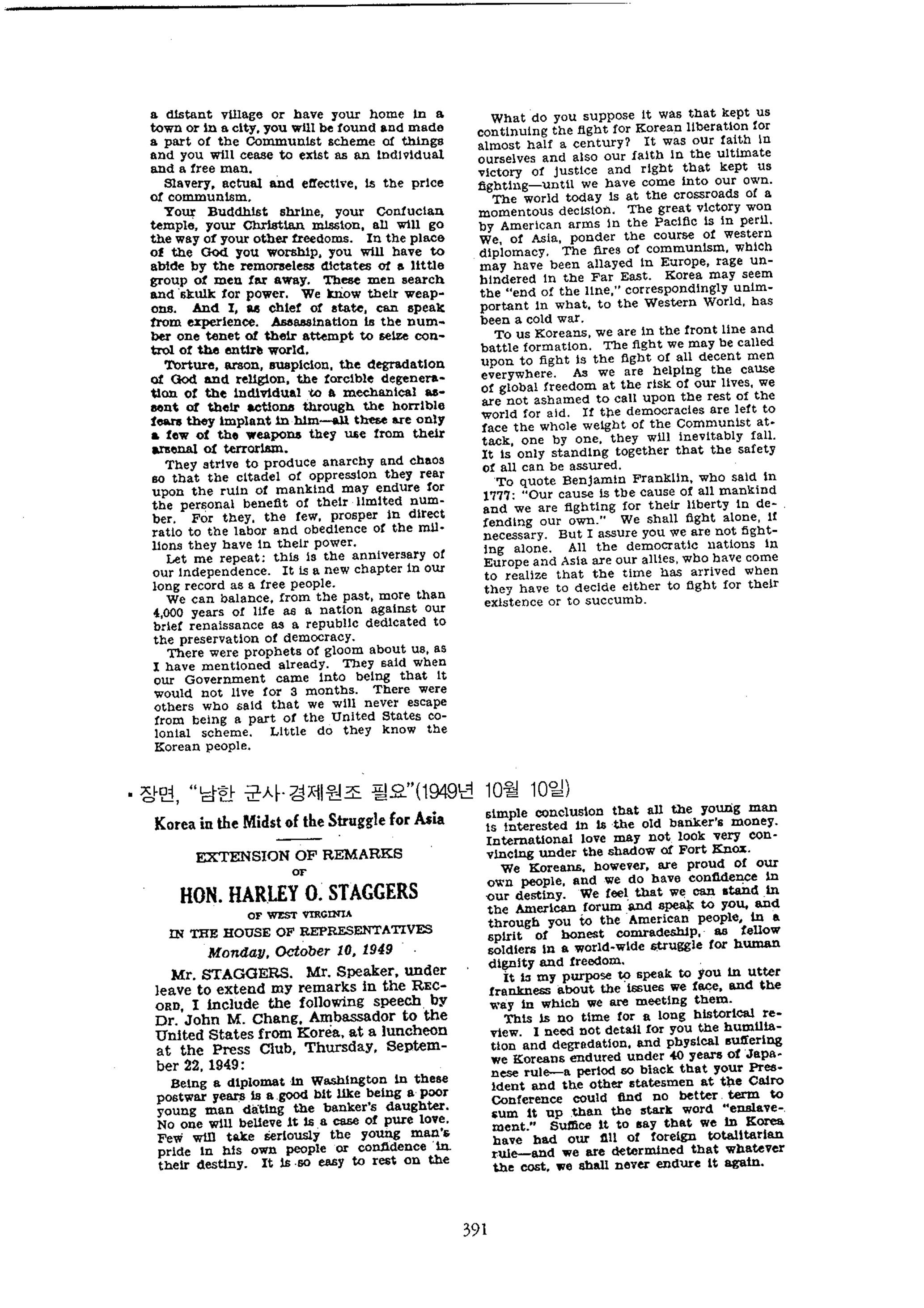
Slavery, actual and effective, is the price of communism.
Your Buddhist shrine, your Confucian temple, your Christian mission, all will go the way of your other freedoms. In the place of the God you worship, you will have to abide by the remorseless dictates of a little group of men far away. These men search and skull for power. We know their weapons. And I, as chief of state, can speak from experience. Assassination is the number one tenet of their attempt to seize control of the entire world.
Torture, arson, suspicion, the degradation of God and religion, the forcible degeneration of the individual to a mechanical assent of their actions through the horrible fears they implant in him—all these are only a few of the weapons they use from their arsenal of terrorism.
They strive to produce anarchy and chaos so that the citadel of oppression they rear upon the ruin of mankind may endure for the personal benefit of their limited number. For they, the few, prosper in direct ratio to the labor and obedience of the millions they have in their power.
Let me repeat: this is the anniversary of our independence. It is a new chapter in our long record as a free people.
We can balance, from the past, more than 4,000 years of life as a nation against our brief renaissance as a republic dedicated to the preservation of democracy.
There were prophets of gloom about us, as I have mentioned already. They said when our Government came into being that it would not live for 3 months. There were others who said that we will never escape from being a part of the United States colonial scheme. Little do they know the Korean people.
What do you suppose it was that kept us continuing the fight for Korean liberation for almost half a century? It was our faith in ourselves and also our faith in the ultimate victory of justice and right that kept us fighting—until we have come into our own.
The world today is at the crossroads of a momentous decision. The great victory won by American arms in the Pacific is in peril. We, of Asia, ponder the course of western diplomacy. The fires of communism, which may have been allayed in Europe, rage unhindered in the Far East. Korea may seem the "end of the line," correspondingly unimportant in what, to the Western World, has been a cold war.
To us Koreans, we are in the front line and battle formation. The fight we may be called upon to fight is the fight of all decent men everywhere. As we are helping the cause of global freedom at the risk of our lives, we are not ashamed to call upon the rest of the world for aid. If the democracies are left to face the whole weight of the Communist attack, one by one, they will inevitably fall. It is only standing together that the safety of all can be assured.
To quote Benjamin Franklin, who said in 1777: "Our cause is the cause of all mankind and we are fighting for their liberty in defending our own." We shall fight alone, if necessary. But I assure you we are not fighting alone. All the democratic nations in Europe and Asia are our allies, who have come to realize that the time has arrived when they have to decide either to fight for their existence or to succumb.
출처:
제주4·3사건진상규명및희생자명예회복위원회 편,
『제주4·3사건자료집 10』 [미국자료편],
번역문 p.198
/ 원문 p.391–393.