미의회기록(Congressional Record), 제95권, A6149-50
1949년 9월 주미대사 장면의 기자실 오찬연설 인용. 극동지역에서 공산주의의 침략에 맞서 국제전을 치르는 한반도에 군사적, 경제적 원조가 필요함을 강조.
공산폭도들은 제주도를 무질서로 몰아넣고 여수와 순천에서 피의 반란을 일으킬 만큼 강력하다.
남한은 극동아시아에서 공산주의자들의 압력에 대항하여 저지선을 유지하고 있다. 우리는 세계의 민주우방들로부터 장단기적인 원조가 필요하다. (후략)
대한민국정부
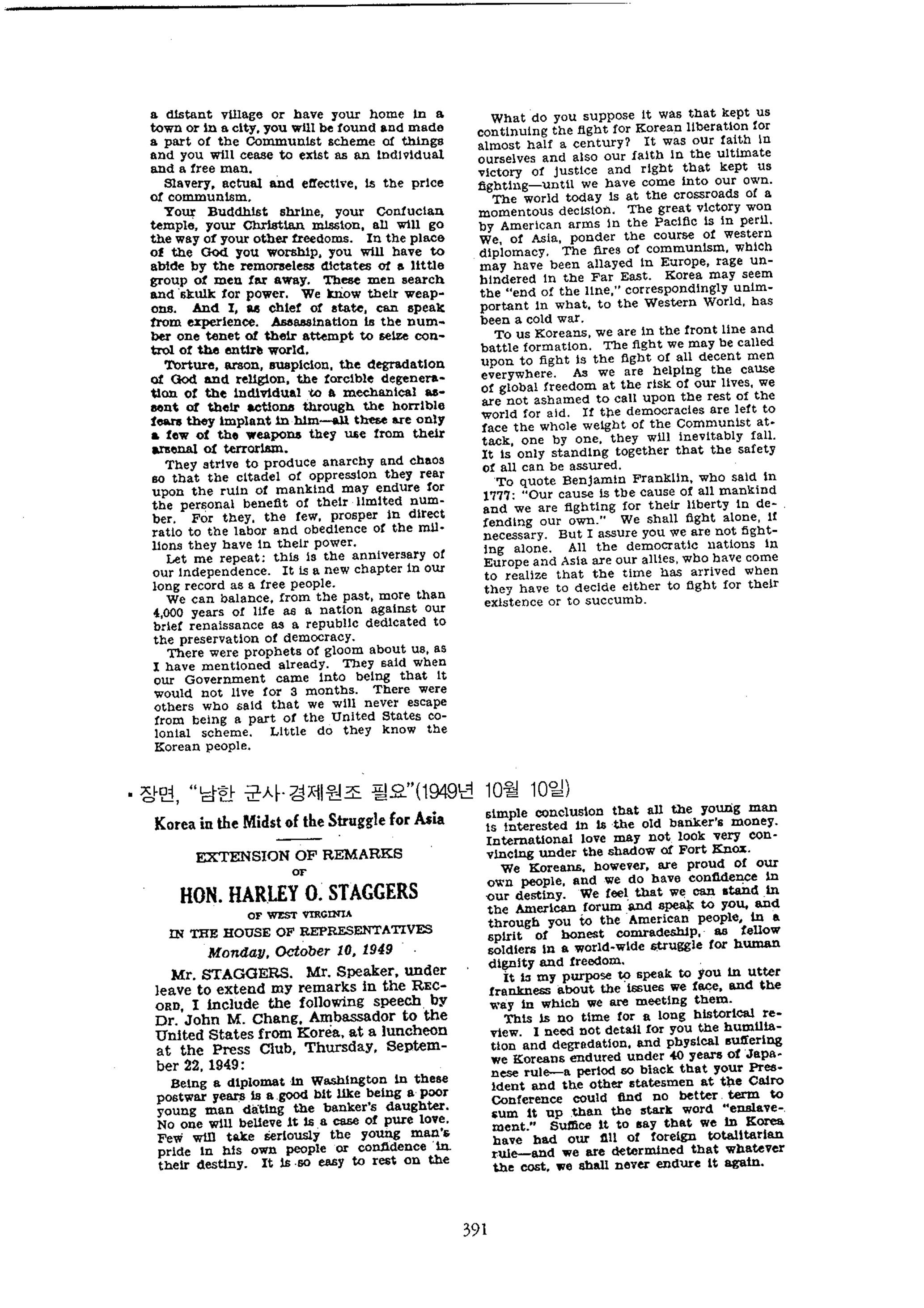
Korea in the Midst of the Struggle for Asia
EXTENSION OF REMARKS
OF
HON. HARLEY O. STAGGERS
OF WEST VIRGINIA
IN THE HOUSE OF REPRESENTATIVES
*Monday, October 10, 1949*
Mr. STAGGERS. Mr. Speaker, under leave to extend my remarks in the RECORD, I include the following speech by Dr. John M. Chang, Ambassador to the United States from Korea, at a luncheon at the Press Club, Thursday, September 22, 1949:
Being a diplomat in Washington in these postwar years is a good bit like being a poor young man dating the banker's daughter. No one will believe it is a case of pure love. Few will take seriously the young man's pride in his own people or confidence in their destiny. It is so easy to rest on the simple conclusion that all the young man is interested in is the old banker's money. International love may not look very convincing under the shadow of Fort Knox.
We Koreans, however, are proud of our own people, and we do have confidence in our destiny. We feel that we can stand in the American forum and speak to you, and through you to the American people, in a spirit of honest comradeship, as fellow soldiers in a world-wide struggle for human dignity and freedom.
It is my purpose to speak to you in utter frankness about the issues we face, and the way in which we are meeting them.
This is no time for a long historical review. I need not detail for you the humiliation and degradation, and physical suffering we Koreans endured under 40 years of Japanese rule—a period so black that your President and the other statesmen at the Cairo Conference could find no better term to sum it up than the stark word "enslavement." Suffice it to say that we in Korea have had our fill of foreign totalitarian rule—and we are determined that whatever the cost, we shall never endure it again.
--- p405 ---
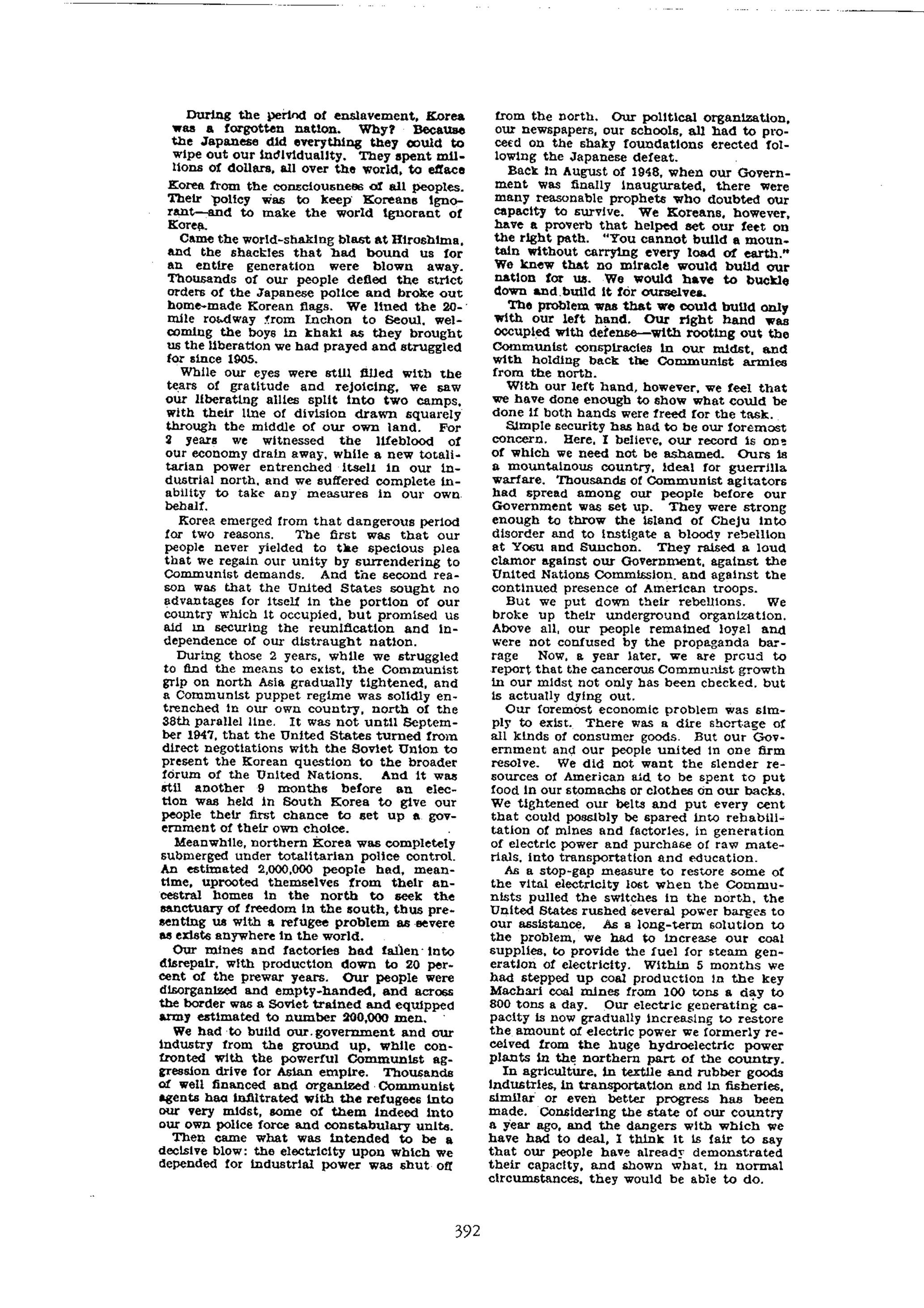
During the period of enslavement, Korea was a forgotten nation. Why? Because the Japanese did everything they could to wipe out our individuality. They spent millions of dollars, all over the world, to efface Korea from the consciousness of all peoples. Their policy was to keep Koreans ignorant—and to make the world ignorant of Korea.
Came the world-shaking blast at Hiroshima, and the shackles that had bound us for an entire generation were blown away. Thousands of our people defied the strict orders of the Japanese police and broke out home-made Korean flags. We lined the 20-mile roadway from Inchon to Seoul, welcoming the boys in khaki as they brought us the liberation we had prayed and struggled for since 1905.
While our eyes were still filled with the tears of gratitude and rejoicing, we saw our liberating allies split into two camps, with their line of division drawn squarely through the middle of our own land. For 2 years we witnessed the lifeblood of our economy drain away, while a new totalitarian power entrenched itself in our industrial north, and we suffered complete inability to take any measures in our own behalf.
Korea emerged from that dangerous period for two reasons. The first was that our people never yielded to the specious plea that we regain our unity by surrendering to Communist demands. And the second reason was that the United States sought no advantages for itself in the portion of our country which it occupied, but promised us aid in securing the reunification and independence of our distraught nation.
During those 2 years, while we struggled to find the means to exist, the Communist grip on north Asia gradually tightened, and a Communist puppet regime was solidly entrenched in our own country, north of the 38th parallel line. It was not until September 1947, that the United States turned from direct negotiations with the Soviet Union to present the Korean question to the broader forum of the United Nations. And it was still another 9 months before an election was held in South Korea to give our people their first chance to set up a government of their own choice.
Meanwhile, northern Korea was completely submerged under totalitarian police control. An estimated 2,000,000 people had, meantime, uprooted themselves from their ancestral homes in the north to seek the sanctuary of freedom in the south, thus presenting us with a refugee problem as severe as exists anywhere in the world.
Our mines and factories had fallen into disrepair, with production down to 20 percent of the prewar years. Our people were disorganized and empty-handed, and across the border was a Soviet trained and equipped army estimated to number 200,000 men.
We had to build our government and our industry from the ground up, while confronted with the powerful Communist aggression drive for Asian empire. Thousands of well financed and organized Communist agents had infiltrated with the refugees into our very midst, some of them indeed into our own police force and constabulary units.
Then came what was intended to be a decisive blow: the electricity upon which we depended for industrial power was shut off from the north. Our political organization, our newspapers, our schools, all had to proceed on the shaky foundations erected following the Japanese defeat.
Back in August of 1948, when our Government was finally inaugurated, there were many reasonable prophets who doubted our capacity to survive. We Koreans, however, have a proverb that helped set our feet on the right path. "You cannot build a mountain without carrying every load of earth." We knew that no miracle would build our nation for us. We would have to buckle down and build it for ourselves.
The problem was that we could build only with our left hand. Our right hand was occupied with defense—with rooting out the Communist conspiracies in our midst, and with holding back the Communist armies from the north.
With our left hand, however, we feel that we have done enough to show what could be done if both hands were freed for the task.
Simple security has had to be our foremost concern. Here, I believe, our record is one of which we need not be ashamed. Ours is a mountainous country, ideal for guerrilla warfare. Thousands of Communist agitators had spread among our people before our Government was set up. They were strong enough to throw the island of Cheju into disorder and to instigate a bloody rebellion at Yosu and Sunchon. They raised a loud clamor against our Government, against the United Nations Commission, and against the continued presence of American troops.
But we put down their rebellions. We broke up their underground organization. Above all, our people remained loyal and were not confused by the propaganda barrage Now, a year later, we are proud to report that the cancerous Communist growth in our midst not only has been checked, but is actually dying out.
Our foremost economic problem was simply to exist. There was a dire shortage of all kinds of consumer goods. But our Government and our people united in one firm resolve. We did not want the slender resources of American aid to be spent to put food in our stomachs or clothes on our backs. We tightened our belts and put every cent that could possibly be spared into rehabilitation of mines and factories, in generation of electric power and purchase of raw materials, into transportation and education.
As a stop-gap measure to restore some of the vital electricity lost when the Communists pulled the switches in the north, the United States rushed several power barges to our assistance. As a long-term solution to the problem, we had to increase our coal supplies, to provide the fuel for steam generation of electricity. Within 5 months we had stepped up coal production in the key Machari coal mines from 100 tons a day to 800 tons a day. Our electric generating capacity is now gradually increasing to restore the amount of electric power we formerly received from the huge hydroelectric power plants in the northern part of the country.
In agriculture, in textile and rubber goods industries, in transportation and in fisheries, similar or even better progress has been made. Considering the state of our country a year ago, and the dangers with which we have had to deal, I think it is fair to say that our people have already demonstrated their capacity, and shown what, in normal circumstances, they would be able to do.
--- p406 ---
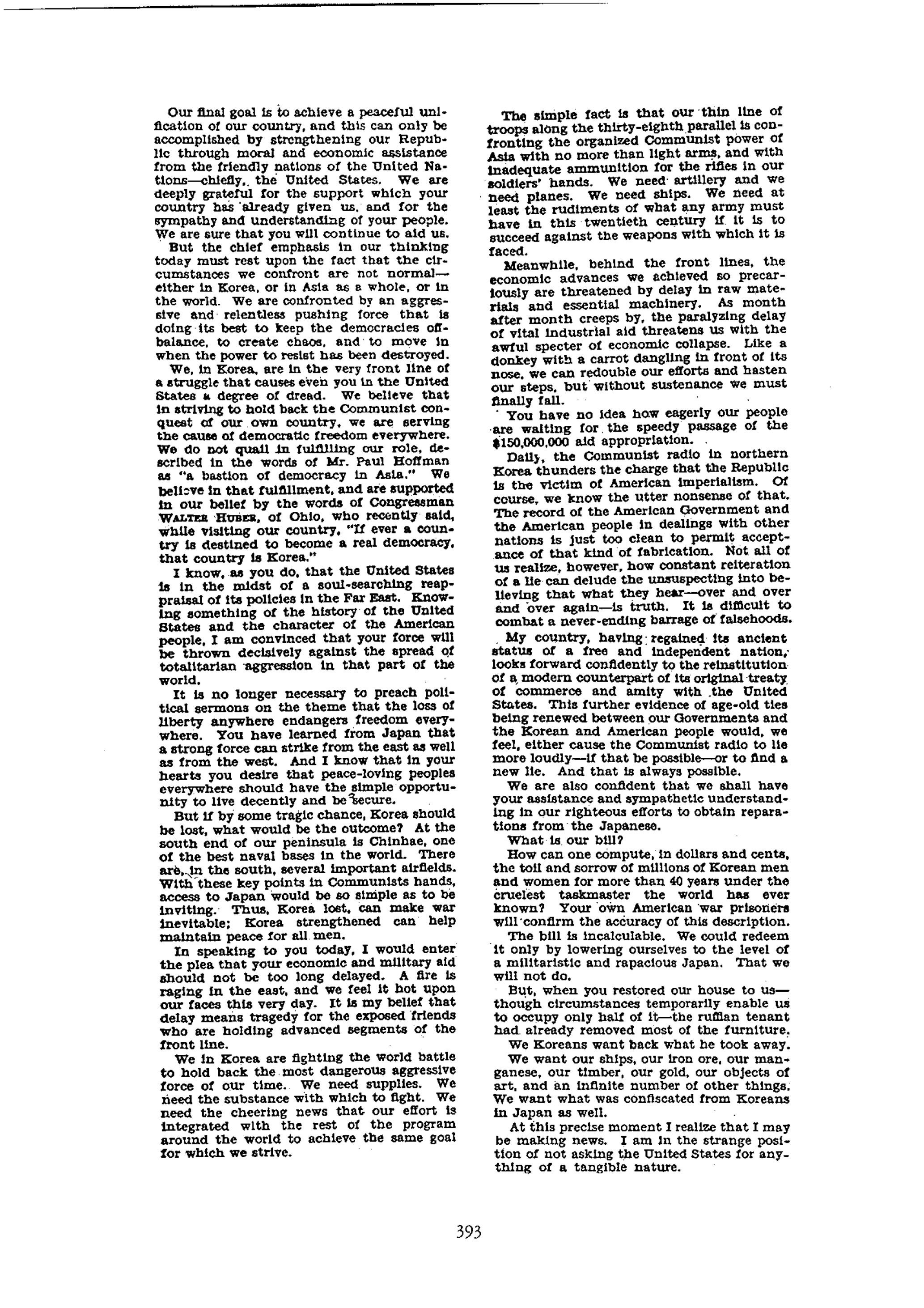
Our final goal is to achieve a peaceful unification of our country, and this can only be accomplished by strengthening our Republic through moral and economic assistance from the friendly nations of the United Nations—chiefly, the United States. We are deeply grateful for the support which your country has already given us, and for the sympathy and understanding of your people. We are sure that you will continue to aid us.
But the chief emphasis in our thinking today must rest upon the fact that the circumstances we confront are not normal— either in Korea, or in Asia as a whole, or in the world. We are confronted by an aggressive and relentless pushing force that is doing its best to keep the democracies off-balance, to create chaos, and to move in when the power to resist has been destroyed.
We, in Korea, are in the very front line of a struggle that causes even you in the United States a degree of dread. We believe that in striving to hold back the Communist conquest of our own country, we are serving the cause of democratic freedom everywhere. We do not quail in fulfilling our role, described in the words of Mr. Paul Hoffman as "a bastion of democracy in Asia." We believe in that fulfillment, and are supported in our belief by the words of Congressman WALTER HUBER, of Ohio, who recently said, while visiting our country, "If ever a country is destined to become a real democracy, that country is Korea."
I know, as you do, that the United States is in the midst of a soul-searching reappraisal of its policies in the Far East. Knowing something of the history of the United States and the character of the American people, I am convinced that your force will be thrown decisively against the spread of totalitarian aggression in that part of the world.
It is no longer necessary to preach political sermons on the theme that the loss of liberty anywhere endangers freedom everywhere. You have learned from Japan that a strong force can strike from the east as well as from the west. And I know that in your hearts you desire that peace-loving peoples everywhere should have the simple opportunity to live decently and be secure.
But if by some tragic chance, Korea should be lost, what would be the outcome? At the south end of our peninsula is Chinhae, one of the best naval bases in the world. There are, in the south, several important airfields. With these key points in Communists hands, access to Japan would be so simple as to be inviting. Thus, Korea lost, can make war inevitable. Korea strengthened can help maintain peace for all men.
In speaking to you today, I would enter the plea that your economic and military aid should not be too long delayed. A fire is raging in the east, and we feel it hot upon our faces this very day. It is my belief that delay means tragedy for the exposed friends who are holding advanced segments of the front line.
We in Korea are fighting the world battle to hold back the most dangerous aggressive force of our time. We need supplies. We need the substance with which to fight. We need the cheering news that our effort is integrated with the rest of the program around the world to achieve the same goal for which we strive.
The simple fact is that our thin line of troops along the thirty-eighth parallel is confronting the organized Communist power of Asia with no more than light arms, and with inadequate ammunition for the rifles in our soldiers' hands. We need artillery and we need planes. We need ships. We need at least the rudiments of what any army must have in this twentieth century if it is to succeed against the weapons with which it is faced.
Meanwhile, behind the front lines, the economic advances we achieved so precariously are threatened by delay in raw materials and essential machinery. As month after month creeps by, the paralyzing delay of vital industrial aid threatens us with the awful specter of economic collapse. Like a donkey with a carrot dangling in front of its nose, we can redouble our efforts and hasten our steps, but without sustenance we must finally fall.
You have no idea how eagerly our people are waiting for the speedy passage of the $150,000,000 aid appropriation.
Daily, the Communist radio in northern Korea thunders the charge that the Republic is the victim of American imperialism. Of course, we know the utter nonsense of that. The record of the American Government and the American people in dealings with other nations is just too clean to permit acceptance of that kind of fabrication. Not all of us realize, however, how constant reiteration of a lie can delude the unsuspecting into believing that what they hear—over and over and over again—is truth. It is difficult to combat a never-ending barrage of falsehoods.
My country, having regained its ancient status of a free and independent nation, looks forward confidently to the reinstitution of a modern counterpart of its original treaty of commerce and amity with the United States. This further evidence of age-old ties being renewed between our Governments and the Korean and American people would, we feel, either cause the Communist radio to lie more loudly—if that be possible—or to find a new lie. And that is always possible.
We are also confident that we shall have your assistance and sympathetic understanding in our righteous efforts to obtain reparations from the Japanese.
What is our bill?
How can one compute, in dollars and cents, the toil and sorrow of millions of Korean men and women for more than 40 years under the cruelest taskmaster the world has ever known? Your own American war prisoners will confirm the accuracy of this description.
The bill is incalculable. We could redeem it only by lowering ourselves to the level of a militaristic and rapacious Japan. That we will not do.
But, when you restored our house to us— though circumstances temporarily enable us to occupy only half of it—the ruffian tenant had already removed most of the furniture.
We Koreans want back what he took away. We want our ships, our iron ore, our manganese, our timber, our gold, our objects of art, and an infinite number of other things. We want what was confiscated from Koreans in Japan as well.
At this precise moment I realize that I may be making news. I am in the strange position of not asking the United States for anything of a tangible nature.
--- p407 ---
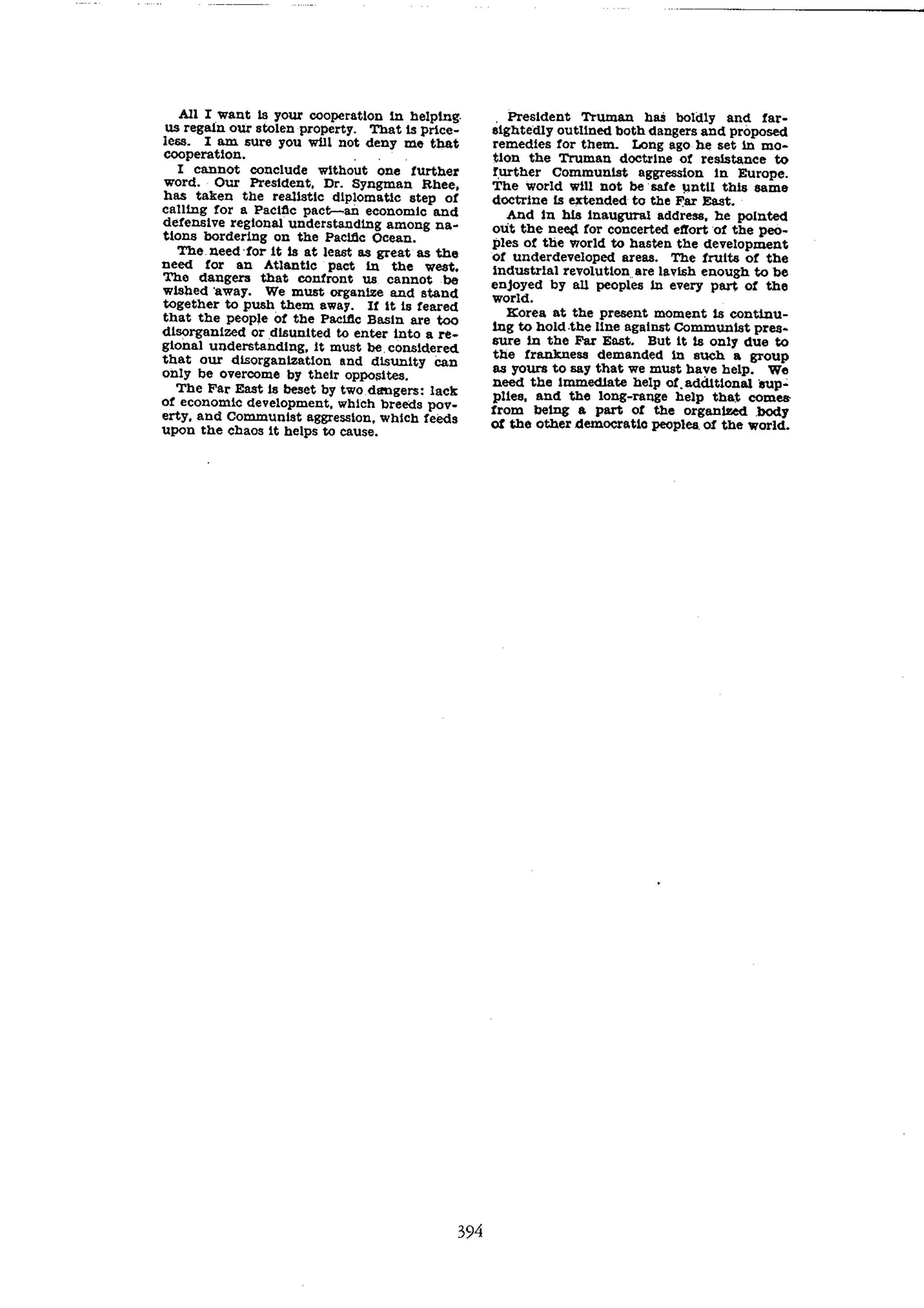
All I want is your cooperation in helping us regain our stolen property. That is priceless. I am sure you will not deny me that cooperation.
I cannot conclude without one further word. Our President, Dr. Syngman Rhee, has taken the realistic diplomatic step of calling for a Pacific pact—an economic and defensive regional understanding among nations bordering on the Pacific Ocean.
The need for it is at least as great as the need for an Atlantic pact in the west. The dangers that confront us cannot be wished away. We must organize and stand together to push them away. If it is feared that the people of the Pacific Basin are too disorganized or disunited to enter into a regional understanding, it must be considered that our disorganization and disunity can only be overcome by their opposites.
The Far East is beset by two dangers: lack of economic development, which breeds poverty, and Communist aggression, which feeds upon the chaos it helps to cause.
President Truman has boldly and farsightedly outlined both dangers and proposed remedies for them. Long ago he set in motion the Truman doctrine of resistance to further Communist aggression in Europe. The world will not be safe until this same doctrine is extended to the Far East.
And in his inaugural address, he pointed out the need for concerted effort of the peoples of the world to hasten the development of underdeveloped areas. The fruits of the industrial revolution are lavish enough to be enjoyed by all peoples in every part of the world.
Korea at the present moment is continuing to hold the line against Communist pressure in the Far East. But it is only due to the frankness demanded in such a group as yours to say that we must have help. We need the immediate help of additional supplies, and the long-range help that comes from being a part of the organized body of the other democratic peoples of the world.
출처:
제주4·3사건진상규명및희생자명예회복위원회 편,
『제주4·3사건자료집 10』 [미국자료편],
번역문 p.199
/ 원문 p.393–396.