주한미사절단
제목: 여수반란에 대한 견해와 관측
존경하는 국무장관 귀하
1948년 10월 25일자 서울의 사절단 <전문> 제153호에 덧붙여 전라남도의 최근 봉기에 관한 보다 완전한 정보를 제출하게 돼 영광입니다. 여기 포함된 자료는 다양한 미군 정보원과 현장에 있는 미국 언론 특파원들, 이 시기 소요지역을 방문한 부영사 데이비드 마크(David E. Mark)로부터 수집했습니다. 후자의 2개 정보원은 일반적으로 정확하다고 믿어진 반면 군 정보는 보고서가 2가지 형태로 돼 있습니다. 한국의 국방경비대와 경찰로부터 넘겨받은 간접 정보로 구성된 첫 번째의 보고서는 어느 정도 모순됩니다. 어쨌든 신뢰도가 낮습니다. 두 번째의 보고서는 미국 정보원으로부터 받은 확신된 보고서로 구성돼 있으며 상위 사령부에 제출된 평가받은 정보로 일반적으로 정확합니다. 그러나 그렇지 않다면 이것은 기준 편지 번호 체계로 평가받습니다.
반란의 본질과 반란이 종료돼 전체내용을 종합하기에는 얼마 지나지 않았기 때문에 이 <급송문서>의 작성을 위해 사용된 대부분의 정보원은 최초의 다양한 정보원입니다.
작전
1948년 10월 19일 오후 7시에서 자정 사이 전라남도 여수 주둔 제14연대에서 한 상사가 이끄는 약 7명의 군인들이 연대 지휘권을 찬탈할 목적으로 경비대원(40여 명 이상)들에게 연설을 토하기 시작했습니다. 이 시위의 표면적인 이유는 반란군들이 제주도에서의 공산게릴라 분자들에 대항해 질서유지 지원 차원에서 제주도에 파견되는 것을 반대하는 것이었습니다.
설득하기도 하고 폭력위협을 가하면서 40여 명 이상의 군인들이 모이자 이들은 탄약고를 탈취해 얻은 무기로 더욱 많은 지지를 얻거나 주둔군의 나머지 병력을 항복시키기 위해 나아갔습니다. 여러 보고서에 따르면 많은 경비대원들은 성공적인 군의 전국 규모의 반란사건이라고 들으며 반란군에 가담하도록 유인 받았습니다.
다른 군인들은 여수의 경찰반란을 진압해 시를 중앙정부에 원상 복귀시키는데 참여하는 것이라고 처음에 생각했습니다.
어쨌든 반란군은 1948년 10월 20일 오전 5시까지 여수의 모든 부분을 장악했습니다. 폭동이 시작될 때 항구에 정박했었던 해안경비대 순시선 2척은 곧바로 라이트가 꺼진 채 사상자 없이 소총 사격을 받으면서 떠났습니다. 순시선에는 그대로 남아 있기를 원한 60~80명의 한국 군인들이 승선했으나 일부 보고서에는 체포된 반란군으로 나왔습니다.
반란군들의 첫 번째 움직임은 여수에서 열차를 빼앗아 순천으로 나가는 것이었습니다. 10월 20일 오후 4시까지 순천을 장악했던 400~1,000여 명으로 구성된 이 반란군 부대는 제4연대의 진압중대와 협력을 했던 것으로 추측됐습니다. 반란군 저지 지원을 요청한 경찰의 요구에 따라 광주에서 순천으로 파견됐었던 이 그룹은 들어오는 반란군에게 발포를 거부했습니다. 순천의 경찰은 결연하게 저지했으나 숫적으로 우세한 반란군에게 항복해야 했습니다.
10월 21일은 아마도 반란분자들에 의해 지역확보가 절정에 다다랐습니다. 이날 그들은 순천으로부터 모든 방향으로 퍼졌습니다. 반란군은 동쪽으로는 광양을 장악했고, 하동과 구례쪽으로 이동했습니다. 북쪽으로는 간단하게 곡성 주위를 공격했으며, 서남쪽으로는 보성을 점령했습니다.
진압군은 반란군이 알게 되는 단호한 어조로 가능한 한 빨리 대응조처를 취하겠다고 발표했습니다. 대체적으로 공격작전은 다른 지역의 경찰과 경비대를 반란지역 주변으로 이동시켜 증강해 거점인 순천을 향해 안쪽으로 밀어 부치는 것으로 그려졌습니다. 진압군이 해안경비대의 함정을 지원받아 수륙양용 공격으로 여수와 그 주변 지역에 상륙하는 동안 진압군의 한 부대는 순천으로부터 여수를 향해 반도를 압박해갔습니다.
이 계획을 지원하면서 경비대 부대들은 경상남도의 부산과 마산, 경상북도의 대구, 전라북도의 군산과 전주, 충청남도의 대전에서 진격해 나갔습니다. 주요 집결지역은 전라남도 광주, 경상남도 하동, 전라북도 군산이 됐습니다. 이들 거점으로부터 가능한 한 빨리 내륙쪽으로 압력을 가했습니다.
최초의 주요한 성공은 남원과 광주로부터 모인 진압부대가 10월 22일 오후 3시와 5시 사이에 순천을 다시 장악할 때였습니다. 시는 진압군이 3개의 박격포를 쏘면서 공격하자 큰 전투없이 함락됐습니다. 반란군들은 재빨리 소규모 부대로 나뉘어 대부분은 광양으로 가는 동쪽을 염두에 뒀고 한 소규모 부대는 보성과 벌교리로 가기 위해 남서쪽으로 진입했습니다.
같은 날 이른 아침 500~700여명의 진압부대는 하동에서 순천의 서쪽방향으로 공격을 시도했습니다. 그러나 그들은 광양에 진입하기 바로 전 언덕에 위치한 반란군에 의해 격퇴됐습니다. 이 사건으로 지휘관을 포함해 약 5명이 죽고 50명이 부상을 입었으며 25명이 실종됐습니다.
10월 23일 시를 공격하기는 불가능했으나 결국 곡성을 통한 남원에서 순천으로 이르는 길을 확보한 진압군은 보성을 공격했습니다. 여수반도 상륙을 지원한 해안경비대는 잘 만들어진 참호로 둘러싸인 반란군에 내쫓겨 실패로 끝났습니다.
이 시간까지 제3, 4, 6, 12, 15연대는 전투지역에 있었으며 대부분 제5여단 총참모장의 지휘 아래 있었습니다.
제15연대는 10월 24일 광양을 향해 하동에서 서쪽 방향으로 다시 공격했고 저항없이 목표물이 이미 순천으로부터 온 아군의 수중에 있는 것을 알았습니다. 적군이 읍을 벗어나 구례 북쪽에 있는 산간지역으로 탈출한 것이 확실하자 양쪽 진압부대는 그 방향으로 전진했습니다. 같은 날 보성에 대한 밀고 밀리는 전투에서는 마침내 벌교리로 진격한 진압군에 의해 되찾은 것으로 결론이 났습니다.
여수에 대한 마지막 공격 계획은 10월 25일 오전 6시 대규모 상륙작전을 시작하는 것으로 마련됐습니다. 이것은 애초 여수시의 바로 북쪽에 육해군의 상륙과 함께 조화되도록 돼 있었습니다. 상륙공격은 계획대로 시작됐지만 여수 교외에 도착한 선발부대는 강력한 저항에 부딪쳐 1마일 이상을 후퇴해야 했습니다. 바다에서의 작전내용은 분명치 않았습니다.
확실히 일부 상륙작전은 정오까지 이뤄졌는지 모릅니다. 그러나 전부는 아니지만, 대부분의 수륙양용 부대가 일시적으로 상륙작전 사령관의 요구에 따라 배에 승선해 있었습니다. 요청할 때까지, 그곳에서 그 날 늦게까지 있었습니다.
이 공격부대의 병력규모는 약 600~750명으로 이뤄졌습니다. 방어하는 반란군은 300~2,000명까지 다양하게 추정됐습니다. 전투는 해안경비대가 해안에 기관총을 난사하고 37㎜ 포를 퍼부으면서 합류한 10월 26일 내내 치열하게 벌어졌습니다.
여수의 4분의 1 가량-특히 항구와 주요 상가지역-이 부분적으로는 포격으로, 사고로, 양쪽으로부터의 군인들의 계획적인 행동으로 화염에 휩싸였습니다. 27일 정오께 저항은 잔여 반란군의 투항으로 종료됐습니다.
여수 함락은 정부군에 의한 주요 공격의 마지막을 기록했습니다. 구례지역에서는 소규모 전투가 계속됐으며 여러 보고들은 읍 자체가 반란군의 수중에 있다고 하기도 하고 없다고 하기도 하고 있습니다. 사실 대부분의 잔여 반란군은 접근하기 어려운 지리산과 백운산 지역으로 도피했습니다. 그곳에서부터 하동, 구례, 광양지역에서 유격전이 지속될 것으로 예상됐습니다. 어느 기자가 기록했듯이 이것은 ‘육지의 제주도’가 될 것입니다.
현재 군 작전 결과에 따른 양쪽의 사상자를 추정하기 위한 충분히 믿을만한 보고서를 가진 책임있는 관리는 없습니다. 그러나 (사상자는) 십중팔구 그렇게 많지는 않습니다. 대체로 약 600~1,400명의 반란군이 체포됐습니다. 이들은 국방경비대에 의해 심문을 받고 있으며 일부 반란군 군인들은 이미 대전형무소에 수감됐습니다.
전투에서 반란군에 합류한 많은 민간인들도 체포됐습니다. 민간인들은 체포된 지역에서 심문받을 예정이지만 일반적으로 그들을 더욱 거칠게 다루는 경찰에 넘겨졌습니다. 몇몇 경우에는 그들을 즉결 처형했습니다. 반란의 중요 인물이 발견될 사례는 기대할 수 없습니다. 그런 사람들은 지리산이나 백운산에 숨어 있거나 배를 이용해 여수에서 알려지지 않은 곳으로 탈출한 사람들 가운데 있었으며 미국 특파원들은 이들을 봤습니다.
봉기의 비군사적 측면
비록 처음에는 미국 관찰자들은 전체 사건이 자신들의 기지에서 제주도에 전투하기 위해 배에 승선하려는 제14연대의 일부 군인들이 거리낌이나 지휘관과의 사소한 싸움 때문에 일어났을 것이라고 생각했으나 반란이 확실히 훈련된 공산주의 지도자들에 의해 촉발, 조직, 관리되고 수행됐다는 것이 며칠 안에 명백해졌습니다. 몇몇 보고서들은 반란이 시기상조였음을 지적했습니다. 이들 보고서들은 충돌이 11월 초순으로 계획됐었지만 제주도로 이동함으로써 폭동을 일으킨 연대의 공산주의자 핵심들에게 닥쳐오는 붕괴와 고립이 계획을 앞당기게 한 원인이라고 제시하고 있습니다.
이것이 사실이든 아니든 반란군들이 일시 장악한 지역에서 그들은 북한의 ‘민주주의인민공화국’과 같은 선전활동 준비와 제휴하고 있고 똑같은 테러와 대규모 대중행동 과정을 입증했습니다.
이틀 동안 장악한 순천에서의 활동은 아마도 전형적인 것일 것입니다. 장악하자마자 곧바로 북한기가 주요 관공서에 내걸렸습니다. 반란군들은 읍내의 민간인 동조자들의 도움을 얻어 주요 우익인사와 다른 주요 공산주의 반대자, 사회의 부유계층, 기독교인들을 비교적 체계적으로 수색하기 시작했습니다.
반란군과 연결된 좌익으로 보이는 중학교 남학생들과 공산주의 조직에게는 ‘반동’분자 소탕을 지원하기 위한 권한과 소총이 주어졌습니다.
전투에서 죽지 않은 경찰관들은 줄을 지어 처형당했습니다. 다른 체포된 사람들은 대개 처음에는 폭행 당하고 나서 유사한 방법으로 총살됐습니다. 이것은 반란군이 떠난 10월 22일 내내 계속됐습니다. 그와 같은 무법통치에서는 자연적으로 반란군을 단지 개인적으로 싫어하는 무고한 많은 사람들이 ‘인민의 적’으로 낙인찍혀 처형당했습니다.
몇몇 보고서는 프랑스 혁명의 ‘트리뷴(Tribune)’과 같은 방법으로 판결하기 위한 ‘법정’이 운영됐다고 밝히고 있습니다.
다른 정보는 심지어 이런 공식적인 절차도 관찰하지 못했다고 지적했습니다. 어쨌든 순천지역에서만 이에 따른 사망자가 전체 500~600명에 이릅니다.
10월 21일 반란군 지도자들로부터 통솔권을 받은 남로당 민간인 지도자들은 북한기와 함께 남로당 깃발을 내걸었고 ‘인민위원회’와 ‘인민공화국’을 위한 대규모 시가행진과 집회를 위해 대중을 동원했습니다.
공산주의 구호를 내건 깃발들이 ‘민주주의인민공화국’ ‘만세’의 외침과 함께 내걸렸습니다. 이런 활동과 함께 관공서들이 습격받았으며 은행은 털렸고 문서들은 파괴됐습니다.
이런 계획들은 매우 완전해 진압군이 시청을 재편성하려고 하자 사실상 모든 공무원들이 사망하였고, 신임 공무원들은 ‘어디서부터 시작해야 할지’ 몰랐습니다.
10월 22일 정부군이 진주하자마자 계엄령이 즉각 선포됐습니다. 경찰의 지원을 받은 진압군은 군대갈 나이가 된 시내의 모든 남자들을 체포하기 시작했습니다. 이런 체포에서는 진압군과 반란군의 차이가 없었습니다.
공산주의자들에 의한 희생자 발견으로 촉발된 분노와 진압군의 낮은 기강 아래서 수많은 사람들이 폭행당하고 즉결 처형이 많이 일어났습니다. 필연적으로 실수가 자행됐고 많은 무고한 사람들과 우익인사들이 공산주의자들과 함께 죽었습니다. 이렇게 해서 죽은 사람들의 정확한 숫자는 25명만이 죽었다는 것 이외에는 집계되지 않았으나 10월 27일 내내 야밤에도 시내에서 총성이 들렸습니다.
결국 결과는 이틀 동안의 공산 테러로부터 구원하기 위해 경찰과 군의 진주를 처음에는 환영했었던 충직한 시민들을 멀어지게 했습니다.
양쪽으로부터 안전하지 않은 시민들은 복종하는 태도를 취했고 초라하게 명령에 복종하였다. 그리고 지프나 권위의 표시가 보이면 패기없는 인사를 했습니다.
여수의 이야기는 이와 너무 다르지는 않습니다. 시내의 일부 경찰은 반란세력에 가담한 것으로 보이지만 그렇게 하지 않은 경찰은 순천에서처럼 신속하게 처치당했습니다.
잘 조직된 방식으로 ‘인민의 정부’는 세워졌고 우호적인 학생과 시민들이 활동했으며 지목받은 관리들과 민간인들이 체포돼 살해되는 한편 선전활동이 시작됐습니다.
후자와 관련해 한 미국 특파원이 발견한 여수인민보(영어 번역본 동봉)의 사본은 약간의 계몽적인 성격을 지니고 있음을 보여줍니다.
이에 따르면 모든 행정기관이 ‘인민위원회’로 넘어간 것이 종결됨에 따라 시민들의 대중집회가 20일 열렸습니다. 충직한 시민들은 북한정권에 충성을 맹세하고 서울정부에 대해 불멸의 적의를 맹세했습니다. 전형적인 공산주의 강령이 채택됐습니다.
남로당, 전평, 학생연맹 그리고 유사단체들을 증명하기 위해 지하존재에서 신속하게 나타난 지방의 공산주의 지도자들이 이끄는 일들은 여전히 기능을 했습니다.
서울과 여수 주변 지역을 제외한 한국의 모든 지역이 ‘민주’ 수중에 있다는 이야기가 퍼졌습니다. 통신과 진상을 알기 위한 아무런 수단도 없기 때문에 많은 시민들은 이것을 믿었습니다. 그들은 아마도 ‘반동’의 압제에서 해방시키고 제주도의 형제들을 죽이기보다는 반란을 일으킨 제14연대의 반란군들에게 갈채를 보내는데 참여함으로써 자신들을 필연적인 사람으로 적응시켰다고 믿을 것입니다.
북한기와 공산주의 선전활동이 들어있는 인쇄된 서류, ‘낫과 망치’가 그려진 완장, 준비된 행정조직, 준비된 계획에 따른 공산주의 교사들의 학교배치, 그리고 ‘인민의 적’의 명단 등 모든 것이 혁명 정권 획득을 위해 신중하게 마련하는 것에 초점이 맞춰졌습니다.
아마도 시기상조이기는 했으나 쌀 창고가 불에 탈 정도로 패배가 가까워졌으면서도 계획은 상당히 철저했고 잘 선전됐습니다.
진압군의 여수 재장악은 순천에서 보다 훨씬 더 규율이 지켜졌습니다. 무차별 난사가 비교적 통제됐으며 곧이어 종료됐습니다. 적극적으로 반란군을 도운 사람들을 제거하려고 반란 참가 가능성이 있는 사람들을 다시 체포했습니다.
그러나 군복을 입은 반란군인들은 거의 발견되지 않았고 대부분 도망가거나 추적을 피하기 위해 민간인 복장을 한 것으로 추측됐습니다.
서울에서는 일부 한국 고위 관리들이 시인한 것으로 김구 진영과 관련 있는 야당 우익인사들이 이번 봉기에서 반란군에 합류했다는 여러 가지 소문이 나돌고 있습니다.
그러한 합류는 지난 4월 이후 평양의 지도자들에 대한 김구의 불장난에 대한 논리적 다음단계일 뿐이라는 것을 시사합니다.
그러한 소문들은 반란미수 혐의로 현재 구속돼 재판을 기다리는 불충한 제14연대의 전 지휘관인 오동기가 김구의 부하라는 점을 지적하고 있습니다.
비록 김구가 이승만 대통령의 정권을 전복시키기 위해 쿠데타를 음모하는 것이 사실일지라도 그가 전라남도 사건에 연루된 것 같지는 않습니다.
그 이유는 첫째로 모든 증거들은 김구가 1948년 8월 25일의 선언으로 절정에 이른 북한 정권의 활동에 대해 김규식과 함께 평양을 공개적으로 비난함으로써 관계를 단절했다는 사실을 지적하고 있습니다.
9월 말 유엔으로 보낸 김구의 편지는 이 태도가 지속되고 있다는 것을 암시하고 있습니다. 두 번째 이유는 김구 음모설에 거론된 대부분의 사람들은 우익 야당진영 소속이며 공산계 활동을 수행 할 것 같지 않습니다.
마지막 이유는 반란군들의 통치 기간에 반란군들이 행한 테러는 한국독립당의 회원들이나 그외 김구 진영의 회원들에게도 예외없이 모든 우익인사와 공산주의 반대분자들처럼 직접적으로 겨냥되었습니다.
그래서 반란은 명백한 무대쇼로 공산주의자들의 준비와 시도, 조종의 증거가 압도적으로 나타납니다.
관측과 결론
비록 봉기의 군사적 측면이 다양한 관찰자들에 의해 이미 다양한 결론을 내렸을지라도 정치적 의미에 대해서는 일반적으로 같은 의견이 존재합니다. 주한미육군사령관 존 콜터(John B. Coulter) 소장은 맥아더(MacArthur) 장군에게 보낸 전문에서 ‘대대적인 국방경비대 집단’이 정부를 지지하는데 신뢰를 줄 수 있다고 결론을 내렸습니다.
그는 이어 한국정부는 한국 육군과 해안경비대, 국립경찰의 파괴분자들을 뿌리뽑아 문제를 해결해야 하고 빨리 신병을 모집해 훈련시키고 교화시켜야 한다고 덧붙였습니다.
비록 반란을 저지하려는 노력 때문에 1개월 정도(1948년 12월 31일까지) 국방경비대의 훈련을 완료하는 게 늦어져도 포화를 받는 시험은 결국 훈련보다 더 값진 경험임을 증명하는 것임을 함축적으로 언급했습니다.
이런 비슷한 견해와 함께 순천의 1개 중대를 제외하고는 여수에서 최초의 반란 이후 반란군에 가담한 군부대는 없다는 중요한 사실을 덧붙였습니다.
그들은 작전을 8일 안에 끝냈고 반란군들은 확실하게 패배했다고 지적하고 있습니다. 게다가 서로 다른 군부대끼리 협력하고 경찰과도 협력하게 됐으며 어느 정도는 해안경비대와도 협력하게 됐습니다. 미군 고문관들이 대부분의 부대에서 활동하고 계획수립에 기여하기는 했으나 결국 성공적인 작전은 주로 준비와 작전을 수행한 한국인 덕분입니다.
덜 낙관적인 관찰자들은 국방경비대의 잠재세력에 대해 의심하지 않고 현재의 효과에 대해 의문을 갖고 있습니다.
그들은 비록 소요가 한 지역에 국한되고 소규모 부대에 의해 반란이 일어나고 있으나 정부군의 압도하는 병력 및 병참지원이 승리를 가져다 주었음은 의심의 여지가 없다는데 주목합니다. 그들은 심지어 주로 민간인 사이에 동시 다발적인 반란이 남한의 여러 곳에서 일어났었다면 결과를 그렇게 확신할 수 없습니다.
비록 다른 경비대는 거의 반란군과 연계돼 있지 않지만 일단 다른 잠재적인 반란성향을 띤 사람들이 이런 특별히 고립된 반란이 실패하리라 예견하고 있는 것은 당연한 일일지 모릅니다. 반란군 대부분이 스스로가 공산주의자가 아니고 단지 공산주의자들의 연설이나 위협에 굴복했다는 사실은 비슷한 충돌이 다른 부대에서도 일어날 수 있다는 것을 가리킵니다.
사실 자신의 부대원 가운데 1명의 선동 연설이 있은 뒤 소요를 일으키도록 하는 국방경비대원들의 감수성은 이미 다시 이번 주 경상북도 대구에서 반쪽 반란으로 나타났습니다.
같은 관찰자들은 국방경비대의 숙군 작업이 충돌을 일으키는 병력과 그 추종세력을 제거하는 것과는 거리가 있을 것이라는 것을 시인합니다. 심지어 이것이 이미 수립된 기본 여단, 연대, 대대조직을 변화시키지 않을 지라도, 그와 같은 대규모 병력 제거는 아마도 심사를 거치고 믿을만한 사람으로 판명된 장교 주위에 변화되고 신병으로 구성된 부대를 재훈련시키는 것이 필요할 것입니다. 우익청년단체 회원들의 대대적인 국방경비대 유입은 이미 특정 정치권과 정부조직에서 요청하고 있습니다.
이들 조처로 요구된 재훈련은 반란군에 대한 진압 작전기간에 국방경비대로 하여금 훨씬 더 강도높은 훈련이 필요하도록 추가해야 할 것입니다.
가장 부족한 것은 아마도 이동무전기와 통신장비, 훈련된 정비병, 교환병 병력일 것입니다. 모든 부대들은 일반적으로 서로 접촉하지 않아 다른 구역에서의 부대 작전과 위치는 서울로부터 보고서를 받아야 했습니다. 서울은 교대로 연락비행기 관측, 비행기에서 지상으로의 통신, 차량에 의한 보고서 전달로 정보를 얻습니다.
또 부족한 것은 많은 한국인 장병들이 미국제 박격포와 기계화 장비, 그들에게 지급된 미국 무기에 아직 충분하게 익숙지 않다는 것입니다. 부주의한 무기 사용과 함께 고장이 반복됐습니다.
예를 들어 미국언론 특파원들은 한 미군 고문관의 충고에도 불구하고 마지막 공격 동안에 여수항 연안에서 공격중인 어느 해안경비대 선박에 장착된 새로 지급받은 박격포를 시험해보기 위해 거의 어린애 같은 욕망 때문에 특파원들의 주변에 박격포탄이 떨어지게 함으로써 특파원들의 생명을 앗아갈 뻔했다고 보도했습니다.
일찍이 군사령관인 송호성 준장은 적군을 향해 장갑차를 질주했으며 그리고 나서 아군을 향해 질주했습니다. 모두 기관총을 내뿜으면서였습니다.
그는 종종 반란군들의 위치에 대한 최신 정보를 얻기 위해 길거리의 민간 통행인들을 심문하기 위해 군부대의 행진을 멈췄습니다. 미국 신문기자들과 고위 미군 고문관들은 안전하게 단독으로 앞으로 전진한 반면 이 정보에 의지함으로써 군부대의 행렬은 잘못된 경고로 여러 차례 멈춰섰고 배치됐습니다.
이런 충돌의 일부분은 올바른 전술접근과는 맞지 않습니다. 몇몇 장교들은 효율적으로 부하들을 지휘하는 것 같지 않습니다. 한 보고서는 지구 사령관의 명령에 따른 전술작전이 서울의 이범석 국무총리로부터 무전받은 다른 작전으로 교체됐다고 지적했습니다.
11월 1일에 시작하기 때문에 10월에는 국방경비대가 주로 1개월 동안의 야전훈련을 시작하지 않았다는 것은 사실입니다.
그러나 다뤄야 할 주제의 큰 범주와 ‘경찰업무 성격을 띤’ 경계근무(이에 따라 훈련을 받지 못함)에 국방경비대의 25%를 사용하는 큰 범주에서, 그리고 특기교육과정에 있는 많은 병력(통신장비, 105㎜ 포 등)들의 견지에서 보면 1개월의 훈련은 충분하다고 볼 수 없습니다.
물론 앞서 말한 덜 낙관적인 관찰자들은 이들 결점들을 극복하기 어려운 문제점으로 보지 않습니다. 그들은 드러난 부족한 유형에 주목하고 개선책은 정해진 미군 철수에 앞서 현재 계획된 2개월 동안의 노력 이상의 문제일 것이라고 생각하고 있습니다.
그들은 국방경비대의 준비기간을 미군이 최근 전쟁에서 대규모 공세(북아프리카)를 준비하기 전에 요구됐던 2년 이상의 노력과 비교합니다.
더욱이 그들은 7~8개월 동안에 시설과 국경을 지키고 반란을 진압하기보다는 조직과 훈련에 모든 열정을 쏟아야 하는 상황이 돼야 한다고 덧붙입니다.
이런 관점에서 정치적 관찰은 관련있게 됐습니다. 여수의 공산주의 조직이 적어도 전형적이라면, 그리고 그것이 평양으로부터 조종되고 지령을 받는다는 데 대해 의심의 여지가 없다면, 유사한 봉기가 언제 어디서든지 일어날 가능성이 있습니다.
여수에서처럼 반란이 잃어버린 명분이 될 것이라는 사실은 확실히 준비를 실행으로 옮기는데 손상될 것이 없습니다. 실패는 한국 정부의 충성스런 지지자들을 불러일으킨 긴장, 혼돈, 지연, 낙심시키는 효과를 가져오는 가치가 있는 것으로 보입니다. 그리고 나서 다시 반란이 일어난다면 몇몇 경우의 결과는 실패보다는 성공할 것입니다.
만일 이 정치적 상황을 덜 낙관적인 관찰자들의 국방경비대의 효과에 대한 견해와 결부시켜 생각한다면 앞으로 2개월 이내에 미군이 최종 철수한 뒤 국내 질서를 유지하기 위한 정부군의 능력에 대한 문제가 떠오르는 것이 확실합니다.
이것에는 미군이 철수한 뒤 북한군이 38선을 넘어 외부에서 공격해올 가능성도 덧붙일 것입니다. 심지어 이와 같은 명백한 모습으로 현실화되지 않을 지라도 남한의 내부 상황이 지속적으로 북한이 선동하는 소요 아래 어느 정도 악화된다면 개연성이 상당히 큽니다. 북한군은 질서회복과 인민 가운데 ‘민주’분자들을 지원한다는 기치 아래 개입할 것입니다.
비교적 ‘비관주의자들’의 견해는 너무 극단적이어서 이처럼 훨씬 드러난 사건에 의해 정당화할 수 없습니다. 그러나 최근 반란에 의해 미군 전술부대가 더 이상 점령하지 않는 가까운 미래에 대한민국 정부의 ‘생존을 위한 그럴듯한 기회’와 관련하여 미국 정부내 정책결정기관들이 다시 한번 고려해야 할 문제들을 진지하게 생각하는 충분한 자료가 드러났습니다.
존 무쵸(John J. Muccio)
첨부문서: 1. 언급된 여수인민보 번역문
2. 언급된 송 장군의 포고 번역문
FOR PUBLICATION KARST KON
CF TIS
[illegible] 기사내용 OF [illegible]
No. 81
American Mission in Suree
Seoul, November 4, 1948 [illegible]
CONFIDENTIAL
SUBJECT: Review of and Observations on the Yosu Rebellion
NORTHEAST ASIAN AFFAIRS
DIVISION OF
[illegible] [illegible]
THE HONORABLE
THE SECRETARY OF STATE,
WASHINGTON.
SIR:
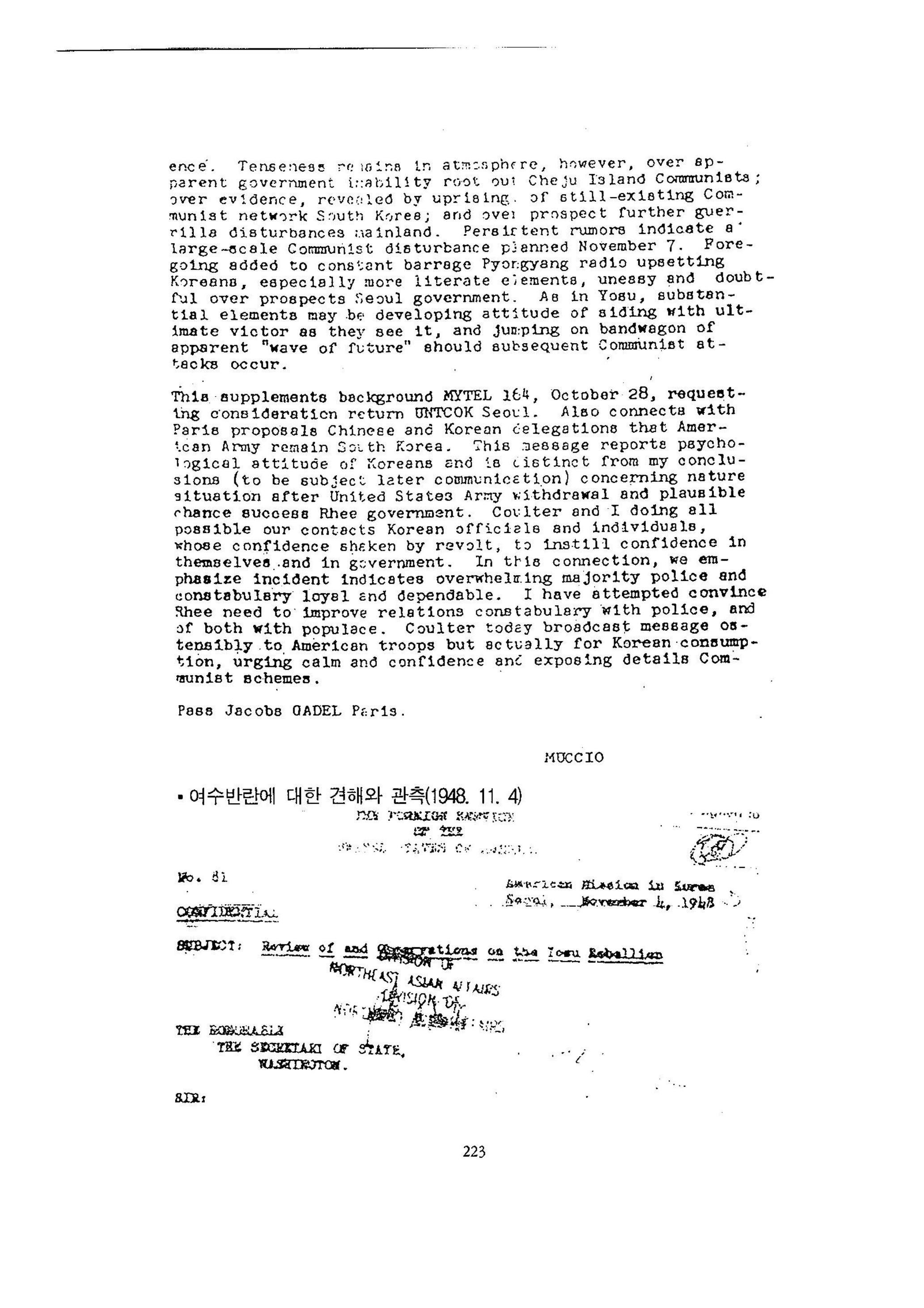
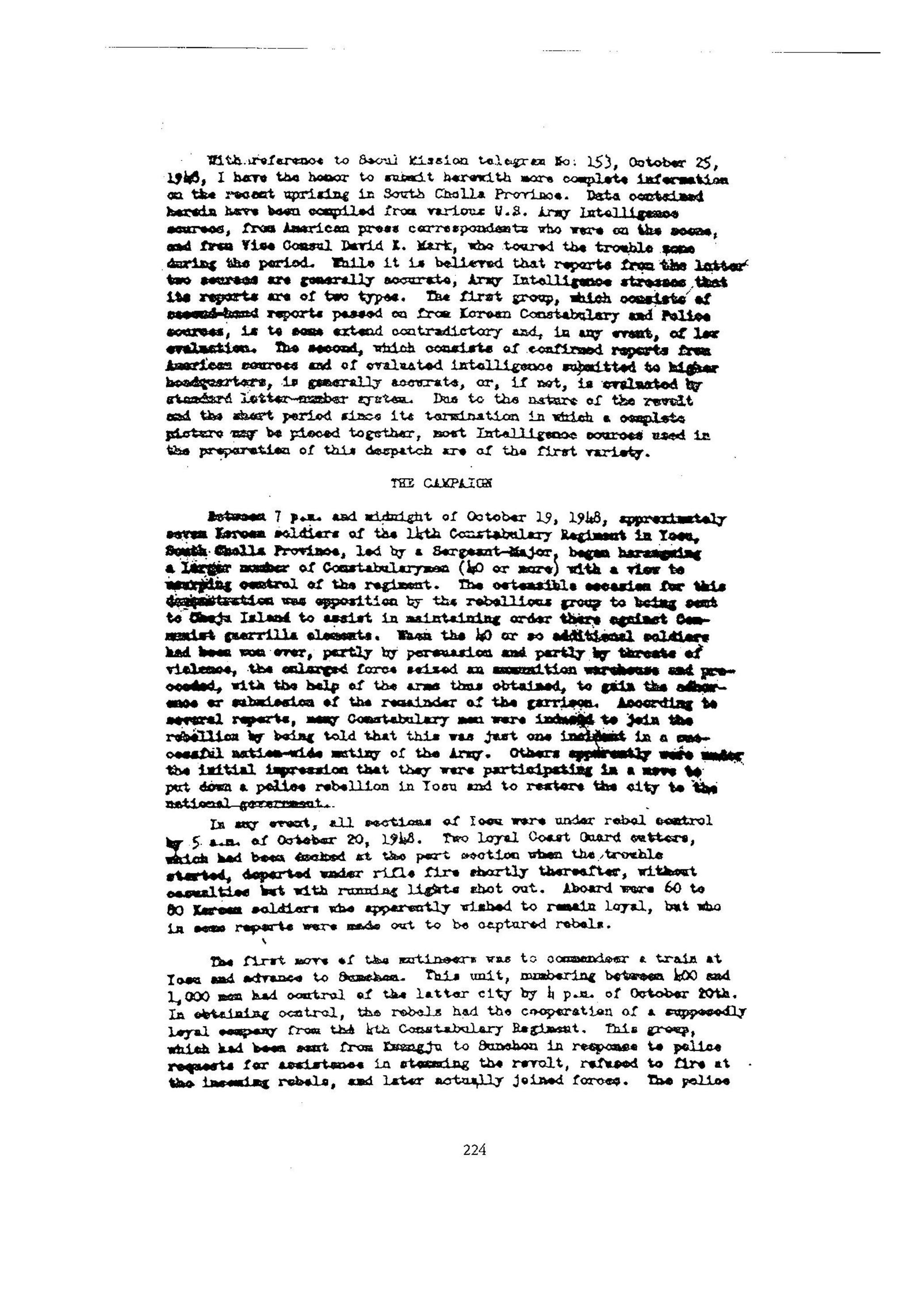
With reference to Seoul Mission telegram No. 153, October 25, 1948, I have the honor to submit herewith more complete information on the recent uprising in South Cholla Province. Data contained herein have been compiled from various U.S. Army Intelligence sources, from American press correspondents who were on the scene, and from Vice Consul David E. Mark, who toured the trouble zone during the period. While it is believed that reports from the latter are generally accurate, Army Intelligence stresses that two sources are of two types. The first group, which consists of second-hand reports passed on from Korean Constabulary and Police sources, is to some extend contradictory and, in any event, of low evaluation. The second, which consists of confirmed reports from American sources and of evaluated intelligence submitted to higher headquarters, is generally accurate, or, if not, is evaluated by standard letter-number system. Due to the nature of the revolt and the short period since its termination in which a complete picture may be pieced together, most Intelligence sources used in the preparation of this despatch are of the first variety.
THE CAMPAIGN
Between 7 p.m. and midnight of October 19, 1948, approximately seven Korean soldiers of the 14th Constabulary Regiment in Yosu, South Cholla Province, led by a Sergeant-Major, began haranguing a larger number of Constabularymen (40 or more) with a view to inciting control of the regiment. The ostensible occasion for this demonstration was opposition by the rebellious group to being sent to Cheju Island to assist in maintaining order there against Communist guerrilla elements. When the 40 or so additional soldiers had been won over, partly by persuasion and partly by threats of violence, the enlarged force seized an ammunition warehouse and proceeded, with the help of the arms thus obtained, to gain the adherence or submission of the remainder of the garrison. According to several reports, many Constabulary men were inclined to join the rebellion by being told that this was just one incident in a successful nation-wide mutiny of the Army. Others apparently were under the initial impression that they were participating in a move to put down a police rebellion in Yosu and to restore the city to the national government.
In any event, all sections of Yosu were under rebel control by 5 a.m. of October 20, 1948. Two loyal Coast Guard cutters, which had been docked at the port section when the trouble started, departed under rifle fire shortly thereafter, without casualties but with running lights shot out. Aboard were 60 to 80 Korean soldiers who apparently wished to remain loyal, but who in some reports were made out to be captured rebels.
The first move of the mutineers was to commandeer a train at Yosu and advance to Sunchon. This unit, numbering between 400 and 1,000 men had control of the latter city by 4 p.m. of October 20th. In obtaining control, the rebels had the co-operation of a supposedly loyal company from the 4th Constabulary Regiment. This group, which had been sent from Kwangju to Sunchon in response to police requests for assistance in stemming the revolt, refused to fire at the incoming rebels, and later actually joined forces. The police
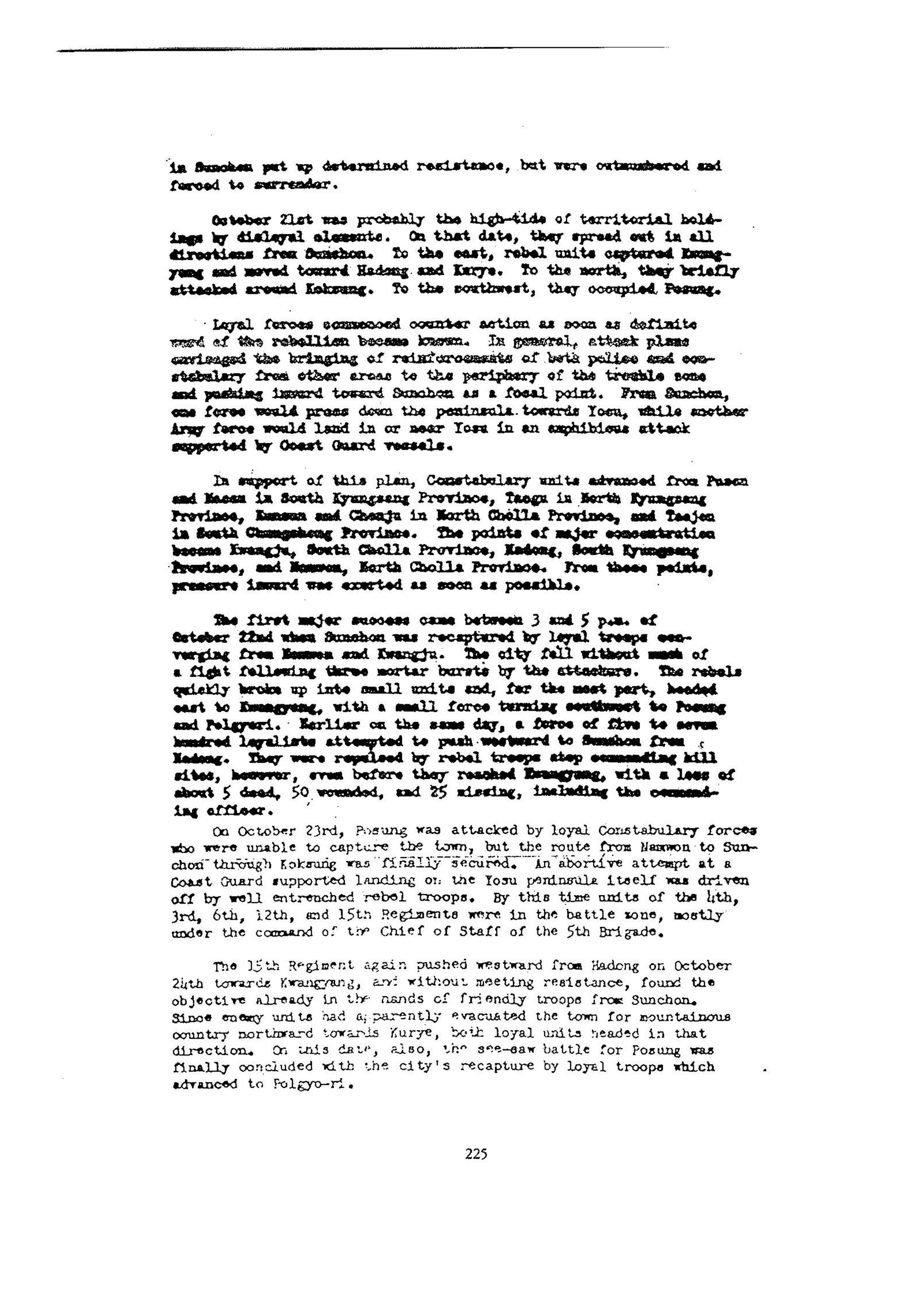
in Sunchon put up determined resistance, but were outnumbered and forced to surrender.
October 21st was probably the high-tide of territorial holdings by disloyal elements. On that date, they spread out in all directions from Sunchon. To the east, rebel units captured Kwangyang and moved toward Hadong and Kurye. To the north, they briefly attacked around Koksung. To the southwest, they occupied Posung.
Loyal forces commenced counter action as soon as definite word of the rebellion became known. In general, attack plans envisaged the bringing of reinforcements of both police and constabulary from other areas to the periphery of the trouble zone and pushing inward toward Sunchon as a focal point. From Sunchon, one force would press down the peninsula towards Yosu, while another Army force would land in or near Yosu in an amphibious attack supported by Coast Guard vessels.
In support of this plan, Constabulary units advanced from Pusan and Masan in South Kyungsang Province, Taegu in North Kyungsang Province, Kunsan and Chonju in North Cholla Province, and Taejon in South Chungchong Province. The points of major concentration became Kwangju, South Cholla Province, Kadong, South Kyungsang Province, and Mopsan, North Cholla Province. From these points, pressure inward was exerted as soon as possible.
The first major success came between 3 and 5 p.m. of October 22nd when Sunchon was recaptured by loyal troops converging from Mopsan and Kwangju. The city fell without much of a fight following three mortar bursts by the attackers. The rebels quickly broke up into small units and, for the most part, headed east to Kwangyang, with a small force turning southwest to Posung and Polgyo-ri. Earlier on the same day, a force of five to seven hundred loyalists attempted to push westward to Sunchon from Kadong. They were repulsed by rebel troops atop commanding hill sites, however, even before they reached Kwangyang, with a loss of about 5 dead, 50 wounded, and 25 missing, including the commanding officer.
On October 23rd, Posung was attacked by loyal Constabulary forces who were unable to capture the town, but the route from Narwon to Sunchon through Koksong was finally secured. An abortive attempt at a Coast Guard supported landing on the Yosu peninsula itself was driven off by well entrenched rebel troops. By this time units of the 4th, 3rd, 6th, 12th, and 15th Regiments were in the battle zone, mostly under the command of the Chief of Staff of the 5th Brigade.
The 15th Regiment again pushed westward from Hadong on October 24th towards Kwangyang, and without meeting resistance, found the objective already in the hands of friendly troops from Sunchon. Since enemy units had apparently evacuated the town for mountainous country northward towards Kurye, both loyal units headed in that direction. On this date, also, the see-saw battle for Posung was finally concluded with the city's recapture by loyal troops which advanced to Polgyo-ri.
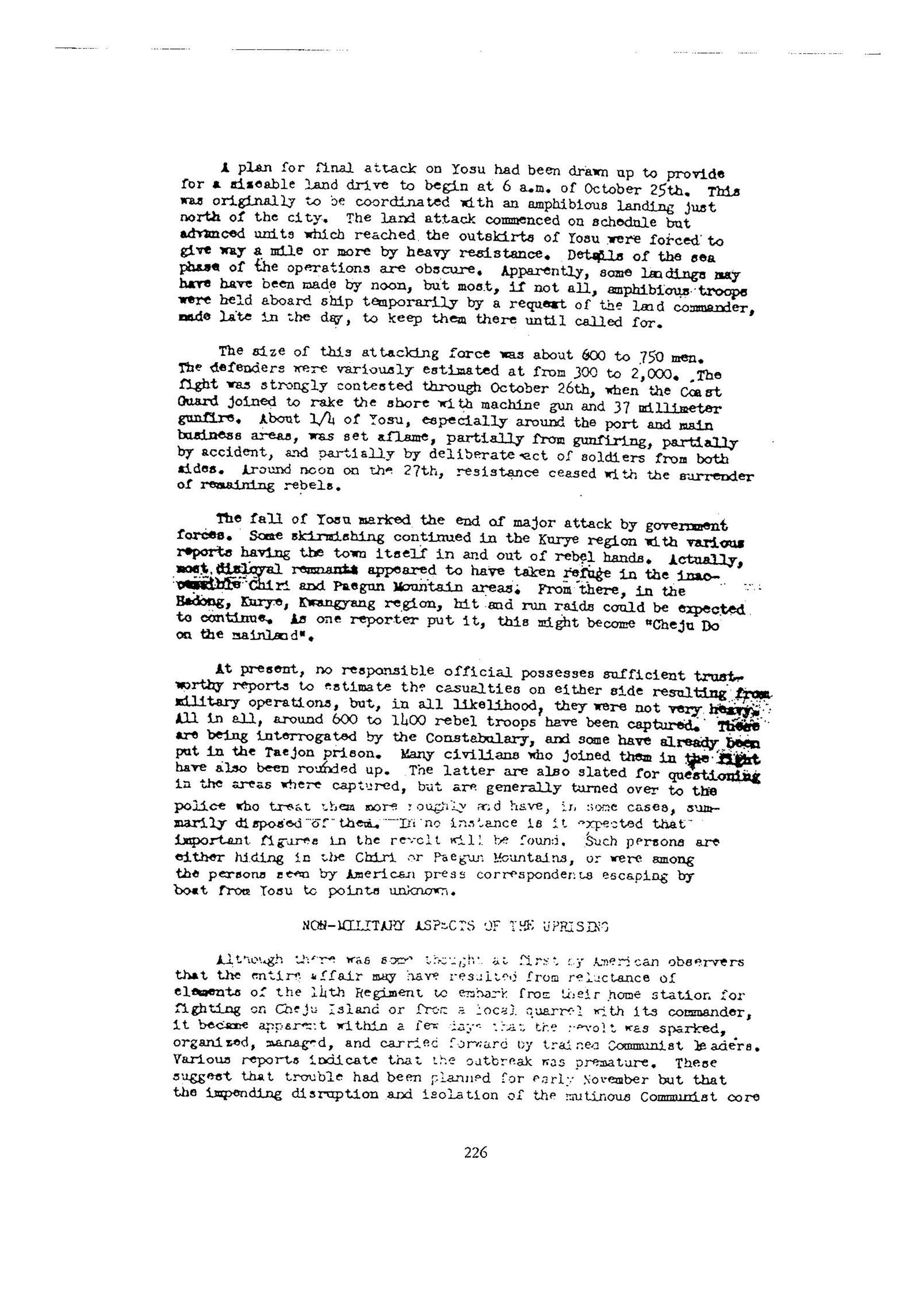
A plan for final attack on Yosu had been drawn up to provide for a sizeable land drive to begin at 6 a.m. of October 25th. This was originally to be coordinated with an amphibious landing just north of the city. The land attack commenced on schedule but advanced units which reached the outskirts of Yosu were forced to give way a mile or more by heavy resistance. Details of the sea phase of the operations are obscure. Apparently, some landings may have have been made by noon, but most, if not all, amphibious troops were held aboard ship temporarily by a request of the land commander, made late in the day, to keep them there until called for.
The size of this attacking force was about 600 to 750 men. The defenders were variously estimated at from 300 to 2,000. The fight was strongly contested through October 26th, when the Coast Guard joined to rake the shore with machine gun and 37 millimeter gunfire. About 1/4 of Yosu, especially around the port and main business areas, was set aflame, partially from gunfiring, partially by accident, and partially by deliberate act of soldiers from both sides. Around noon on the 27th, resistance ceased with the surrender of remaining rebels.
The fall of Yosu marked the end of major attack by government forces. Some skirmishing continued in the Kurye region with various reports having the town itself in and out of rebel hands. Actually, most disloyal remnants appeared to have taken refuge in the inac- [illegible] Chiri and Paegun Mountain areas. From there, in the Hadong, Kurye, Kwangyang region, hit and run raids could be expected to continue. As one reporter put it, this might become "Cheju Do on the mainland".
At present, no responsible official possesses sufficient trust- worthy reports to estimate the casualties on either side resulting from military operations, but, in all likelihood, they were not very heavy. All in all, around 600 to 1400 rebel troops have been captured. These are being interrogated by the Constabulary, and some have already been put in the Taejon prison. Many civilians who joined them in the [illegible] have also been rounded up. The latter are also slated for questioning in the areas where captured, but are generally turned over to the police who treat them more roughly and have, in some cases, summarily disposed of them. "In no instance is it expected that important figures in the revolt will be found. Such persons are either hiding in the Chiri or Paegun Mountains, or were among the persons seen by American press correspondents escaping by boat from Yosu to points unknown.
NON-MILITARY ASPECTS OF THE UPRISING
Although there was some thought at first by American observers that the entire affair may have resulted from reluctance of elements of the 14th Regiment to embark from their home station for fighting on Cheju Island or from a local quarrel with its commander, it became apparent within a few days that the revolt was sparked, organized, managed, and carried forward by trained Communist leaders. Various reports indicate that the outbreak was premature. These suggest that trouble had been planned for early November but that the impending disruption and isolation of the mutinous Communist core
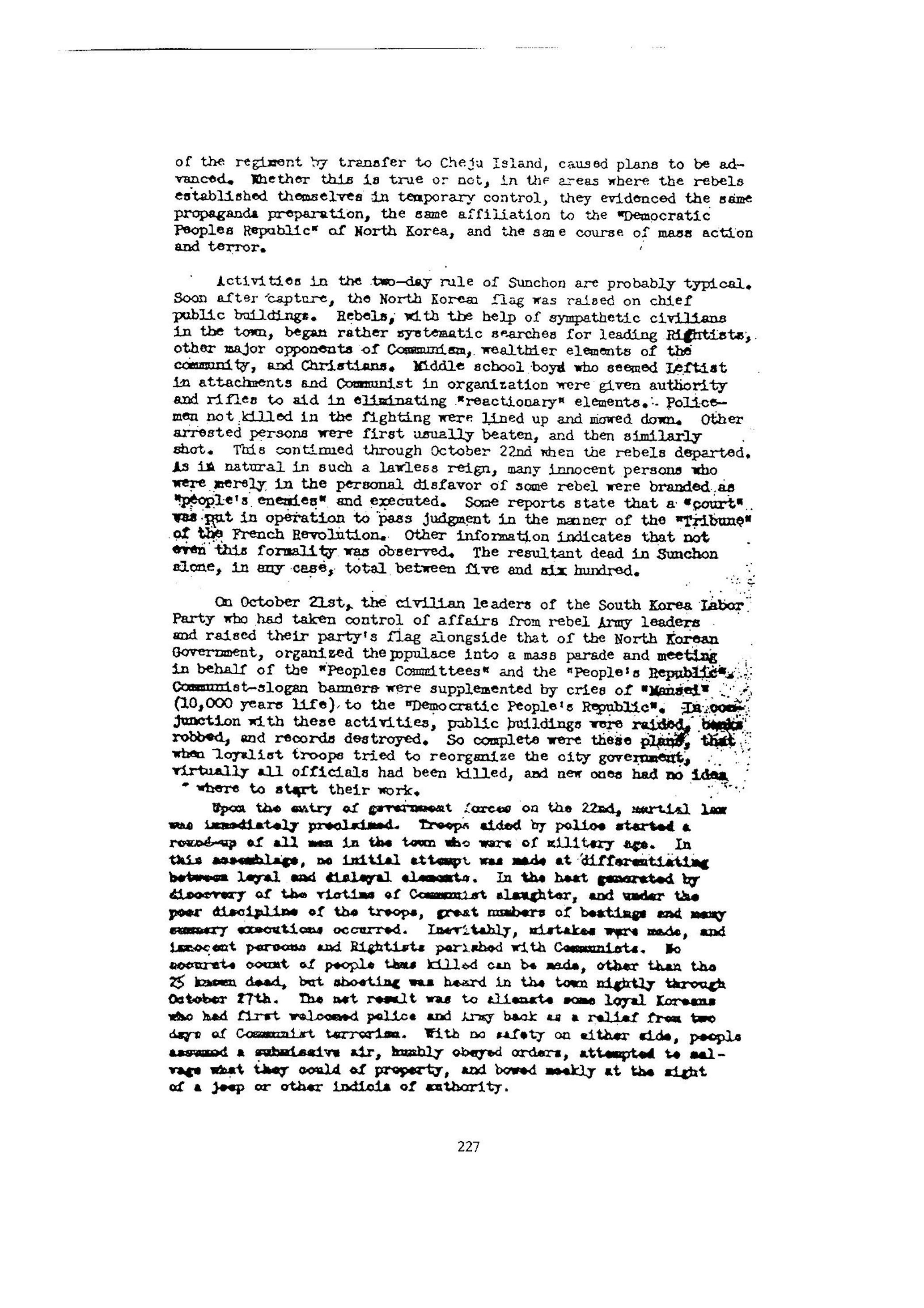
of the regiment by transfer to Cheju Island, caused plans to be advanced. Whether this is true or not, in the areas where the rebels established themselves in temporary control, they evidenced the same propaganda preparation, the same affiliation to the "Democratic Peoples Republic" of North Korea, and the same course of mass action and terror.
Activities in the two-day rule of Sunchon are probably typical. Soon after capture, the North Korean flag was raised on chief public buildings. Rebels, with the help of sympathetic civilians in the town, began rather systematic searches for leading Rightists, other major opponents of Communism, wealthier elements of the community, and Christians. Middle school boys who seemed Leftist in attachments and Communist in organization were given authority and rifles to aid in eliminating "reactionary" elements. Policemen not killed in the fighting were lined up and mowed down. Other arrested persons were first usually beaten, and then similarly shot. This continued through October 22nd when the rebels departed. As is natural in such a lawless reign, many innocent persons who were merely in the personal disfavor of some rebel were branded as "people's enemies" and executed. Some reports state that a "court" was put in operation to pass judgment in the manner of the "Tribune" of the French Revolution. Other information indicates that not even this formality was observed. The resultant dead in Sunchon alone, in any case, total between five and six hundred.
On October 21st, the civilian leaders of the South Korea Labor Party who had taken control of affairs from rebel Army leaders and raised their party's flag alongside that of the North Korean Government, organized the populace into a mass parade and meeting in behalf of the "Peoples Committees" and the "People's Republic". Communist-slogan banners were supplemented by cries of "Manse!" (10,000 years life) to the "Democratic People's Republic". In com junction with these activities, public buildings were raided, banks robbed, and records destroyed. So complete were these plans, that when loyalist troops tried to reorganize the city government, virtually all officials had been killed, and new ones had no idea where to start their work.
Upon the entry of government forces on the 22nd, martial law was immediately proclaimed. Troops aided by police started a round-up of all men in the town who were of military age. In this assemblage, no initial attempt was made at differentiating between loyal and disloyal elements. In the heat generated by discovery of the victims of Communist slaughter, and under the poor discipline of the troops, great numbers of beatings and many summary executions occurred. Inevitably, mistakes were made, and innocent persons and Rightists perished with Communists. No accurate count of people thus killed can be made, other than the 25 known dead, but shooting was heard in the town nightly through October 27th. The net result was to alienate some loyal Koreans who had first welcomed police and Army back as a relief from two days of Communist terrorism. With no safety on either side, people assumed a submissive air, humbly obeyed orders, attempted to salvage what they could of property, and bowed meekly at the sight of a jeep or other indicia of authority.
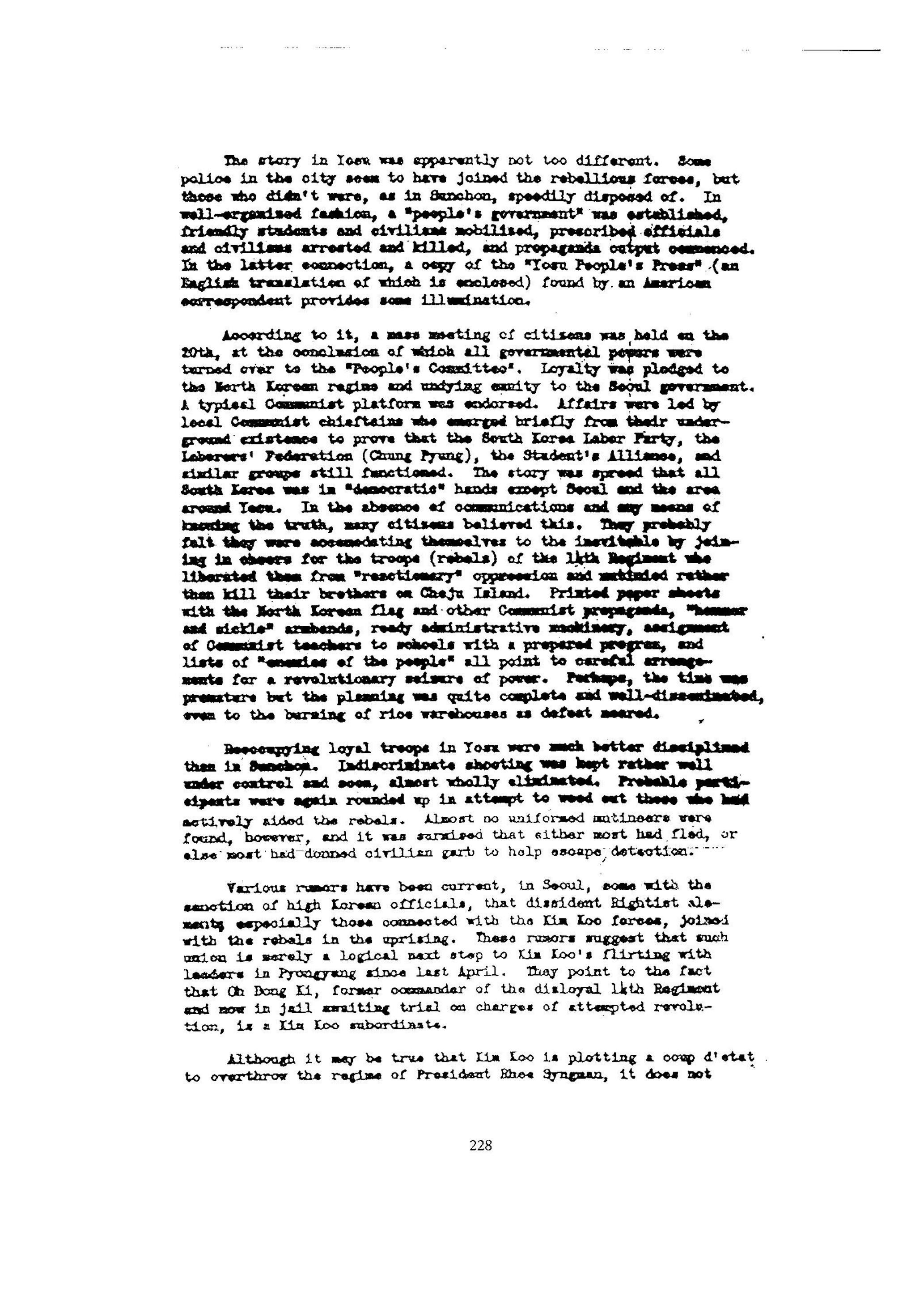
The story in Yosu was apparently not too different. Some police in the city seem to have joined the rebellious forces, but those who didn't were, as in Sunchon, speedily disposed of. In well-organized fashion, a "people's government" was established, friendly students and civilians mobilized, proscribed officials and civilians arrested and killed, and propaganda output commenced. In the latter connection, a copy of the "Yosu People's Press" (an English translation of which is enclosed) found by an American correspondent provides some illumination.
According to it, a mass meeting of citizens was held on the 20th, at the conclusion of which all governmental powers were turned over to the "People's Committee". Loyalty was pledged to the North Korean regime and undying enmity to the Seoul government. A typical Communist platform was endorsed. Affairs were led by local Communist chieftains who emerged briefly from their underground existence to prove that the South Korea Labor Party, the Laborers' Federation (Chung Pyung), the Student's Alliance, and similar groups still functioned. The story was spread that all South Korea was in "democratic" hands except Seoul and the area around Taegu. In the absence of communications and any means of knowing the truth, many citizens believed this. They probably felt they were accommodating themselves to the inevitable by joining in cheers for the troops (rebels) of the 14th Regiment the liberated them from "reactionary" oppression and assisted rather than kill their brothers on Cheju Island. Printed paper sheets with the North Korean flag and other Communist propaganda, "banner and sickle" armbands, ready administrative machinery, assignment of Communist teachers to schools with a prepared program, and lists of "enemies of the people" all point to careful arrangements for a revolutionary seizure of power. Perhaps, the time was premature but the planning was quite complete and well-disseminated, even to the burning of rice warehouses as defeat neared.
Reoccupying loyal troops in Yosu were much better disciplined than in Sunchon. Indiscriminate shooting was kept rather well under control and some, almost wholly eliminated. Probable participants were again rounded up in attempt to weed out those who had actively aided the rebels. Almost no uniformed mutineers were found, however, and it was surmised that either most had fled, or else most had donned civilian garb to help escape detection.
Various rumors have been current, in Seoul, some with the sanction of high Korean officials, that dissident Rightist elements especially those connected with the Kim Koo forces, joined with the rebels in the uprising. These rumors suggest that such union is merely a logical next step to Kim Koo's flirting with leaders in Pyongyang since last April. They point to the fact that Oh Dong Ki, former commander of the disloyal 14th Regiment and now in jail awaiting trial on charges of attempted revolution, is a Kim Koo subordinate.
Although it may be true that Kim Koo is plotting a coup d'etat to overthrow the regime of President Rhee Syngman, it does not
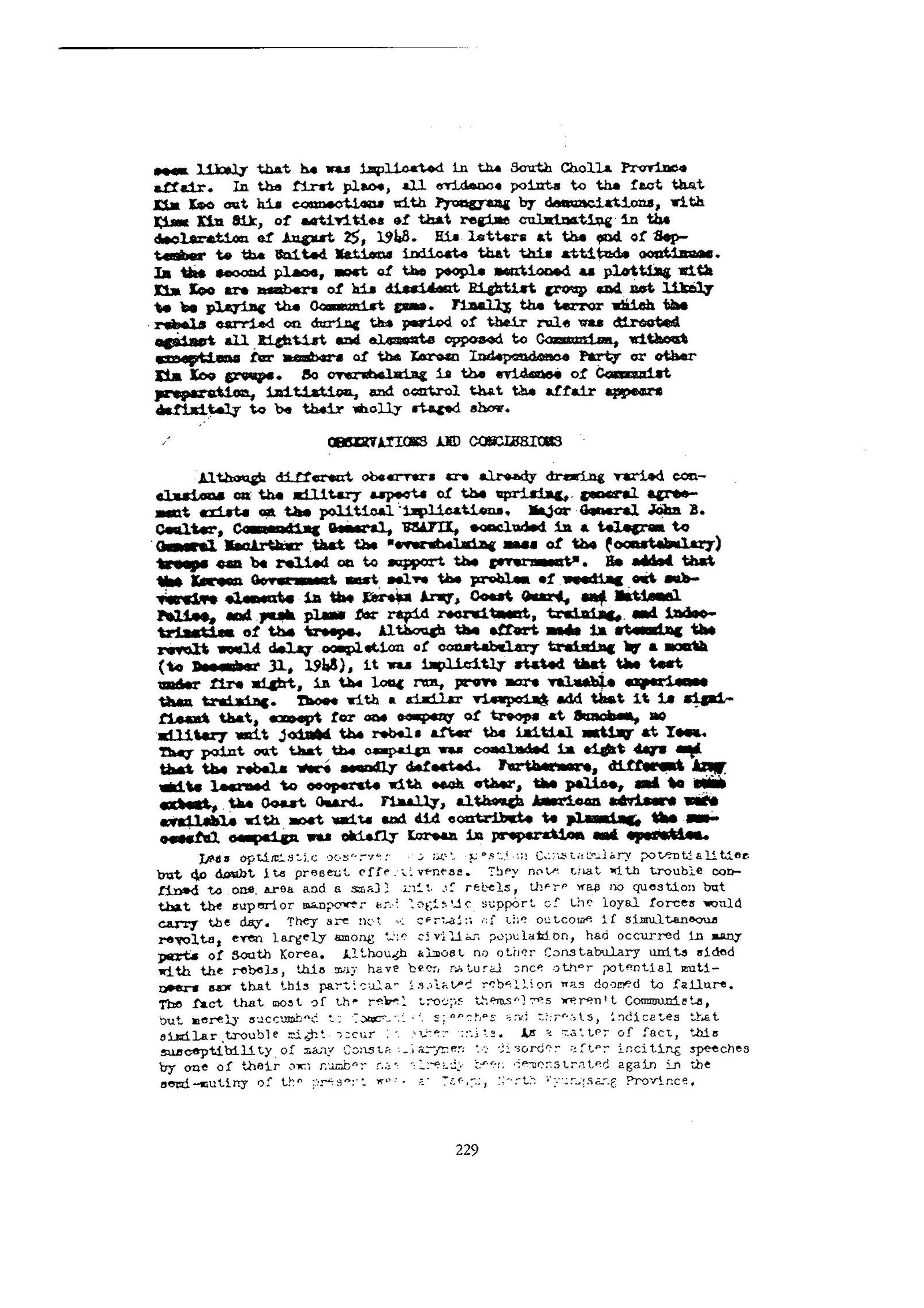
seem likely that he was implicated in the South Cholla Province affair. In the first place, all evidence points to the fact that Kim Koo out his connections with Pyongyang by denunciations, with Kimm Kiu Sik, of activities of that regime culminating in the declaration of August 25, 1948. His letters at the end of September to the United Nations indicate that this attitude continues. In the second place, most of the people mentioned as plotting with Kim Koo are members of his dissident Rightist group and not likely to be playing the Communist game. Finally the terror which the rebels carried on during the period of their rule was directed against all Rightist and elements opposed to Communism, without exceptions for members of the Korean Independence Party or other Kim Koo groups. So overwhelming is the evidence of Communist preparation, initiation, and control that the affair appears definitely to be their wholly staged show.
OBSERVATIONS AND CONCLUSIONS
Although different observers are already drawing varied conclusions on the military aspects of the uprising, general agreement exists on the political implications. Major General John B. Coulter, Commanding General, USAFIK, concluded in a telegram to General MacArthur that the "overwhelming mass of the (constabulary) troops can be relied on to support the government". He added that the Korean Government must solve the problem of weeding out subversive elements in the Korean Army, Coast Guard, and National Police, and push plans for rapid recruitment, training, and indoctrination of the troops. Although the effort made in stemming the revolt would delay completion of constabulary training by a month (to December 31, 1948), it was implicitly stated that the test under fire might, in the long run, prove more valuable experience than training. Those with a similar viewpoint add that it is significant that, except for one company of troops at Sunchon, no military unit joined the rebels after the initial mutiny at Yosu. They point out that the campaign was concluded in eight days and that the rebels were soundly defeated. Furthermore, different Army units learned to cooperate with each other, the police, and to some extent, the Coast Guard. Finally, although American advisers were available with most units and did contribute to planning, the successful campaign was chiefly Korean in preparation and operation.
Less optimistic observers do not question Constabulary potentialities but do doubt its present effectiveness. They note that with trouble confined to one area and a small unit of rebels, there was no question but that the superior manpower and logistic support of the loyal forces would carry the day. They are not so certain of the outcome if simultaneous revolts, even largely among the civilian population, had occurred in many parts of South Korea. Although almost no other Constabulary units sided with the rebels, this may have been natural once other potential mutineers saw that this particular isolated rebellion was doomed to failure. The fact that most of the rebel troops themselves weren't Communists, but merely succumbed to [illegible] speeches and threats, indicates that similar trouble might occur in other units. As a matter of fact, this susceptibility of many Constabulary men to disorder after inciting speeches by one of their own number has already been demonstrated again in the semi-mutiny of the present work at Taegu, North Kyungsang Province,
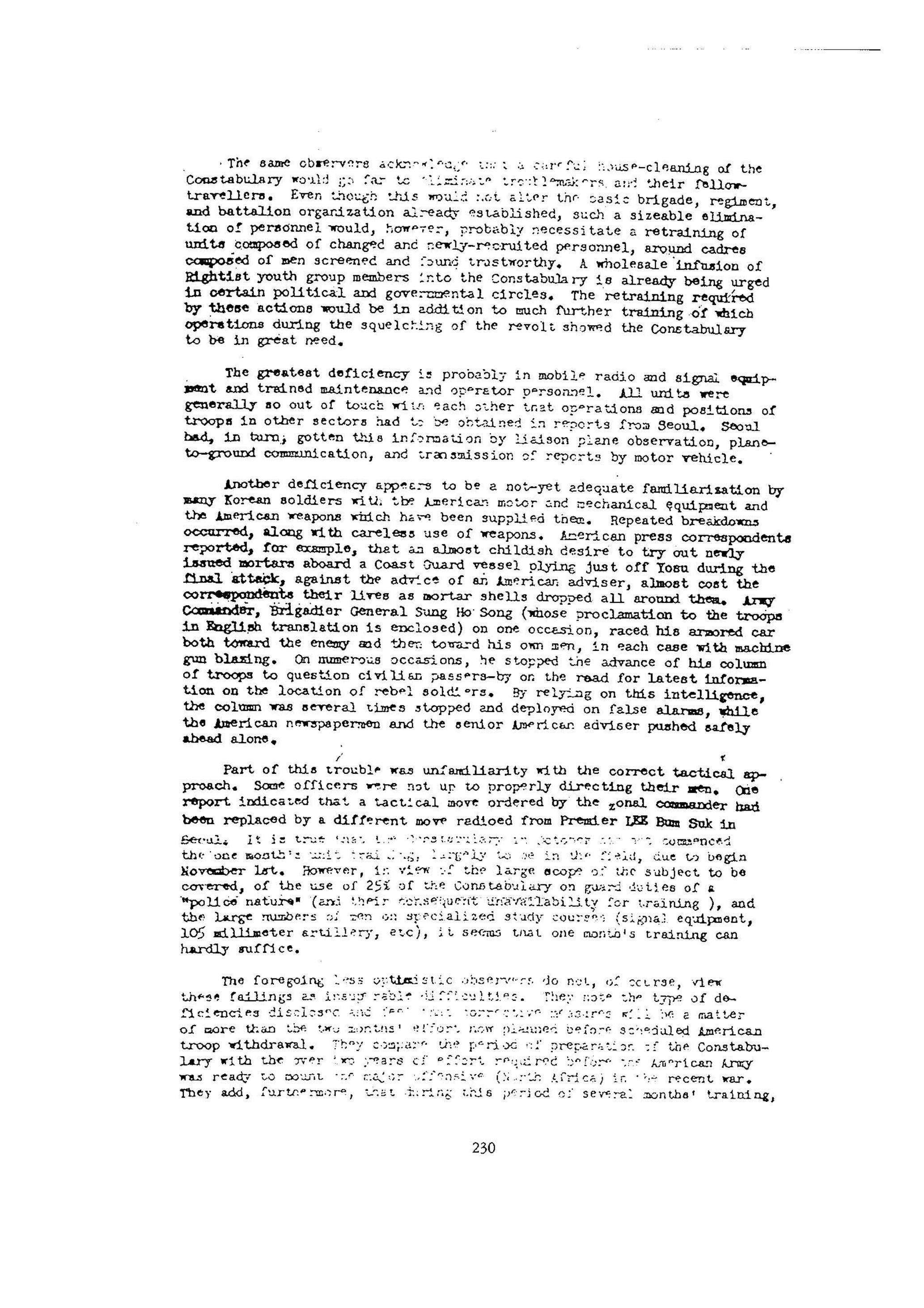
The same observers acknowledge that a careful house-cleaning of the Constabulary would go far to eliminate troublemakers and their fellow-travellers. Even though this would not alter the basic brigade, regiment, and battalion organization already established, such a sizeable elimination of personnel would, however, probably necessitate a retraining of units composed of changed and newly-recruited personnel, around cadres composed of men screened and found trustworthy. A wholesale infusion of Rightist youth group members into the Constabulary is already being urged in certain political and governmental circles. The retraining required by these actions would be in addition to much further training of which operations during the squelching of the revolt showed the Constabulary to be in great need.
The greatest deficiency is probably in mobile radio and signal equipment and trained maintenance and operator personnel. All units were generally so out of touch with each other that operations and positions of troops in other sectors had to be obtained in reports from Seoul. Seoul had, in turn, gotten this information by liaison plane observation, plane-to-ground communication, and transmission of reports by motor vehicle.
Another deficiency appears to be a not-yet adequate familiarization by many Korean soldiers with the American motor and mechanical equipment and the American weapons which have been supplied them. Repeated breakdowns occurred, along with careless use of weapons. American press correspondents reported, for example, that an almost childish desire to try out newly issued mortars aboard a Coast Guard vessel plying just off Yosu during the final attack, against the advice of an American adviser, almost cost the correspondents their lives as mortar shells dropped all around them. Army Commander, Brigadier General Sung Ho Song (whose proclamation to the troops in English translation is enclosed) on one occasion, raced his armored car both toward the enemy and then toward his own men, in each case with machine gun blazing. On numerous occasions, he stopped the advance of his column of troops to question civilian passers-by on the road for latest information on the location of rebel soldiers. By relying on this intelligence, the column was several times stopped and deployed on false alarms, while the American newspapermen and the senior American adviser pushed safely ahead alone.
Part of this trouble was unfamiliarity with the correct tactical approach. Some officers were not up to properly directing their men. One report indicated that a tactical move ordered by the zonal commander had been replaced by a different move radioed from Premier LKE Bum Suk in Seoul. It is true that [illegible] [illegible] in [illegible] [illegible] to [illegible] commenced the one month's unit [illegible] training, [illegible] to be in [illegible] field, due to begin November 1st. However, in view of the large scope of the subject to be covered, of the use of 25% of the Constabulary on guard duties of a "police nature" (and their consequent unavailability for training ), and the large numbers of men on specialized study courses (signal equipment, 105 millimeter artillery, etc), it seems that one month's training can hardly suffice.
The foregoing [illegible] optimistic observers do not, of course, view these failings as insuperable difficulties. They note the type of deficiencies disclosed and [illegible] [illegible] [illegible] of [illegible] will be a matter of more than the two months' effort now planned before scheduled American troop withdrawal. They compare the period of preparation of the Constabulary with the over two years of effort required before the American Army was ready to mount the major offensive (North Africa) in the recent war. They add, furthermore, that during this period of several months' training,
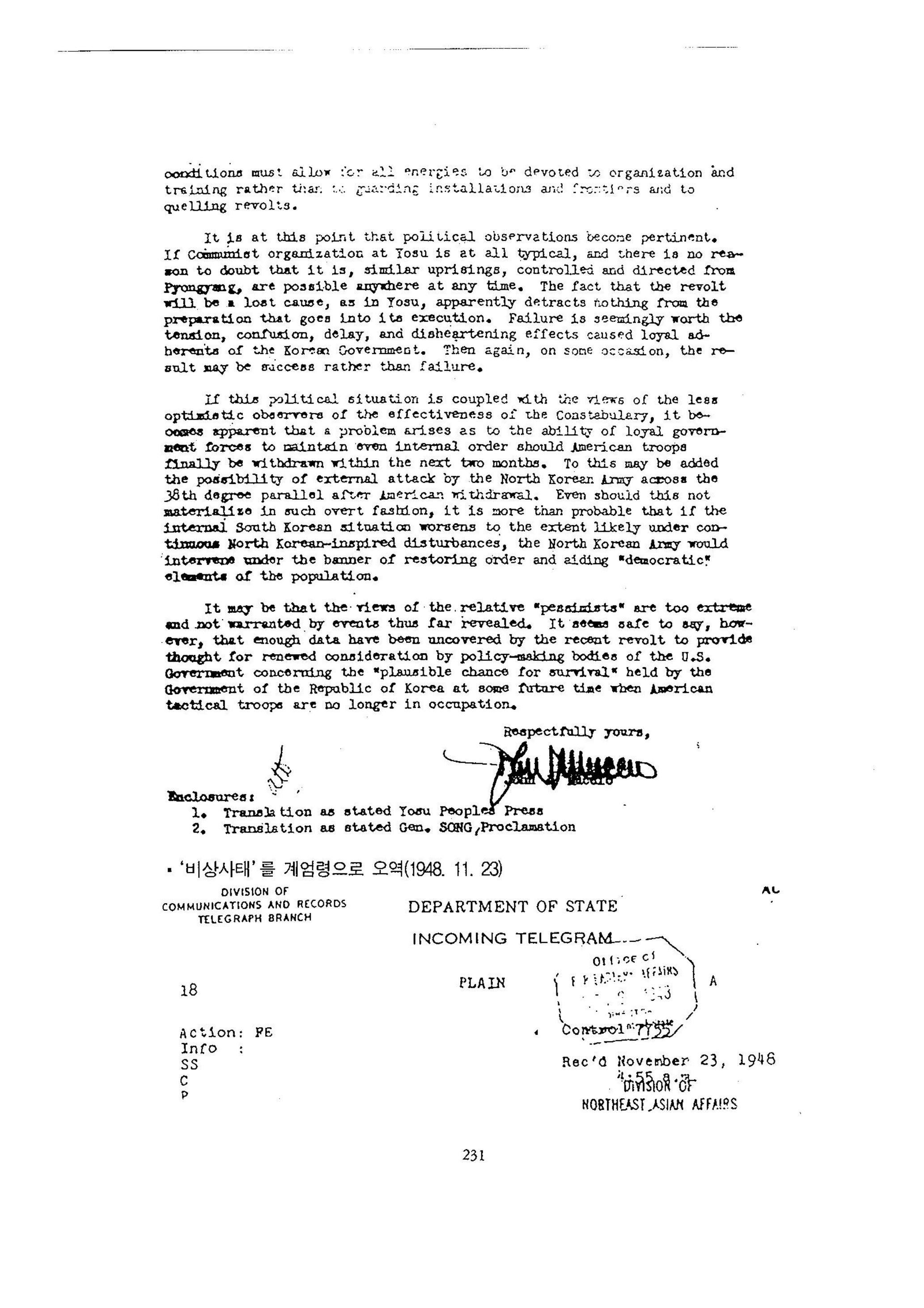
conditions must allow for all energies to be devoted to organization and training rather than to guarding installations and frontiers and to quelling revolts.
It is at this point that political observations become pertinent. If Communist organization at Yosu is at all typical, and there is no reason to doubt that it is, similar uprisings, controlled and directed from Pyongyang, are possible anywhere at any time. The fact that the revolt will be a lost cause, as in Yosu, apparently detracts nothing from the preparation that goes into its execution. Failure is seemingly worth the tension, confusion, delay, and disheartening effects caused loyal adherents of the Korean Government. Then again, on some occasion, the result may be success rather than failure.
If this political situation is coupled with the views of the less optimistic observers of the effectiveness of the Constabulary, it becomes apparent that a problem arises as to the ability of loyal government forces to maintain even internal order should American troops finally be withdrawn within the next two months. To this may be added the possibility of external attack by the North Korean Army across the 38th degree parallel after American withdrawal. Even should this not materialize in such overt fashion, it is more than probable that if the internal South Korean situation worsens to the extent likely under continuous North Korean-inspired disturbances, the North Korean Army would intervene under the banner of restoring order and aiding "democratic" elements of the population.
It may be that the views of the relative "pessimists" are too extreme and not warranted by events thus far revealed. It seems safe to say, however, that enough data have been uncovered by the recent revolt to provide thought for renewed consideration by policy-making bodies of the U.S. Government concerning the "plausible chance for survival" held by the Government of the Republic of Korea at some future time when American tactical troops are no longer in occupation.
Respectfully yours,
[illegible signature]
Enclosures:
1. Translation as stated Yosu Peoples Press
2. Translation as stated Gen. SONG,Proclamation
출처:
제주4·3사건진상규명및희생자명예회복위원회 편,
『제주4·3사건자료집 11』 [미국자료편],
번역문 p.25
/ 원문 p.223–231.