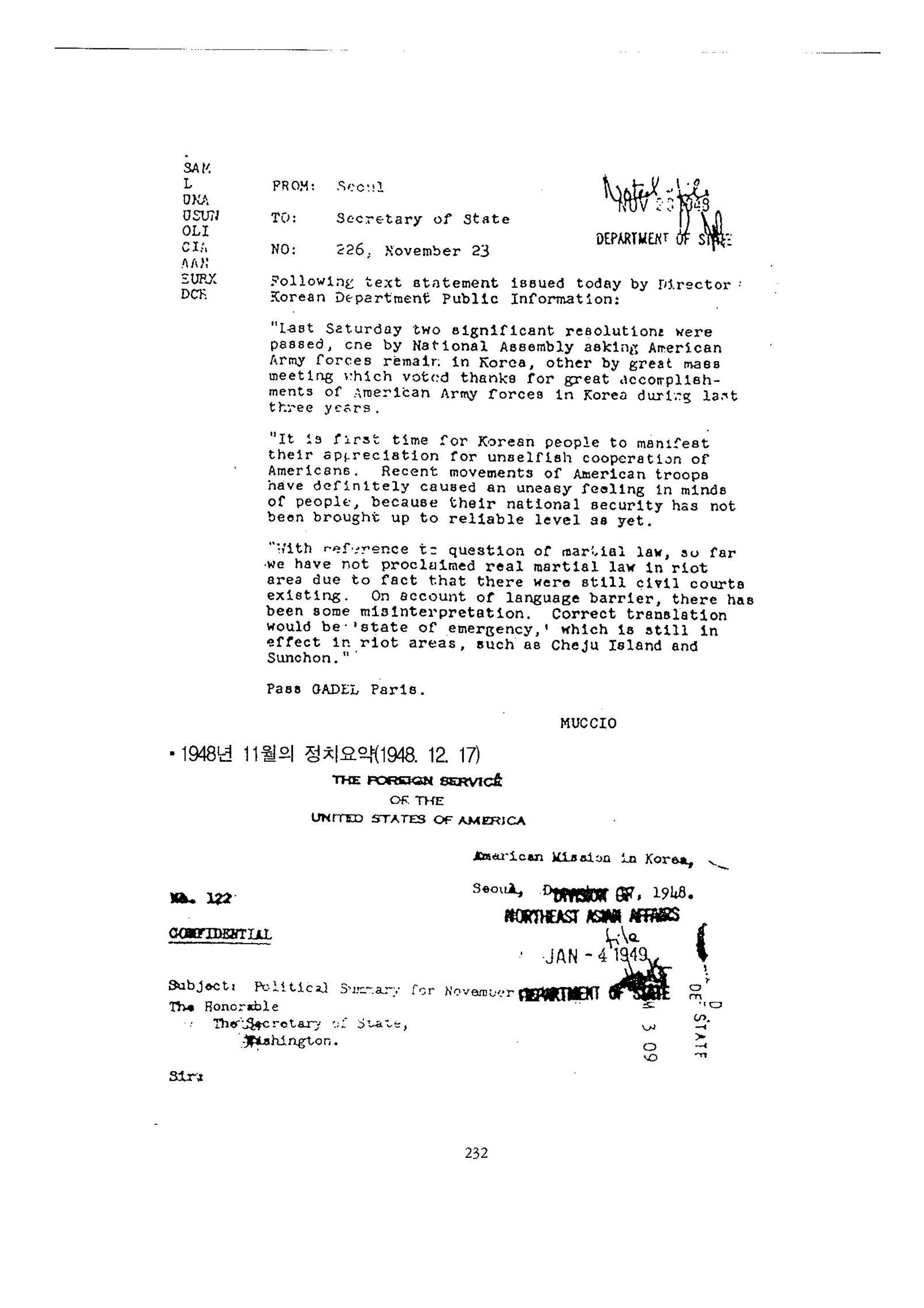
주한미사절단
제목: 1948년 11월의 정치요약
존경하는 국무장관 귀하
10월의 정치 발전 상황에 대해 보고한 1948년 11월 16일의 사절단 <급송문서> 제90호에 이어 1948년 11월 한국의 정치 발전 상황을 보고하게 돼 영광입니다.
I. 개요
10월에 전라남도에서 국방경비대의 반란에 대한 즉각적인 영향이 국회에 광범위하게 나타나고 이승만 대통령 정부의 행동과 조직에 대한 대중적 비난으로 나타난 반면 지체된 반응은 미국에 더욱 직접적으로 중요한 것임이 증명됐습니다.
이것은 언론과 정부기관, 국회에서 광범위한 선전형태로 나타났으며 사회 지도층 사이에서는 신생 공화국의 통합을 지키기 위해 미국으로 하여금 한국내 군대를 지속적으로 주둔하도록 하는 필요성을 확신시키려는 움직임이 나타났습니다. 그러나 미군의 향후 처리에 관해 어떠한 미국인 관리도 확실한 언질을 하지 않고 10월이 끝나가자 한국정부 당국은 그들의 주의를 파리에서 열리는 유엔총회로 돌렸습니다. 그들은 그곳에서 한국정부의 국제 인식 확보와 미군의 한국주둔을 유도할 몇몇 방식을 고안하기를 희망했습니다.
위험하지만 우익 정치연합을 향한 약간의 진전이 있었습니다. 특히 청년단체의 진전이 있었습니다. 군은 또한 자신들의 부대내 파괴 우려가 있는 분자들을 숙청하는데 적극적이며, 충돌에 대비해 자신들을 정신적, 육체적으로 준비를 하는데도 적극적입니다. 그럼에도 불구하고 정부의 힘을 약화시키는 국무회의내 파벌간의 반목과 무능력이 있는 반면 모든 반공분자들의 연합전선은 아직도 먼 희망입니다.
더욱이 북한이 사주한 공산주의자들이 진압군에게 조금의 휴식도 주지 않고 제주도와 여수와 순천의 산악지역에서 게릴라 활동을 계속하고 있으며 강원도(38선 바로 남쪽)에서 새로운 작전을 시작했습니다. 또 국방경비대에서 중요한 2건의 탈주를 부추기고 지하 당조직과 함께 계획을 중단하기 위해 압력을 넣고 있습니다.
(중략)
II. 한국의 공산주의자
다행히 11월에는 여수봉기 만큼의 충돌은 반복되지 않았지만 마을경찰 습격, 공산폭도 보복 등 남한의 평화를 훼손하는 오랫동안 익숙한 형태의 몇몇 사건이 산발적으로 흩어져 일어났습니다. 한 국방경비대 반란은 제3의 대도시 대구에서 11월 3일 거의 미연에 방지됐습니다. 그러나 약 200여 명의 불충한 군인들은 총과 차량, 보급품을 갖고 시골로 탈주했습니다. 이 달이 끝나기 전에 대부분 잡혔습니다. 전라남도의 한 국방경비대 중대는 11월 2일 지휘관을 살해하고 도주했으나 많은 반란병력들은 16일 체포된 것으로 보고됐습니다.
10월 반란이 일어난 지역은 결코 아직 정상이 아닙니다. 전라남도 구례에 대한 반복되는 공격과 함께 지리산과 백운산 근처에서 꽤 큰 습격이 있었습니다.
11월말까지 국방경비대는 상당한 양의 무기와 보급품을 탈환하고 700명의 반란군을 체포했다고 보고했습니다. 제주도에서는 사태의 개선 전망이 밝지 않은 채 양쪽의 습격과 죽임이 아직도 계속되고 있다고 보고됐습니다. 강원도 오대산의 게릴라 활동은 강화됐습니다. 38선 바로 남쪽인 이 지역에는 평양의 공산 ‘정치학원’ 졸업생 200~500여명이 남한을 쑥밭으로 만들기 위해 침투하고 있습니다. 그들의 주요 시도는 남한 전력의 약 3분의 1을 공급하는 영월발전소에 침투해 이를 파괴하기 위한 시도에 있는 것으로 보입니다.
그들은 많은 포로들을 잡기 위해 공격한 국방경비대의 경비부대에 의해 패주했습니다. 이 달 말까지 이 특별한 지역에서는 소탕작전이 진행될 것으로 보입니다.
남한에서의 총궐기와 북한 ‘인민군’의 침략에 관한 보고서와 소문들이 계속해서 유포되고 있습니다. 이들 가운데 아무것도 특별히 신뢰할만한 가치는 없는 것으로 보입니다. (후략)
존 무쵸(John J. Muccio)
THE FOREIGN SERVICE
OF THE
UNITED STATES OF AMERICA
American Mission in Korea,
Seoul, December 07, 1948.
No. 122
NORTHEAST ASIAN AFFAIRS
CONFIDENTIAL
JAN - 4 1949
Subject: Political Summary for November DEPARTMENT OF STATE
The Honorable
The Secretary of State,
Washington.
Sir:
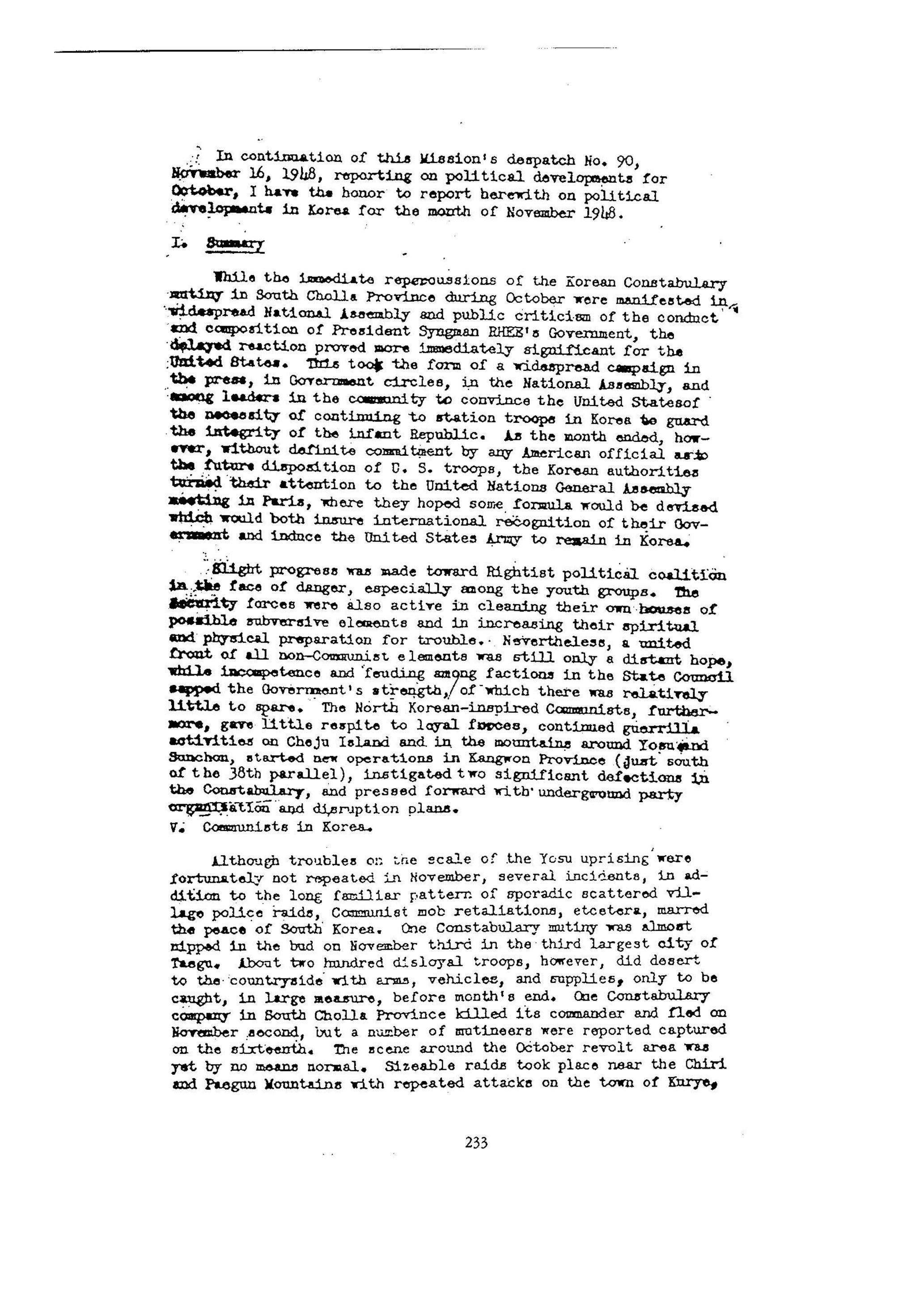
In continuation of this Mission's despatch No. 90, November 16, 1948, reporting on political developments for October, I have the honor to report herewith on political developments in Korea for the month of November 1948.
I. Summary
While the immediate repercoussions of the Korean Constabulary mutiny in South Cholla Province during October were manifested in widespread National Assembly and public criticism of the conduct and composition of President Syngman RHEE's Government, the delayed reaction proved more immediately significant for the United States. This took the form of a widespread campaign in the press, in Government circles, in the National Assembly, and among leaders in the community to convince the United Statesof the necessity of continuing to station troops in Korea to guard the integrity of the infant Republic. As the month ended, however, without definite commitment by any American official as to the future disposition of U. S. troops, the Korean authorities turned their attention to the United Nations General Assembly meeting in Paris, where they hoped some formula would be devised which would both insure international recognition of their Government and induce the United States Army to remain in Korea.
Slight progress was made toward Rightist political coalition in the face of danger, especially among the youth groups. The security forces were also active in cleaning their own houses of possible subversive elements and in increasing their spiritual and physical preparation for trouble. Nevertheless, a united front of all non-Communist elements was still only a distant hope, while incompetence and feuding among factions in the State Council sapped the Government's strength, of which there was relatively little to spare. The North Korean-inspired Communists, furthermore, gave little respite to loyal forces, continued guerrilla activities on Cheju Island and in the mountains around Yosu and Sunchon, started new operations in Kangwon Province (just south of the 38th parallel), instigated two significant defections in the Constabulary, and pressed forward with underground party organization and disruption plans.
V. Communists in Korea.
Although troubles on the scale of the Yosu uprising were fortunately not repeated in November, several incidents, in addition to the long familiar pattern of sporadic scattered village police raids, Communist mob retaliations, etcetera, marred the peace of South Korea. One Constabulary mutiny was almost nipped in the bud on November third in the third largest city of Taegu. About two hundred disloyal troops, however, did desert to the countryside with arms, vehicles, and supplies, only to be caught, in large measure, before month's end. One Constabulary company in South Cholla Province killed its commander and fled on November second, but a number of mutineers were reported captured on the sixteenth. The scene around the October revolt area was yet by no means normal. Sizeable raids took place near the Chiri and Paegun Mountains with repeated attacks on the town of Kurye,
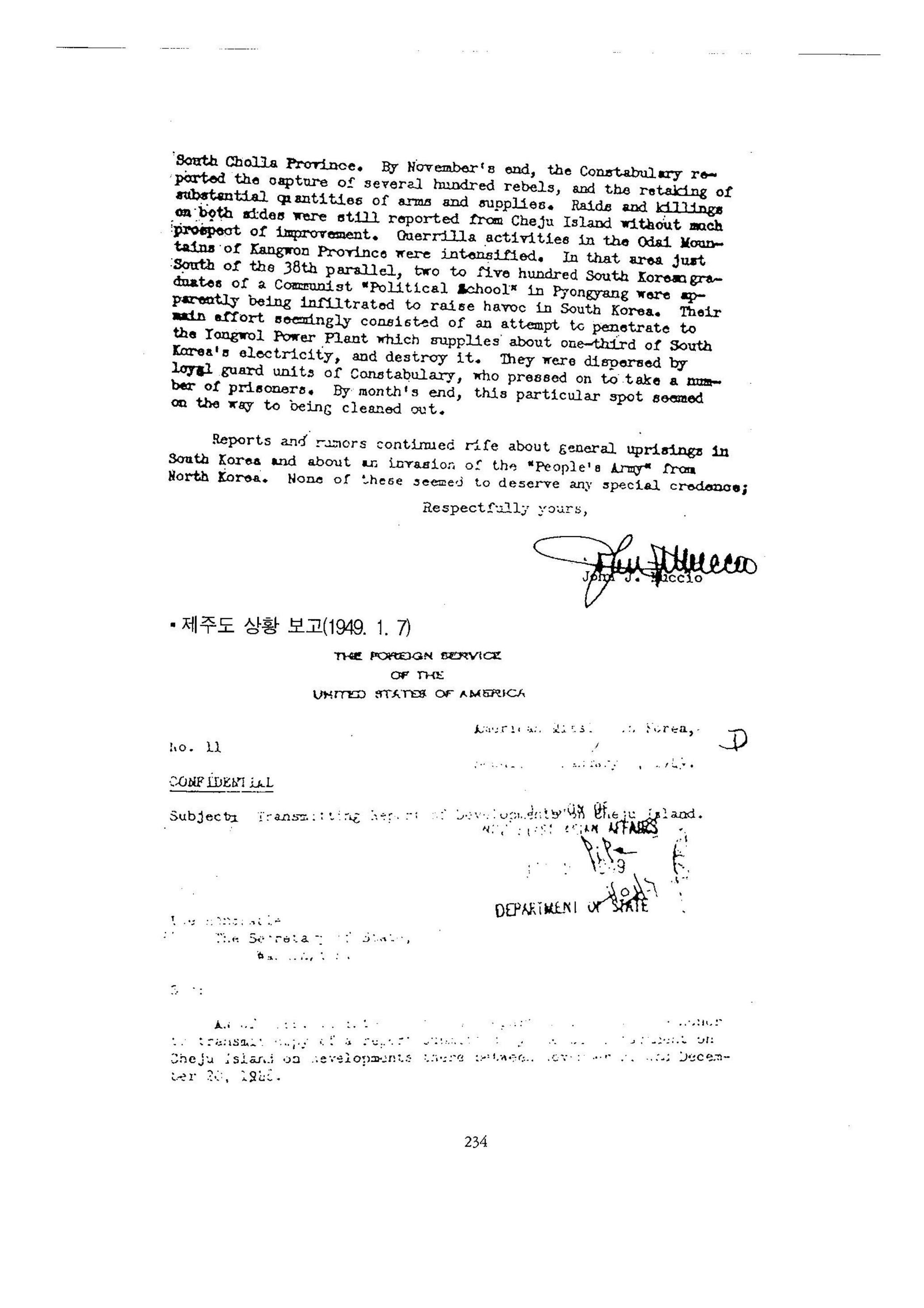
South Cholla Province. By November's end, the Constabulary reported the capture of several hundred rebels, and the retaking of substantial quantities of arms and supplies. Raids and killings on both sides were still reported from Cheju Island without much prospect of improvement. Guerrilla activities in the Odai Mountains of Kangwon Province were intensified. In that area just South of the 38th parallel, two to five hundred South Korean graduates of a Communist "Political School" in Pyongyang were apparently being infiltrated to raise havoc in South Korea. Their main effort seemingly consisted of an attempt to penetrate to the Yongwol Power Plant which supplies about one-third of South Korea's electricity, and destroy it. They were dispersed by loyal guard units of Constabulary, who pressed on to take a number of prisoners. By month's end, this particular spot seemed on the way to being cleaned out.
Reports and rumors continued rife about general uprisings in South Korea and about an invasion of the "People's Army" from North Korea. None of these seemed to deserve any special credence;
Respectfully yours,
John J. Muccio
출처:
제주4·3사건진상규명및희생자명예회복위원회 편,
『제주4·3사건자료집 11』 [미국자료편],
번역문 p.36
/ 원문 p.232–234.