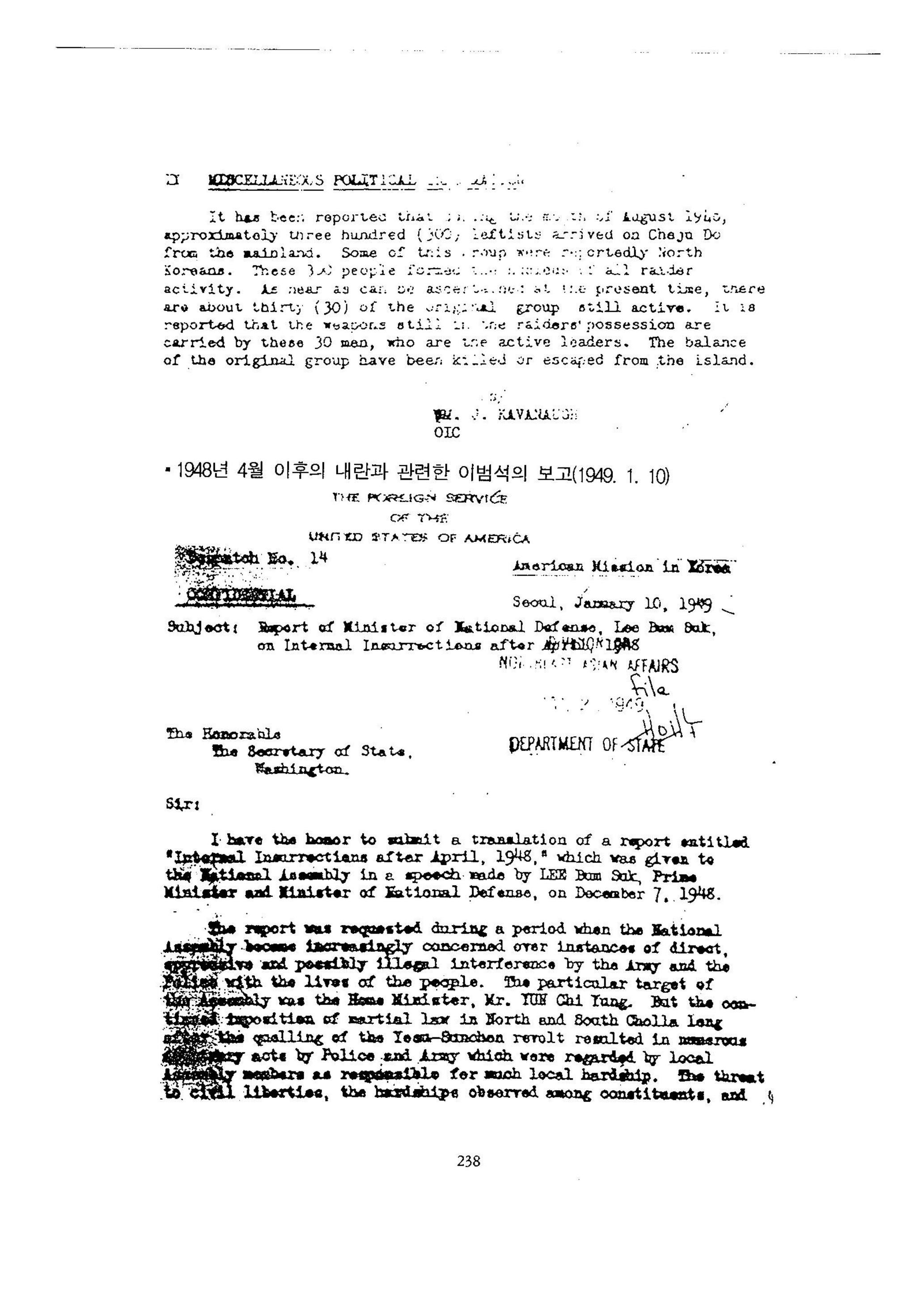
주한미사절단
제목: 1948년 4월 이후의 내란과 관련한 이범석 국방장관의 보고
존경하는 국무장관 귀하
1948년 12월 7일 이범석 국방장관 겸 국무총리가 국회에서 연설한 ‘1948년 4월 이후의 소란사건’이라는 제목의 번역본을 제출하게 돼 영광입니다.
이 보고서는 국민의 생명과 관련해 군과 경찰에 의한 직접적, 공격적, 불법적인 듯한 간섭에 대해 국회가 점점 우려하는 시점에 요구됐습니다.
국회의 특별한 목표는 윤치영 내무장관입니다. 그러나 여수순천반란이 진압된 뒤 오랫동안 계속되는 전라남도와 전라북도에 대한 계엄령 실시는 군경의 무수한 독단적 행위를 낳게 했습니다. 지방의회 의원들은 지방에서 겪는 많은 곤경에 대한 책임이 군경에 있는 것으로 간주합니다.
시민의 자유권에 대한 위협, 선거인들이 관찰한 학대, 지역주민들이 계엄령하에서 자신들이 겪는 고통에 때문에 국회를 비난하려는 경향 등은 국회로 하여금 체면을 잃고 중요한 곡물수집과 반민족행위자 처벌법의 성공적인 진행을 위태롭게 하고 있다고 생각하게 하는 원인이 됐습니다.
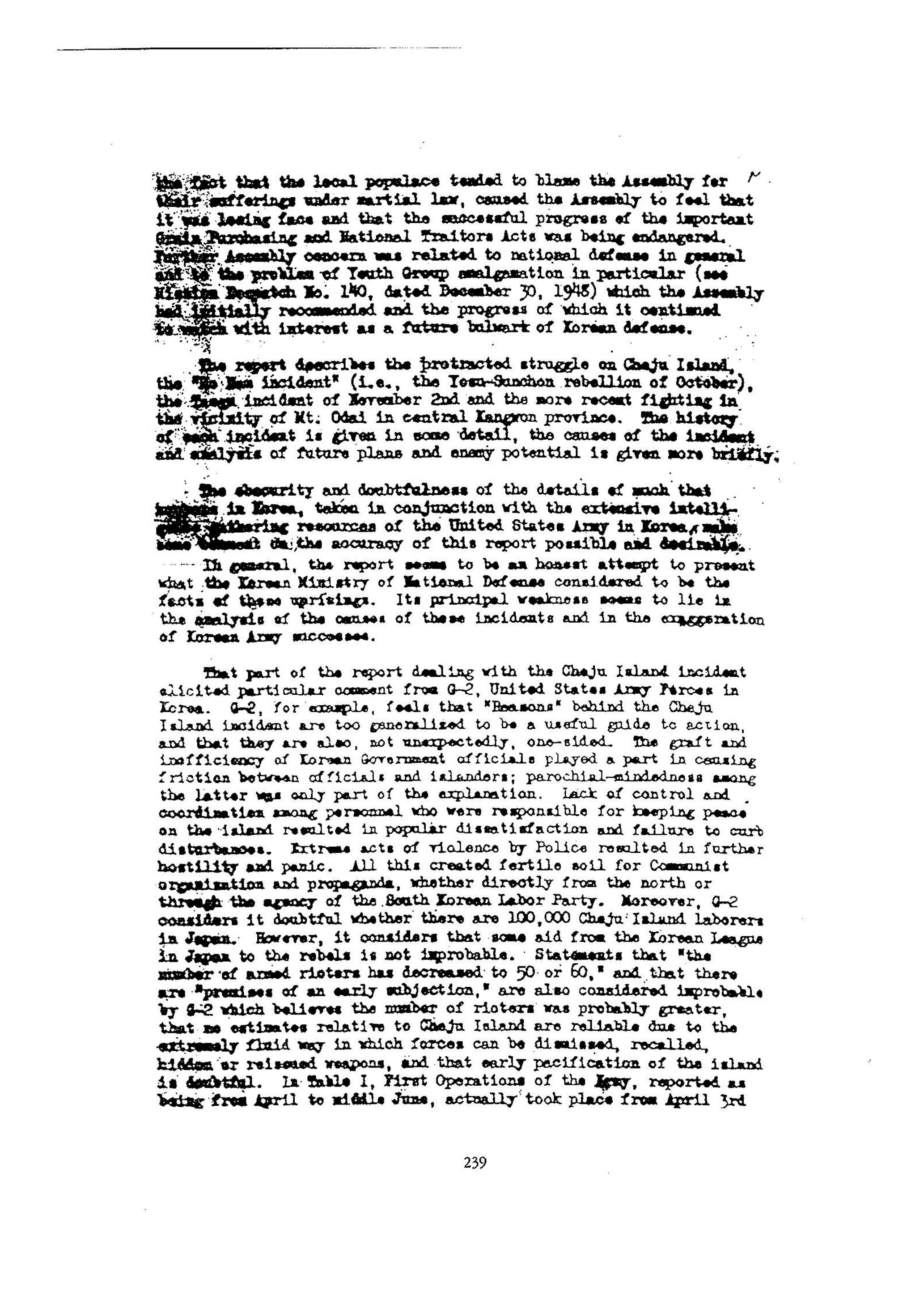
추가로 국회의 관심은 일반적으로 국가방위와 특히 청년단체의 통합문제(사절단 <급송문서> 제140호, 1948년 12월 30일자)와 관련이 있습니다. 국회는 국가방위의 향후 보루로서 흥미를 갖고 지속적으로 이것을 지켜봤고 처음 건의했습니다.
보고서는 오래 끌고 있는 제주도의 투쟁과 호남사건(여수순천 10월 반란 등), 11월 2일의 대구사건, 강원도 중부지역인 오대산 부근에서의 최근 전투를 설명하고 있는데 각 사건의 경과를 어느 정도 상세하게 소개하고 있으며 사건의 원인과 향후 계획의 분석, 적정(敵情)이 보다 간결하게 나와있습니다.
이 보고서는 주한미육군의 광범위한 정보 수집원들과 관련해 이뤄졌기 때문에 한국에서 일어난 많은 일들의 모호함과 불확실한 점들이 있지만 보고서의 정확성에 관해 어느 정도 가능하고 바람직한 것으로 논평하고 있습니다.
대체적으로 보고서는 한국 국방장관이 이들 봉기의 사실을 보여주는데 공정하게 노력하는 것처럼 보입니다. 이것의 근본적인 취약점은 이들 사건들의 원인분석과 한국군들이 성공적인 작전에 대한 과장에 있는 것처럼 보입니다.
제주도 사건을 다룬 부분은 주한미육군사령부 정보참모부의 특별한 논평을 이끌어내고 있습니다.
예를 들면, 정보참모부는 제주도 사건의 이면에 있는 ‘원인’들이 너무 일반화 돼 작전을 취하기에는 유용한 방안이 될 수 없으며, 또한 예상대로 너무 일방적이라고 생각하고 있습니다.
한국 정부 관리들의 부패과 무능이 관리들과 제주도민들 사이의 한 마찰요인이 됐습니다. 즉 제주도 주민들의 편협한 사고는 단지 설명의 한 부분일 뿐이며 섬의 치안유지에 책임이 있는 인사들간의 통제와 조정기능 결핍 때문에 도민들의 불만이 나왔고 소요를 억제하는데 실패하는 결과를 초래했습니다.
경찰에 의한 극단적 폭력행위는 더욱 적대적이고 공포심을 초래했습니다. 북에서 직접 지령이 나오던지 남로당 조직을 통해 나오던지 간에 이런 모든 것이 공산주의 조직과 선전활동에 비옥한 토양을 제공했습니다.
더욱이 정보참모부는 제주도 노동자 10만여 명이 일본에 있는지에 대해 의심스럽게 여기고 있습니다. 그러나 재일조선인연맹의 반란군들에 대한 일부 원조의 가능성은 있다고 보고 있습니다.
‘무장폭도의 수가 50~60명으로 줄었다’와 ‘초기진압 약속’ 발언도 정보참모부는 타당하지 않은 것으로 간주하고 있습니다.
정보참모부는 폭도들의 수가 더 많을 것이고 게릴라 부대의 해산, 재소집, 은신, 무기 재발급 등의 극단적인 가변상황 때문에 제주도와 관련한 추정은 신뢰할 수 없으며 따라서 제주도에서의 초기 평정은 의심스럽다고 보고 있습니다.
제1표에서 4월부터 6월 중순으로 보고된 육군의 첫 작전은 실제 4월 3일부터 7월 15일까지 진행됐습니다. 정보참모부는 모두 135명의 공산주의자들이 죽었다고 보고했습니다.
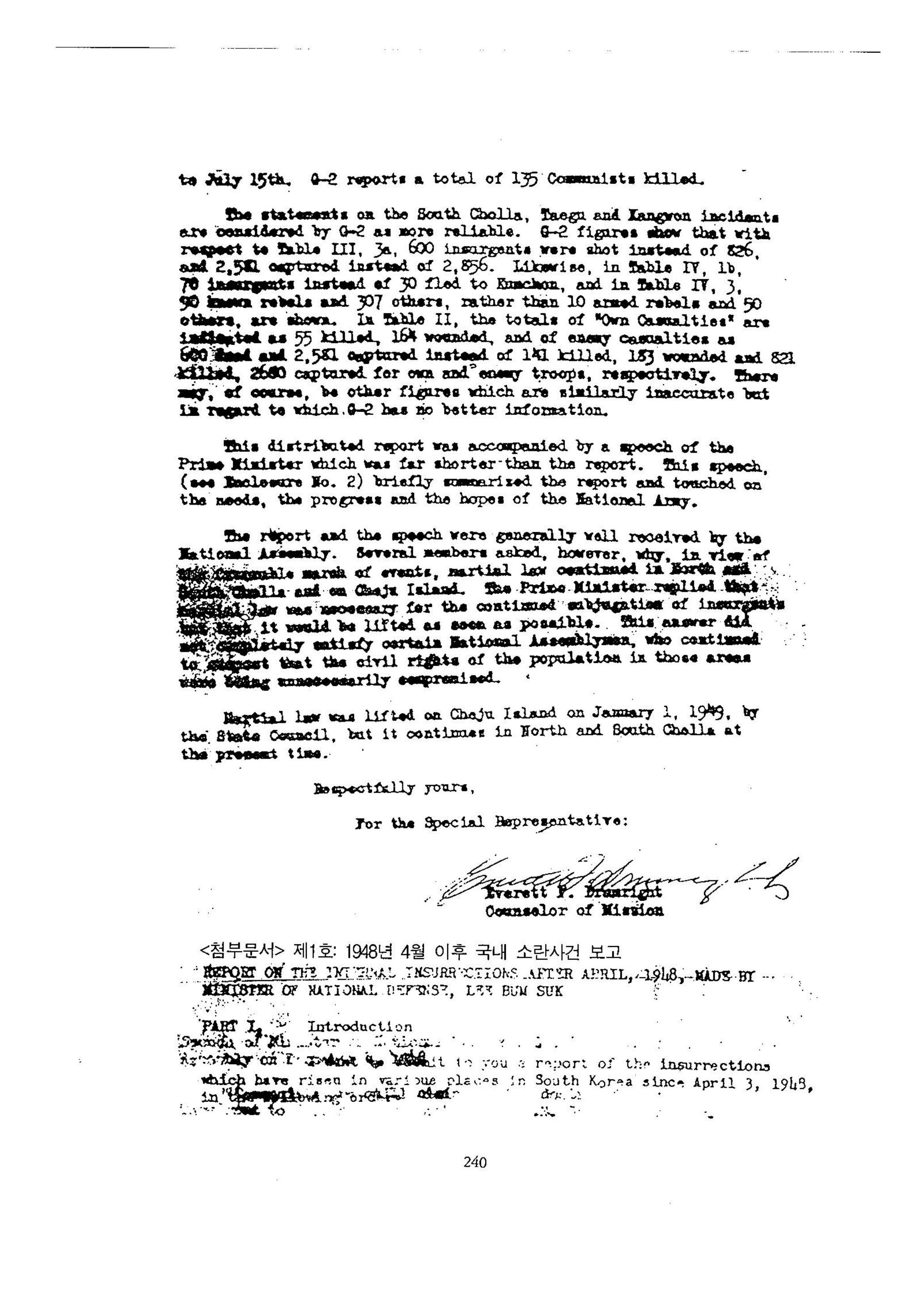
정보참모부는 전라남도와 대구, 강원도 사건에 대한 발언에 대해서는 더 믿을만한 것으로 보고 있습니다. 제3표, 3a와 관련한 정보참모부 집계는 반도 826명 대신에 600명이 사살되고, 2,856명 대신에 2,581명이 체포된 것으로 나와 있습니다. 마찬가지로 제4표, 1b에는 반도 30명 대신에 70명이 금천에서 도주한 것으로 나와있으며, 제4표, 3에는 10명의 알려진 반란군과 50명의 반도 보다 50명의 알려진 반란군과 307명의 반도에 대한 집계를 보여주고 있습니다.
제2표에서는 아군쪽 141명 사망, 183명 부상, 적군쪽 821명 사망, 2,680명 생포 대신에 우리쪽 피해는 55명 사망, 164명 부상, 그리고 적군쪽 피해는 600명 사망, 2,581명이 생포됐다는 것을 보여줍니다.
물론 정보참모부가 더 나은 정보를 갖고 있지 않기 때문에 부정확한 다른 수치들이 비슷하게 있을 것입니다.
배포된 이 보고서는 이보다 훨씬 짧은 국무총리의 연설을 담고 있습니다. 이 연설(첨부문서 제2호 참조)은 보고서를 간결하게 요약했으며 국군의 진행과정과 희망 등 필요한 부분을 언급하고 있습니다.
국회는 보고서와 연설을 대체적으로 잘 받아들였습니다. 그러나 몇몇 국회의원들은 사건들이 순조롭게 진행되고 있는데 전라남도와 전라북도, 제주도에서 왜 계엄령이 계속되는지를 질의했습니다. 국무총리는 계엄령은 반란군들의 지속적인 진압에 필요하지만 가능한 한 빨리 해제할 것이라고 대답했습니다. 이 대답은 이들 지역에서 시민권이 불필요하게 손상됐다고 주장하는 일부 국회의원들을 충분하게 만족시키지 못했습니다.
국무회의는 1949년 1월 1일 제주도에 내려졌던 계엄령을 해제했습니다. 그러나 전라북도와 전라남도에 내려진 계엄령은 현재도 계속되고 있습니다.
특별대표를 위하여
사절단 참사관 에버레트 드럼라이트
<첨부문서> 제1호 1948년 4월 이후 국내 소란사건 보고 (1949. 1. 10. 보고)
(역주: <첨부문서> 제1호는 이범석 국무총리가 제1회 124차 국회 본회의에서 보고한 내용을 번역한 것이다. 여기서는 보고내용을 그대로 옮겨 적었다.<대한민국 제1회 국회 속기록 제124호, 1948. 12. 8>
▷단기 1948년 4월 이후 국내 소란사건 보고
제1절 총론
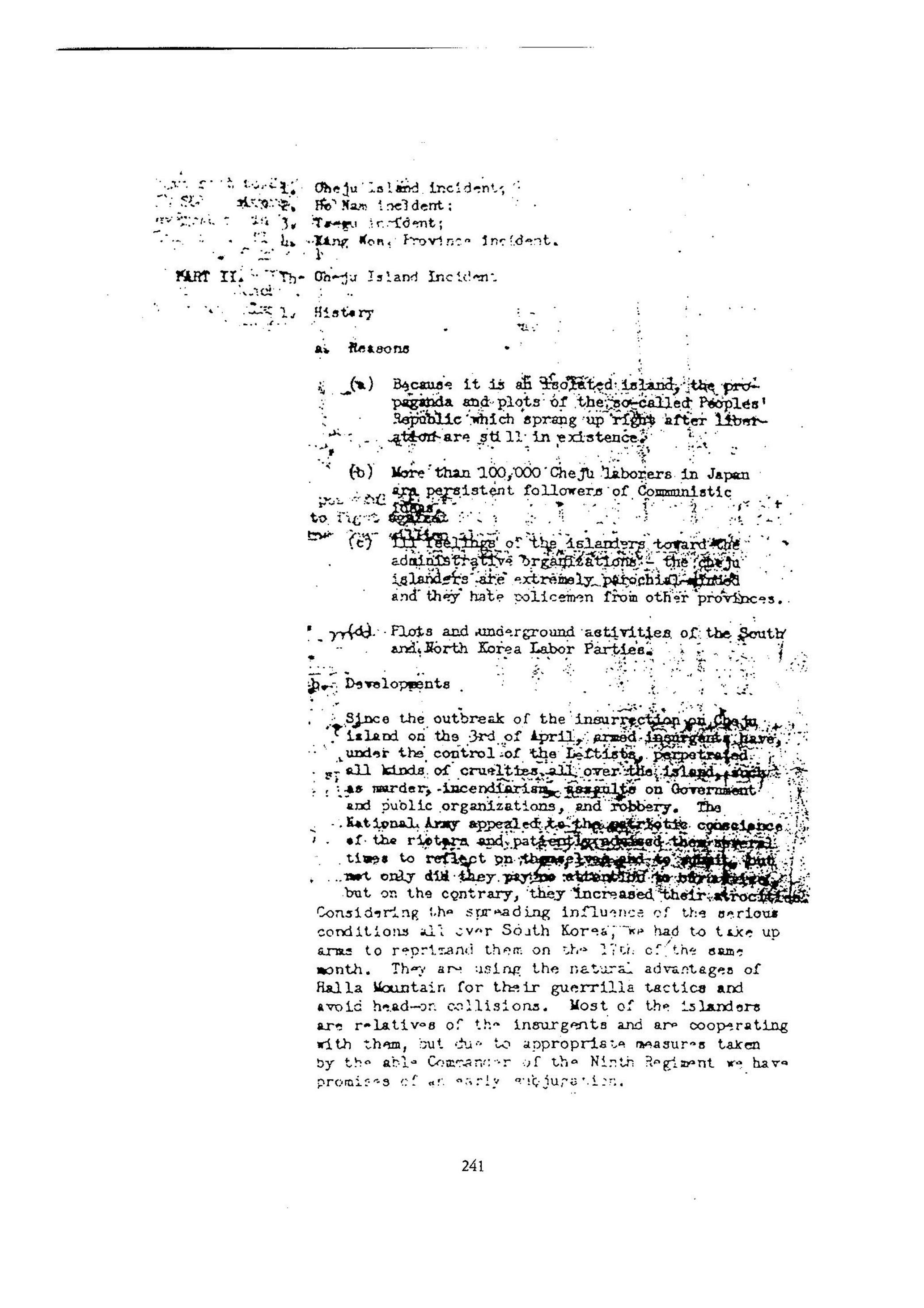
단기 1947년(1948년의 오기인 듯: 역주) 4월 3일 이후 남조선 각지에서 발생한 사건에 관하여 좌기(左記) 순서에 따라 보고하겠음. 즉 제주도사건, 호남사건, 대구사건, 강원도사건 순으로 설명하겠음.
제2절 제주도사건
1. 경과
가. 원인
1) 이도(離島)인 관계로 해방 직후에 소위 인민공화국 선전모략이 존속함
2) 재일본 제주도 출신 노동자 10여만이 좌익사상을 포기치 않고 고집함
3) 행정관청에 대한 악감(惡感) 특히 배타심 왕성한 제주도민께 타도 출신 경찰관이 복무한다는 사실
4) 남로당과 북로당의 모략과 준동(蠢動)
나. 개요(槪要)
4월 3일 제주도에 발생한 폭동 봉기한 사건 이후 무장폭도는 교묘한 좌익계열 조종하에 살인, 방화, 관공서 습격, 강탈 등등 전도적(全島的)으로 갖은 폭역(暴逆)을 감행하였음. 국군은 폭도측이 민족적 양심에서 우러나는 반성을 요구하며 은인자중(隱忍自重) 재삼재사(再三再四) 귀순을 권고하였으나 폭행은 가일 심하여 가는 사실과 그 험악한 사태가 남한 전체에 미치는 영향을 고려하여 동월 17일 단호한 응징의 철퇴(鐵槌)를 사용케 되었음. 폭도는 자연조건이 유격전에 요애(要碍)인 제주도 지세를 이용하여 정공(正攻)전법을 피하며 암약(暗躍)하고 있음. 또한 제주도민은 폭도와 인척관계가 유(有)한 자가 대부분이므로 폭동에 협력하는 도민도 있으나 근일에는 적절한 제9연대장 처치 하 진압 전도(前途)의 서광을 보고 있음.
2. 처치
가. 방침
폭도측의 민족적 양심을 요청하되 불응자는 철저히 박멸 근절시키려 함에 있음.
나. 처치
제주도 육군 제9연대는 4월 중순 이하 장교 116명 사병 2,968명으로써 금일까지 9개월간의 진정사업에 노력케 하였음. 그간 현지에서 제12연대를 편성하였으며 동년 7월 일부 병력을 교대하여 제11연대 주력을 경기도 수원에 이주하였음. 그 세부전(細部戰) 행동의 종합결과 별표 제1과 여(如)함. 한편 해군으로서 육군병력 해상운송의 함정을 배속하며 10월 18일부터 금일까지는 출동함정 7척, 인원 303명으로써 해상봉쇄를 하는 동시 육군작전에 절대한 협동을 할 수 있음.
3. 장래성
가. 적정(敵情)
국군의 맹렬한 섬멸전과 식량난 및 병기 탄약 보급 불충분과 아울러 협력자 감소에 따라 무장폭도 현재 근근 50, 60명에 불과한 도민 중 다수가 폭도의 정신적 가담자라는 것은 참 유감사임.
나. 제9연대 장병이 전(全) 제주도내에 주요 지점을 확보하며 산간부락 양민을 해안선 도시에 보갑제(保甲制‧마을공동책임)를 실시키 위하여 이주시키며, 도내 도로 양측 총림(叢林)을 벌채하여 폭도 급습에 대비하며 폭도에 대한 보급선을 완전 차단하는 동시 폭도에 대한 협력자의 철저한 처단을 단행함으로써 일로(一路) 제주 재건에 매진중임.
다. 장래성
운명이 풍전(風前)의 등화화(燈火化)한 폭도는 최후적 발악으로 방화를 결행하는 경향이 있으나 강력 철저한 작전 계속과 11월 16일 이하 계엄령 시행으로 인하여 급속도적 호전을 보고 있으며, 특히 군경관(軍警官)은 일체화되어 있음. 금후 도민에 대한 정신지도에 만전을 기할 필요가 있음.
제1표. 제주사건 종합보고
*303명의 오기인 듯(역주)
제3절 호남사건
1. 경과
가. 원인
1) 남로당의 세포가 부대내에 침투한 것
2) 제주도에 출동시 제14연대내 좌익 세포에게 당 지령이 있는 것
3) 지방인 좌익 청년단체와 학교내에 좌익 세포망이 군세포망에 속계(速繫)된 것
4) 오동기 소령 체포로 말미암아 극우 극좌의 합작음모가 폭로된 것
나. 개요(槪要)
10월 19일 제주도사건 진압차 출동하려던 여수 제14연대는 남로당 계열 분자 지도하에 3명의 장교와 일부 40명 내외 하사관은 각 대대장의 결사적 제지에도 불구하고 반란 폭동화 하여 동월 20일 8시 여수를 완전 점령하는 한편 지방 좌익단체와 학생 등으로 인민군을 편성하며 동일 8시 순천 도착, 계속 점령 후 그 세력은 학구, 보성, 벌교, 고흥 등등 각지에 인화(引火)하여 살인, 방화, 경찰서 파괴, 약탈, 강간 등등 폭역무도(暴逆無道)한 천인공로의 참사를 감행하였음.
2. 처치
가. 방침
급속히 본적(本敵)을 여순지구에 포위 섬멸하려 하였으나 육군은 송호성 장군을 호남방면 군사령관으로 임명하는 동시 제4연대(광주)는 여수 서방으로부터, 제3연대(전주) 일부 병력은 제2연대(대전) 일부 병력과 긴밀 제휴하여 여수 북방으로, 제12연대(군산) 일부 병력은 광주에서 여수 서북방으로, 제5연대(부산) 일부 병력은 여수항 외 해상으로, 제6연대(대구) 일부 병력은 장백산맥을 답파(踏破)하여 여수 동북방으로, 제15연대(마산) 일부 병력은 여수 동방으로 진격, 21일 18시에는 완전히 반란군을 포위하였음. 국군이 학구 점령, 이어서 순천 점령, 3일간 격전과 수천 호의 소진(燒盡)후에 여수 점령, 점차 질서 회복하는 벌교, 보성, 고흥 등등 금일에는 완전히 구(舊)태세로 돌아가고 있음. 그후 일부 반란병은 포위망을 타개하고 백운산 지리산에 도피하여 현재 계속 준동(蠢動)중에 있으며 세부는 별표 제2에 설명되어 있음. 일편(一便) 해군은 여수 해상봉쇄작전에 또는 각(各) 도서(島嶼) 소탕 등에 22회이란 전투를 하며 해상 경비에 만전을 다하였음.
3. 장래성
가. 적정(敵情)
본 전투 전후를 통하여 사살 826명, 포로 2,856명 외 대부분의 병기 피복 식량을 회수하였으며 지리산, 백운산 일대에 반도와 폭도 약 150명 보성부근 기타에 약 50명 합계 200명 내외임. 특히 한기(寒氣)와 기아에서 사로(死路)를 방황하고 있음. 물론 병기, 탄약 보충은 전혀 없음.
나. 오군(吾軍)의 상황
장교 140명, 사병 4,232명이 본 전투에 참가하고 있음. 백운산 지리산을 포위 포착(捕促)하고자 전략을 다하고 장병 사기 대단히 왕성함.
다. 장래성
탄약부족 월동난으로 적의 사기는 쇠퇴하여 전의(戰意) 무(無)하며 투항 등으로 근 2개월 이내에는 완전히 소탕되리라 생각함.
제2표 호남사건 종합보고
(후략)
THE FOREIGN SERVICE
OF THE
UNITED STATES OF AMERICA
Dispatch No. 14
American Mission in Korea
CONFIDENTIAL
Seoul, January 10, 1949
Subject: Report of Minister of National Defense, Lee Bum Suk, on Internal Insurrections after April 1948
NO. [illegible] KOREAN AFFAIRS
[illegible]
The Honorable
The Secretary of State,
Washington.
DEPARTMENT OF STATE
Sir:
I have the honor to submit a translation of a report entitled "Internal Insurrections after April, 1948," which was given to the National Assembly in a speech made by LEE Bum Suk, Prime Minister and Minister of National Defense, on December 7, 1948.
The report was requested during a period when the National Assembly became increasingly concerned over instances of direct, [illegible] and possibly illegal interference by the Army and the [illegible] with the lives of the people. The particular target of the Assembly was the Home Minister, Mr. YUH Chi Yung. But the con-[illegible] imposition of martial law in North and South Cholla lang [illegible] the qualling of the Yesu-Sunchon revolt resulted in numerous [illegible] acts by Police and Army which were regarded by local [illegible] members as responsible for much local hardship. The threat to civil liberties, the hardships observed among constituents, and [illegible]
--- p249 ---
[illegible] that the local populace tended to blame the Assembly for their sufferings under martial law, caused the Assembly to feel that it was losing face and that the successful progress of the important Cheju Purchasing and National Traitors Acts was being endangered. Further Assembly concern was related to national defense in general and the problem of Youth Group amalgamation in particular (see Mission Despatch No. 140, dated December 30, 1948) which the Assembly had initially recommended and the progress of which it continued to watch with interest as a future bulwark of Korean defense.
The report describes the protracted struggle on Cheju Island, the "the Mai incident" (i.e., the Yosu-Sunchon rebellion of October), the Cheju incident of November 2nd and the more recent fighting in the vicinity of Mt. Odai in central Kangwon province. The history of each incident is given in some detail, the causes of the incident and analysis of future plans and enemy potential is given more briefly.
The security and doubtfulness of the details of much that happens in Korea, taken in conjunction with the extensive intelligence gathering resources of the United States Army in Korea, make the amount due the accuracy of this report possible and desirable.
In general, the report seems to be an honest attempt to present what the Korean Ministry of National Defense considered to be the facts of these uprisings. Its principal weakness seems to lie in the analysis of the causes of these incidents and in the exaggeration of Korean Army successes.
That part of the report dealing with the Cheju Island incident elicited particular comment from G-2, United States Army Forces in Korea. G-2, for example, feels that "Reasons" behind the Cheju Island incident are too generalized to be a useful guide to action, and that they are also, not unexpectedly, one-sided. The graft and inefficiency of Korean Government officials played a part in causing friction between officials and islanders; parochial-mindedness among the latter was only part of the explanation. Lack of control and coordination among personnel who were responsible for keeping peace on the island resulted in popular dissatisfaction and failure to curb disturbances. Extreme acts of violence by Police resulted in further hostility and panic. All this created fertile soil for Communist organization and propaganda, whether directly from the north or through the agency of the South Korean Labor Party. Moreover, G-2 considers it doubtful whether there are 100,000 Cheju Island laborers in Japan. However, it considers that some aid from the Korean League in Japan to the rebels is not improbable. Statements that "the number of armed rioters has decreased to 50 or 60," and that there are "premises of an early subjection," are also considered improbable. By G-2 which believes the number of rioters was probably greater, that me estimates relative to Cheju Island are reliable due to the extremely fluid way in which forces can be dismissed, recalled, hidden or reissued weapons, and that early pacification of the island is doubtful. In Table I, First Operations of the Army, reported as being from April to middle June, actually took place from April 3rd
--- p250 ---
to July 15th, G-2 reports a total of 135 Communists killed.
The statements on the South Cholla, Taegu and Kangwon incidents are considered by G-2 as more reliable. G-2 figures show that with respect to Table III, 3a, 600 insurgents were shot instead of 826, and 2,581 captured instead of 2,856. Likewise, in Table IV, 1b, 70 insurgents instead of 30 fled to Kumchon, and in Table IV, 3, 90 human rebels and 307 others, rather than 10 armed rebels and 50 others, are shown. In Table II, the totals of "Own Casualties" are indicated as 55 killed, 164 wounded, and of enemy casualties as 600 [illegible] and 2,581 captured instead of 141 killed, 153 wounded and 821 killed, 2660 captured for own and enemy troops, respectively. There may, of course, be other figures which are similarly inaccurate but in regard to which G-2 has no better information.
This distributed report was accompanied by a speech of the Prime Minister which was far shorter than the report. This speech, (see Enclosure No. 2) briefly summarized the report and touched on the needs, the progress and the hopes of the National Army.
The report and the speech were generally well received by the National Assembly. Several members asked, however, why, in view of [illegible] marsh of events, martial law continued in North and [illegible] Cholla and on Cheju Island. The Prime Minister replied that [illegible] law was necessary for the continued subjugation of insurgents [illegible] it would be lifted as soon as possible. This answer did [illegible] entirely satisfy certain National Assemblymen, who continued to [illegible] that the civil rights of the population in those areas were being unnecessarily compromised.
Martial law was lifted on Cheju Island on January 1, 1949, by the State Council, but it continues in North and South Cholla at the present time.
Respectfully yours,
For the Special Representative:
Everett F. Drumright
Counselor of Mission
<첨부문서> 제1호: 1948년 4월 이후 국내 소란사건 보고
REPORT ON THE INTERNAL INSURRECTIONS AFTER APRIL, 1948, MADE BY
MINISTER OF NATIONAL DEFENSE, LEE BUM SUK
PART I. Introduction
[illegible] of the [illegible]
[illegible] to [illegible] it to you a report of the insurrections which have risen in various places in South Korea since April 3, 1948, in [illegible] order [illegible]
--- p251 ---
Cheju Island Incident;
Ho Nam Incident;
Taegu Incident;
King Kong Province Incident.
**PART II** - The Cheju Island Incident
1. History
a. Reasons
(a) Because it is an isolated island, the propaganda and plots of the so-called Peoples' Republic which sprang up right after liberation are still in existence.
(b) More than 100,000 Cheju laborers in Japan are persistent followers of Communistic [illegible]
(c) [illegible] of the islanders toward the administrative organizations, the [illegible] islanders are extremely [illegible] and they hate policemen from other provinces.
(d) Plots and underground activities of the South and North Korea Labor Parties.
D. Developments
Since the outbreak of the insurrection on Cheju Island on the 3rd of April, armed insurgents have, under the control of the Leftists, perpetrated all kinds of cruelties all over the island, [illegible] as murder, incendiarism, assaults on Government and public organizations, and robbery. The National Army appealed to the [illegible] the conscience of the rioters and patriots [illegible] the [illegible] times to reflect on the [illegible] not only did they pay no attention [illegible] but on the contrary, they increased their atrocities. Considering the spreading influence of the serious conditions all over South Korea, we had to take up arms to reprimand them on the 11th of the same month. They are using the natural advantages of Halla Mountain for their guerrilla tactics and avoid head-on collisions. Most of the islanders are relatives of the insurgents and are cooperating with them, but due to appropriate measures taken by the able Commander of the Ninth Regiment we have promises of an early subjugation.
--- p252 ---
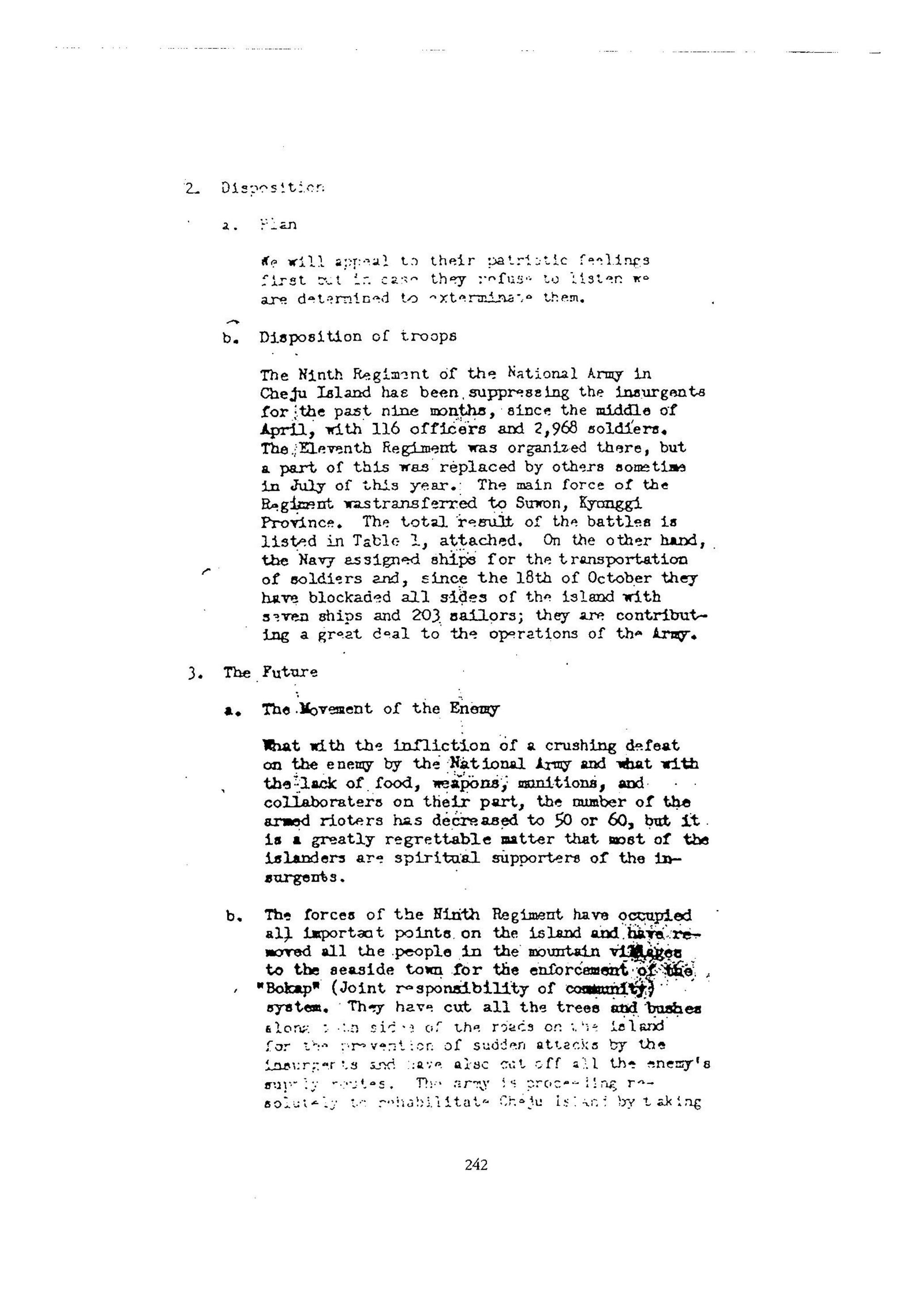
2. Disposition
a. Plan
We will appeal to their patriotic feelings first but in case they refuse to listen we are determined to exterminate them.
b. Disposition of troops
The Ninth Regiment of the National Army in Cheju Island has been suppressing the insurgents for the past nine months, since the middle of April, with 116 officers and 2,968 soldiers. The Eleventh Regiment was organized there, but a part of this was replaced by others sometime in July of this year. The main force of the Regiment was transferred to Suwon, Kyonggi Province. The total result of the battles is listed in Table 1, attached. On the other hand, the Navy assigned ships for the transportation of soldiers and, since the 18th of October they have blockaded all sides of the island with seven ships and 203 sailors; they are contributing a great deal to the operations of the Army.
3. The Future
a. The Movement of the Enemy
What with the infliction of a crushing defeat on the enemy by the National Army and what with the lack of food, weapons, munitions, and collaboraters on their part, the number of the armed rioters has decreased to 50 or 60, but it is a greatly regrettable matter that most of the islanders are spiritual supporters of the insurgents.
b. The forces of the Ninth Regiment have occupied all important points on the island and have removed all the people in the mountain villages to the seaside town for the enforcement of the "Bokap" (Joint responsibility of community) system. They have cut all the trees and bushes along [illegible] sides of the roads on the island for the prevention of sudden attacks by the insurgents and have also cut off all the enemy's supply routes. The army is proceeding [illegible] solutely to rehabilitate Cheju island by taking
--- p253 ---
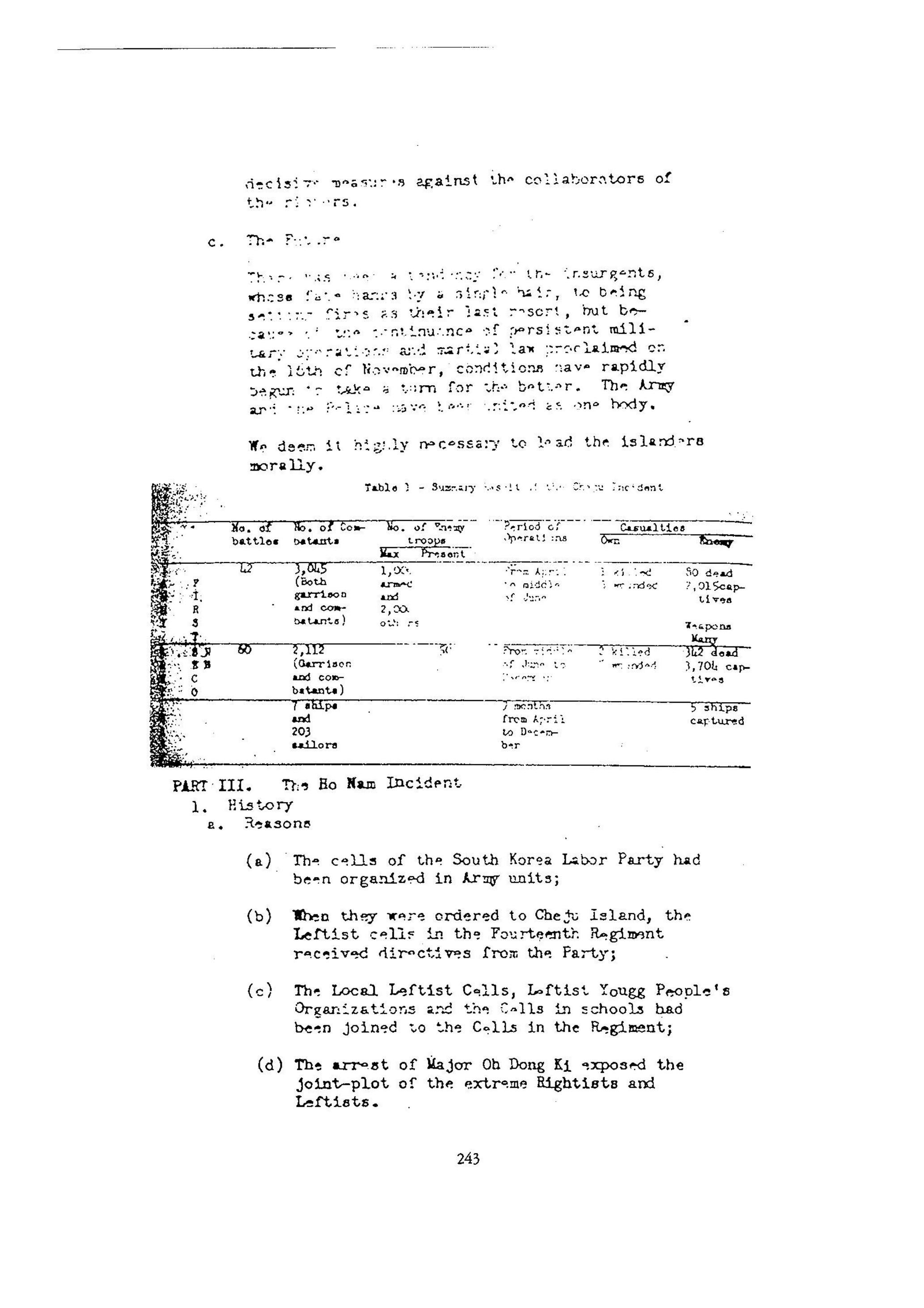
decisive measures against the collaborators of the rioters.
c. The Future
There was a tendency for the insurgents, whose fate was being by a single hair, to being satisfying fires as their last resort, but because of the continuance of persistent military operations and martial law proclaimed on the 16th of November, conditions have rapidly begun to take a turn for the better. The Army and the Police have been united as one body.
We deem it highly necessary to lead the islanders morally.
Table 3 - Summary result of the Cheju Incident
| No. of | No. of com- | No. of Enemy | Period of | Casualties | |
|battles|batants|troops|Operations|Own|Enemy|
|||Max|Present||||
| 12 | 3,015 | 1,00. | | From April | 1 killed | 50 dead |
| | (Both | armed | | to middle | 3 wounded | 7,015cap- |
| 1. | garrison | and | | of June | | tives |
| R | and com- | 2,00. | | | | |
| 3 | batants) | others | | | | Weapons |
| | | | | | | Many |
| 60 | 2,112 | 30 | | From middle | 5 killed | 102 dead |
| 8 B | (Garrison | | | of June to | wounded | 3,704 cap- |
| C | and com- | | | present | | tives |
| 0 | batants) | | | | | |
| | 7 ships | | | 7 months | | 5 ships |
| | and | | | from April | | captured |
| | 203 | | | to Decem- | | |
| | sailors | | | ber | | |
PART III. The Ho Nam Incident
1. History
a. Reasons
(a) The cells of the South Korea Labor Party had been organized in Army units;
(b) When they were ordered to Cheju Island, the Leftist cells in the Fourteenth Regiment received directives from the Party;
(c) The Local Leftist Cells, Leftist Yougg People's Organizations and the Cells in schools had been joined to the Cells in the Regiment;
(d) The arrest of Major Oh Dong Ki exposed the joint-plot of the extreme Rightists and Leftists.
--- p254 ---
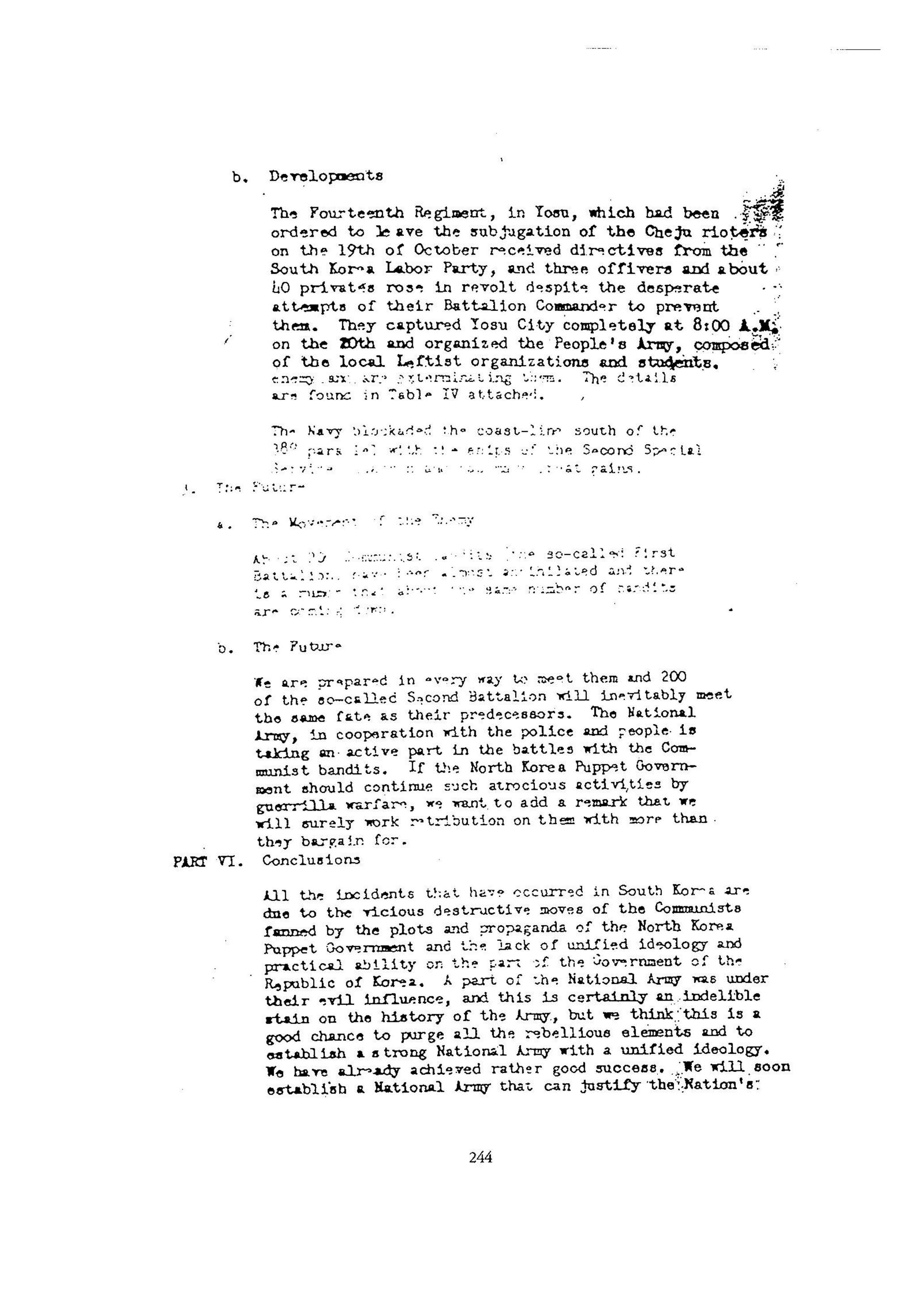
b. Developments
The Fourteenth Regiment, in Yosu, which had been ordered to leave the subjugation of the Cheju rioters on the 19th of October received directives from the South Korea Labor Party, and three officers and about 40 privates rose in revolt despite the desperate attempts of their Battalion Commander to prevent them. They captured Yosu City completely at 8:00 A.M. on the 20th and organized the People's Army, composed of the local Leftist organizations and students. enemy and are exterminating them. The details are found in Table IV attached.
The Navy blockaded the coast-line south of the 180 para [illegible] with the ships of the Second Special [illegible] [illegible] [illegible] [illegible] great rains.
3. The Future
a. The Movement of the Enemy
At it [illegible] Communist [illegible] the so-called First Battalion, [illegible] leader almost annihilated and there is a run- the about the same number of bandits are pointing [illegible].
b. The Future
We are prepared in every way to meet them and 200 of the so-called Second Battalion will inevitably meet the same fate as their predecessors. The National Army, in cooperation with the police and people is taking an active part in the battles with the Communist bandits. If the North Korea Puppet Government should continue such atrocious activities by guerrilla warfare, we want to add a remark that we will surely work retribution on them with more than they bargain for.
PART VI. Conclusions
All the incidents that have occurred in South Korea are due to the vicious destructive moves of the Communists fanned by the plots and propaganda of the North Korea Puppet Government and the lack of unified ideology and practical ability on the part of the Government of the Republic of Korea. A part of the National Army was under their evil influence, and this is certainly an indelible stain on the history of the Army, but we think this is a good chance to purge all the rebellious elements and to establish a strong National Army with a unified ideology. We have already achieved rather good success. We will soon establish a National Army that can justify the Nation's
--- p255 ---
trust and stop all the destructive activities, however strong their perpetrators may be. We are making preparations against all cases of emergencies to the satisfaction of the people.
We hope that the high and low of this country will unite together with an iron will and strong cooperative spirit in order to tide over the extremely difficult situation we are facing at present and to ensure the happiness of our posterity of thousands of generations to come.
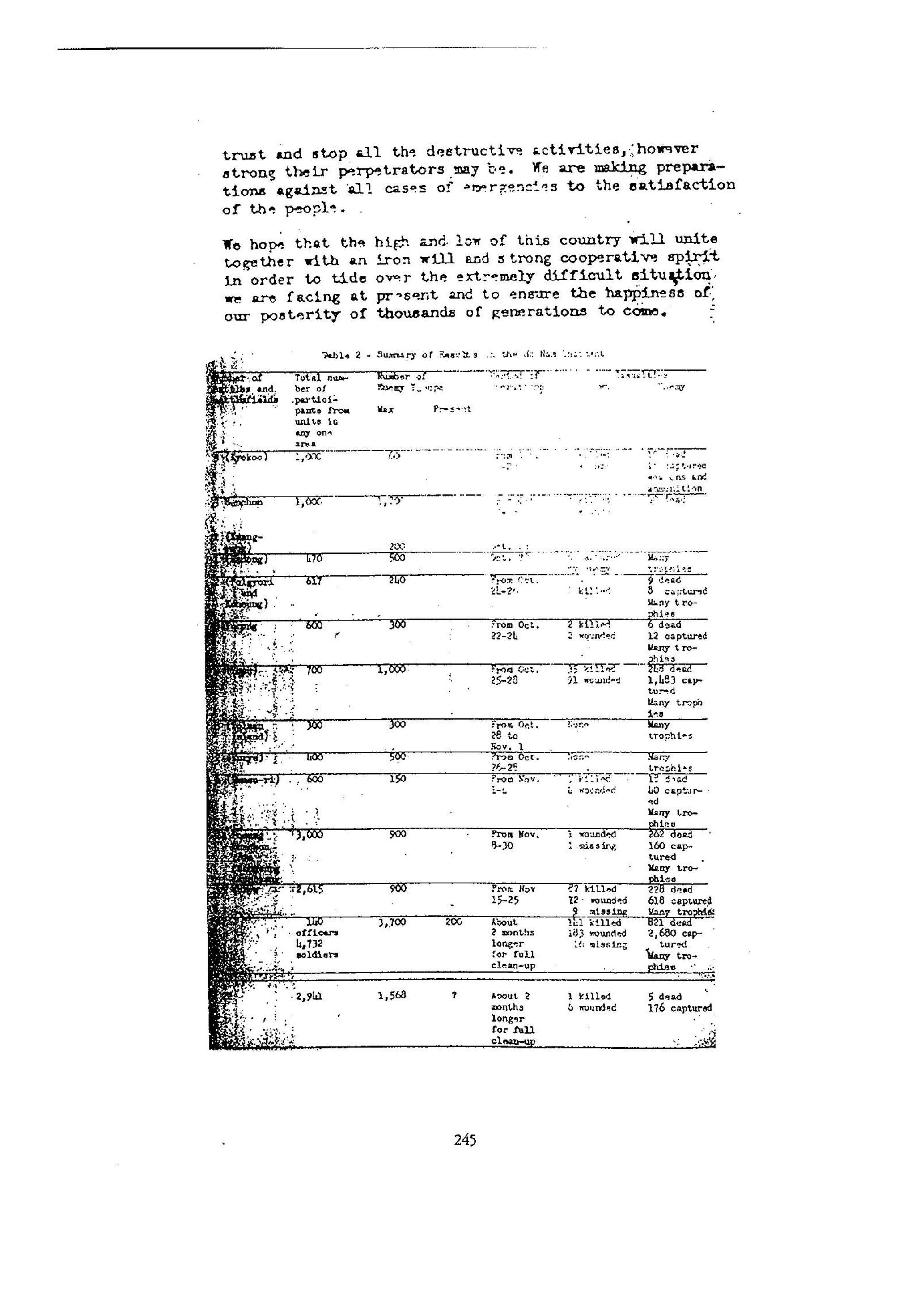
Table 2 - Summary of Results of the [illegible] No. [illegible]
| [illegible] of | Total num- | Number of | [illegible] | | [illegible] |
| [illegible] and | ber of | [illegible] T[illegible] | [illegible] | [illegible] | [illegible] |
| [illegible] | partici- | | | | |
| | pants from | Max | Present | | |
| | units in | | | | |
| | any one | | | | |
| | area | | | | |
| [illegible](Sokoo) | 2,000 | 70 | [illegible] | [illegible] | [illegible] |
| | | | | | [illegible] captured |
| | | | | | [illegible] and |
| | | | | | [illegible] |
| [illegible]phon | 1,000 | [illegible] | [illegible] | [illegible] | [illegible] |
| [illegible] | | | | | |
| [illegible] | | 200 | [illegible] | | |
| [illegible] | 170 | 500 | [illegible] | [illegible] | Many trophies |
| [illegible] | 617 | 200 | From Oct. | | 9 dead |
| [illegible] | | | 24-27 | killed | 5 captured |
| | | | | | Many tro- |
| | | | | | phies |
| | 600 | 300 | From Oct. | 2 killed | 6 dead |
| | | | 22-24 | 2 wounded | 12 captured |
| | | | | | Many tro- |
| | | | | | phies |
| | 700 | 1,000 | From Oct. | 15 killed | 263 dead |
| | | | 25-28 | 91 wounded | 1,183 cap- |
| | | | | | tured |
| | | | | | Many troph |
| | | | | | ies |
| | 300 | 300 | From Oct. | None | Many |
| | | | 28 to | | trophies |
| | | | Nov. 1 | | |
| [illegible] | 400 | 500 | From Oct. | None | Many |
| | | | 26-25 | | trophies |
| [illegible] | 600 | 150 | From Nov. | [illegible] killed | 12 dead |
| | | | 1-4 | 4 wounded | 40 captur- |
| | | | | | ed |
| | | | | | Many tro- |
| | | | | | phies |
| | *3,000 | 900 | From Nov. | 1 wounded | 262 dead |
| | | | 5-30 | 1 missing | 160 cap- |
| | | | | | tured |
| | | | | | Many tro- |
| | | | | | phies |
| | *2,615 | 900 | From Nov | 27 killed | 228 dead |
| | | | 15-25 | 72 wounded | 618 captured |
| | | | | 3 missing | Many trophies |
| | 110 | 3,700 | 200 | About | 141 killed | 821 dead |
| | officers | | | 2 months | 183 wounded | 2,680 cap- |
| | 4,732 | | | longer | 16 missing | tured |
| | soldiers | | | for full | | Many tro- |
| | | | | clean-up | | phies |
| | 2,914 | 1,568 | 7 | About 2 | 1 killed | 5 dead |
| | | | | months | 6 wounded | 176 captured |
| | | | | longer | | |
| | | | | for full | | |
| | | | | clean-up | | [illegible] |
출처:
제주4·3사건진상규명및희생자명예회복위원회 편,
『제주4·3사건자료집 11』 [미국자료편],
번역문 p.41
/ 원문 p.238–245.