한국군은 공세를 취하여 폭도들을 은신처로 몰아 넣었다. 그 결과 지난 3월 마지막 3주는 1947년 3월 1일 이래 가장 평온했다.
제주도 상황에 대한 현장보고는 <첨부 1>을 참고할 것.
<일일정보보고 제1097호, 첨부 1>
제주도
제주도는 역사적으로 한국의 불안정한 지역이었으며, 지난 한 해 동안 도민 1만5,000명이 살해당하고, 주택의 1/3이 파괴되는 등 적대적인 이데올로기 대립의 피비린내 나는 전투현장이었다. 제주도는 점차적으로 평온을 되찾고 있으며 3월의 마지막 3주간은 1947년 3월 1일 이후 가장 조용한 시기였다. 현재의 제주도 상황을 보다 잘 이해하기 위해서는 제주의 역사, 민중, 지리, 그리고 소강상태 이전의 반란군에 대한 군작전 기록을 검토할 필요가 있다.
지리
한반도 남쪽 끝 60마일 지점에 위치한 화산섬인 제주도는 대략 폭이 20마일, 길이가 50마일 정도 된다. 섬 중앙에 위치한 6,000 피트 높이의 한라산을 향해 좁은 해안 평원이 뻗어 올라가는 지형을 보이며, 산이 많은 섬 내부는 관목과 잡풀이 많고 아주 비탈진 지형이다. 제주도는 화산 폭발 당시의 암석으로 뒤덮여 있고, 자그마한 밭들은 돌담으로 둥글게 둘러쌓여 있다. 이 돌담은 섬내 횡단여행과 군 작전에 어려움을 더해주고 있다. 언급할 만한 가치가 있는 섬의 유일한 도로는 거친 일주도로 하나뿐이다.
민중
역사적으로 섬주민은 삼성(三姓)에서 유래됐다고 알려져 있다. 그런데 일제지배 이전과 이(李)왕조 600여 년 간 제주도는 본토로부터 정치적 반항자들의 유배지였다. 일반적으로 더 낮은 계층의 주민들은 본토의 같은 계층 사람들보다 더 높은 지능과 신체적 조건을 갖추고 있는 것처럼 보인다. 그들은 본질적으로 정직하고 자주적이며 간섭을 싫어하고, 본토 관리나 이주자들과 관련된 도둑질과 부정이득을 싫어한다. 여성들의 노동량은 많은 편이고, 남성들은 주로 관리, 장사, 사냥, 어업에 자신들의 시간을 바친다.
역사
이 보고서는 해방 후 주민투쟁의 배경을 제공하기 위한 것이기 때문에 이러한 내용과 관련이 없는 섬의 역사는 기술되지 않을 것이다.
제주를 수세기 동안 정치적 소수자에 대한 유배지로 이용해 온 점과 정부의 잘못된 통치행위는 제주섬에 점차적으로 분리주의 심리를 증대시켰다. 제주도민의 분리주의 의식은 60마일이나 되는 지리적 간격보다 더 넓었는데, 이러한 의식은 제주도를 한국의 한 지역으로 보기보다는 속국으로 취급하는 본토 정부의 정책에 의해 더욱 심화되었다.
일제도 제주도를 전라남도의 한 지역으로 지배했을 뿐 제주도를 본토와 좀더 밀착시키기 위한 어떠한 시도도 하지 않았다. 사실 일본인 관료들은 섬주민들의 혁명기질에 대한 양보로 본토 주민들보다 제주인들에게 좀더 관대한 태도를 취했다. 결과적으로 반일감정은 한국의 타지역보다 덜 할 수밖에 없었다.
일제는 일본 제국의 확대와 그로 인한 인력유출 때문에 군사상의 필요에 따라 섬주민들을 일본군대를 위한 노예노동과 강제노역에 징발하였다. 이러한 행위는 상대적으로 안정된 시기의 종말을 고했으며, 섬주민들은 즉시 압제에 항거하여 공산주의 기회주의자들의 주도하에 저항운동을 조직화하기 시작했다.
1945년 가을 일제의 억압으로부터 해방되었을 때 공산주의자들의 지하운동은 이미 존재하고 있었다. 이들의 운동은 허약한 정부행정 하에서 규모나 강도면에서 성장을 거듭했고 외부로 공산주의의 촉진을 증대시켰다.
1946년 후반 섬사람들에 대한 양보로써 제주도는 도(道)로 승격되었다. 현재 제주도지사는 토박이인 임관호이며 10개월째 재직하고 있다.
1947년 3월 1일 경찰이 제주읍에서 일단의 좌익 3‧1절 행사 참가자들을` 공격하여 몇 사람을 죽이기 전까지는 제주섬에서 공산주의자들이 선동하여 일으킨 소요들은 제주도를 점령하고 있는 미군에 의하여 비교적 느슨하게 억제되고 있었다. 공격을 받은 섬 주민들은 경찰에 대하여 즉각적인 보복을 하였고 1년여에 걸친 유혈폭력이 시작되었다.
소요는 몇 달 동안은 산발적이었다. 그러나 1948년 4월 상황은 섬에 주둔하고 있는 1,200명의 경찰만으로는 상대적인 안정조차 유지하기 힘들 정도로 심각하게 되었다. 남조선과도정부는 군사력으로 경찰력을 보강하기로 결정했다.
초기 군 작전
1948년 4월 최초로 한국군 1개 대대가 섬으로 파견되었다. 다음달 이 대대는 제11연대의 핵심으로 편제되고, 다른 2개 대대가 본토 주둔 연대에서 11연대로 파견되었다.
제11연대는 거의 실질적인 효력을 거두지 못했다. 그 구성원들 중 상당수가 공산주의자거나 좌익 동조자였다. 부대원 중 일부는 반란군에 합류하기 위해 산으로 도주했고, 연대장 박대령은 부하에게 살해되었다.
1948년 7월 제11연대를 철수시키고 제9연대로 교체하였다. 제9연대는 즉시 제11연대의 ‘무대응’ 정책을 무차별적 공포통치로 대치했다.
제9연대는 폭도들에 대하여 상당히 성공적인 전투를 수행했다. 그러나 동시에 모든 저항을 발본색원하기 위하여 제9연대는 모든 중산간마을 주민들이 분명히 게릴라에게 도움과 편의를 제공하고 있다는 가정 아래 마을 주민에 대한 집단학살계획을 채택했다. 1948년 12월까지 9연대가 점령했던 기간동안 섬 주민들에 대한 대부분의 살상이 발생했다.
제9연대의 계획은 겉으로는 주효한 듯이 보여 1948년의 마지막 2개월은 제주도의 폭도 활동이 비교적 적은 시기였으나 9연대의 무차별적 진압작전은 새로운 폭도 합류자들을 양산해냈다. 제2연대와 제9연대가 교체했던 12월에 새로운 흐름의 게릴라 테러가 시작되었다.
함병선 대령이 지휘하는 제2연대는 처음부터 해안마을에 숙사를 정했다. 함 대령은 섬사람들의 계몽을 위한 선전 계획과 폭도들의 하산을 호소하는 계획을 수립했다.
산에 은신해 있는 무장폭도에 대한 공격작전의 중단은 그러한 계획을 웃음거리로 만들었으며 이에 고무된 게릴라는 방어부대의 코밑에 있는 해안마을을 공격하기 위하여 산 정상에서 멀리 벗어나서 식량을 징발했다.
그러자 제2연대는 다소 공격적이 되었다. 그러나 그들의 행위는 주로 폭도부대를 도와준 혐의를 받고 있는 해안마을 주민들에 대한 반격조치에 한정됐으며 주민들은 종종 재판없이 대규모로 한꺼번에 처형당했다.
유 대령의 도착
폭도들에 대한 작전은 통합부대장인 유재홍 대령이 제주도에 파견된 3월 2일 이후에야 실제로 성공을 거두기 시작했다.
일본 육군 장교의 아들인 유대령은 그 자신이 제2차 대전 중 정예 일본 제2방어사단의 박격포 대대장을 지냈으며 제주도 파견 전까지는 육군사관학교 부교장이었다. 그는 매우 유능한 장교이며 미 고문관들과 잘 협조하고 있다.
그는 자신의 부대를 해안 마을에서 끌어 올려 게릴라와 대치중인 산으로 보냈다. 그는 사면계획을 채택해 중산간 주민에 대한 무분별한 사살을 중지토록 했다.
현재의 정책은 작전중에 체포됐거나 자발적으로 투항했거나를 불문하고 산에서 내려온 모든 사람을 구금하는 것이다. 여자, 어린이, 노인은 대부분 피난민으로 분류되고 있는 반면, 전투 가능 연령의 남자들은 피난민 지위가 부여되기 전에 철저히 심사되고 교육된다.
유대령 도착 이후 300명에 달하는 폭도나 혹은 그 동조자가 사살되었고 1,500명이 수감됐으며, 소총 22정과 권총 1정이 회수됐다. 무장폭도들은 은신처를 이곳 저곳으로 옮기느라 고통받고 있다. 3월 9일 산길에서 한국군 1개 소대를 매복공격한 것을 제외하면 폭도들은 이제 반격을 가하거나 마을을 기습할 능력을 상실하였다.
반란군
1948년 여름까지 제주도 지역의 남로당원은 5만명이라는 최고조의 세력을 이루었던 것으로 추정되나 사실상 정치적으로 무지한 농어민들 가운데 진정한 공산주의 신조에 대한 실질적인 동조나 지지는 거의 없었던 것으로 보인다. 오히려 그들은 해방 후의 경제적 어려움이나 민간인 소요를 해결하는 만병통치약은 당원이 되는 길밖에 없다고 설득당했다.
많아야 수백 명에 불과한 핵심 공산주의자들이 저항운동의 중추가 되고 있다. 그러나 전투적이고 열광적이며 잘 조직돼 있는 이들은 숫자에 비해 대단히 파괴적이다.
그들의 힘이 처음으로 분명히 입증된 것은 1948년 5‧10 총선거였다. 일반적이고 광범위한 폭동이 제주도 전역에서 일어났다. 민간인 52명과 경찰과 공무원 약간 명이 살해당했고, 국회의원 3개 지역구 중 2개 구의 투표가 무효화됐다. 현재까지도 제주도 2개 지역의 국회 의석이 빈 채로 남아 있다.
현재 무장폭도들은 약 250명 정도 남아 있는 것으로 추정된다. 이들은 산에 은신해 있는 1,000~1,500명의 지원자나 동조자들에 의해 뒷받침되고 있다. 폭도의 위치와 조직은 매일 바뀐다. 3월 27일 현재 파악되는 전투 서열은 다음과 같다.
폭도 지도자
김시원(KIM Shi Won), 35세, 공산당 지도자, 군대 경험이 없는 제주도 토박이
이덕구(LEE DUK KOO), 32세, 무장폭도 부대 지도자, 한 때 일본육군에 복무
김평호(KIM Pyung Ho), 전 한국군 제9연대 장교. 탈주 후 좌표 958-1138 지역의 산악지역에 위치해 있는 폭도 훈련학교 지휘자가 됨.
폭도부대와 부대 위치
폭도 제12군단 : YONG DIM SAW(966-1138)에 위치. 일본제 99식 소총 72정, M-1 소총 10정, 카빈소총 15정, 브라우닝 자동소총 3정으로 무장한 대원 100명으로 구성.
폭도 제8군단 : 성판악에 위치. 대원 100명 중 30명은 비무장. 일본제 99식 소총 50정, 카빈소총 10정, M-1 소총 6정 보유.
폭도 제23군단 : 좌표 955-1132 지역의 산악에 위치. 일본제 99식 소총 10정, 카빈소총 1정, M-1 소총 1정으로 무장한 대원 12명으로 구성.
폭도 제3군단 : TOL Oram(944-1131)에 위치. 대원 30명 중 20명은 비무장. 99식 소총 8정, M-1 소총 1정, 카빈소총 1정 보유.
훈련소 : 산중(958-1138, 물장오리 지역 : 역주)에 위치. 소규모 파견대로 약간 양의 무기만 보유.
도당 사령부 : 좌표 955-1144 지역의 산악에 위치. 폭도 약 50명으로 구성되어 있는 것으로 추정되나 무장인원은 극소수. 3월 26일 한국군이 도당 사령부를 공격해 폭도 11명을 사살하고 4명을 생포함. 이때 소총 1정과 라디오 1대, 모아 놓은 무기 일부 노획.
면사령부 : 섬의 12개 면마다 소규모의 면당 본부가 있음. 각 본부에는 지도 요원 3~5명이 있음. 이들은 탄약을 총구로 재는 낡은 일본제 훈련용 소총으로 무장하고 있음.
비무장 폭도 지원자 : 산악 지역 곳곳에 흩어져 있으며 그 숫자는 1,000~1,500명 정도로 추산됨. 3월 2일 이래 폭도 지원자 중 300명이 사살당했고, 1,500명이 생포되어 현재 구류 중임.
게릴라 병참술
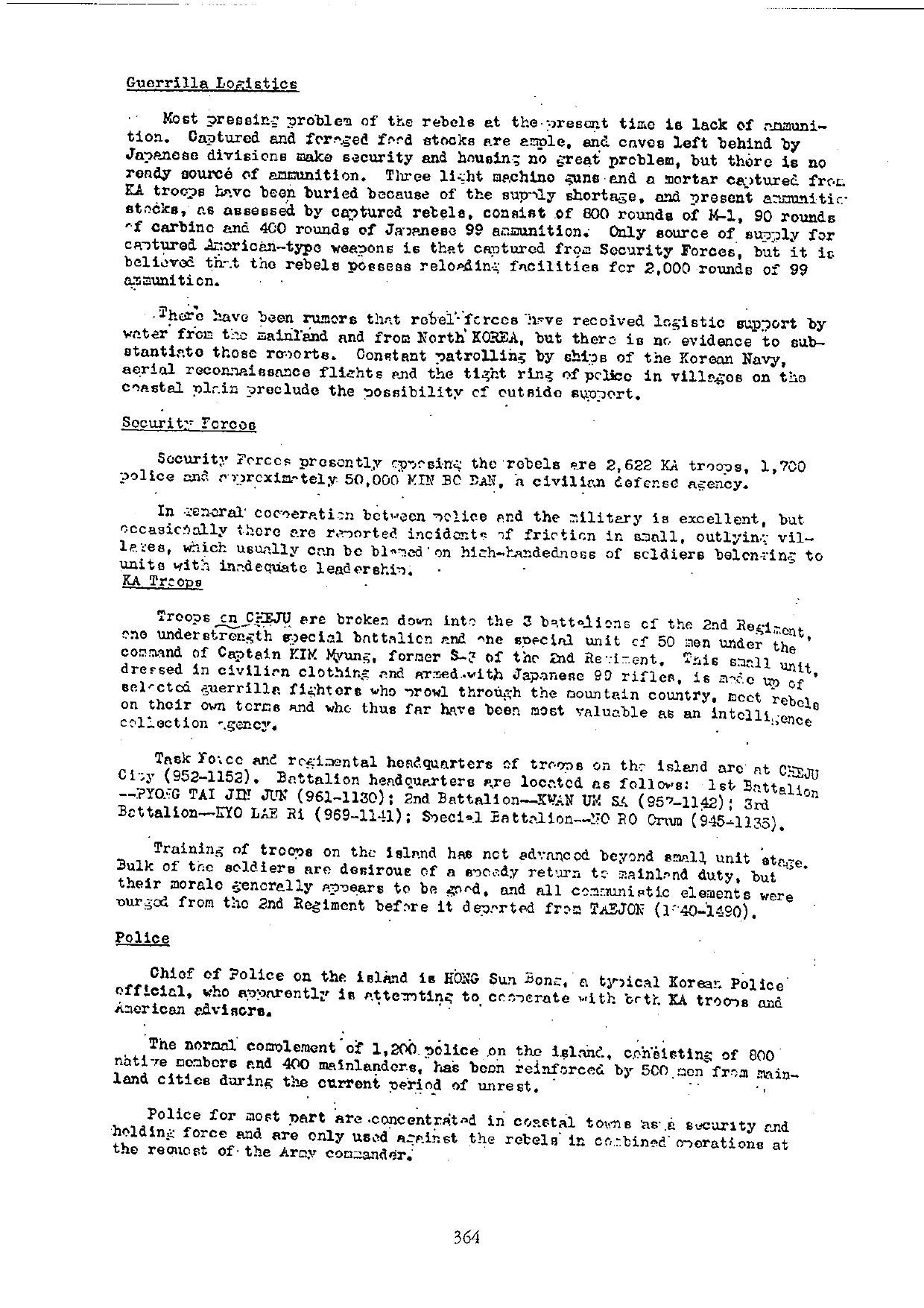
현재 게릴라의 가장 시급한 문제는 탄약부족이다. 노획하고 탈취한 식량은 풍부하다. 일본 군대가 남긴 동굴은 꽤 안전한 은신처가 되어 주고 있으나, 탄약 공급에 대한 대책이 없다. 한국군으로부터 노획한 경기관총 3정과 박격포도 탄약 부족으로 무용지물이 되어 버렸다. 생포된 폭도들에 따르면 현재 탄약 저장량은 M-1 소총 실탄 800발, 카빈 소총 실탄 90발, 일본제 99식 소총 실탄 400발에 불과하다 한다. 노획한 미제 무기의 탄약은 토벌대로부터 탈취하는 것이 유일한 공급원이다. 그러나 폭도들은 99식 소총의 경우 실탄 2,000발 정도의 재장전 설비를 보유하고 있는 것으로 보인다.
일부에서는 폭도들이 본토나 북한으로부터 병참지원을 받고 있다는 소문도 있으나 이러한 보고를 증명할 아무런 증거도 없다. 한국 해군함정의 지속적인 순찰과 공중 정찰 및 경찰의 해안 마을에 대한 빈틈없는 방어는 외부지원 가능성을 차단하고 있다.
토벌대
현재 폭도들에 대항 중인 토벌대는 한국군 2,622명, 경찰 1,700명, 민간인 방어조직인 민보단 약 5만 명으로 구성되어 있다. 경찰과 군대간의 일반적인 협조는 잘 이뤄지고 있다. 그러나 가끔 외곽 마을에서 소규모의 충돌사고가 발생하고 있다고 보고 되기도 하는데, 이는 보통 적절한 지도가 이루어지지 않는 부대에 소속된 군인들의 횡포 때문이다.
한국군 부대
제주에 주둔하고 있는 부대는 제2연대의 3개 대대와 인원 미달의 1개 특수대대, 제2연대의 전 작전참모 김명 대위가 지휘하는 50명의 특수부대로 구성되어 있다. 민간인 복장을 하고 일본제 99식 소총으로 무장한 이 김명 대위의 특수부대는 선발된 게릴라 요원들로 구성되어 있다. 이들은 산악을 배회하다 폭도들과 만나면 사투리로 이야기를 하는 등 정보수집에 아주 가치있는 조직이다. 작전병력과 연대본부는 제주읍에 주둔하고 있고, 대대본부의 경우 제1대대가 PYONG TAI JIN JUN(961-1130), 제2대대가 관음사, 제3대대가 교래리, 특수부대는 노루오름에 위치해 있다.
제주도 주둔 부대원의 훈련은 소단위 부대 훈련에 머물고 있다. 대다수 군인들은 한시바삐 본토로 복귀하기를 바라고 있으나 그들의 사기는 일반적으로 좋아 보인다. 제2연대의 모든 공산주의적인 요소는 대전을 출발하기 전에 깨끗이 제거됐다.
경찰
제주도 경찰의 총수는 전형적인 한국 경찰관리인 홍순봉이다. 그는 한국군과 미 군사고문단에게 협조하기 위해 노력하고 있다. 제주도 주둔 경찰 1,200명은 토착인 800명, 본토인 400명으로 구성되어 있었는데 최근 소요기간 동안 본토로부터 500명이 보강됐다. 경찰의 대부분은 안전보장과 예비부대로서 경찰력의 해안 마을에 집중 주둔해 있으며, 군 지휘관의 요구가 있을 때 폭도 토벌을 위한 군경 합동작전에만 동원된다.
민보단
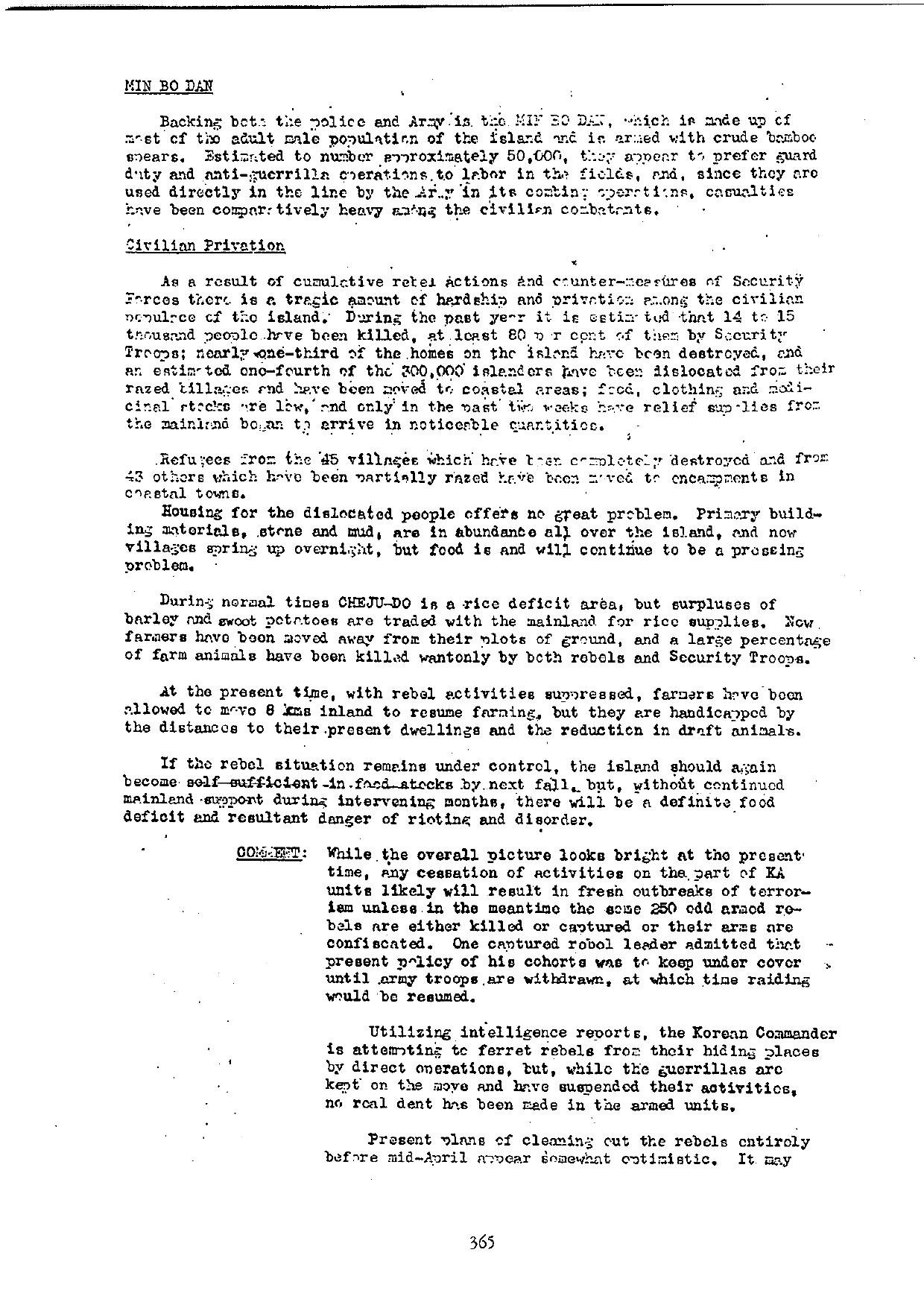
군경을 지원하고 있는 민보단은 대부분 성년 남자로 구성되어 있으며 보잘 것 없는 죽창으로 무장하고 있다. 약 5만 명으로 추산되는 민보단은 농사일보다는 보초를 서거나 게릴라 토벌전에 나가기를 더 좋아하는 것 같다. 군과의 합동작전 때 일선에서 직접 활동하기 때문에 민간인 전투원들 중에서 비교적 사상자가 많이 발생하고 있다.
주민 궁핍
누적되는 공산폭도의 공격과 토벌대의 대항으로 섬 주민 중에는 엄청난 고통과 기아에 허덕이는 사람들이 많다. 지난 한 해 동안 1만 4,000명~1만 5,000명의 주민이 사망한 것으로 추정되며, 이들 중 최소한 80%가 토벌대에 의해 살해됐다. 섬에 있는 주택 중 약 1/3이 파괴됐고, 주민 30만 명 중 약 1/4분이 자신들의 마을이 파괴당한 채 해안으로 소개당했다. 식량, 의복, 의약품 등이 부족한 실정이다. 다만 지난 2주 동안 본토로부터 상당량의 구호물자가 도착했다.
마을이 완전히 파괴되어 버린 45개 마을과 부분적으로 파괴된 43개 마을로부터 피난민들이 해안 마을의 수용소로 이동해왔다. 소개 주민을 수용하는 문제는 별 어려움이 없다. 돌이나 진흙 같은 일차적 건축재료가 섬 도처에 깔려 있어 하룻밤 사이에 새로운 마을이 생겨나기도 하지만, 식량문제의 경우 지금도 그렇고 앞으로도 절박한 문제임에 틀림없다. 평소 제주도는 쌀의 불모지대여서 보리와 고구마 잉여분으로 본토로부터 쌀을 사왔었다. 그러나 현재 농부들은 밭에서 쫓겨났으며 대부분의 가축도 폭도와 토벌대에 의해 제멋대로 도축당했다.
현재 폭도들의 활동이 뜸해져 감에 따라 농부들은 농사를 짓기 위해 산쪽으로 8㎞까지 이동하는 것을 허가받았다. 그러나 그들은 현 거주지와의 거리와 가축의 감소로 불편을 겪고 있다. 만일 폭도들의 활동을 지금처럼 통제할 수만 있다면 섬은 이번 가을에는 식량 자급이 가능할 것이다. 다만 그때까지 본토에서 지원을 계속하지 않는다면 식량부족 사태에 직면하게 될 것이고, 이는 결과적으로 폭동이나 혼란의 위험을 초래할 것이 분명하다.
논평 : 현재 전체적인 전망이 희망적임에도 불구하고 남아 있는 무장폭도 250여 명을 사살하거나, 생포하여 무장해제 시키지 않은 상태에서 한국군 측이 작전을 중지한다면, 제주도에서는 새로운 테러가 일어날 가능성도 있다. 체포된 한 폭도 지도자는 동료들의 현재 정책은 경비대가 철수할 때까지 숨어 있는 것이라면서 그때가 되면 공격을 재개할 것이라고 말했다.
정보보고서에 따르면, 한국군 지휘자는 정면 작전으로 폭도들을 은신처에서 찾아내려 하고 있으나 게릴라가 이동을 계속하면서 활동을 중지해 버려 별 효과가 없다고 말했다 한다.
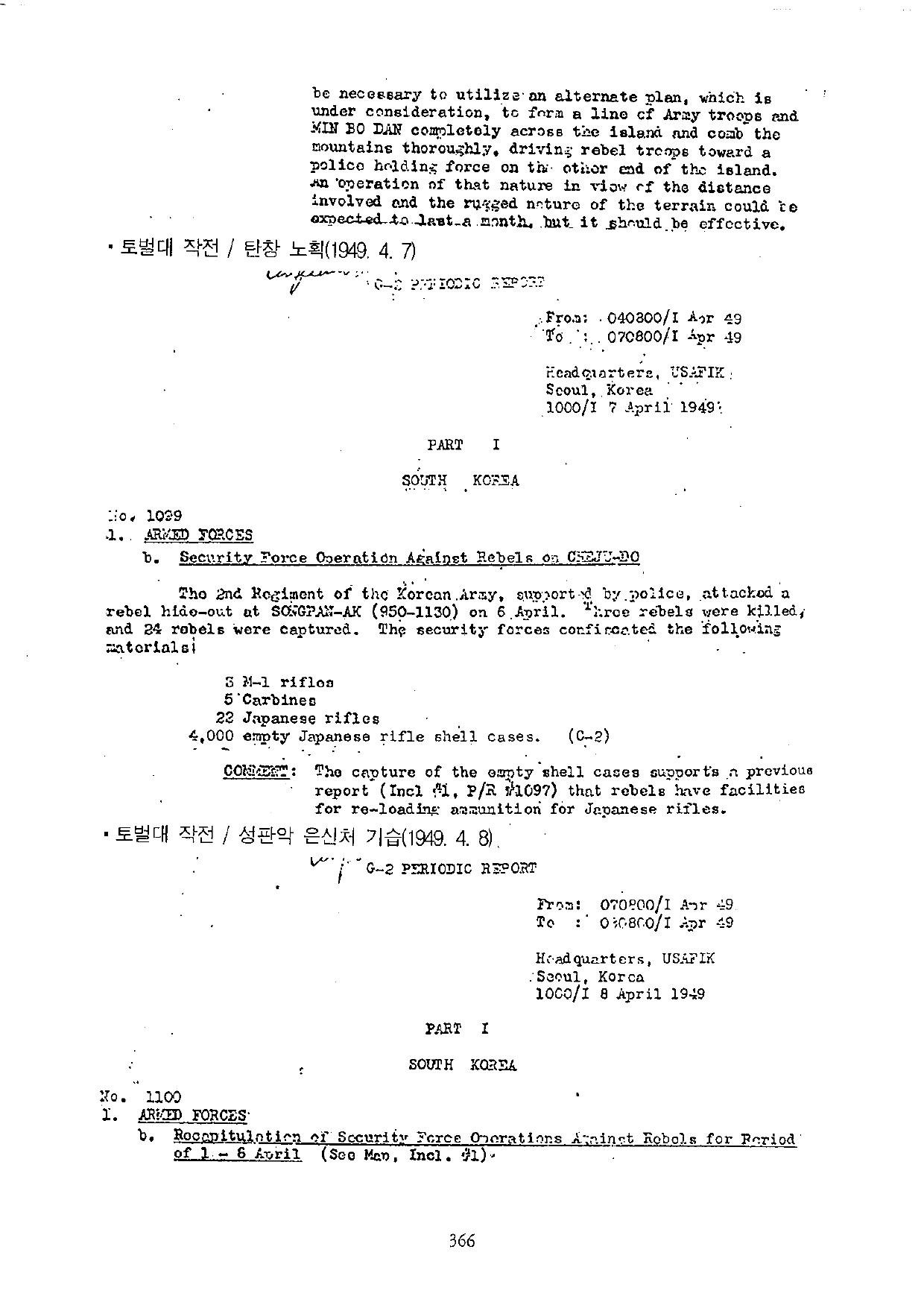
4월 중순 이전에 폭도들을 완벽하게 소탕한다는 현재의 계획은 다소 낙관적이다. 지금 고려중인 다른 계획, 즉 군부대와 민보단으로 섬을 완전히 횡단하는 선을 형성하고 산을 빗질하듯 쓸어내려 폭도들을 섬의 반대쪽에 진치고 있는 경찰 쪽으로 몰아간다는 계획을 실행에 옮기는 것이 필요할지도 모른다. 그런 식의 작전은 거리면이나 험악한 지형 등을 고려해 볼 때 한 달 정도 걸릴 것으로 보이나 효과적일 것이다.
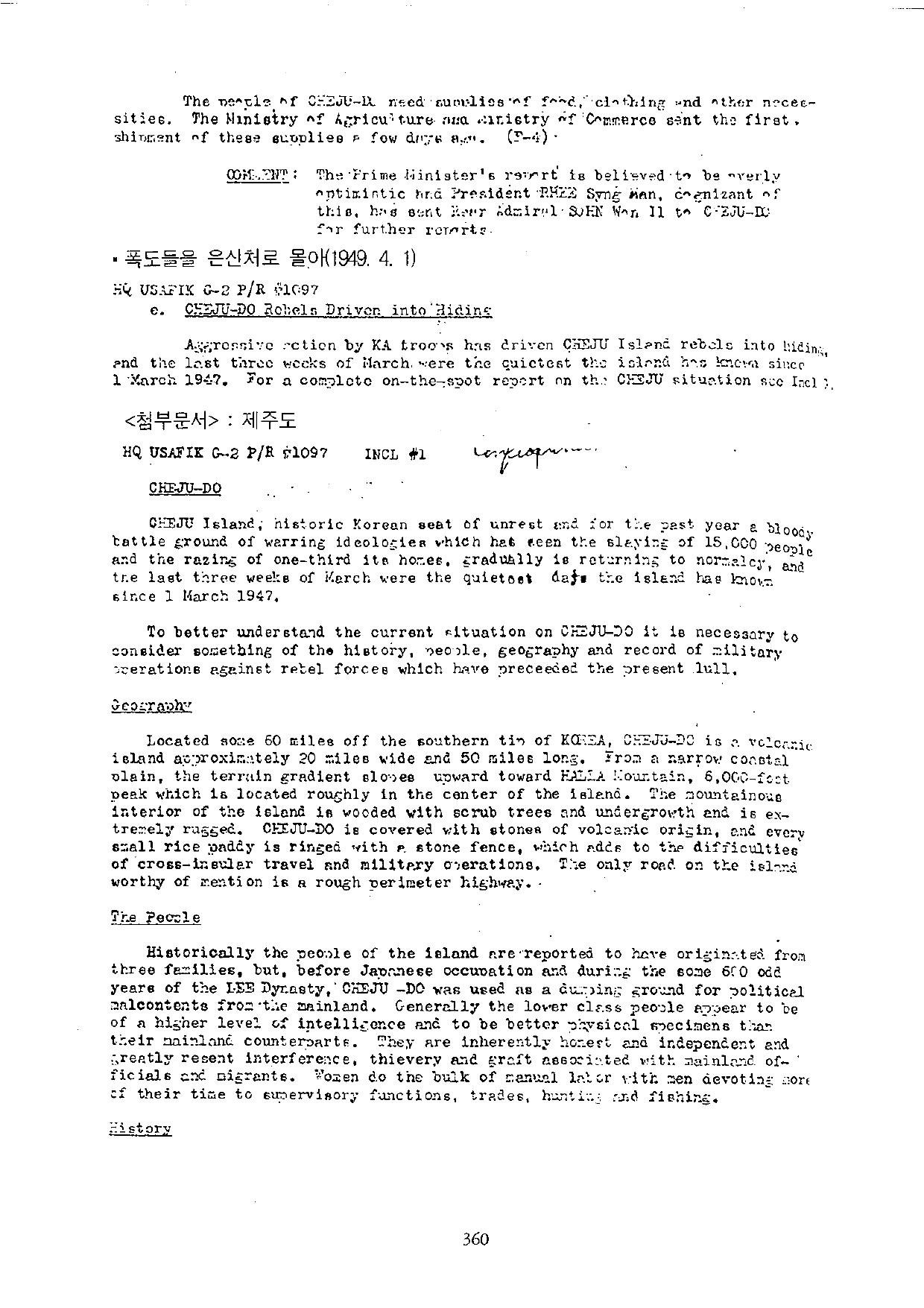
HQ USAFIK G-2 P/R #1097
e. CHEJU-DO Rebels Driven into Hiding
Aggressive action by KA troops has driven CHEJU Island rebels into hiding and the last three weeks of March were the quietest the island has known since 1 March 1947. For a complete on-the-spot report on the CHEJU situation see Incl 3.
<첨부문서> : 제주도
HQ USAFIK G-2 P/R #1097 INCL #1
Lo[illegible]
CHEJU-DO
CHEJU Island, historic Korean seat of unrest and for the past year a bloody battle ground of warring ideologies which has seen the slaying of 15,000 people and the razing of one-third its homes, gradually is returning to normalcy, and the last three weeks of March were the quietest days the island has known since 1 March 1947.
To better understand the current situation on CHEJU-DO it is necessary to consider something of the history, people, geography and record of military operations against rebel forces which have preceeded the present lull.
Geography
Located some 60 miles off the southern tip of KOREA, CHEJU-DO is a volcanic island approximately 20 miles wide and 50 miles long. From a narrow coastal plain, the terrain gradient slopes upward toward HALLA Mountain, 6,000-foot peak which is located roughly in the center of the island. The mountainous interior of the island is wooded with scrub trees and undergrowth and is extremely rugged. CHEJU-DO is covered with stones of volcanic origin, and every small rice paddy is ringed with a stone fence, which adds to the difficulties of cross-insular travel and military operations. The only road on the island worthy of mention is a rough perimeter highway.
The People
Historically the people of the island are reported to have originated from three families, but, before Japanese occupation and during the some 600 odd years of the LEE Dynasty, CHEJU -DO was used as a dumping ground for political malcontents from the mainland. Generally the lower class people appear to be of a higher level of intelligence and to be better physical specimens than their mainland counterparts. They are inherently honest and independent and greatly resent interference, thievery and graft associated with mainland officials and migrants. Women do the bulk of manual labor with men devoting more of their time to supervisory functions, trades, hunting and fishing.
History
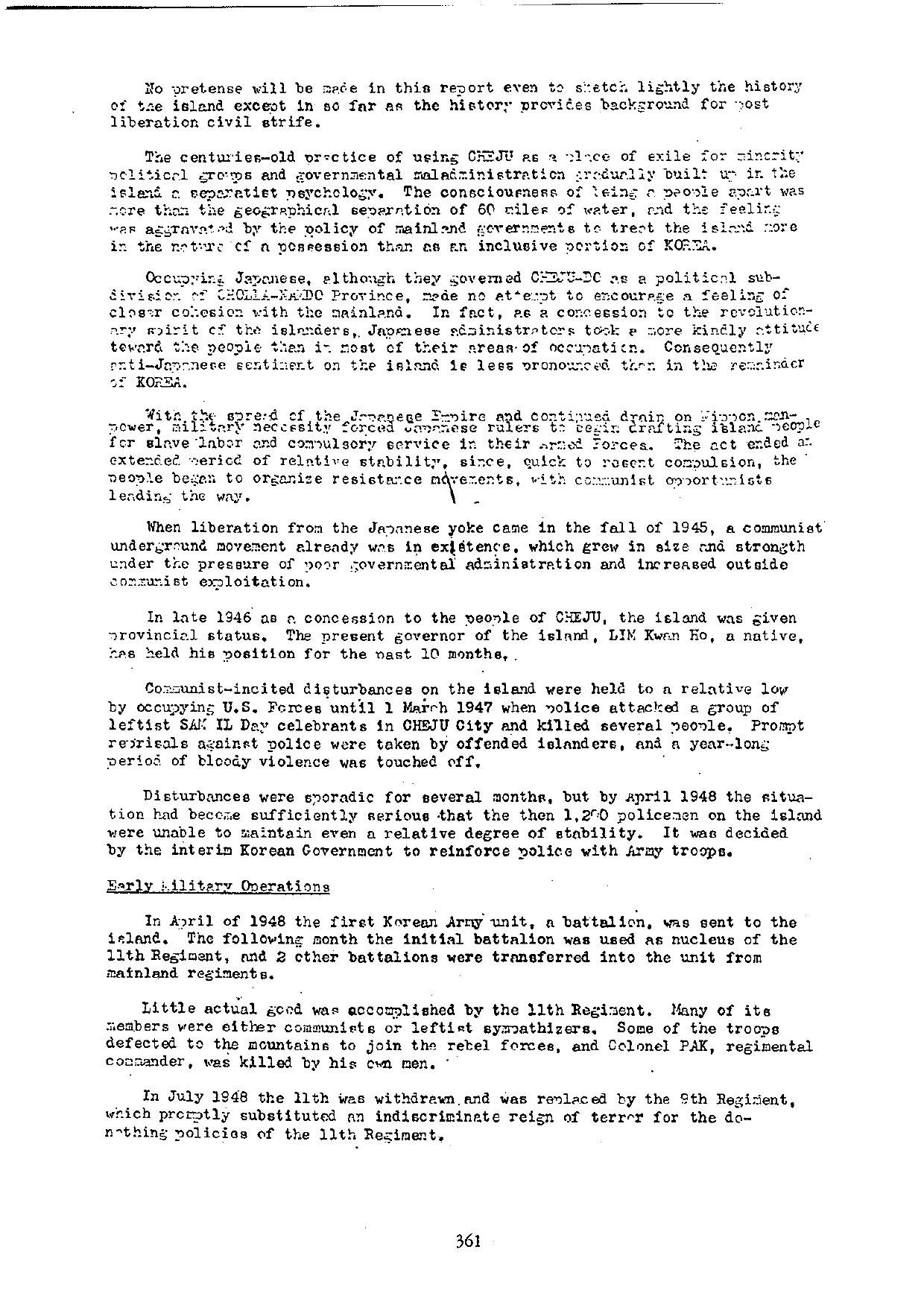
No pretense will be made in this report even to sketch lightly the history of the island except in so far as the history provides background for post liberation civil strife.
The centuries-old practice of using CHEJU as a place of exile for minority political groups and governmental maladministration gradually built up in the island a separatist psychology. The consciousness of being a people apart was more than the geographical separation of 60 miles of water, and the feeling was aggravated by the policy of mainland governments to treat the island more in the nature of a possession than as an inclusive portion of KOREA.
Occupying Japanese, although they governed CHEJU-DO as a political subdivision of CHOLLA-NAMDO Province, made no attempt to encourage a feeling of closer cohesion with the mainland. In fact, as a concession to the revolutionary spirit of the islanders, Japanese administrators took a more kindly attitude toward the people than in most of their areas of occupation. Consequently anti-Japanese sentiment on the island is less pronounced than in the remainder of KOREA.
With the spread of the Japanese Empire and continued drain on [illegible] manpower, military necessity forced Japanese rulers to begin drafting island people for slave labor and compulsory service in their armed Forces. The act ended an extended period of relative stability, since, quick to resent compulsion, the people began to organize resistance movements, with communist opportunists lending the way.
When liberation from the Japanese yoke came in the fall of 1945, a communist underground movement already was in existence, which grew in size and strength under the pressure of poor governmental administration and increased outside communist exploitation.
In late 1946 as a concession to the people of CHEJU, the island was given provincial status. The present governor of the island, LIM Kwan Ho, a native, has held his position for the past 10 months.
Communist-incited disturbances on the island were held to a relative low by occupying U.S. Forces until 1 March 1947 when police attacked a group of leftist SAM IL Day celebrants in CHEJU City and killed several people. Prompt reprisals against police were taken by offended islanders, and a year-long period of bloody violence was touched off.
Disturbances were sporadic for several months, but by April 1948 the situation had become sufficiently serious that the then 1,200 policemen on the island were unable to maintain even a relative degree of stability. It was decided by the interim Korean Government to reinforce police with Army troops.
Early Military Operations
In April of 1948 the first Korean Army unit, a battalion, was sent to the island. The following month the initial battalion was used as nucleus of the 11th Regiment, and 2 other battalions were transferred into the unit from mainland regiments.
Little actual good was accomplished by the 11th Regiment. Many of its members were either communists or leftist sympathizers. Some of the troops defected to the mountains to join the rebel forces, and Colonel PAK, regimental commander, was killed by his own men.
In July 1948 the 11th was withdrawn and was replaced by the 9th Regiment, which promptly substituted an indiscriminate reign of terror for the do-nothing policies of the 11th Regiment.
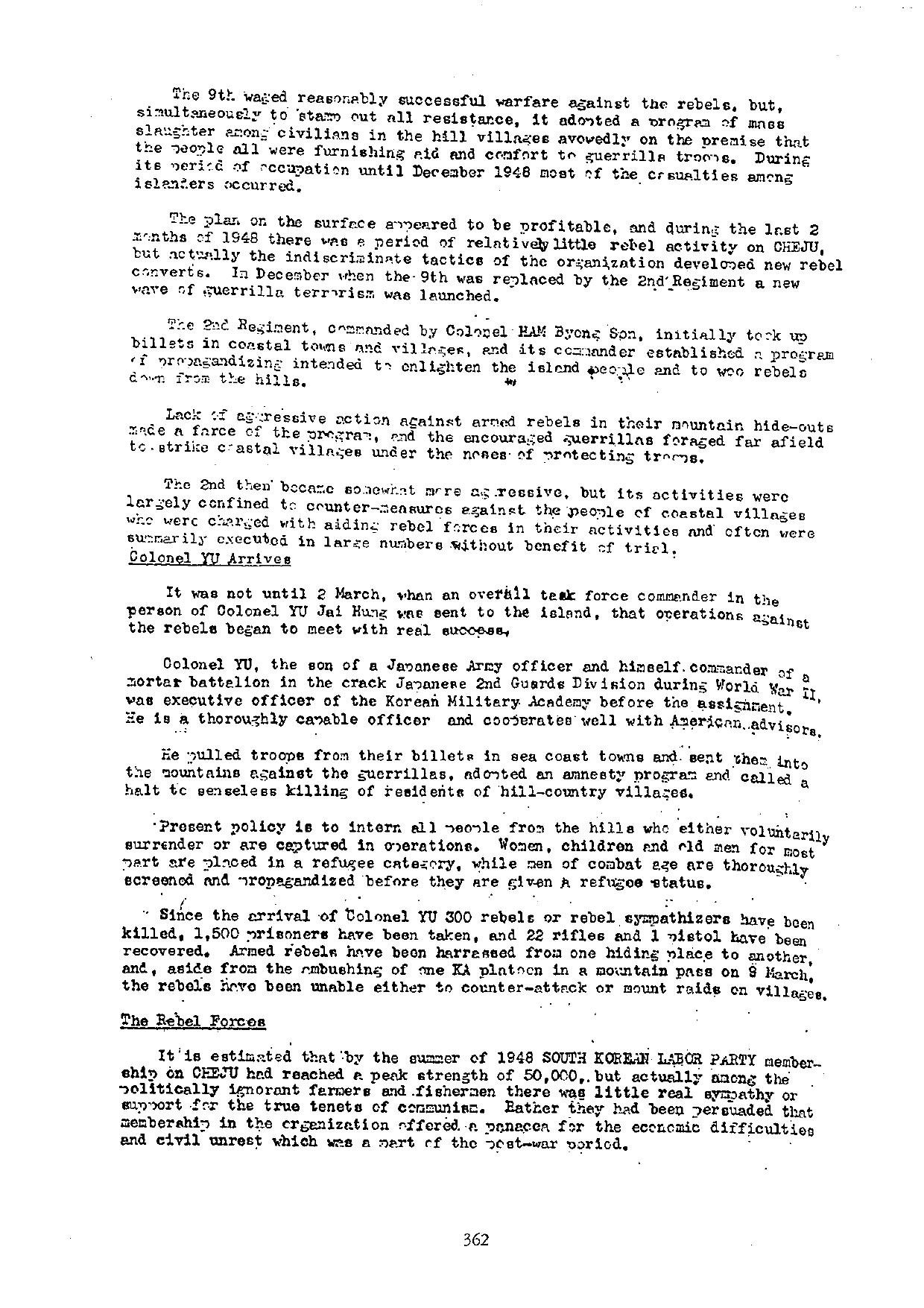
The 9th waged reasonably successful warfare against the rebels, but, simultaneously to stamp out all resistance, it adopted a program of mass slaughter among civilians in the hill villages avowedly on the premise that the people all were furnishing aid and comfort to guerrilla troops. During its period of occupation until December 1948 most of the casualties among islanders occurred.
The plan on the surface appeared to be profitable, and during the last 2 months of 1948 there was a period of relatively little rebel activity on CHEJU, but actually the indiscriminate tactics of the organization developed new rebel converts. In December when the 9th was replaced by the 2nd Regiment a new wave of guerrilla terrorism was launched.
The 2nd Regiment, commanded by Colonel HAM Byong Son, initially took up billets in coastal towns and villages, and its commander established a program of propagandizing intended to enlighten the island people and to woo rebels down from the hills.
Lack of aggressive action against armed rebels in their mountain hide-outs made a farce of the program, and the encouraged guerrillas foraged far afield to strike coastal villages under the noses of protecting troops.
The 2nd then became somewhat more aggressive, but its activities were largely confined to counter-measures against the people of coastal villages who were charged with aiding rebel forces in their activities and often were summarily executed in large numbers without benefit of trial.
Colonel YU Arrives
It was not until 2 March, when an overall task force commander in the person of Colonel YU Jai Hung was sent to the island, that operations against the rebels began to meet with real success.
Colonel YU, the son of a Japanese Army officer and himself commander of a mortar battalion in the crack Japanese 2nd Guards Division during World War II, was executive officer of the Korean Military Academy before the assignment. He is a thoroughly capable officer and cooperates well with American advisors.
He pulled troops from their billets in sea coast towns and sent them into the mountains against the guerrillas, adopted an amnesty program and called a halt to senseless killing of residents of hill-country villages.
Present policy is to intern all people from the hills who either voluntarily surrender or are captured in operations. Women, children and old men for most part are placed in a refugee category, while men of combat age are thoroughly screened and propagandized before they are given a refugee status.
Since the arrival of Colonel YU 300 rebels or rebel sympathizers have been killed, 1,500 prisoners have been taken, and 22 rifles and 1 pistol have been recovered. Armed rebels have been harrassed from one hiding place to another, and, aside from the ambushing of one KA platoon in a mountain pass on 9 March, the rebels have been unable either to counter-attack or mount raids on villages.
The Rebel Forces
It is estimated that by the summer of 1948 SOUTH KOREAN LABOR PARTY membership on CHEJU had reached a peak strength of 50,000, but actually among the politically ignorant farmers and fishermen there was little real sympathy or support for the true tenets of communism. Rather they had been persuaded that membership in the organization offered a panacea for the economic difficulties and civil unrest which was a part of the post-war period.
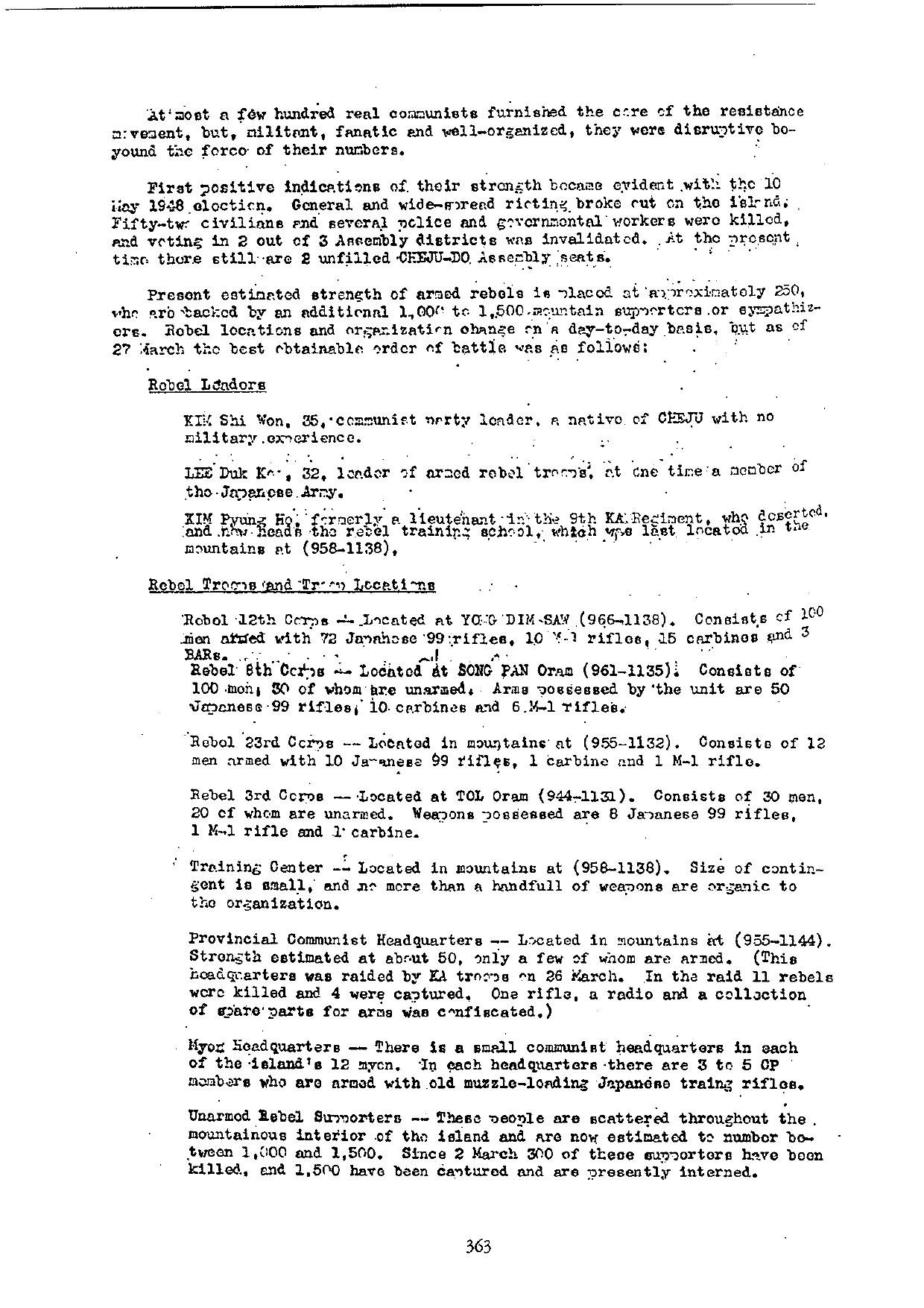
At most a few hundred real communists furnished the core of the resistance movement, but, militant, fanatic and well-organized, they were disruptive beyond the force of their numbers.
First positive indications of their strength became evident with the 10 May 1948 election. General and wide-spread rioting broke out on the island. Fifty-two civilians and several police and governmental workers were killed, and voting in 2 out of 3 Assembly districts was invalidated. At the present time there still are 2 unfilled CHEJU-DO Assembly seats.
Present estimated strength of armed rebels is placed at approximately 250, who are backed by an additional 1,000 to 1,500 mountain supporters or sympathizers. Rebel locations and organization change on a day-to-day basis, but as of 27 March the best obtainable order of battle was as follows:
Rebel Leaders
KIM Shi Won, 35, communist party leader, a native of CHEJU with no military experience.
LEE Duk Ko-, 32, leader of armed rebel troops, at one time a member of the Japanese Army.
KIM Pyung Ho, formerly a lieutenant in the 9th KA Regiment, who deserted, and now heads the rebel training school, which was last located in the mountains at (958-1138).
Rebel Troops and Troop Locations
Rebel 12th Corps -- Located at YO:G DIM-SAW (966-1138). Consists of 100 men armed with 72 Japanese 99 rifles, 10 M-1 rifles, 15 carbines and 3 BARs.
Rebel 8th Corps -- Located at SONG PAN Oram (961-1135). Consists of 100 mon, 50 of whom are unarmed. Arms possessed by the unit are 50 Japanese 99 rifles, 10 carbines and 6 M-1 rifles.
Rebel 23rd Corps -- Located in mountains at (955-1132). Consists of 12 men armed with 10 Japanese 99 rifles, 1 carbine and 1 M-1 rifle.
Rebel 3rd Corps -- Located at TOL Oram (944-1131). Consists of 30 men, 20 of whom are unarmed. Weapons possessed are 8 Japanese 99 rifles, 1 M-1 rifle and 1 carbine.
Training Center -- Located in mountains at (958-1138). Size of contingent is small, and no more than a handfull of weapons are organic to the organization.
Provincial Communist Headquarters -- Located in mountains at (955-1144). Strength estimated at about 50, only a few of whom are armed. (This headquarters was raided by KA troops on 26 March. In the raid 11 rebels were killed and 4 were captured. One rifle, a radio and a collection of spare parts for arms was confiscated.)
Myon Headquarters -- There is a small communist headquarters in each of the island's 12 myon. In each headquarters there are 3 to 5 CP members who are armed with old muzzle-loading Japanese training rifles.
Unarmed Rebel Supporters -- These people are scattered throughout the mountainous interior of the island and are now estimated to number between 1,000 and 1,500. Since 2 March 300 of these supporters have been killed, and 1,500 have been captured and are presently interned.
Guerrilla Logistics
Most pressing problem of the rebels at the present time is lack of ammunition. Captured and foraged food stocks are ample, and caves left behind by Japanese divisions make security and housing no great problem, but there is no ready source of ammunition. Three light machine guns and a mortar captured from KA troops have been buried because of the supply shortage, and present ammunition stocks, as assessed by captured rebels, consist of 800 rounds of M-1, 90 rounds of carbine and 400 rounds of Japanese 99 ammunition. Only source of supply for captured American-type weapons is that captured from Security Forces, but it is believed that the rebels possess reloading facilities for 2,000 rounds of 99 ammunition.
There have been rumors that rebel forces have received logistic support by water from the mainland and from North Korea, but there is no evidence to substantiate those reports. Constant patrolling by ships of the Korean Navy, aerial reconnaissance flights and the tight ring of police in villages on the coastal plain preclude the possibility of outside support.
Security Forces
Security Forces presently opposing the rebels are 2,622 KA troops, 1,700 police and approximately 50,000 MIN BO DAN, a civilian defense agency.
In general cooperation between police and the military is excellent, but occasionally there are reported incidents of friction in small, outlying villages, which usually can be blamed on high-handedness of soldiers belonging to units with inadequate leadership.
KA Troops
Troops in CHEJU are broken down into the 3 battalions of the 2nd Regiment, one understrength special battalion and one special unit of 50 men under the command of Captain KIM Myung, former S-3 of the 2nd Regiment. This small unit, dressed in civilian clothing and armed with Japanese 99 rifles, is made up of selected guerrilla fighters who prowl through the mountain country, meet rebels on their own terms and who thus far have been most valuable as an intelligence collection agency.
Task Force and regimental headquarters of troops on the island are at CHEJU City (952-1152). Battalion headquarters are located as follows: 1st Battalion --PYONG TAI JIN JUN (961-1130); 2nd Battalion--KWAN UM SA (957-1142); 3rd Battalion--KYO LAE Ri (969-1141); Special Battalion--MO RO Crum (945-1135).
Training of troops on the island has not advanced beyond small unit stage. Bulk of the soldiers are desirous of a speedy return to mainland duty, but their morale generally appears to be good, and all communistic elements were purged from the 2nd Regiment before it departed from TAEJON (1040-1490).
Police
Chief of Police on the island is HONG Sun Bong, a typical Korean Police official, who apparently is attempting to cooperate with both KA troops and American advisors.
The normal complement of 1,200 police on the island, consisting of 800 native members and 400 mainlanders, has been reinforced by 500 men from mainland cities during the current period of unrest.
Police for most part are concentrated in coastal towns as a security and holding force and are only used against the rebels in combined operations at the request of the Army commander.
MIN BO DAN
Backing both the police and Army is the MIN BO DAN, which is made up of most of the adult male population of the island and is armed with crude bamboo spears. Estimated to number approximately 50,000, they appear to prefer guard duty and anti-guerrilla operations to labor in the fields, and, since they are used directly in the line by the Army in its combing operations, casualties have been comparatively heavy among the civilian combatants.
Civilian Privation
As a result of cumulative rebel actions and counter-measures of Security Forces there is a tragic amount of hardship and privation among the civilian population of the island. During the past year it is estimated that 14 to 15 thousand people have been killed, at least 80 to r cent of them by Security Troops; nearly one-third of the homes on the island have been destroyed, and an estimated one-fourth of the 300,000 islanders have been dislocated from their razed villages and have been moved to coastal areas; food, clothing and medicinal stocks are low, and only in the past two weeks have relief supplies from the mainland begun to arrive in noticeable quantities.
Refugees from the 45 villages which have been completely destroyed and from 43 others which have been partially razed have been moved to encampments in coastal towns.
Housing for the dislocated people offers no great problem. Primary building materials, stone and mud, are in abundance all over the island, and now villages spring up overnight, but food is and will continue to be a pressing problem.
During normal times CHEJU-DO is a rice deficit area, but surpluses of barley and sweet potatoes are traded with the mainland for rice supplies. Now farmers have been moved away from their plots of ground, and a large percentage of farm animals have been killed wantonly by both rebels and Security Troops.
At the present time, with rebel activities suppressed, farmers have been allowed to move 8 kms inland to resume farming, but they are handicapped by the distances to their present dwellings and the reduction in draft animals.
If the rebel situation remains under control, the island should again become self-sufficient in food stocks by next fall, but without continued mainland support during intervening months, there will be a definite food deficit and resultant danger of rioting and disorder.
COMMENT: While the overall picture looks bright at the present time, any cessation of activities on the part of KA units likely will result in fresh outbreaks of terrorism unless in the meantime the some 250 odd armed rebels are either killed or captured or their arms are confiscated. One captured rebel leader admitted that present policy of his cohorts was to keep under cover until army troops are withdrawn, at which time raiding would be resumed.
> Utilizing intelligence reports, the Korean Commander is attempting to ferret rebels from their hiding places by direct operations, but, while the guerrillas are kept on the move and have suspended their activities, no real dent has been made in the armed units.
> Present plans of cleaning out the rebels entirely before mid-April appear somewhat optimistic. It may
be necessary to utilize an alternate plan, which is under consideration, to form a line of Army troops and MIN BO DAN completely across the island and comb the mountains thoroughly, driving rebel troops toward a police holding force on the other end of the island. An operation of that nature in view of the distance involved and the rugged nature of the terrain could be expected to last a month, but it should be effective.
출처:
제주4·3사건진상규명및희생자명예회복위원회 편,
『제주4·3사건자료집 7』 [미국자료편],
번역문 p.117
/ 원문 p.360–366 / No. 1097.