주한미대사관
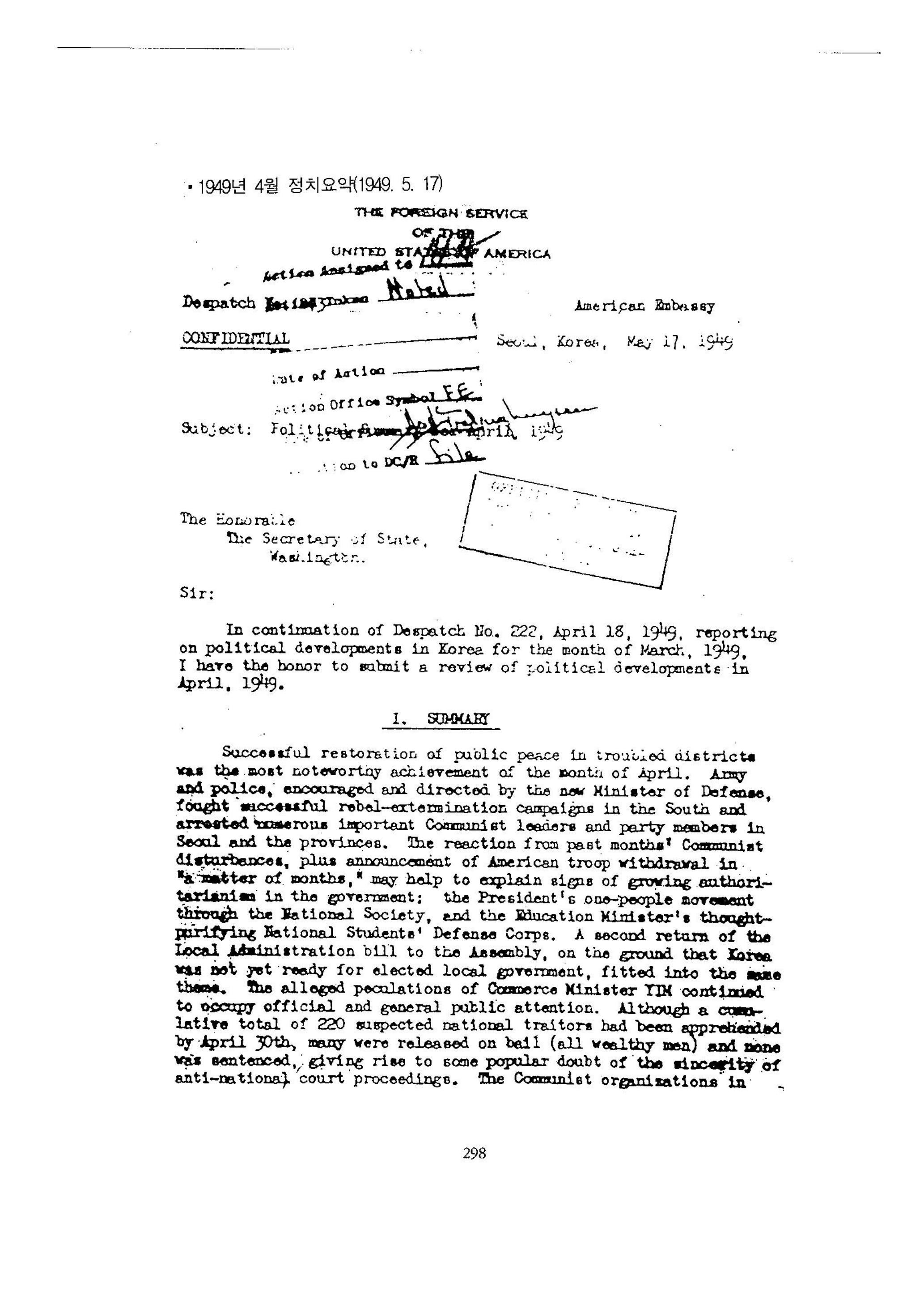
제목: 1949년 4월의 정치요약
존경하는 국무장관 귀하
1949년 3월 한국의 정치발전 상황을 보고한 1949년 4월 18일의 <급송문서> 제222호에 이어 1949년 4월의 정치발전 상황 개관을 제출하게 돼 영광입니다.
I. 개요
4월의 가장 주목할 만한 성과는 소요지역의 치안상태가 성공적으로 회복된 것입니다. 신임 국방부장관이 격려하고 지시한 군과 경찰은 남부지방에서 반란군에 대한 성공적인 섬멸작전을 펼치고 있으며 서울과 지방에서 상당수의 주요 공산주의 지도자들과 당원들을 체포했습니다.
‘시간의 문제’인 미군철수 발표와 이제까지의 공산주의자들의 소요에 따른 정부측 반응은 정부내에 증가하는 권위주의에 대한 표시로 설명하는데 도움이 될 것입니다. 즉 국민회를 통한 대통령의 일민회 움직임과 문교부장관의 사고를 정화하는 학도호국단이 그것입니다.
정부가 한국은 현재 지방정부를 선출할 준비가 되지 않았다는 이유로 국회에 두 번씩이나 지방자치법안을 환송한 것은 앞서 언급한 진술들과 일맥상통합니다.
상무부장관 임(영신)의 공금유용 혐의는 공식적이고 일반의 관심을 계속 끌었습니다. 4월 30일까지 전체 누계 220명의 반민족혐의자들이 체포됐으나 많은 사람들이 보석(모두 재산가)으로 석방됐으며 아무도 형을 선고받지 않아 반민족행위자 재판절차의 성실성에 일부 대중들의 의혹을 불러 일으켰습니다.
남한의 공산주의 조직들은 보안군에게 패배했습니다. 미국대사와 프랑스 대리대사는 대한민국에 신임장을 제정했습니다. 유엔한국위원단의 대표들은 신중하고 계속해서 시찰했습니다. 한국과 연합국군최고사령부는 일본과의 무역협정에 서명했습니다. 문교부는 의무교육 실시계획을 발표했습니다.
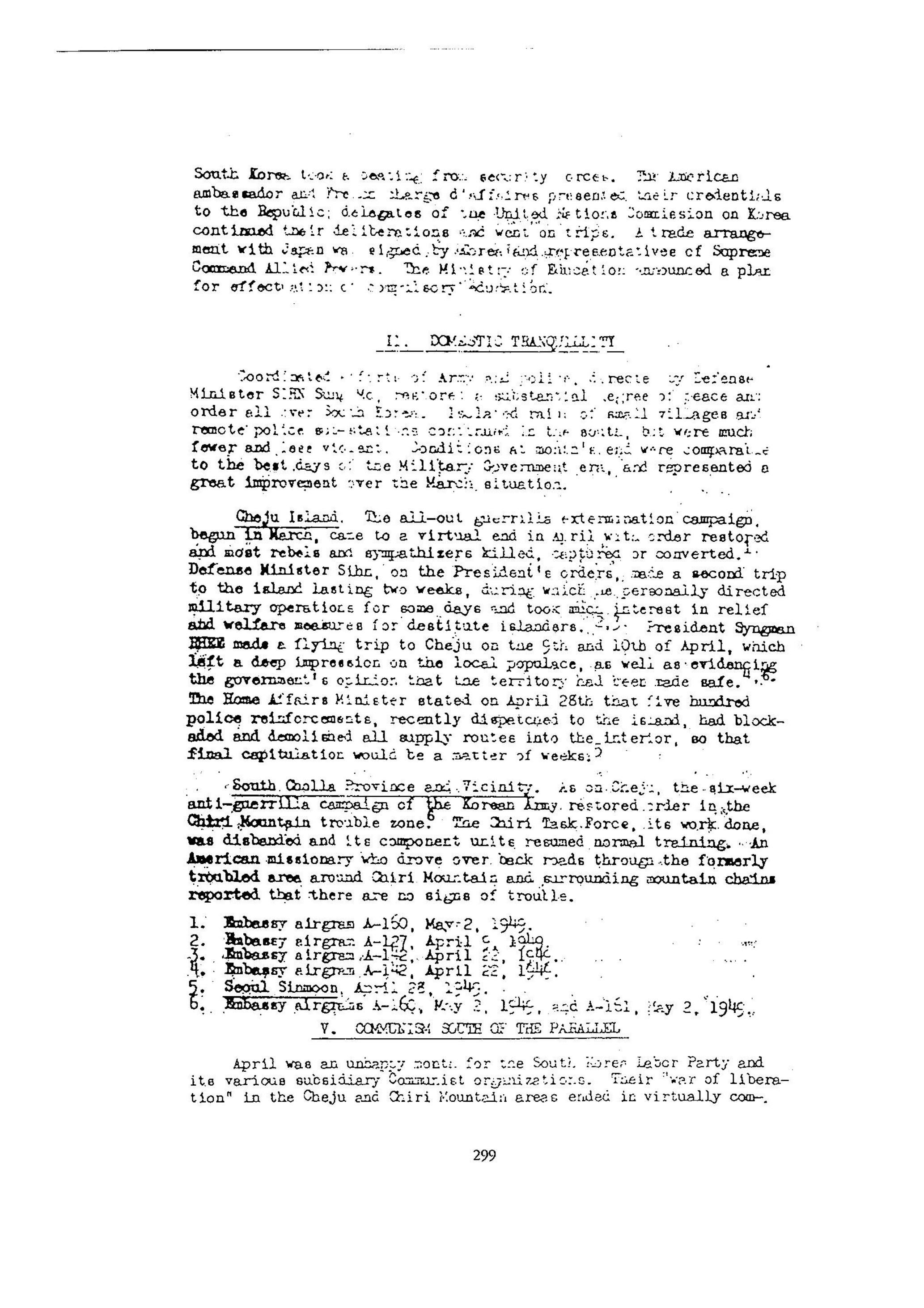
II. 국내 평온상태
국방부장관 신성모가 지휘하는 군과 경찰의 합동작전으로 남한 전역에서 어느 정도 실질적인 치안이 회복됐습니다.
작은 마을과 오지의 경찰지서들에 대한 습격이 남부지방에서 계속됐으나 폭력행위는 상당히 줄어들었습니다. 4월 말의 상황은 군정시대에 가장 좋았던 날들과 비교되고 3월의 상황보다 상당한 진전을 보여줬습니다.
제주도
3월에 시작된 전면적인 게릴라 소탕작전이 4월말 질서가 회복되면서 사실상 막을 내렸습니다. 대부분의 반란군과 동조자들이 죽거나 체포되거나 사상을 전향했습니다(대사관 <항공우편> A-160, 1949년 5월 2일).
대통령의 명령에 따라 국방부장관 신(성모)은 2주 일정으로 제주도를 두 번째 시찰했습니다. 그는 제주도에 체류하는 동안 개인적으로 며칠 동안 군 작전을 지휘했고 궁핍한 섬주민들을 위해 구호와 후생에 상당한 관심을 기울였습니다(대사관 <항공우편> A-127, 1949년 4월 9일 ; A-142, 1949년 4월 22일). 이승만 대통령은 4월 9, 10일 제주도를 방문했습니다. 이 방문에서 이 대통령은 국토가 안전하다는 정부의 견해를 입증했을 뿐 아니라 제주도민들에게 깊은 인상을 남겼습니다(대사관 <항공우편> A-142, 1949년 4월 22일 ; A-160, 1949년 5월 2일 ; A-161, 1949년 5월 2일).
내무부장관은 4월 28일 최근 제주도로 급파된 500명의 응원경찰대가 내륙으로 통하는 모든 보급로를 차단하고 파괴해 최종 조건부 항복은 수주일의 문제일 것이라고 밝혔습니다(서울신문 1949년 4월 28일).
전라남도와 주변 지역
제주도에서처럼 한국군의 6주 동안에 걸친 대게릴라 작전으로 지리산의 소요지구에서 질서를 회복했습니다(대사관 <항공우편> A-160, 1949년 5월 2일 ; A-161, 1949년 5월 2일).
작전을 수행한 지리산전투사령부는 해체돼 각 부대는 정상 훈련을 재개했습니다. 이전의 지리산 주변 소요지구와 주변 산악지역을 관통하는 도로를 따라 돌아온 한 미국 선교사는 어떠한 소요 징후도 찾아볼 수 없다고 보고했습니다.
(중략)
III. 38선 이남의 공산주의
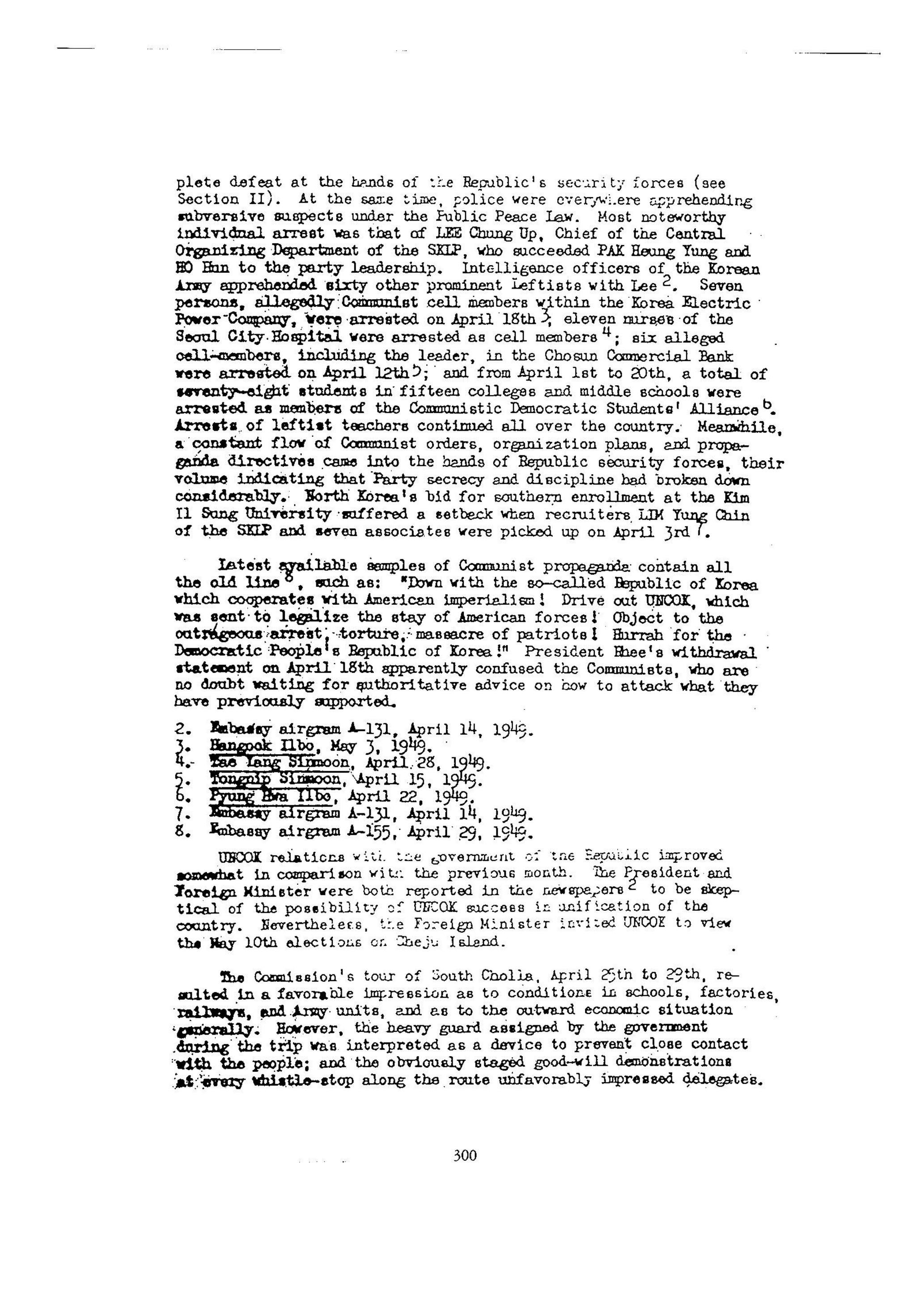
4월은 남로당과 남로당의 하부 조직들에게는 불행한 달이었습니다. 제주도와 지리산 지역에서의 그들의 ‘해방전쟁’은 대한민국의 보안군(II. 국내 평온상태 참조)에 의해 사실상 완전한 패배로 끝났습니다. 동시에 경찰은 공안법에 따라 파괴분자 혐의자를 어디에서건 체포하고 있습니다.
가장 주목할 만한 체포인사는 박헌영과 허헌의 지도력을 계승한 남로당 중앙조직부장 이정엽입니다. 한국군 정보장교들은 이정엽과 함께 60명의 주요 좌익인사들을 체포했습니다(대사관 <항공우편> A-131, 1949년 4월 14일). 남선전기회사의 공산주의 세포 조직원 혐의자 7명이 4월 18일 체포되고(한국일보 1949년 5월 3일) 서울시립병원의 간호사 11명이 세포 조직원으로 체포됐습니다(태양신문 1949년 4월 28일). 조선상업은행에서 지도책을 포함해 세포 혐의자 6명이 4월 12일 체포됐습니다(독립신문 1949년 4월 15일). 그리고 4월 1일부터 20일까지 전체 15개 대학과 중학교에서 학생 78명이 공산민주학생연맹 조직원으로 체포됐습니다(평화일보 1949년 4월 22일).
좌익교사들에 대한 체포가 전국적으로 계속됐습니다. 반면 끊임없는 공산주의자들의 명령, 조직계획, 선전지령이 대한민국 보안군의 수중에 들어왔으며 이는 남로당의 비밀과 규율이 상당히 깨졌다는 것을 암시했습니다. 김일성 대학에 남쪽 학생들을 등록시키기 위한 북한의 노력은 남로당의 임영진과 7명의 동료들이 4월 3일 신입생에 선발됨으로써 좌절을 겪었습니다(대사관 <항공우편> A-131, 1949년 4월 14일).
가장 최근에 사용한 공산주의 선전활동의 사례는 ‘미제국주의와 협력하는 이른바 대한민국을 무너뜨리자! 미군 주둔을 합법화한 유엔한국위원단을 쫓아내자! 애국인사들에 대한 광폭한 체포와 고문, 학살을 반대하자! 조선민주주의 인민공화국 만세!’와 같은 모두 옛 노선입니다(대사관 <항공우편> A-155, 1949년 4월 29일).
4월 18일의 이 대통령의 철수발언은 공산주의자들에 당혹스러운 것이었는데 그 이유는 자신들이 전에 지지했던 미군철수 주장을 이승만 대통령이 어떻게 공격할 것인지에 대하여 권위적인 조언을 할 것이라고 믿어 의심치 않았기 때문이었다.
(중략)
대한민국 정부와 유엔한국위원단의 관계는 이전 달과 비교하면 다소 개선됐습니다. 대통령과 외무부장관 둘 다 통일과 관련해 유엔한국위원단의 성공 가능성을 회의적으로 보고 있다고 신문에 보도됐습니다. 그럼에도 불구하고 외무부장관은 제주도의 5월 10일 선거를 참관하도록 유엔한국위원단을 초청했습니다.
4월 25일부터 29일까지 전라남도에 대한 위원단의 시찰을 통해 학교와 공장, 철도, 군부대의 상황과 일반적으로 외부 경제상황에 대해 좋다는 인상을 받았습니다.
그러나 시찰 기간 동안 정부가 배치한 중무장한 경비병들이 주민들과의 밀접한 접촉을 막기 위한 장치로 해석됐습니다. 도로를 따라 모든 간이정거장에 확실히 마련된 선의의 환영인파는 대표단에게 비우호적인 인상을 남겼습니다.
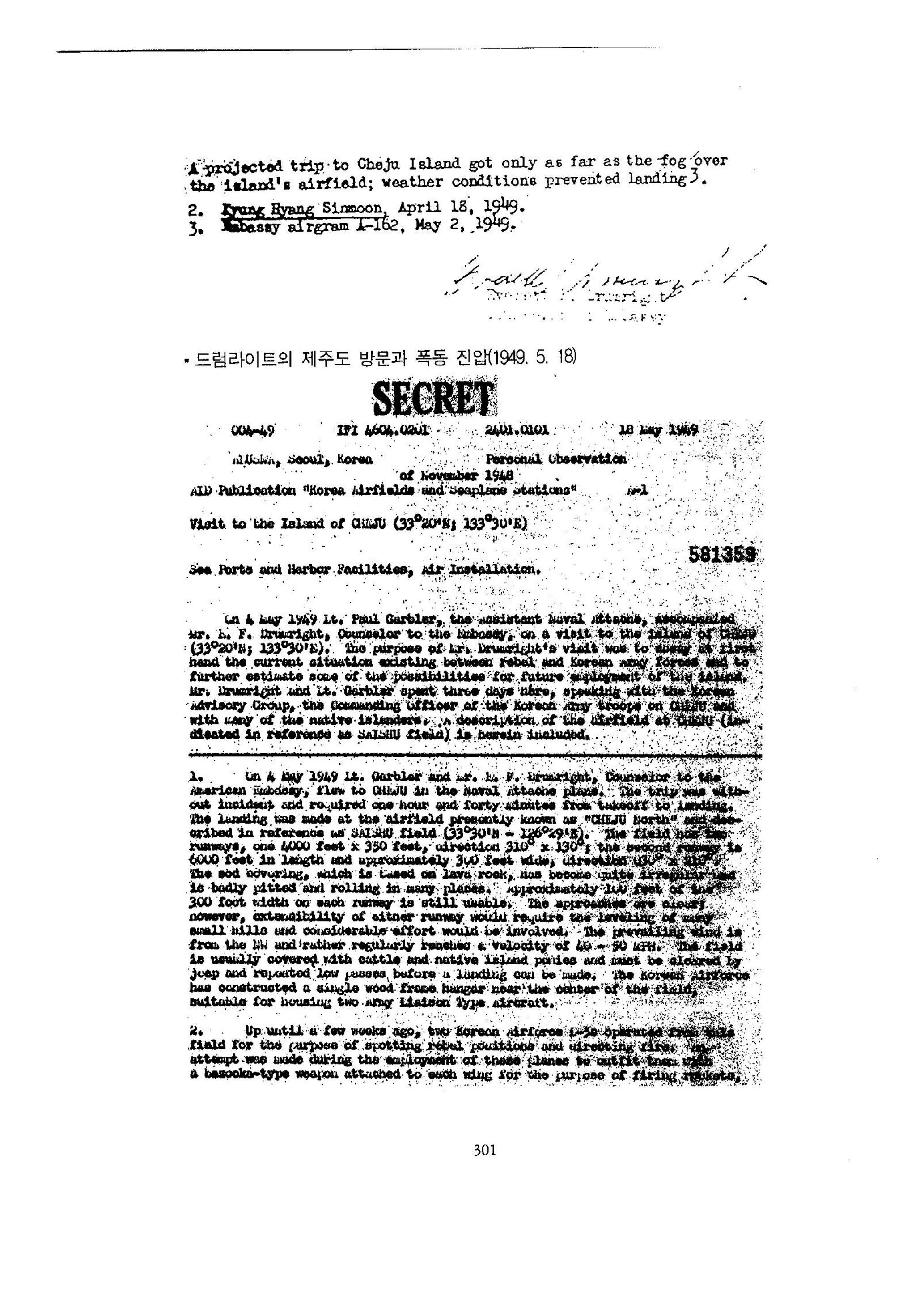
제주도에 대한 계획된 시찰은 제주도 비행장의 안개가 제거되는 대로 빨리 시작됐습니다. 기후조건 때문에 착륙하지 못했습니다(대사관 <항공우편> A-162, 1949년 5월 2일).
(중략)
대사관 참사관 에버레트 드럼라이트(Everett F. Drumright)
THE FOREIGN SERVICE
OF
UNITED STATES OF AMERICA
Action Assigned to
Despatch No. [illegible]
American Embassy
CONFIDENTIAL
Seoul, Korea, May 17, 1949
Date of Action
Section Office Symbol [illegible]
Subject: Political [illegible] April 1949
Action to DC/R [illegible]
The Honorable
The Secretary of State,
Washington.
Sir:
In continuation of Despatch No. 222, April 18, 1949, reporting on political developments in Korea for the month of March, 1949, I have the honor to submit a review of political developments in April, 1949.
I. SUMMARY
Successful restoration of public peace in troubled districts was the most noteworthy achievement of the month of April. Army and police, encouraged and directed by the new Minister of Defense, fought successful rebel-extermination campaigns in the South and arrested numerous important Communist leaders and party members in Seoul and the provinces. The reaction from past months' Communist disturbances, plus announcement of American troop withdrawal in "a matter of months," may help to explain signs of growing authoritarianism in the government: the President's one-people movement through the National Society, and the Education Minister's thought-purifying National Students' Defense Corps. A second return of the Local Administration bill to the Assembly, on the ground that Korea was not yet ready for elected local government, fitted into the same theme. The alleged peculations of Commerce Minister YIM continued to occupy official and general public attention. Although a cumulative total of 220 suspected national traitors had been apprehended by April 30th, many were released on bail (all wealthy men) and none was sentenced, giving rise to some popular doubt of the sincerity of anti-national court proceedings. The Communist organizations in South Korea took a beating from security forces. The American ambassador and Pre..ic large d'affaires presented their credentials to the Republic; delegates of the United Nations Commission on Korea continued their deliberations and went on trips. A trade arrangement with Japan was signed by Korean and representatives of Supreme Command Allied Powers. The Ministry of Education announced a plan for effectuation of compulsory education.
I. DOMESTIC TRANQUILLITY
Coordinated efforts of Army and police, directed by Defense Minister SHIN Sung Mo, therefore a substantial degree of peace and order all over South Korea. Island and ruins of small villages and remote police sub-stations continued is the south, but were much fewer and less violent. Conditions at month's end were comparable to the best days of the Military Government era, and represented a great improvement over the March situation.
Cheju Island. The all-out guerrilla extermination campaign, begun in March, came to a virtual end in April with order restored and most rebels and sympathizers killed, captured or converted. Defense Minister Sihn, on the President's orders, made a second trip to the island lasting two weeks, during which he personally directed military operations for some days and took much interest in relief and welfare measures for destitute islanders. President Syngman RHEE made a flying trip to Cheju on the 9th and 10th of April, which left a deep impression on the local populace, as well as evidencing the government's opinion that the territory had been made safe. The Home Affairs Minister stated on April 28th that five hundred police reinforcements, recently dispatched to the island, had blockaded and demolished all supply routes into the interior, so that final capitulation would be a matter of weeks.
South Cholla Province and Vicinity. As on Cheju, the six-week anti-guerrilla campaign of the Korean Army restored order in the Chiri Mountain trouble zone. The Chiri Task Force, its work done, was disbanded and its component units resumed normal training. An American missionary who drove over back roads through the formerly troubled area around Chiri Mountain and surrounding mountain chains reported that there are no signs of trouble.
1. Embassy airgram A-160, May 2, 1949.
2. Embassy airgram A-127, April 5, 1949
3. Embassy airgram A-112, April 22, [illegible]
4. Embassy airgram A-142, April 22, 1949.
5. Seoul Sinmoon, April 28, 1949.
6. Embassy airgrams A-160, May 2, 1949, and A-151, May 2, 1949.
V. COMMUNISM SOUTH OF THE PARALLEL
April was an unhappy month for the South Korean Labor Party and its various subsidiary Communist organizations. Their "war of liberation" in the Cheju and Chiri Mountain areas ended in virtually complete defeat at the hands of the Republic's security forces (see Section II). At the same time, police were everywhere apprehending subversive suspects under the Public Peace Law. Most noteworthy individual arrest was that of LEE Chung Up, Chief of the Central Organizing Department of the SKIP, who succeeded PAK Heung Yung and HO Enn to the party leadership. Intelligence officers of the Korean Army apprehended sixty other prominent leftists with Lee 2. Seven persons, allegedly Communist cell members within the Korea Electric Power Company, were arrested on April 18th 3; eleven nurses of the Seoul City Hospital were arrested as cell members 4; six alleged cell-members, including the leader, in the Chosun Commercial Bank were arrested on April 12th 5; and from April 1st to 20th, a total of seventy-eight students in fifteen colleges and middle schools were arrested as members of the Communistic Democratic Students' Alliance b. Arrests of leftist teachers continued all over the country. Meanwhile, a constant flow of Communist orders, organization plans, and propaganda directives came into the hands of Republic security forces, their volume indicating that Party secrecy and discipline had broken down considerably. North Korea's bid for southern enrollment at the Kim Il Sung University suffered a setback when recruiters LIM Yung Chin of the SKIP and seven associates were picked up on April 3rd 7.
Latest available samples of Communist propaganda contain all the old line 8, such as: "Down with the so-called Republic of Korea which cooperates with American imperialism! Drive out UNCOK, which was sent to legalize the stay of American forces! Object to the outrageous arrest, torture, massacre of patriots! Hurrah for the Democratic People's Republic of Korea!" President Rhee's withdrawal statement on April 18th apparently confused the Communists, who are no doubt waiting for authoritative advice on how to attack what they have previously supported.
2. Embassy airgram A-131, April 14, 1949.
3. Bangkok Ilbo, May 3, 1949.
4. Tae lang Sinmoon, April 28, 1949.
5. Tongnip Sinmoon, April 15, 1949.
6. Pyung Hwa Ilbo, April 22, 1949.
7. Embassy airgram A-131, April 14, 1949.
8. Embassy airgram A-155, April 29, 1949.
UNCOK relations with the government of the Republic improved somewhat in comparison with the previous month. The President and Foreign Minister were both reported in the newspapers 2 to be skeptical of the possibility of UNCOK success in unification of the country. Nevertheless, the Foreign Minister invited UNCOK to view the May 10th elections on Cheju Island.
The Commission's tour of South Cholla, April 25th to 29th, resulted in a favorable impression as to conditions in schools, factories, railways, and Army units, and as to the outward economic situation generally. However, the heavy guard assigned by the government during the trip was interpreted as a device to prevent close contact with the people; and the obviously staged good-will demonstrations at every whistle-stop along the route unfavorably impressed delegates.
A projected trip to Cheju Island got only as far as the fog over the island's airfield; weather conditions prevented landing 3.
2. Evang Hyang Sinmoon, April 18, 1949.
3. Embassy airgram I-162, May 2, 1949.
[illegible handwritten text]
출처:
제주4·3사건진상규명및희생자명예회복위원회 편,
『제주4·3사건자료집 11』 [미국자료편],
번역문 p.106
/ 원문 p.298–301.