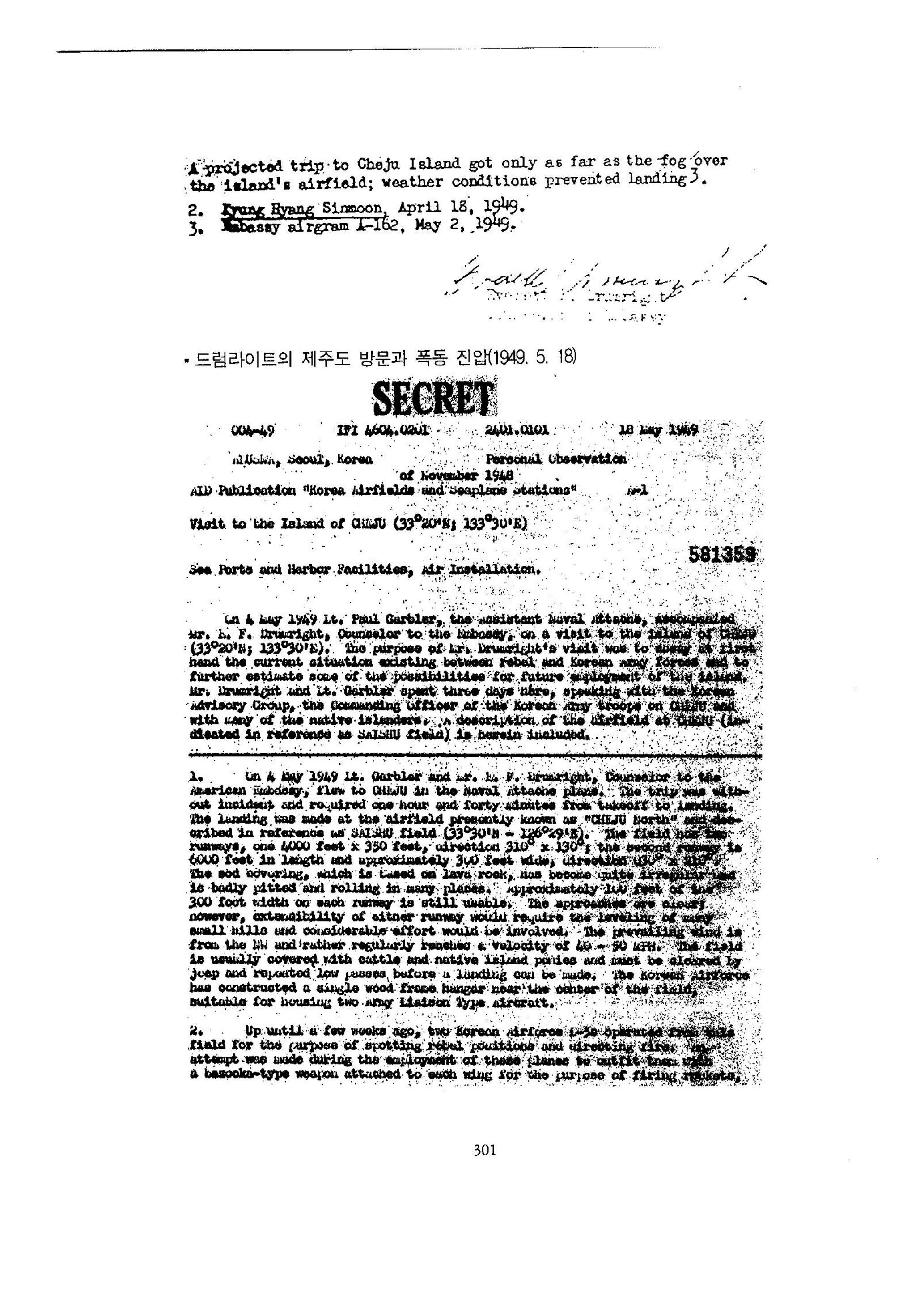
제목: 제주도 방문
1949년 5월 4일 주한미대사관 해군무관(Assistant Naval Attache) 폴 가블러(Paul Garbler) 중위는 주한미대사관 드럼라이트(E. F. Drumright) 참사관의 제주도 방문을 수행하였다. 드럼라이트의 방문 목적은 한국군과 폭도들 사이에 존재하고 있는 현재의 상황을 직접 보는 것이며 나아가 제주도의 장래 이용 가능성을 평가하는 것이었다. 드럼라이트 참사와 가블러 중위는 그 곳에서 3일 동안 머물면서 고문단(Korean Advisory Group), 제주도 주둔 한국군 지휘관, 제주도 주민들과 대화를 나누었다. 제주도 비행장(Saishu 공항이라고 알려져 있다)에 관한 기사도 이문서에 실려있다.
1. 도착과 제주비행장의 모습에 관한 기사 (역주)
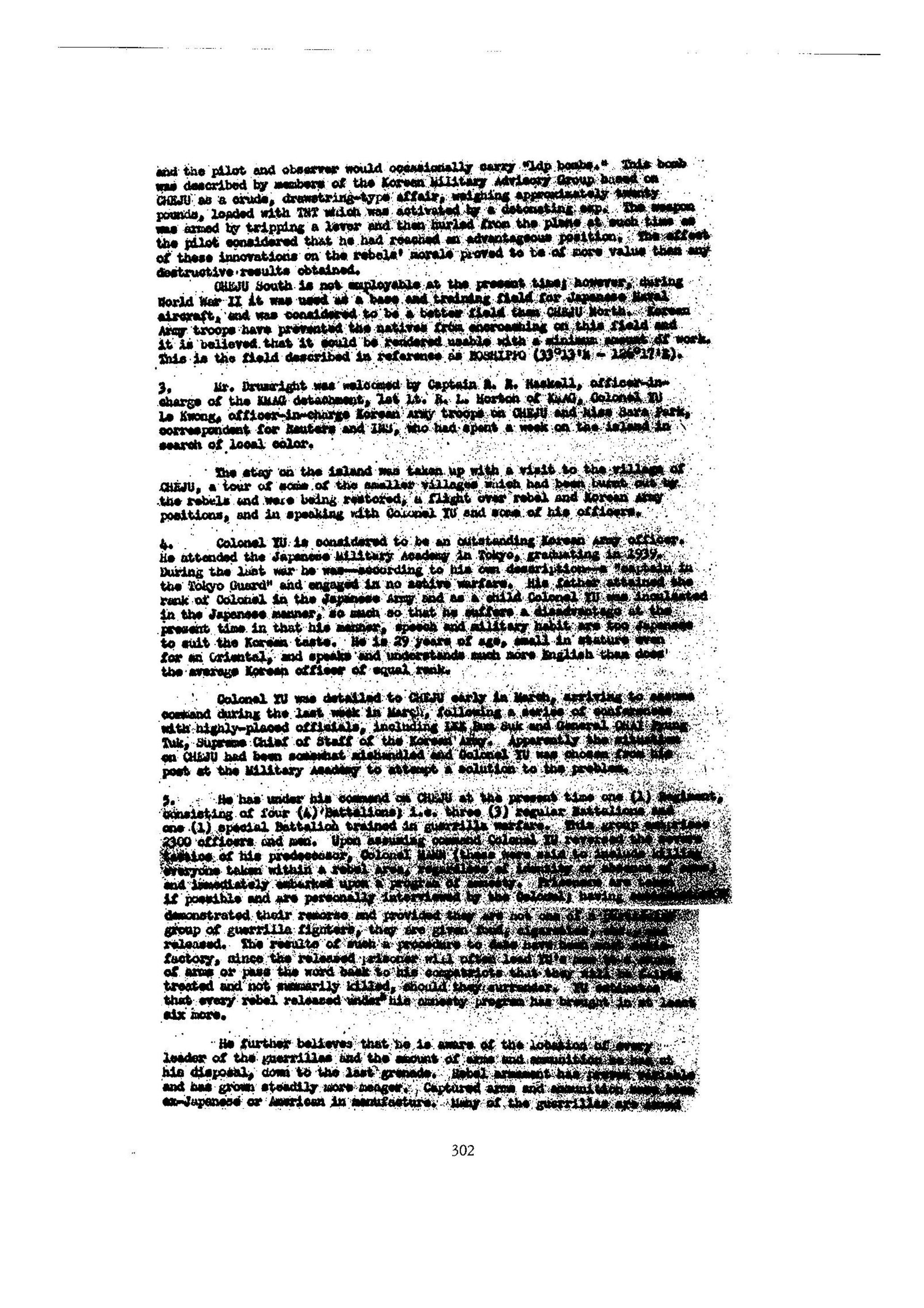
2. 몇 주일 전까지 한국공군의 L-5 두 대가 폭도들의 위치를 파악하여 사격을 유도하기 위하여 제주비행장에서 작전을 수행하였다. 이 비행기가 이용되는 동안에 로켓을 발사할 목적으로 비행기의 양쪽 날개에 바주카 형태의 무기를 장착시키려는 시도가 있었으며 그럴 경우 조종사와 감시자는 경우에 따라서 ‘ldp 폭탄’을 싣게 될 것이다. 제주도에 주둔하고 있는 군사고문단 요원들은 이 폭탄의 무게가 약 20파운드이며 뇌관으로 격발되는 TNT를 장전한 거칠고 허리가 잘록한 물건이라고 묘사되었다. 이 무기는 고리로 걸어서 장착하며 조종사가 유리한 위치에 이르렀다고 판단한 때에 비행기에서 투하된다. 이러한 새로운 작전이 폭도들의 사기에 미치는 영향은 실제로 얻게 될 파괴적인 결과보다도 훨씬 더 가치있는 것으로 증명되었다.
(중략)
제주도 남부는 현재 활용할 수 없다. 그러나 제2차대전 중 일본의 해군항공의 기지와 훈련장으로 활용되었으며 제주도 북부보다도 더 좋은 곳으로 판단된다. 남한 육군은 주민들이 이곳에 접근하는 것을 막고 있으며 이곳은 약간의 공사를 하면 사용될 수 있을 것으로 사료된다.
3. 드럼라이트는 미군사고문단 파견대의 책임관 하스켈(R. R. Haskell) 대위, 호튼(R. L. Horton) 소위, 제주도 주둔 한국군 사령관 유재흥 대령, 로이터와 INS 파견기자로서 제주도의 지역 특징을 취재하기 위하여 일주일 동안 머물고 있던 사라 박(Sara Park) 등의 영접을 받았다.
제주도의 체류는 제주도의 촌락 방문, 폭도들이 불태웠으나 복구되고 있는 몇몇 작은 촌락의 방문, 폭도들과 남한군 부대의 주둔지에 대한 항공정찰, 유 대령과 그의 부하장교들과의 대화 등으로 이루어졌다.
4. 유 대령은 유능한 한국군 장교로 여겨진다. 그는 동경의 일본 육군사관학교에 입학하여 1939년에 졸업하였다. 자신의 진술에 따르면 그는 2차대전 중 ‘동경근위대의 대위’였으며 실제 전투에는 참가하지 않았다고 한다. 그의 부친은 일본 육군에서 대령까지 진급하였으며 어렸을 때 유 대령은 일본방식에 고취되었기 때문에 현재 그러한 자신의 태도에 있어서 약점을 안고 있다. 말과 군사행동이 너무나 일본식이기 때문에 한국적 방식에 적응할 수 없다. 그는 29세이며 동양인으로서도 왜소한 체구이며 같은 계급의 한국군 장교들보다도 훨씬 더 잘 영어를 말하고 이해한다.
유 대령은 3월 초에 제주도에 파견되어 이범석, 한국군 총사령관 채병덕 장군 등의 고위관리와 연쇄 회담을 가진 후 3월 마지막 주에 도착하여 지휘권을 잡았다. 분명히 제주도의 상황은 다소 서투르게 다루어졌으므로 문제의 해결을 시도하기 위하여 육군사관학교에 근무하는 유 대령이 선택되었다.
5. 유 대령은 현재 자신의 휘하에 4개 대대로 구성된 1개 연대를 갖고 있는데 3개 대대는 일반 대대이며 1개 대대는 게릴라 전투를 훈련받은 특수대대이다. 이 연대는 2,300명의 사병과 장교로 이루어져 있다. 지휘권을 잡은 즉시 유 대령은 전임자 함(HAHN)대령의 잔인한 작전(이 작전은 신분이나 무기의 소지여부를 가리지 않고 폭도지역에서 발견된 모든 사람을 사살하는 것을 포함한다)을 바꾸어 즉각적으로 사면계획을 시작하였다. 가능한 한 포로들을 붙잡아서 유 대령 자신이 직접 심문하였다. 포로들은 양심의 가책을 나타냈으며 만일 그들이 게릴라 전투요원으로 가담한 자가 아니면 음식과 담배 등을 주어서 석방하였다. 현재까지 이러한 방법의 결과는 만족스럽다. 왜냐하면 석방된 포로들은 유 대령의 부대를 무기 은닉처로 안내할 것이며 그들의 동료들에게 항복하면 모두 사살당하지 않고 공정하게 대우를 받을 것이라는 말을 퍼뜨릴 것이기 때문이다. 유 대령은 자신의 사면계획 하에서 석방된 포로들마다 최소한 6명씩을 데리고 왔다고 추산하고 있다.
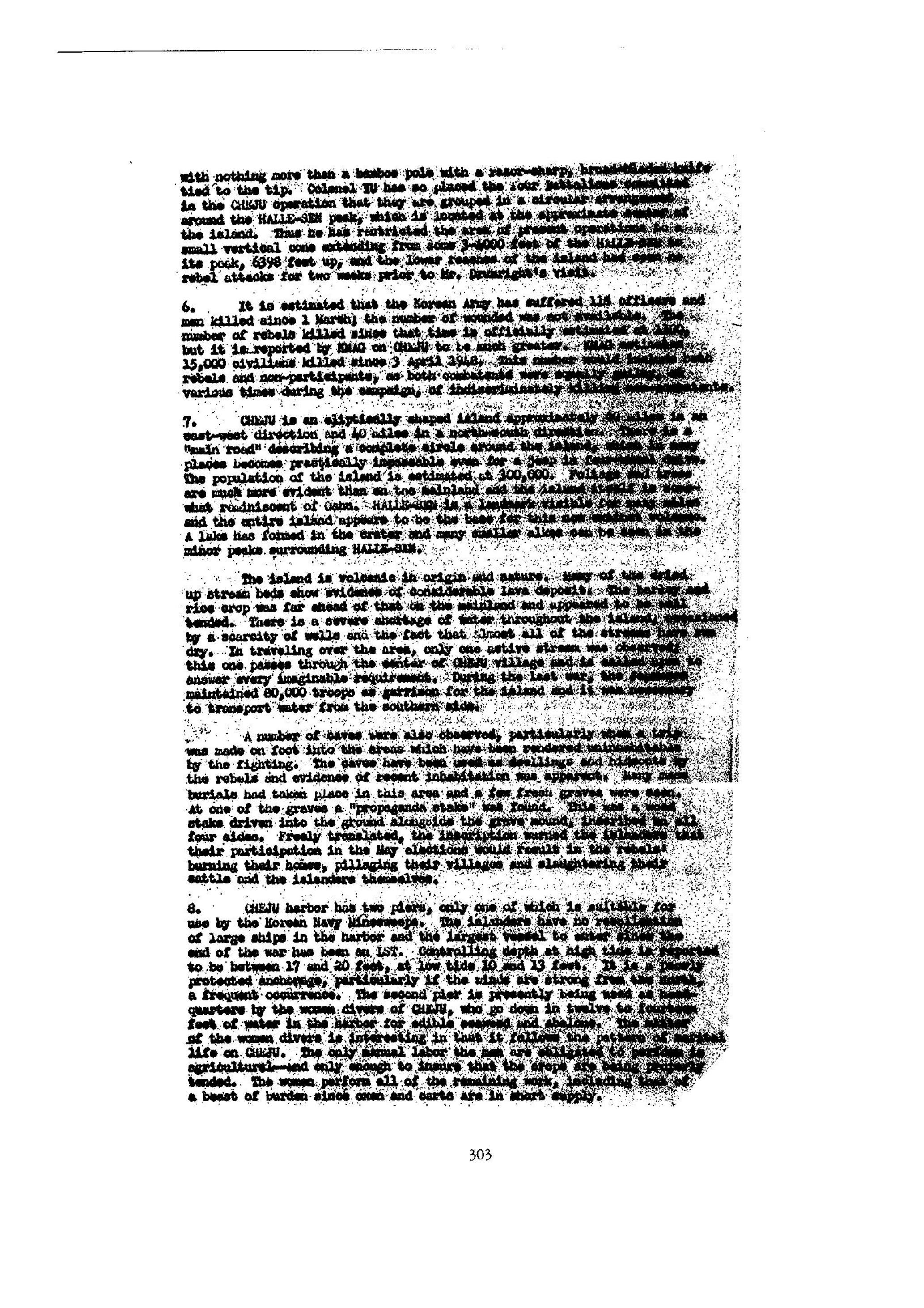
더 나아가 유 대령은 모든 게릴라 지도자들의 소재지와 마지막 한발의 수류탄에 이르기까지 그들이 보유하고 있는 무기와 탄약의 양을 파악하고 있다고 판단하고 있다. 폭도들의 무장은 다양하지만 점차 줄어들고 있다. 노획된 무기와 탄약은 일제내지 미제이다. 대부분의 폭도들은 겨우 날카로운 칼날이나 넓은 칼을 꼭대기에 꼿은 대나무 막대기로 무장하고 있을 뿐이다. 유 대령은 따라서 4개 대대를 섬의 중앙에 위치한 한라산의 정상 주위에 원형으로 대형을 만들었다. 이와같이 유 대령은 현재의 작전지역을 한라산 정상인 6,398피트에서 약 3,000~4,000피트에 이르는 지역까지 작은 원추형태로 제한하였으므로 섬의 낮은 지역은 드럼라이트가 방문하기 전 2주 동안 폭도의 공격을 경험하지 않았다.
6. 3월 1일 이래 한국군은 118명의 장교와 사병이 사망하는 손실을 입었으며 부상자 수는 알려지지 않았다. 3월 1일 이래 사살당한 폭도들의 숫자는 공식적으로 1,100명으로 산출되었으나 제주도에 주둔하고 있는 KMAG은 훨씬 더 많을 것이라고 보고하였다. 미군사고문단은 1948년 4월 3일 이래 1만 5,000명의 민간인이 사살당하였다고 추산한다. 이 숫자는 폭도들과 비참가자들 모두를 포함한다. 여러 작전기간 동안 비참가자들을 무차별 사살한 책임은 양측 전투대원들 모두에게 있다.
7. 제주도는 남북으로 약 40마일, 동서로 약 60마일에 이르는 타원형의 섬이다. 섬주위를 원형으로 싸고도는 한 개의 주요 도로가 있는데 많은 부분 4륜 짚차 조차도 지나갈 수 없는 형편이다. 섬의 인구는 약 30만으로 추산된다. 관엽수와 나무들이 본토 전체보다 훨씬 더 무성하며 섬 자체는 다소 오아후 섬을 연상시킨다. 한라산은 수마일 떨어진 곳에서도 볼 수 있는 이정표이며 섬 전체가 현재는 이 사화산의 토대처럼 보인다. 분화구에는 호수가 형성되어 있으며 많은 작은 호수들이 한라산을 둘러싸고 있는 작은 봉우리들에서 발견된다.
제주도는 화산폭발로 형성되었다. 수많은 메마른 하천 바닥은 상당한 용암층의 집적을 보여준다. 보리와 쌀 작물은 본토의 것보다도 훨씬 시기적으로 앞서있으며 잘 자라는 것으로 보인다. 섬 전체에 심각한 물 부족현상이 있으며 우물의 결핍과 거의 모든 하천은 메말라 있다는 사실 때문에 물 부족은 더욱 심화되었다. 섬을 둘러보는 과정에서 물이 흐르는 유일한 하천을 보았는데 이것은 제주읍의 중앙을 관통하고 있다. 2차대전 중 일본인들은 섬에 8만 명의 병력을 주둔시켰으며 남쪽에서 물을 실어 날랐다. 전투로 인하여 사람이 살 수 없게 된 지역을 걸어서 둘러보았을 때 수많은 동굴들이 눈에 띄었다. 그 동굴들은 폭도들의 은신처이자 거주지로 활용되었으며 최근까지 거주했던 흔적이 분명했다. 수많은 집단매장이 이 지역에서 일어났으며 최근에 만들어진 묘소들이 눈에 띄었다. 한 묘소에서 ‘선동문구 말뚝’이 발견되었다. 이것은 나무 말뚝인데 봉분 주위에서 사방으로 봉분 안쪽으로 박아 넣었다. 있는 그대로 번역하자면, 새겨진 문구는 섬 주민들에게 5월 총선거에 참가하면 폭도들이 집을 불태우고 마을을 약탈하고 가축들과 섬 주민들을 죽이는 결과를 초래할 것이라고 경고하고 있었다.
8. 제주항에 오직 두 개의 부두가 있는데 그 중 한 개만이 한국 해군 소해정들이 사용할 수 있다. 섬 주민들은 항구에 큰배를 정박시킬 필요가 없으며 2차대전이래 제주항에 들어온 가장 큰 배는 LST였다. 만조 때의 수심은 17~20피트이며 간조 때는 10~13피트인 것으로 알려져 있다. 정박소는 형편없이 설비되어 있어서 거의 보호를 받지 못하고 있으며 특히 잦은 북풍 때문에 더욱 심각하다. 두 번째 부두는 물속에서 먹을 것을 구하기 위해 항구에서 약 12~14피트의 물속까지 잠수하는 해녀들의 본부로 사용되고 있다. 해녀들의 문제는 제주도의 실생활의 모습을 볼 수 있다는 면에서 흥미롭다. 남자들의 유일한 육체노동은 농작물이 잘 자라도록 돌보는 농사일뿐이다. 소와 달구지의 부족으로 인하여 짐승들이 할 일까지도 포함하여 그 외의 모든 다른 노동은 여성들의 몫이다.
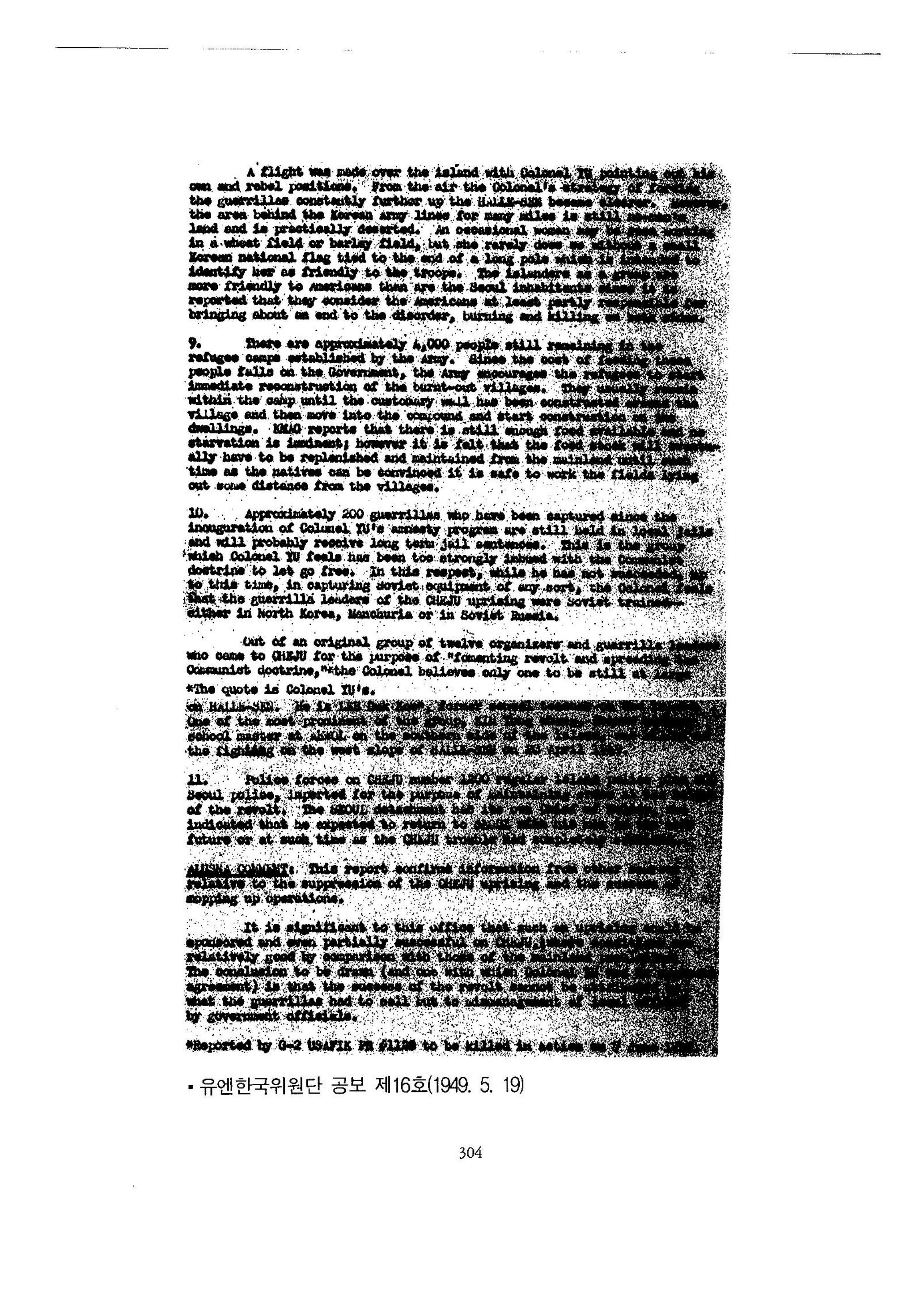
비행기는 자신의 주둔지와 폭도들의 주둔지를 가리키는 유 대령과 함께 섬의 상공을 선회하였다. 상공에서 보니 폭도들을 지속적으로 한라산 위쪽으로 몰아가는 유 대령의 작전이 훨씬 더 명확하게 보였다. 그러나 한국군의 방어선 뒤쪽에 남겨진 수마일의 땅은 누구의 땅도 아닌 채 버려져 있었다. 우연히 한 여인이 밀밭이나 보리밭에서 일하는 것을 보았는데 그녀는 군대에 우호적이라는 표시로 긴 막대기 끝에 소형 국기를 매단 채 일을 하고 있었다. 섬 주민들은 전반적으로 서울 사람들보다도 미국인들에게 더 친절하였다. 왜냐하면 그들은 미국인들이 최소한 양측이 저지르고 있는 소요, 살인, 방화 등을 종식시키는 데 어느 정도 책임을 질 것이라고 믿고 있기 때문이다.
9. 아직도 육군이 설치한 난민수용소에는 약 4,000명의 사람들이 남아 있다. 이들 난민을 먹이는 비용이 정부의 몫이기 때문에 육군은 난민들에게 즉시 불에 탄 마을을 재건할 것을 격려하고 있다. 그들은 보통 마을 주위에 보호벽이 설치될 때까지 수용소에 남아 있다가 설치가 완료되면 마을로 가서 주거지의 재건을 시작한다. 미군사고문단은 아직 충분한 식량이 있으며 굶주림은 없다고 보고하고 있다. 그러나 섬 주민들이 마을에서 멀리 떨어진 논과 밭에서 안전하게 일할 수 있다는 확신을 가질 때까지 본토에서 식량이 보충되어야 한다고 사료된다.
10. 유 대령의 사면 계획이 시작된 이래 붙잡힌 약 200명의 게릴라들이 아직도 감옥에 억류되어 있으며 아마도 장기형을 받을 것이다. 이 집단은 유 대령이 보기에 너무나 강하게 공산주의 강령에 심취되어 있어서 방면할 수 없는 사람들이다. 이러한 관점에서 아직은 소련제 장비를 노획하지 못했지만 유 대령은 제주폭동의 지도적 게릴라들이 북한, 만주, 또는 소련연방에서 소련식 훈련을 받았다고 느끼고 있다.
공산주의 신조의 확산과 폭동을 조장하려는 목적으로 제주도에 왔던 12명의 최초의 조직가와 게릴라 지도자 가운데 한 명만이 아직도 체포되지 않은 채 한라산에 숨어있다고 유 대령은 믿고 있다. 그는 이덕구이다. 이 집단의 가장 유명한 사람 중 하나인 섬의 남쪽에 있는 애월의 학교 교사 출신 김□□은 1948년 4월 20일 한라산 서쪽 기슭의 전투에서 사살되었다.
11. 제주주둔 일반 제주 경찰병력 1,200명에 더하여 폭동의 와중에서 질서를 유지하기 위하여 서울 경찰 □00이 파견되었다. 서울 증원병력은 자체의 지휘관이 있는데 그는 자신은 제주도 사태가 완전히 가라앉으면 머지않아 서울로 복귀할 것이라고 말하였다.
ALUSNA 논평: 이 보고서는 진압작전의 성공과 제주폭동의 진압에 관련하여 다른 정보근거에서 발췌한 정보를 확인한 것이다.
본토의 민중들과 비교하여 상황이 비교적 양호한 제주도에서 폭동이 후원을 받았으며 부분적으로 성공적이었다는 사실이 본관에게는 중요한 것으로 보인다. 도출할 수 있는 결론(유 대령도 동의한 바와 같이)은 게릴라들이 정부 관리들의 지방업무의 시행착오라고 주장하였던 것이 폭동의 성공요인이라고 볼 수 없다는 것이다.
SECRET
004-49 IFI 460a.0201 2401.0101 18 May 1949
nilskin, Seoul, Korea Personal Observation
of November 1948
AID Publication "Korea Airfields and Seaplane Stations" m-1
Visit to the Island of ChiJU (33°20'N; 133°30'E)
581353
See Ports and Harbor Facilities, Air Installation.
On 4 May 1949 Lt. Paul Gartler, the assistant Naval attaché, accompanied Mr. D. F. Drumright, Counselor to the Embassy, on a visit to the island of ChiJU (33°20'N; 133°30'E). The purpose of Mr. Drumright's visit was to check at first hand the current situation existing between rebel and Korean army forces and to further estimate some of the possibilities for future development or the island. Mr. Drumright and Lt. Gartler spent three days there, speaking with the Korean Advisory Group, the Commanding Officer of the Korean Army troops on ChiJU and with many of the native islanders. A description of the airfields at ChiJU (as directed in reference as SALSHU field) is herein included.
1. On 4 May 1949 Lt. Gartler and Mr. D. F. Drumright, Counselor to the American Embassy, flew to ChiJU in the Naval Attache plane. The trip was made out incident and required one hour and forty minutes from takeoff to landing. The landing was made at the airfield presently known as "ChiJU North" and described in reference as SALSHU field (33°30'N - 126°29'E). The field has two runways, one 4000 feet x 350 feet, direction 310° x 130°; the second runway is 6000 feet in length and approximately 300 feet wide, direction [illegible]. The sod covering, which is based on lava rock, has become quite irregular and is badly pitted and rolling in many places. approximately 1/3 feet of [illegible] 300 foot width on each runway is still usable. The approaches are almost nowhere, extensibility of either runway would require the levelling of [illegible] small hills and considerable effort would be involved. The prevailing wind is from the NW and rather regularly reaches a velocity of 40 - 50 MPH. The field is usually covered with cattle and native island police and must be cleared by jeep and repeated low passes before a landing can be made. The Korean airforce has constructed a single wood frame hangar near the center of the field, suitable for housing two Army liaison type aircraft.
2. Up until a few weeks ago, two Korean airforce [illegible] planes were field for the purpose of spotting rebel positions and directing [illegible] attempt was made during the employment of these planes to outfit them with a bazooka-type weapon attached to each wing for the purpose of firing [illegible]
and the pilot and observer would occasionally carry "lap bombs." This bomb was described by members of the Korean Military Advisory Group based on CHEJU as a crude, drawstring-type affair, weighing approximately thirty pounds, loaded with TNT which was activated by a detonating cap. The weapon was armed by tripping a lever and then hurled from the plane at each time the pilot considered that he had reached an advantageous position. The effect of these innovations on the rebels' morale proved to be of more value than any destructive results obtained.
CHEJU South is not employable at the present time; however, during World War II it was used as a base and training field for Japanese Naval aircraft, and was considered to be a better field than CHEJU North. Korean Army troops have prevented the natives from encroaching on this field and it is believed that it could be rendered usable with a minimum amount of work. This is the field described in reference as MOSULPO (33°13'N - 126°17'E).
3. Mr. Drumright was welcomed by Captain R. R. Haskell, officer-in-charge of the KMAG detachment, 1st Lt. R. L. Morton of KMAG, Colonel Yu Le Kwong, officer-in-charge Korean army troops on CHEJU and Miss Sara Park, correspondent for Reuters and INS, who had spent a week on the island in search of local color.
The stay on the island was taken up with a visit to the village of CHEJU, a tour of some of the smaller villages which had been burnt out, the rebels and were being restored, a flight over rebel and Korean army positions, and in speaking with Colonel YU and some of his officers.
4. Colonel YU is considered to be an outstanding Korean army officer. He attended the Japanese Military Academy in Tokyo, graduating in 1939. During the last war he was—according to his own description—[illegible] in the Tokyo Guard" and engaged in no active warfare. His father attained the rank of Colonel in the Japanese army and as a child Colonel YU was [illegible] in the Japanese manner, so much so that he [illegible] a disadvantage at the present time in that his manner, speech and military habit are too Japanese to suit the Korean taste. He is 29 years of age, small in stature [illegible] for an Oriental, and speaks and understands much more English than does the average Korean officer of equal rank.
Colonel YU was detailed to CHEJU early in March, arriving to assume command during the last week in March, following a series of conferences with highly-placed officials, including [illegible] Jun-suk and General CHAI [illegible] Duk, Supreme Chief of Staff of the Korean Army. Apparently his [illegible] on CHEJU had been somewhat established and Colonel YU was chosen from his post at the Military Academy to attempt a solution to the problem.
5. He has under his command on CHEJU at the present time one (1) [illegible] consisting of four (4) battalions i.e. three (3) regular battalions and one (1) special battalion trained in guerrilla [illegible]. [illegible] 2300 officers and men. Upon [illegible] command Colonel YU [illegible] [illegible] of his predecessor, Colonel [illegible] [illegible] [illegible] [illegible] taken within a [illegible] [illegible] and immediately [illegible] upon [illegible] if possible and are personally [illegible] [illegible] demonstrated their remorse and provided they [illegible] not [illegible] group of guerrilla fighters, they are given [illegible] released. The results of such a procedure [illegible] factory, since the released [illegible] will [illegible] lead [illegible] of arms or pass the word back to his compatriots that they [illegible] treated and not necessarily killed, should they surrender. [illegible] that every rebel released under his amnesty program has brought in at least six more.
He further believes that he is aware of the location of every leader of the guerrillas and the amount of arms and ammunition [illegible] his disposal, down to the last grenade. Rebel [illegible] [illegible] and has grown steadily more meager. Captured arms and ammunition [illegible] ex-Japanese or American in manufacture. Many of the guerrillas are [illegible]
with nothing more than a bamboo pole with a [illegible],bre[illegible] tied to the tip. Colonel IV has so placed the four [illegible] in the CHEJU operation that they are grouped in a circular [illegible] around the HALLE-SAN peak, which is located at the [illegible] the island. Thus he has reoriented the are[illegible] of [illegible] operations [illegible] small vertical cone extending from some [illegible] feet of the HALLE[illegible] its peak, 6398 feet up, and the lower reaches of the island [illegible] rebel attacks for two weeks prior to Mr. Drumright's visit.
6. It is estimated that the Korean Army has suffered 118 officers and men killed since 1 March; the number of wounded was not [illegible] number of rebels killed since that time is officially [illegible] but it is reported by KMAG on CHEJU to be much greater. [illegible] 15,000 civilians killed since 3 April 1948. This [illegible] rebels and non-participants, as both combatants [illegible] various times during the campaign, of indiscriminate[illegible]
7. CHEJU is an elliptically shaped island approximately [illegible] 14 [illegible] east-west direction and 40 miles in a north[illegible] direction [illegible] "main road" describing a complete circle around the [illegible] places becomes practically impassable even for a [illegible] the population of the island is estimated at 300,000. [illegible] are much more evident than on [illegible] the [illegible] what reminiscent of Guam. HALLE-[illegible] and the entire island appears to be the [illegible] A lake has formed in the crater and many [illegible] minor peaks surrounding HALLE-SAN.
The island is volcanic in origin and nature. Many of the [illegible] up stream beds show evidence of considerable lava deposits. [illegible] rice crop was far ahead of that on the mainland and appeared [illegible] tended. There is a severe shortage of water throughout the [illegible] by a scarcity of wells and the fact that almost all of the [illegible] dry. In traveling over the area, only one active stream was [illegible] this one passes through the center of CHEJU village and is [illegible] answer every imaginable requirement. During the last [illegible] maintained 80,000 troops as garrison for the island and it [illegible] to transport water from the southern side.
A number of caves were also observed, particularly [illegible] was made on foot into the areas which have been rendered [illegible] by the fighting. The caves have been used as dwellings and [illegible] the rebels and evidence of recent inhabitation was apparent. Many [illegible] burials had taken place in this area and a few fresh graves were [illegible] At one of the graves a "propaganda stake" was found. This was a [illegible] stake driven into the ground alongside the grave mound, [illegible] four sides. Freely translated, the inscription warned the [illegible] their participation in the May elections would result in the rebels burning their homes, pillaging their villages and slaughtering [illegible] cattle and the islanders themselves.
8. CHEJU harbor has two piers, only one of which is suitable for use by the Korean Navy [illegible]. The islanders have no [illegible] of large ships in the harbor and the largest vessel to [illegible] end of the war has been an LST. Controlling depth at high tide [illegible] to be between 17 and 20 feet, at low tide 10 and 13 feet. [illegible] protected anchorage, particularly if the winds are strong [illegible] a frequent occurrence. The second pier is presently being [illegible] quarters by the women divers of CHEJU, who go down in twelve to [illegible] feet of water in the harbor for [illegible] of the women divers is interesting in that it [illegible] life on CHEJU. The only animal labor the [illegible] agricultural—and only enough to insure that the [illegible] tended. The women perform all of the remaining work, [illegible] a beast of burden since oxen and carts are in short supply.
A flight was made over the island with Colonel [illegible] making [illegible] one and rebel positions. From the air the Colonel's [illegible] of [illegible] the guerrillas constantly further up the HALLI-SAN became [illegible] the area behind the Korean army lines for many miles is still [illegible] land and is practically deserted. An occasional woman may [illegible] in a wheat field or barley field, but she rarely does so [illegible] Korean national flag tied to the end of a long pole [illegible] identity her as friendly to the troops. The islanders are [illegible] more friendly to americans than are the Seoul inhabitants [illegible] reported that they consider the Americans at least partly [illegible] bringing about an end to the disorder, burning and killing [illegible]
9. There are approximately 4,000 people still remaining in [illegible] refugee camps established by the Army. Since the cost of [illegible] people falls on the Government, the Army encourages the [illegible] immediate reconstruction of the burnt-out villages. [illegible] within the camp until the customary wall has been [illegible] village and then move into the compound and start construction [illegible] dwellings. KMAG reports that there is still enough food [illegible] starvation is imminent; however it is felt that the food [illegible] ally have to be replenished and maintained from the mainland [illegible] time as the natives can be convinced it is safe to work the fields [illegible] out some distance from the villages.
10. Approximately 200 guerrillas who have been captured since the inauguration of Colonel IU's amnesty program are still held in [illegible] and will probably receive long term jail sentences. This is [illegible] which Colonel IU feels has been too strongly issued with the [illegible] doctrine to let go free. In this respect, while he has not [illegible] to this time, in capturing soviet equipment of any sort, the Colonel [illegible] that the guerrilla leaders of the CHEJU uprising were soviet trained either in North Korea, Manchuria or in Soviet Russia.
Out of an original group of twelve organizers and guerrilla [illegible] who came to CHEJU for the purpose of "fomenting revolt and [illegible] Communist doctrine,"the Colonel believes only one to be still at [illegible] *the quote is Colonel IU's.
[illegible] HALLI-SAN. [illegible] one of the most [illegible] of [illegible] school matter at [illegible] at the [illegible] the fighting on the west slope of [illegible]
11. Police forces on CHEJU [illegible] Seoul police, imported for the purpose of [illegible] of the revolt. The GROUP [illegible] indicated that he expected to return to [illegible] future or at such time as the CHEJU [illegible]
[illegible] COMMENT. This report continues [illegible] of the CHEJU spring [illegible] mopping up operations.
It is significant to this office that [illegible] expressed and even partially [illegible] relatively good by comparison with those of [illegible] the conclusion to be drawn (and one with which [illegible] agreement) is that the scenes of the revolt [illegible] that the guerrillas had to sell but to [illegible] by government officials.
*Reported by G-2 USAFIK in #1128 to be killed in action [illegible]
출처:
제주4·3사건진상규명및희생자명예회복위원회 편,
『제주4·3사건자료집 11』 [미국자료편],
번역문 p.110
/ 원문 p.301–304.