주한미대사관
제목: 총회에 보내는 유엔한국위원단 보고서 개요 초안
대사는 유엔한국위원단의 활동에 관한 보고서를 요구한 1949년 6월 30일자 국무부의 <전문> 제542호에 덧붙여 총회에 보낼 유엔한국위원단 보고서의 제시된 개요 사본을 첨부해 국무부 정보용으로 보내게 돼 영광입니다.
대사는 이 초안이 유엔한국위원단이 공식적으로 승인한 적이 없는 반면 총회에 제출할 보고서는 본질적인 변화없이 개요를 따를 것이라고 이해합니다.
가디너(Gardiner)
첨부문서: 총회에 제출할 유엔한국위원단 보고서의 제시된 개요
<첨부문서> 제1호: 총회에 보고할 유엔한국위원단 보고서 개요초안 (1949. 7. 23. 보고)
총회에 보고할 유엔한국위원단 보고서 개요 초안
제1권
1. 창설, 참고용어, 구성과 기구
2. 위원단과 산하 기관의 주요 활동 요약
1) 위원단
(1) 예비, 일지 등
(2) 위원단 결정
① 분과위원회 창설
② 접근과 사회적 약속
ⅰ. 정부와의 관계
ⅱ. 청문
ⅲ. 언론
③ 북한과의 접촉
④ 대표정부의 발전
⑤ 철병
⑥ 기타
2) 분과위원회
(1) 제1분과위원회
① 참고용어, 조직, 연표 등
② 정보와 여론 조사
③ 결론과 건의사항
(2) 제2분과위원회
① 참고용어, 조직, 연표 등
② 정보와 여론 조사
③ 결론과 건의사항
(3) 철수와 관련한 분과위원회
(4) 집행위원회
3. 한국 독립과 통일 문제에 영향을 끼치는 정치, 경제, 사회발전과 요소
1) 대한민국의 평가
(1) 관할권이양 완료
① 재무협정
② 재산의 양도
(2) 미군철수
① 철수완료
② 군사고문단
(3) 외부관계-정치 및 경제적 측면
① 서울 외국 사절단의 설립(미국, 영국, 프랑스, 중국, 바티칸, 필리핀)
② 해외 한국사절단의 설립(미국, 영국, 프랑스, 중국, 바티칸, 필리핀)
③ 경제협조처의 활동
④ 일본과의 무역
⑤ 홍콩과 기타 지역과의 무역
(4) 보안군 조직
① 육군
② 해안경비대
③ 경찰
④ 예비군
(5) 민주정부 발전
① 국회 활동
② 언론의 자유
③ 정당활동
④ 법과 질서
ⅰ. 전라남도 반란
ⅱ. 제주도
4. 요약과 결론
1) 1948년 12월12일의 유엔총회 결의안 이행을 위한 위원단의 노력
(1) 통일
① 북한에 접근하기 위한 위원단의 노력
② 통일을 위한 한국인의 시도와 제안: 남한과 북한
(2) 보안군의 통합
(3) 38선-우호관계의 장애물
① 상호의심, 필요한 경제교환에 대한 장애물
② 접경선 사건
③ 슬라브권의 이익에 의한 인민공화국의 승인
④ 김일성의 모스크바 방문
⑤ 조-소 경제협정 소문
(4) 대표정부의 추가 발전
(5) 점령군의 철수
2) 1948년 12월 12일의 유엔총회 결의안 이행에 영향을 끼치는 요소
3) 한국문제의 현상태: 분석 요약
(1) 평화통일을 위한 보통 사람의 기도
(2) 타협정신의 결핍
(3) 남북한의 점증하는 군사력
(4) 국제정치풍토
4) 결론과 건의사항
(1) 미-소협정-필수조건
(2) 유엔의 역할
(3) 건의사항(있는 경우)
제2권
별첨
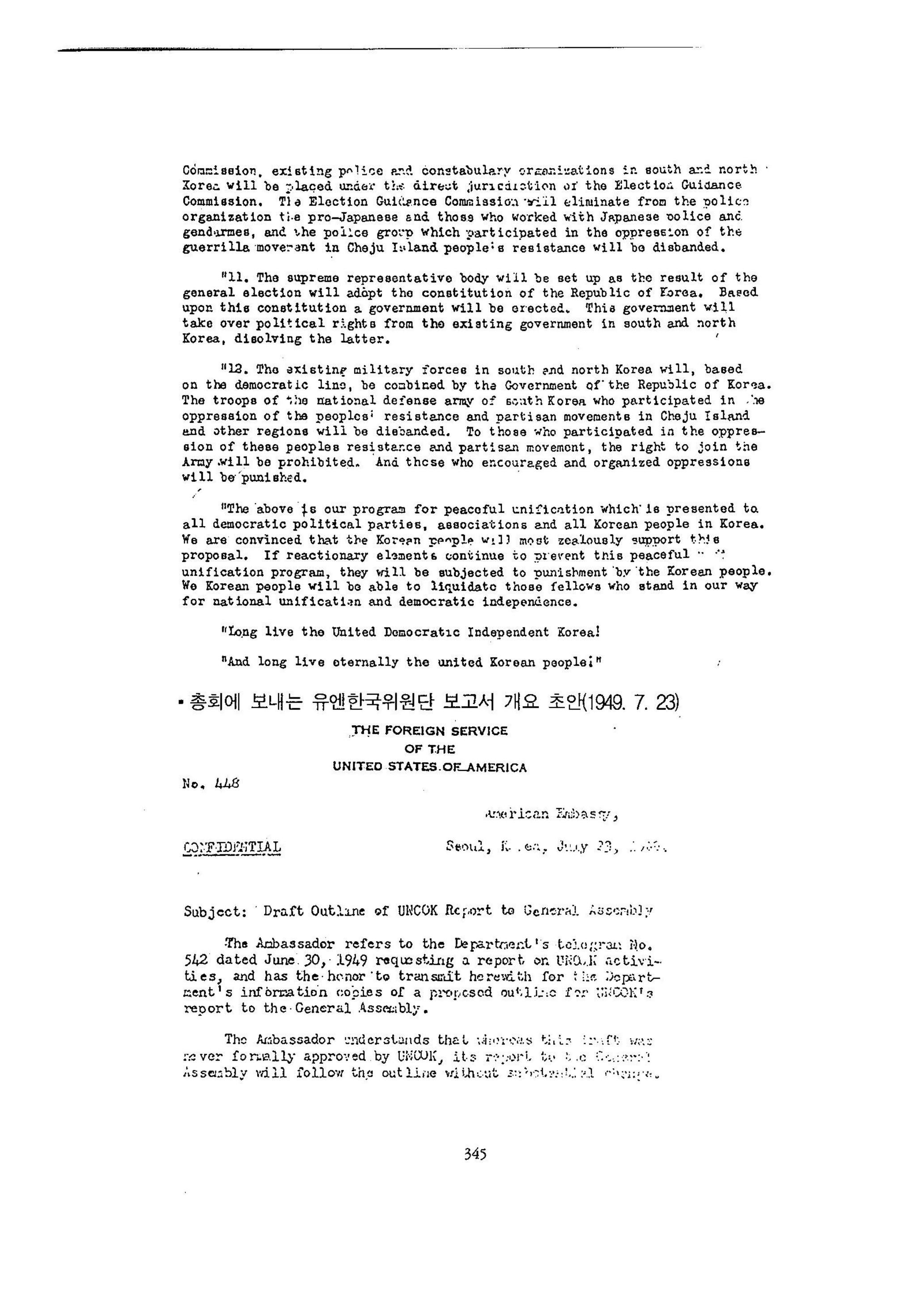
THE FOREIGN SERVICE
OF THE
UNITED STATES OF AMERICA
No. 448
American Embassy,
CONFIDENTIAL
Seoul, Korea, July 23, 1949.
Subject: Draft Outline of UNCOK Report to General Assembly
The Ambassador refers to the Department's telegram No. 542 dated June 30, 1949 requesting a report on UNCOK activities, and has the honor to transmit herewith for the Department's information copies of a proposed outline for UNCOK's report to the General Assembly.
The Ambassador understands that whereas this draft was never formally approved by UNCOK, its report to the General Assembly will follow the outline without substantial changes.
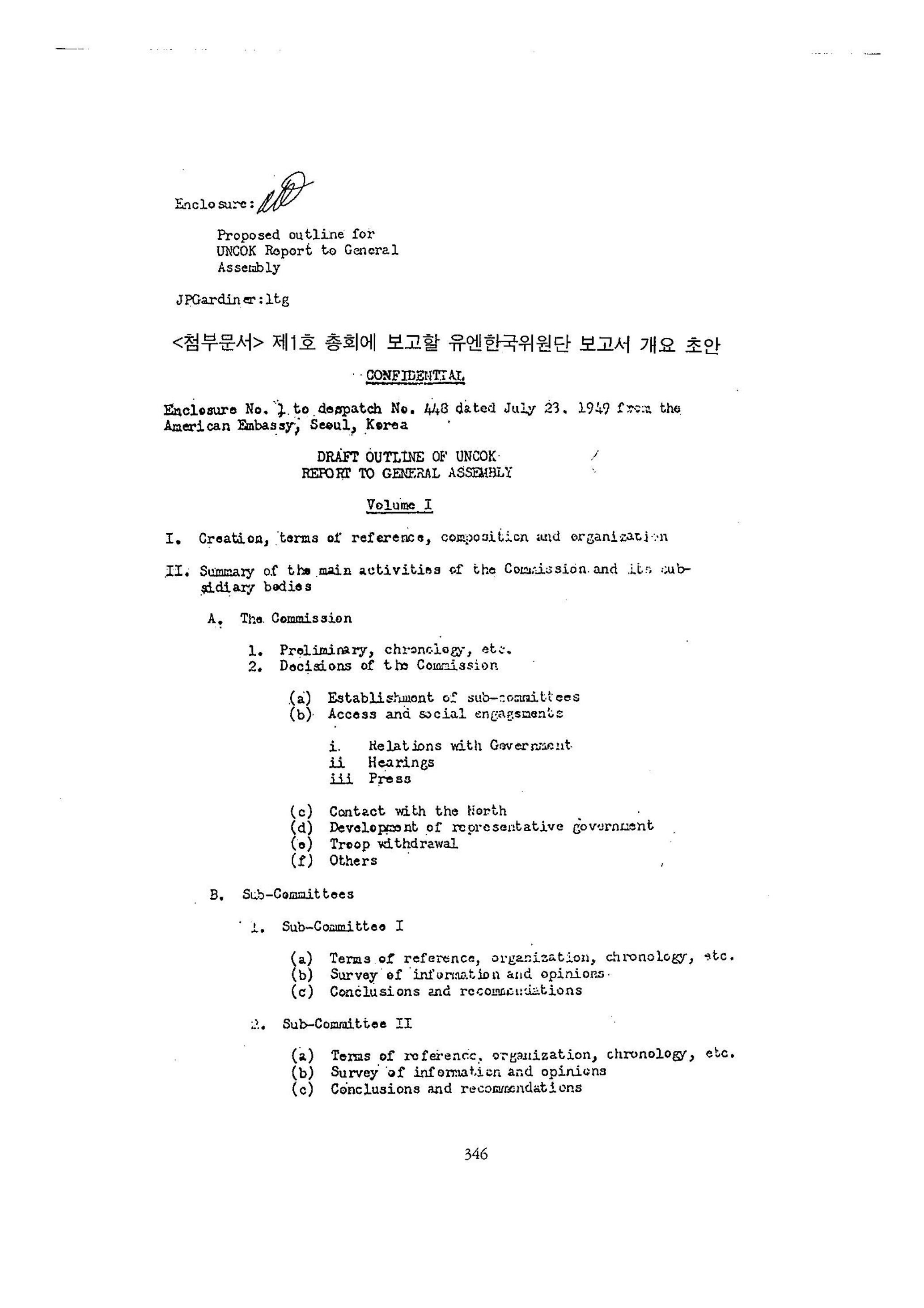
Enclosure:
Proposed outline for
UNCOK Report to General
Assembly
JPGardiner:ltg
CONFIDENTIAL
Enclosure No. 1 to despatch No. 448 dated July 23. 1949 from the American Embassy, Seoul, Korea
DRAFT OUTLINE OF UNCOK
REPORT TO GENERAL ASSEMBLY
Volume I
I. Creation, terms of reference, composition and organization
II. Summary of the main activities of the Commission and its subsidiary bodies
A. The Commission
1. Preliminary, chronology, etc.
2. Decisions of the Commission
(a) Establishment of sub-committees
(b) Access and social engagements
i. Relations with Government
ii Hearings
iii Press
(c) Contact with the North
(d) Development of representative government
(e) Troop withdrawal
(f) Others
B. Sub-Committees
1. Sub-Committee I
(a) Terms of reference, organization, chronology, etc.
(b) Survey of information and opinions
(c) Conclusions and recommendations
2. Sub-Committee II
(a) Terms of reference, organization, chronology, etc.
(b) Survey of information and opinions
(c) Conclusions and recommendations
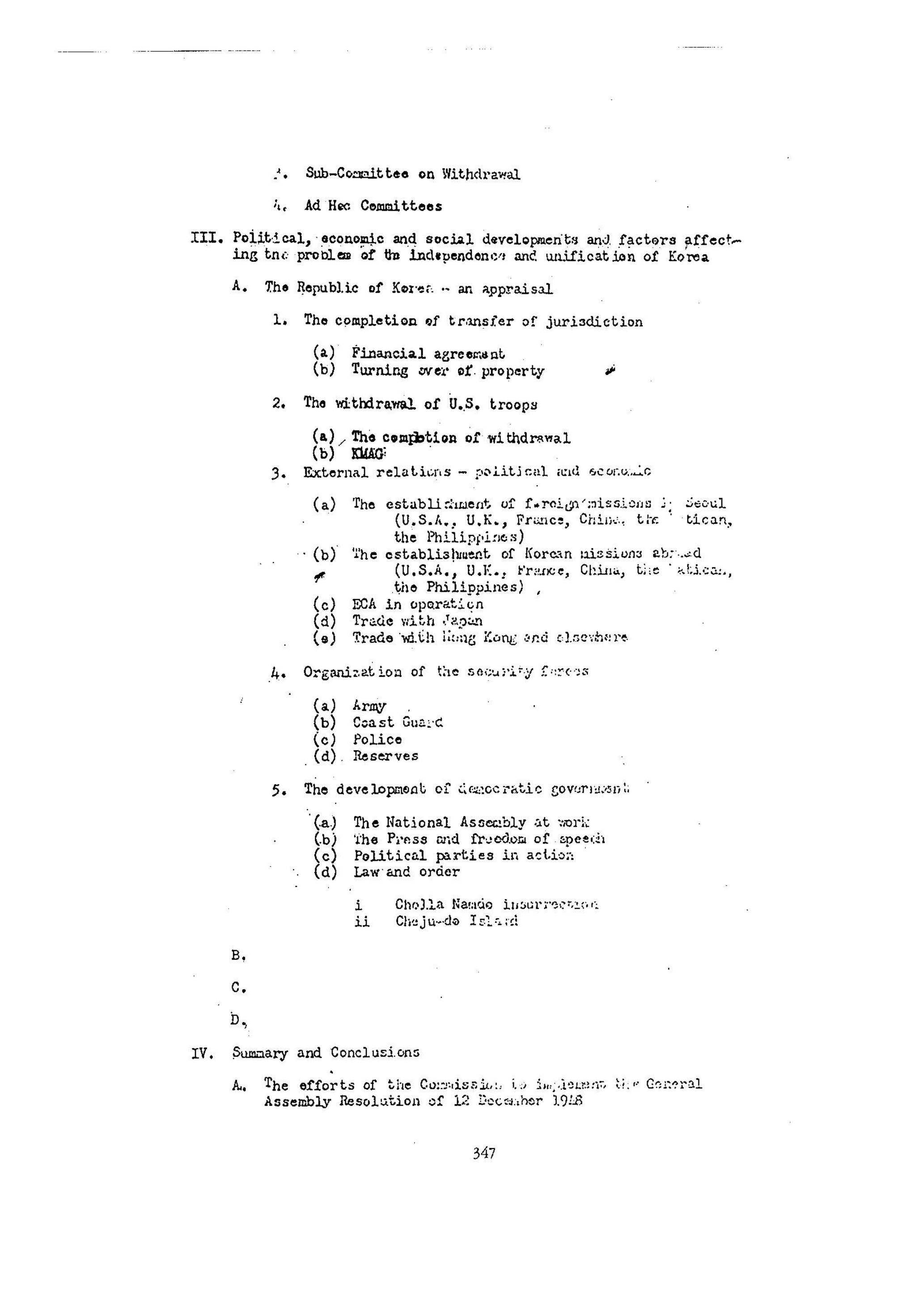
3. Sub-Committee on Withdrawal
4. Ad Hec Committees
III. Political, economic and social developments and factors affecting the problem of the independence and unification of Korea
A. The Republic of Korea - an appraisal
1. The completion of transfer of jurisdiction
(a) Financial agreement
(b) Turning over of property
2. The withdrawal of U.S. troops
(a) The completion of withdrawal
(b) KMAG
3. External relations - political and economic
(a) The establishment of foreign missions in Seoul (U.S.A., U.K., France, China, the tican, the Philippines)
(b) The establishment of Korean missions abroad (U.S.A., U.K., France, China, the Vatican, the Philippines)
(c) ECA in operation
(d) Trade with Japan
(e) Trade with Hong Kong and elsewhere
4. Organization of the security forces
(a) Army
(b) Coast Guard
(c) Police
(d) Reserves
5. The development of democratic government
(a) The National Assembly at work
(b) The Press and freedom of speech
(c) Political parties in action
(d) Law and order
i Cholla Namdo insurrection
ii Cheju-do Island
B.
C.
D.
IV. Summary and Conclusions
A. The efforts of the Commission to implement the General Assembly Resolution of 12 December 1948
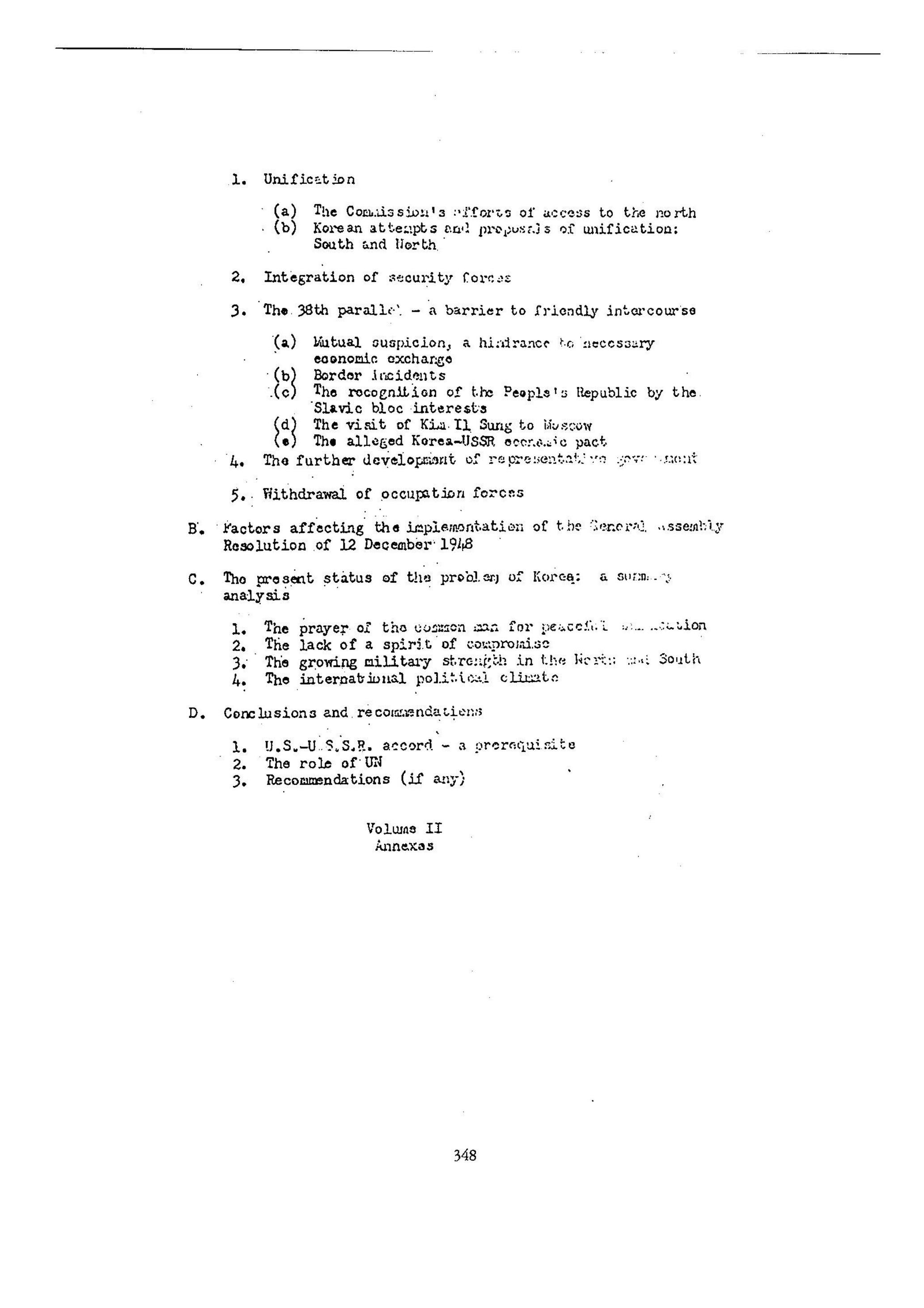
1. Unification
(a) The Commission's efforts of access to the north
(b) Korean attempts and proposals of unification:
South and North
2. Integration of security forces
3. The 38th parallel - a barrier to friendly intercourse
(a) Mutual suspicion, a hindrance to necessary economic exchange
(b) Border incidents
(c) The recognition of the People's Republic by the Slavic bloc interests
(d) The visit of Kim Il Sung to Moscow
(e) The alleged Korea-USSR economic pact
4. The further development of representative government
5. Withdrawal of occupation forces
B. Factors affecting the implementation of the General Assembly Resolution of 12 December 1948
C. The present status of the problem of Korea: a summary analysis
1. The prayer of the common man for peaceful and [illegible] solution
2. The lack of a spirit of compromise
3. The growing military strength in the North and South
4. The international political climate
D. Conclusions and recommendations
1. U.S.-U.S.S.R. accord - a prerequisite
2. The role of UN
3. Recommendations (if any)
Volume II
Annexes
출처:
제주4·3사건진상규명및희생자명예회복위원회 편,
『제주4·3사건자료집 11』 [미국자료편],
번역문 p.157
/ 원문 p.345–348.