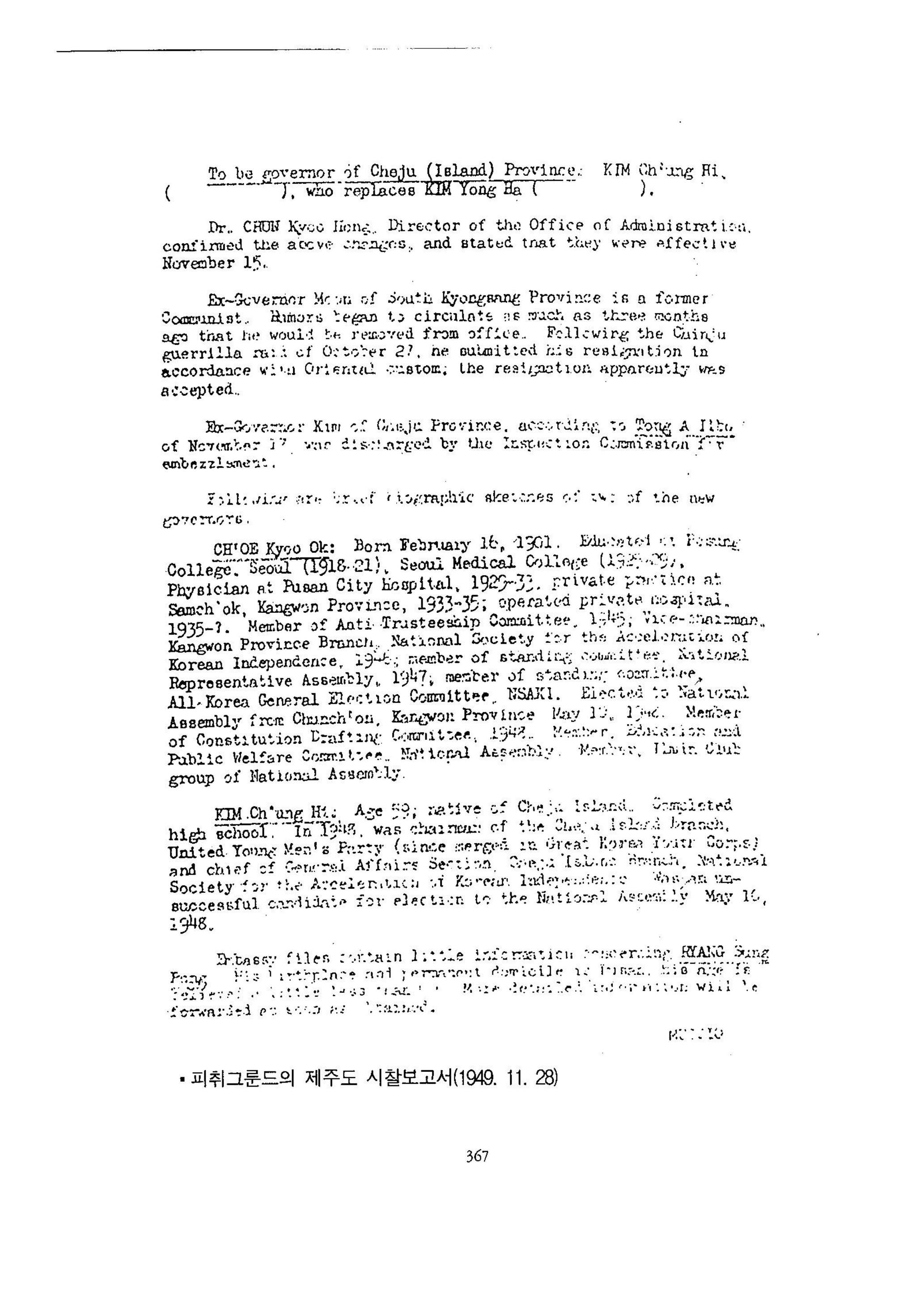
주한미대사관
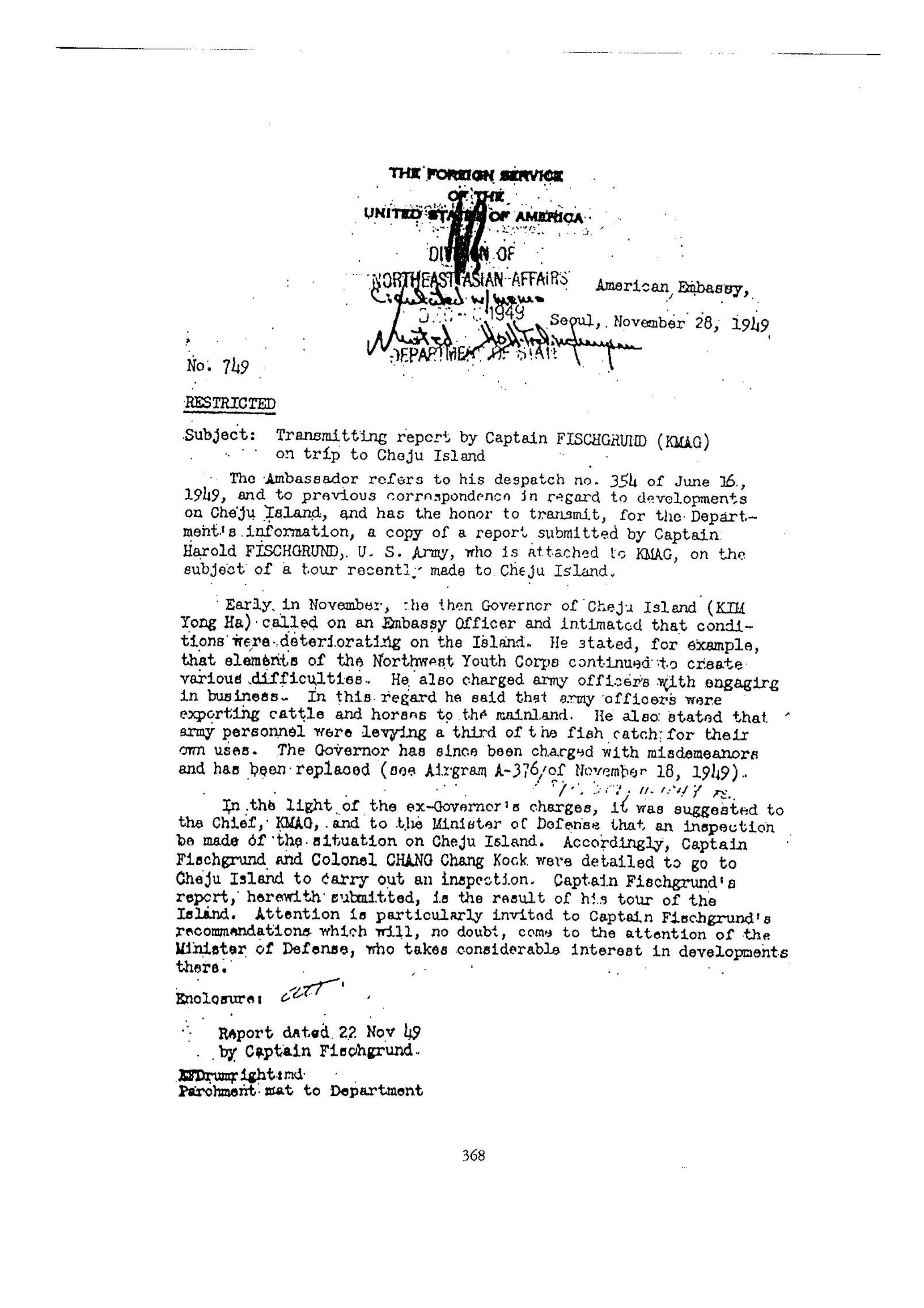
제목: 피쉬그룬드(Fischgrund)(주한미군사고문단) 대위의 제주도 시찰보고서 송달
대사는 1949년 6월 16일의 <급송문서> 제354호와 제주도에서의 진전상황과 관련해 이전의 통신문에 관해 언급하며 주한미군사고문단 소속 미국 육군 헤롤드 피쉬그룬드(Harold Fischgrund) 대위가 최근 제주도를 시찰한 결과에 관해 제출한 보고서 사본을 국무부 정보용으로 보내게 돼 영광입니다.
11월 초 당시 제주도지사(김용하)가 대사관 관리를 방문해 제주도의 상황이 악화되고 있다고 슬쩍 비췄습니다.
가령 그는 서북청년단 단원들이 여러 가지 말썽을 계속해서 일으키고 있다고 언급했습니다. 그는 또 군 장교들이 사업을 벌이고 있다고 비난했습니다. 이와 관련해 그는 군 장교들이 소떼나 말들을 육지로 반출하고 있다고 말했습니다. 그는 또 군 요원들이 어획량의 3분의 1을 자신들 용으로 징수하고 있다고 진술했습니다. 지사는 이후 비행으로 고발돼 교체됐습니다(<항공우편> A-376, 1949년 11월 18일 참고).
전 지사의 주장에 비춰 주한미군사고문단장과 국방부장관에게 제주도의 상황을 시찰하겠다고 제안이 있었습니다. 따라서 피쉬그룬드 대위와 장창국 대령은 감찰활동을 벌이기 위해 제주도로 파견됐습니다.
여기 첨부된 피쉬그룬드의 보고서는 제주도 시찰에 대한 그의 결과물입니다. 특히 관심을 끄는 대목은 분명히 제주도의 진전상황에 국방부 장관이 관심을 갖는다라는 사실입니다. 국방부장관은 제주도 진전상황에 상당한 관심을 가지고 있습니다.
첨부문서: 피쉬그룬드 대위의 49년 11월 22일자 보고서
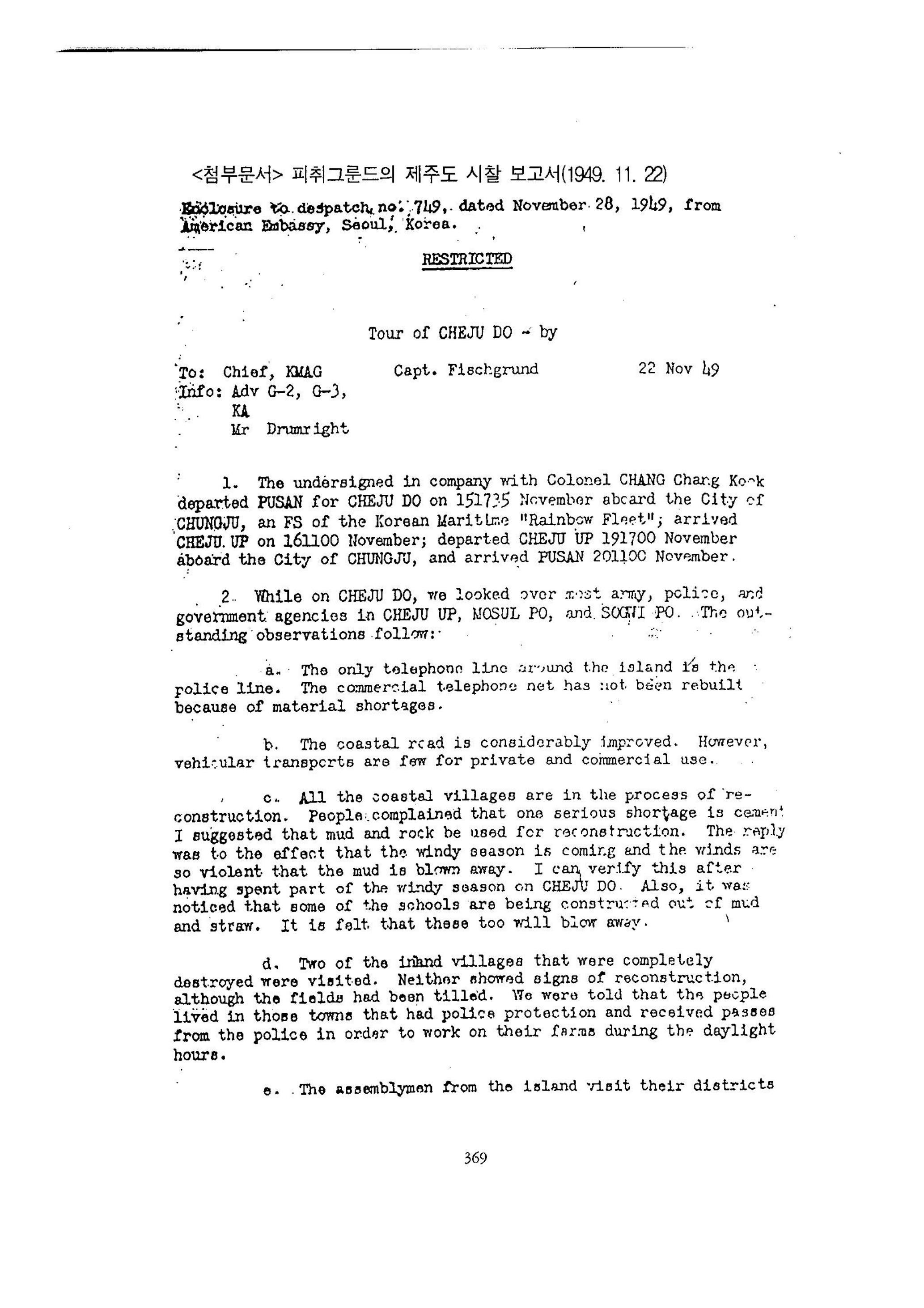
<첨부문서> 피쉬그룬드의 제주도 시찰 보고서 (1949. 11. 28. 보고)
제주도 시찰
1949년 11월 22일
작성자: 피쉬그룬드 대위
수신: 주한미군사고문단 단장
참고: 한국군 정보참모부, 작전참모부 고문관, 드럼라이트(Drumright)
1. 본인은 장창국 대령과 함께 한국 해양부의 FS급 ‘무지개함대’소속 충주시호에 승선해 15일 오후 5시 35분 부산을 출발해 제주도로 향했다. 11월 16일 오전 11시 제주읍에 도착했다. 이어 11월 19일 오후 5시 제주읍을 출발해 충주시호를 타고 11월 20일 오전 11시 부산에 도착했다.
2. 제주도에 체류하는 동안 우리는 제주읍과 모슬포, 서귀포에 있는 대부분의 군과 경찰, 정부기관들을 일일이 조사했다. 주요 관찰내용은 다음과 같다.
a. 제주도를 둘러싸는 유일한 전화선은 경찰 전화선이다. 상업용 전화망은 물자부족으로 재건되지 않았다.
b. 해안도로는 상당히 개선됐다. 그러나 운송수단은 개인용과 상업용 모두 거의 없는 형편이다.
c. 모든 해안마을은 재건중이다. 주민들은 한가지 심각하게 부족한 것이 시멘트라고 불평했다. 본인은 진흙과 돌을 재건에 사용할 것을 제안했다. 바람이 센 계절이 다가오고 있고 바람이 너무 사나워 진흙이 날아가 버린다는 답변만을 들었다.
본인은 제주도에서 바람이 센 계절을 조금 지냈기 때문에 이를 입증할 수 있다. 또한 일부 학교들이 진흙과 짚이 없이 공사하고 있음을 주목했다. 이것 역시 날아갈 것이라고 느꼈다.
d. 완전히 파괴된 내륙마을 두 곳을 방문했다. 밭은 경작되고 있었지만 재건의 징조는 눈에 띄지 않았다. 우리는 이들 마을에 살았던 주민들이 경찰 보호하에 있으며 낮 시간 밭에서 일하기 위해 경찰로부터 통행증을 받는다고 들었다.
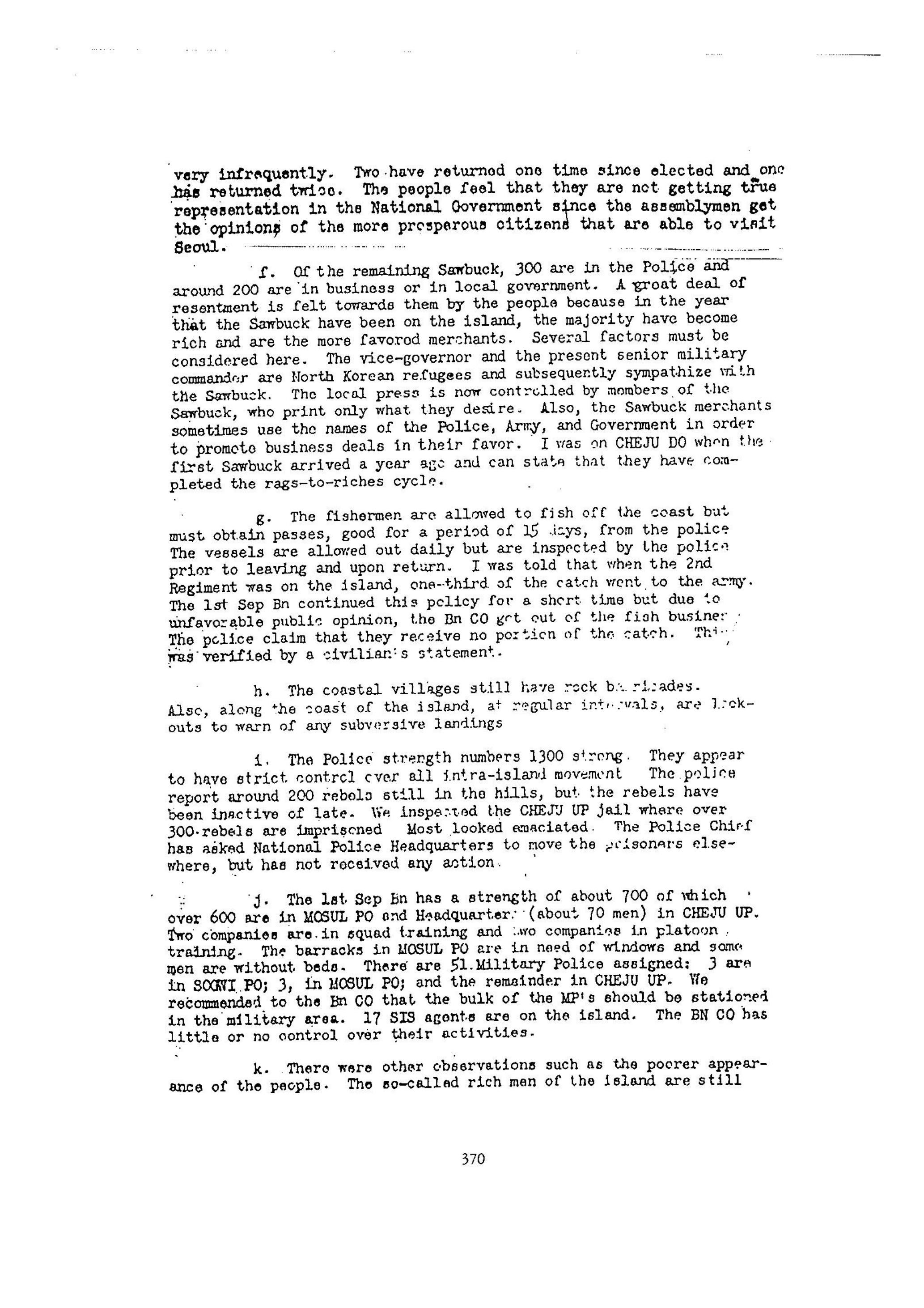
e. 제주도의 국회의원들은 자신들의 지역구를 거의 찾지 않는다. 2명의 국회의원은 당선된 뒤 한번 귀향했고 다른 1명은 두 번 귀향했다. 주민들은 국회의원들이 서울을 방문할 수 있는 보다 유능한 시민들의 의견들을 수렴하기 때문에 진정한 정부의 대표가 자신들에게 없다고 느끼고 있다.
f. 잔류중인 서북(서북청년단) 가운데 300명은 경찰에 있으며 200여 명은 사업을 하거나 지방정부에 근무하고 있다. 주민들은 서북이 제주도에 들어온 해 동안 이들 가운데 상당수가 부자가 되거나 자신들보다 더 혜택을 받은 상인들이 되고 있기 때문에 서북에 대해 상당한 원한을 가지고 있다. 여기서 여러 가지 요소들이 고려돼야 한다. 부지사와 현재의 군사령관은 북한 피난민 출신들로 서북에 동정적이다. 지방언론은 현재 서북 회원들이 운영하며 그들이 원하는 것만 보도하고 있다. 또한 서북 상인들은 때때로 자신들에게 유리하게 사업을 발전시키기 위해 경찰과 군, 정부의 이름을 차용하고 있다. 본인은 1년 전 서북이 제주도에 처음 왔을 때 현지에 있었기 때문에 그들이 가난에서 출발해 부자가 됐다고 말할 수 있다.
g. 어민들은 연안에서 고기잡이가 허용됐으나 경찰로부터 15일짜리 조업용 통행증을 받아야 한다. 배들은 매일 출항하는 것이 허용되지만 출하하기 전과 돌아올 때 경찰이 검사한다.
본인은 제2연대가 제주도에 주둔할 때 어획량의 3분의 1이 군으로 들어간다고 들었다. 제1독립대대는 짧은 기간 동안 이 정책을 실시했으나 비우호적인 여론 때문에 대대 지휘관은 어업에서 손을 뗐다. 경찰은 어획량을 받지 않았다고 주장했다. 이것은 한 민간인의 진술에 의해 입증됐다.
h. 해안마을은 여전히 돌로 된 장애물들이 있다. 또 섬 해안을 따라 파괴분자들의 상륙을 경고하기 위한 망루가 일정한 간격으로 있다.
i. 경찰은 1,300명이 있다. 그들은 섬 내륙의 모든 움직임을 엄격하게 통제하는 것으로 보인다. 경찰은 아직도 200여 명의 반란군들이 오름에 있지만 이들의 최근 활동은 활발하지 않다고 보고하였다.
우리는 300명의 반도들이 수감돼 있는 제주읍의 유치장을 감찰했으며, 대부분 쇠약한 모습이었다. 경찰청장은 국립경찰 본부(경무부)에 포로들을 다른 곳으로 옮길 것을 요청했으나 어떠한 조처도 받지 못했다.
j. 제1독립대대는 700여 명의 병력으로 이 가운데 모슬포에 600여 명 이상이 있고 제주읍의 본부에는 70여 명 이상이 있다. 2개 중대는 분대훈련중이며, 2개 중대는 소대훈련중이다. 모슬포의 막사들은 유리가 부족하고 일부 군인들은 침상없이 지낸다. 51명의 헌병이 배치돼 있다. 이들 가운데 3명은 서귀포에, 3명은 모슬포에 있으며 나머지는 제주읍에 있다. 우리는 대대 지휘관에게 대부분의 헌병은 군사지역에 체류해야 한다고 건의했다. 특무대 요원 17명이 제주도에 있다. 대대 지휘관은 그들의 활동을 거의 또는 전혀 통제하지 못한다.
k. 더욱 가난하게 보이는 주민들도 관찰됐다. 이른바 제주도의 부자들은 정부기관의 통제가 3차례나 바뀐 사실에도 불구하고 아직도 영향을 발휘하고 있다. 즉 복잡한 정치, 경제, 교육적 상황은 경찰과 정부(도청), 특무과, 헌병, 제1독립대대가 통제하는 데 기인하고 있다.
l. 제주읍과 모슬포의 비행장 활주로 상태는 변하지 않았다. 항만도 확장 공사를 벌이고 있는 모슬포항을 제외하고는 이전과 마찬가지다.
3. 건의
a. 한미 경제협조처팀이 제주도의 부족물품과 특성을 더욱 자세하게 파악하기 위해 제주도를 감찰한다.
b. 모든 서북(청년단원)은 제주도에서 철수한다.
c. 군사령관은 모든 군부대를 지휘하는 위치에 놓여야 한다.
d. 제주도의 국회의원들은 지역구를 더욱 자주 방문해야 한다.
e. 제주도의 포로들을 옮기기 위해 조처가 취해져야 한다.
f. 군과 경찰 고문관들이 정기적으로 제주도를 방문한다.
g. 제주도의 특무대와 헌병 숫자를 감소시켜야 한다. 헌병은 제주읍에서 모슬포 로 옮겨야 한다.
h. 제주읍의 제1독립대대 본부를 보급계통만 남겨둔 채 모슬포로 옮겨야 한다.
i. 한국군은 모슬포 부대를 재건축하기 위해 자금을 할당한다.
작전참모부 부고문관 대위 헤롤드 피쉬그룬드(Harold Fischgrund)
THE FOREIGN SERVICE
OF THE
UNITED STATES OF AMERICA
DIVISION OF
NORTHEAST ASIAN AFFAIRS
American Embassy,
Seoul, November 28, 1949
No. 749
DEPARTMENT [illegible]
RESTRICTED
Subject: Transmitting report by Captain FISCHGRUND (KMAG) on trip to Cheju Island
The Ambassador refers to his despatch no. 354 of June 16, 1949, and to previous correspondence in regard to developments on Cheju Island, and has the honor to transmit, for the Department's information, a copy of a report submitted by Captain Harold FISCHGRUND, U. S. Army, who is attached to KMAG, on the subject of a tour recently made to Cheju Island.
Early in November, the then Governor of Cheju Island (KIM Yong Ha) called on an Embassy Officer and intimated that conditions were deteriorating on the Island. He stated, for example, that elements of the Northwest Youth Corps continued to create various difficulties. He also charged army officers with engaging in business. In this regard he said that army officers were exporting cattle and horses to the mainland. He also stated that army personnel were levying a third of the fish catch for their own uses. The Governor has since been charged with misdemeanors and has been replaced (see Airgram A-376/of November 18, 1949).
In the light of the ex-Governor's charges, it was suggested to the Chief, KMAG, and to the Minister of Defense that an inspection be made of the situation on Cheju Island. Accordingly, Captain Fischgrund and Colonel CHANG Chang Kock were detailed to go to Cheju Island to carry out an inspection. Captain Fischgrund's report, herewith submitted, is the result of his tour of the Island. Attention is particularly invited to Captain Fischgrund's recommendations which will, no doubt, come to the attention of the Minister of Defense, who takes considerable interest in developments there.
Enclosures: [illegible]
Report dated 22 Nov 49
by Captain Fischgrund.
EDDrumright.md
Parchment mat to Department
Enclosure to despatch no. 749, dated November 28, 1949, from American Embassy, Seoul, Korea.
RESTRICTED
Tour of CHEJU DO - by
To: Chief, KMAG Capt. Fischgrund 22 Nov 49
Info: Adv G-2, G-3,
KA
Mr Drumright
1. The undersigned in company with Colonel CHANG Chang Kook departed PUSAN for CHEJU DO on 151735 November aboard the City of CHUNGJU, an FS of the Korean Maritime "Rainbow Fleet"; arrived CHEJU UP on 161100 November; departed CHEJU UP 191700 November aboard the City of CHUNGJU, and arrived PUSAN 201100 November.
2. While on CHEJU DO, we looked over most army, police, and government agencies in CHEJU UP, MOSUL PO, and SOGNI PO. The outstanding observations follow:
a. The only telephone line around the island is the police line. The commercial telephone net has not been rebuilt because of material shortages.
b. The coastal road is considerably improved. However, vehicular transports are few for private and commercial use.
c. All the coastal villages are in the process of reconstruction. People complained that one serious shortage is cement. I suggested that mud and rock be used for reconstruction. The reply was to the effect that the windy season is coming and the winds are so violent that the mud is blown away. I can verify this after having spent part of the windy season on CHEJU DO. Also, it was noticed that some of the schools are being constructed out of mud and straw. It is felt that these too will blow away.
d. Two of the inland villages that were completely destroyed were visited. Neither showed signs of reconstruction, although the fields had been tilled. We were told that the people lived in those towns that had police protection and received passes from the police in order to work on their farms during the daylight hours.
e. The assemblymen from the island visit their districts very infrequently. Two have returned one time since elected and one has returned twice. The people feel that they are not getting true representation in the National Government since the assemblymen get the opinions of the more prosperous citizens that are able to visit Seoul.
f. Of the remaining Sawbuck, 300 are in the Police and around 200 are in business or in local government. A great deal of resentment is felt towards them by the people because in the year that the Sawbuck have been on the island, the majority have become rich and are the more favored merchants. Several factors must be considered here. The vice-governor and the present senior military commander are North Korean refugees and subsequently sympathize with the Sawbuck. The local press is now controlled by members of the Sawbuck, who print only what they desire. Also, the Sawbuck merchants sometimes use the names of the Police, Army, and Government in order to promote business deals in their favor. I was on CHEJU DO when the first Sawbuck arrived a year ago and can state that they have completed the rags-to-riches cycle.
g. The fishermen are allowed to fish off the coast but must obtain passes, good for a period of 15 days, from the police. The vessels are allowed out daily but are inspected by the police prior to leaving and upon return. I was told that when the 2nd Regiment was on the island, one-third of the catch went to the army. The 1st Sep Bn continued this policy for a short time but due to unfavorable public opinion, the Bn CO got out of the fish business. The police claim that they receive no portion of the catch. This was verified by a civilian's statement.
h. The coastal villages still have rock barricades. Also, along the coast of the island, at regular intervals, are lookouts to warn of any subversive landings
i. The Police strength numbers 1300 strong. They appear to have strict control over all intra-island movement The police report around 200 rebels still in the hills, but the rebels have been inactive of late. We inspected the CHEJU UP jail where over 300 rebels are imprisoned Most looked emaciated. The Police Chief has asked National Police Headquarters to move the prisoners elsewhere, but has not received any action.
j. The 1st Sep Bn has a strength of about 700 of which over 600 are in MOSUL PO and Headquarters (about 70 men) in CHEJU UP. Two companies are in squad training and two companies in platoon training. The barracks in MOSUL PO are in need of windows and some men are without beds. There are 51 Military Police assigned: 3 are in SOGNI PO; 3, in MOSUL PO; and the remainder in CHEJU UP. We recommended to the Bn CO that the bulk of the MP's should be stationed in the military area. 17 SIS agents are on the island. The BN CO has little or no control over their activities.
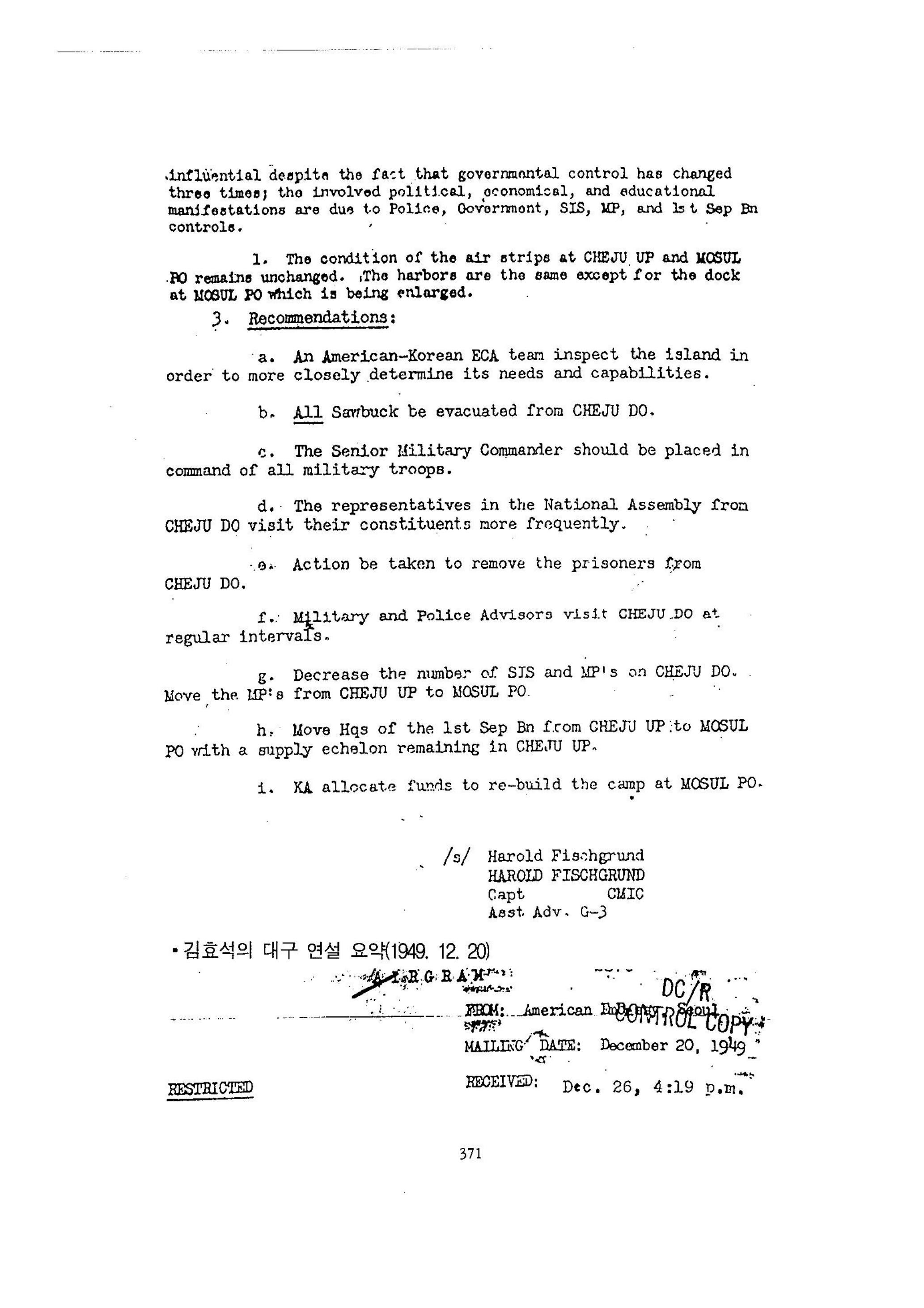
k. There were other observations such as the poorer appearance of the people. The so-called rich men of the island are still influential despite the fact that governmental control has changed three times; the involved political, economical, and educational manifestations are due to Police, Government, SIS, MP, and 1st Sep Bn controls.
1. The condition of the air strips at CHEJU UP and MOSUL PO remains unchanged. The harbors are the same except for the dock at MOSUL PO which is being enlarged.
3. Recommendations:
a. An American-Korean ECA team inspect the island in order to more closely determine its needs and capabilities.
b. All Sawbuck be evacuated from CHEJU DO.
c. The Senior Military Commander should be placed in command of all military troops.
d. The representatives in the National Assembly from CHEJU DO visit their constituents more frequently.
e. Action be taken to remove the prisoners from CHEJU DO.
f. Military and Police Advisors visit CHEJU DO at regular intervals.
g. Decrease the number of SJS and MP's on CHEJU DO. Move the MP's from CHEJU UP to MOSUL PO.
h. Move Hqs of the 1st Sep Bn from CHEJU UP to MOSUL PO with a supply echelon remaining in CHEJU UP.
i. KA allocate funds to re-build the camp at MOSUL PO.
/s/ Harold Fischgrund
HAROLD FISCHGRUND
Capt CMIC
Asst Adv. G-3
출처:
제주4·3사건진상규명및희생자명예회복위원회 편,
『제주4·3사건자료집 11』 [미국자료편],
번역문 p.178
/ 원문 p.367–371.