발신:『코리안퍼시픽프레스』
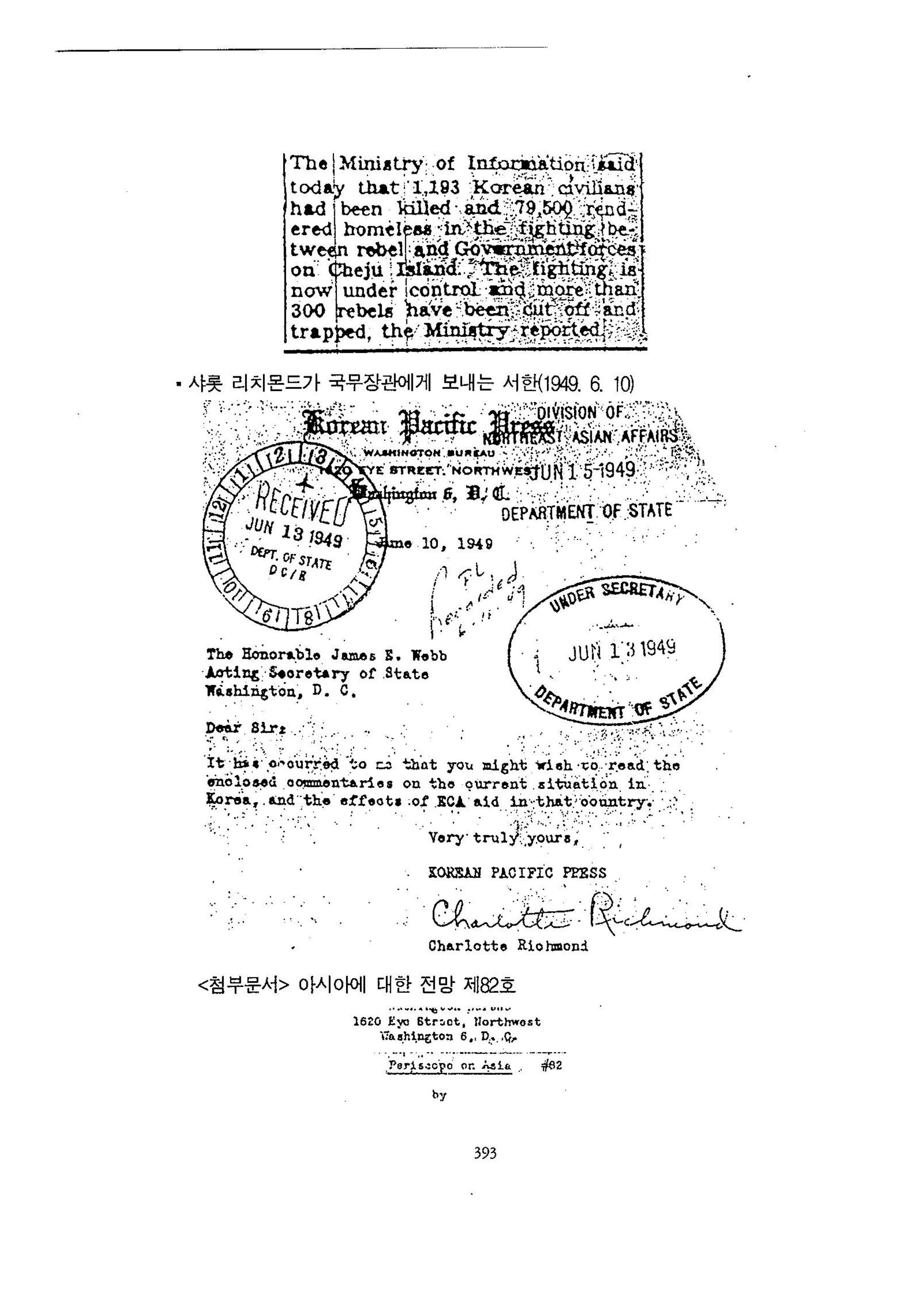
존경하는 국무장관 대리 제임스 웹(James E. Webb) 귀하
귀하가 한국의 현 상황과 한국에서의 경제협조처의 원조효과에 관해 동봉된 논평을 읽기 원할 것이라는 생각이 들었습니다.
퍼시픽 프레스
샤롯 리치몬드(Charlotte Richmond)
<첨부문서> 아시아에 대한 전망 제82호 (1949. 6. 10)
아시아에 대한 전망 제82호
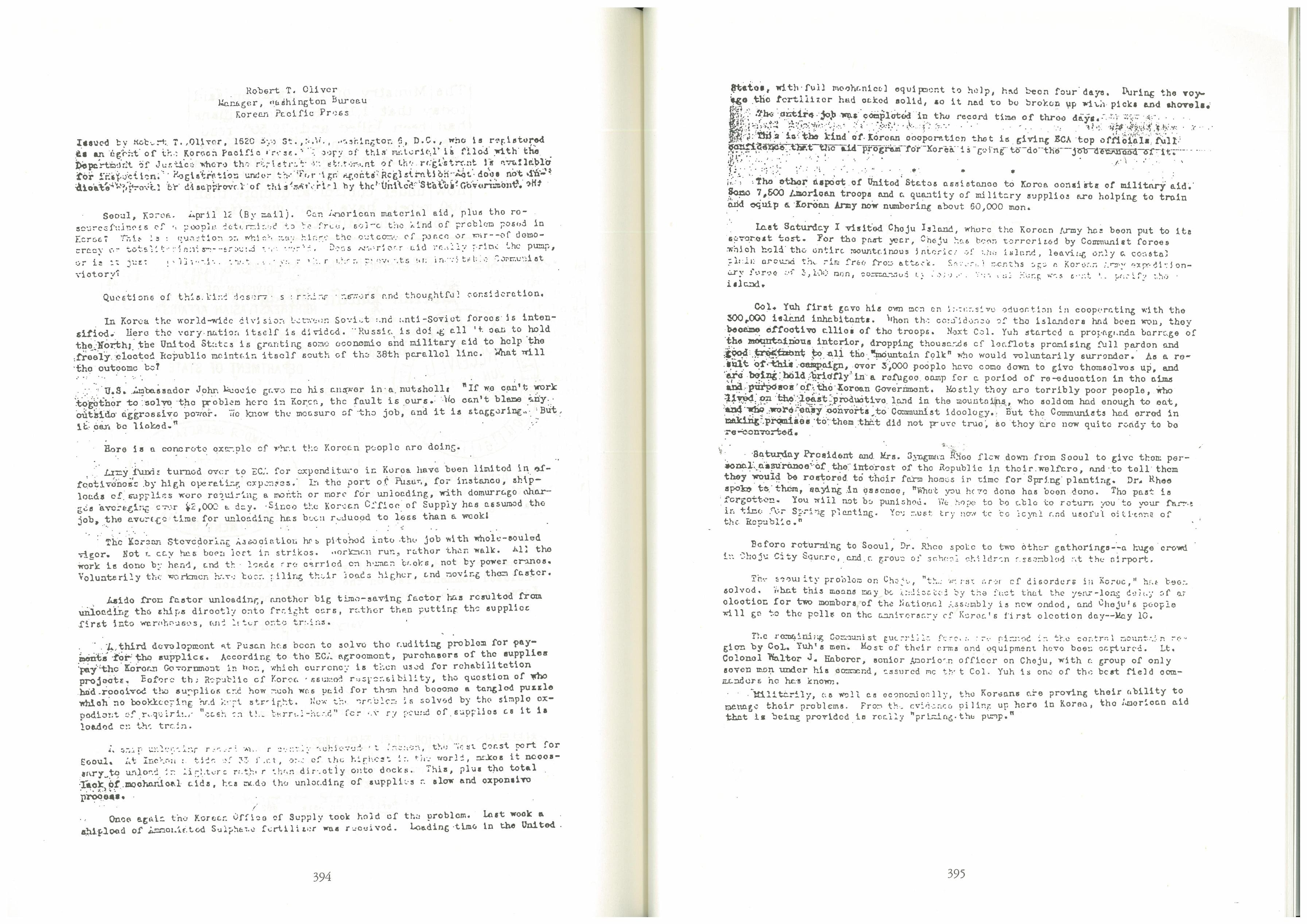
작성자:『코리안퍼시픽프레스』 워싱턴지국 매니저 로버트 올리버
『코리안퍼시픽프레스』의 에이전트로 등록된 로버트 올리버(Robert T. Oliver)(1620 Eye St, N. W., Washington, D.C.)가 발표. 이 기사 사본은 등록자를 조사할 수 있는 법무부에 보관돼 있다. 외국에이전 트등록법에 따라 등록은 미합중국 정부에 의한 이 기사의 승인여부를 의미하지 않는다.
4월 12일 서울(우송). 인적지원과 함께 미국의 물자원조가 한국이 처해있는 문제를 자유롭게 하고 해결할 수 있는가? 이 문제는 세계의 평화와 전쟁, 즉 민주주의와 전체주의의 결과를 조건으로 삼은 문제이다. 미국의 원조가 정말로 경기부양책일 수 있을까? 아니면 단지 필연적인 공산주의의 승리를 막는다기보다는 지연시키는 일시적인 효과일 뿐인가?
이런 종류의 질문은 해답을 찾을 가치가 있으며 진지하게 고려할만한 가치가 있다.
한국에서 소비에트 대 반(反)소비에트 진영 사이의 전세계적인 분단이 강화되고 있다. 여기 국가 자체는 분단돼 있다. 러시아는 북한을 장악하기 위해 할 수 있는 모든 것을 하고 있다. 미합중국은 38선 이남의 자유선거를 통해 수립된 대한민국 자체를 유지하도록 돕기 위해 어느 정도의 경제, 군사적 원조를 하고 있다. 결과는 무엇인가?
주한미대사 존 무쵸(John J. Muccio)는 아주 간결하게 나에게 답변했다. “한국의 문제를 함께 해결할 수 없다면 잘못은 우리 것입니다. 우리는 조금도 외부의 참략세력을 비난할 수 없습니다. 우리는 우리 일의 역량을 알고 있으며 비틀거리고 있습니다. 호되게 얻어맞을 수 있습니다.”
여기 한국인이 하고 있는 구체적인 사례가 있다.
한국에서의 지출을 위해 경제협조처(ECA)가 넘겨진 군자금은 높은 운영비용 때문에 효과적으로 수행을 하지 못하고 있습니다. 예를 들어 부산에서는 보급품을 실은 선박이 하역하는데는 1일 평균 2,000달러 이상의 초과 정박료를 내면서 1개월 이상 걸린다.
한국의 보급처가 이 일을 맡은 뒤로는 평균 하역시간이 일주일 이하로 감소됐다.
조선항만하역협회는 열정적으로 이 일에 매달렸다. 하루도 파업이 일어나지 않았다. 노동자들은 걷기보다는 뛰어다녔다. 모든 작업은 손으로 이뤄졌으며 짐은 동력 크레인을 이용하는 게 아니라 등짐으로 지고 날랐다. 자발적으로 노동자들은 자신들의 짐을 더 많이 지고 날랐고 더 빨리 움직였다.
빠른 하역 이외에 시간을 크게 줄인 또 다른 요인은 선박에서 보급품들을 처음 창고에 넣고 이어 열차로 옮긴 게 아니라 직접 선박에서 화물차로 하역한데 따른 것이다.
부산에서의 제3단계 발전은 보급품에 대한 지불비용에 대한 회계감사 문제를 해결하고 있다. 경제협조처 협정에 따르면 보급품 매입자는 부흥계획에 사용되는 화폐인 원화로 한국정부에 지불하도록 하고 있다. 대한민국이 책임을 떠맡기 전에 보급품을 받았던 문제와 얼마를 지불할 것인지의 문제는 부기를 제대로 하지 않아 미해결의 수수께끼가 됐다. 이제 문제는 열차에 짐을 실을 때마다 매 보급품의 파운드당 무게에 대해 간단하게 요구하는 ‘많은 현찰’로 해결되고 있다.
선박의 하역기록을 최근 서울의 서해안 항구인 인천에서 달성했다. 세계에서 가장 높은 조류 가운데 한곳인 33m의 조수간만의 차이가 있는 인천항에서는 직접 부두에 하역하는 것보다 거룻배를 이용해 하역하는 게 필요하다. 전체적으로 기술원조가 부족해 보급품 하역은 느렸고 비용은 많이 들었다.
다시 한번 한국의 보급처는 문제를 다뤘다. 지난주 암모니아와 화합한 황산비료 1척분을 받았다. 완전한 기술장비의 도움으로 미합중국의 선적시간은 4일이 걸렸다. 항해하는 동안 비료는 단단하게 굳어 곡괭이와 삽으로 깨뜨렸다. 전체 작업은 3일 동안의 기록을 세우고 끝났다.
이것은 경제협조처의 최고위 관리들이 한국에 대한 원조계획이 요구에 부응하고 있다고 확신하도록 하는 일종의 한국인들의 협력이다.
(중략)
미국의 대한원조의 또 다른 면은 군사원조다. 미국은 7,500여 명의 미군과 상당량의 군용물자를 동원해 현재 6만여명에 이르는 한국군을 훈련시키고 장비를 지원하고 있다.
지난 토요일 본인은 한국군들이 가장 심각한 시험을 치르는 제주도를 방문했다. 제주도는 과거 섬의 해안가와 평지만이 습격으로부터 안전한 채 내륙 전체 산간지역이 공산폭도들에 의해 장악돼 테러화 했다. 수개월전 유재흥 대령을 사령관으로 한 3,100명의 한국군 원정군이 제주도를 진압하기 위해 파견됐다.
유 대령은 처음 휘하 장병들에게 30만여명의 제주도민들과 협력하도록 교육을 강화했다. 제주도민들이 군을 신뢰하게 되면서 이들은 군의 효율적인 동맹군이 됐다. 유 대령은 다음으로 산간 내륙지역에 완전 사면과 자발적으로 귀순하는 모든 ‘산사람들’을 좋게 처리하겠다는 내용의 수천장의 유인물을 뿌리면서 선저공세를 펼쳤다. 이 작전으로 3,000여명이 귀순해 내려와 한국정부의 목표와 목적 하에 일정기간 재교육을 위해 피난민수용소에 일시 수감됐다. 그들 대부분은 지극히 가난하다. 그들은 거의 아무 것도 생산되지 않는 산에서 살아왔으며 항상 먹을 것이 부족해 공산주의 사상에 쉽게 빠졌다.
그러나 공산주의자들은 그들에게 거짓 약속을 했고 이것이 사실이 아닌 것으로 판명되자 그들은 현재 사상을 다시 전향하려 하고 있다.
이승만 대통령 내외는 토요일 제주도민들에게 복지와 관련해 대한민국의 관심에 대한 개인적인 확신을 심어주기 위해 서울에서 제주도로 날아갔으며 춘기 파종을 위해 농가들이 제때 복구될 것이라고 말했다. 이 박사는 기본적으로 도민들에게 “과거지사는 과거지사다. 과거는 잊어야 한다. 여러분들은 처벌받지 않을 것이다. 우리는 여러분들이 춘기파종을 위해 제 때 밭으로 돌아갈 수 있기를 희망한다. 여러분들은 이제 대한민국의 충직하고 유용한 시민이 되도록 노력해야 한다”고 말했다.
이 박사는 귀경하기 전 제주읍 광장에 모인 수많은 군중과 비행장에 모인 학생들에게 이렇게 말했다.
‘한국의 최악의 소요지역’인 제주도의 치안문제는 해결되고 있다. 이 말의 의미는 1년간 끌어온 국회의원 2명을 선출할 재선거 연기가 이제 끝났다는 말에서 찾을 수 있을 것이다. 제주도민들은 대한민국의 첫 총선 기념일인 5월 10일 투표장에 갈 것이다.
유 대령의 부대는 잔존 게릴라를 산간 중심지대로 몰아넣고 있다. 대부분의 게릴라 무기와 장비가 압수됐다. 휘하에 7명의 부하만을 두고 있는 제주도의 수석 미군장교인 월터 하버러(Walter J. Haberer) 중령은 본인에게 유 대령이 자신이 알고 있는 가장 훌륭한 야전 지휘관 가운데 1명이라고 확신했다.
군사적으로 뿐 아니라 경제적으로도 한국인들은 자신들의 문제를 해결하는데 능력을 증명하고 있다. 한국에 축적되고 있는 증거로 보건대 미국이 제공하고 있는 원조는 정말 ‘경기부양책’이 되고 있다.
제주4‧3사건자료집 11
[미국자료편⑤ 영인본]
Korean Pacific Press
WASHINGTON BUREAU
1620 EYE STREET, NORTHWEST
Washington 5, B, C.
DIVISION OF NORTHEAST ASIAN AFFAIRS
JUN 1 5 1949
DEPARTMENT OF STATE
June 10, 1949
RECEIVED
JUN 13 1949
DEPT. OF STATE
DC/R
UNDER SECRETARY
JUN 13 1949
DEPARTMENT OF STATE
The Honorable James E. Webb
Acting Secretary of State
Washington, D. C.
Dear Sir:
It has occurred to us that you might wish to read the enclosed commentaries on the current situation in Korea, and the effects of ECA aid in that country.
Very truly yours,
KOREAN PACIFIC PRESS
Charlotte Richmond
Charlotte Richmond
<첨부문서> 아시아에 대한 전망 제82호
1620 Eye Street, Northwest
Washington 6, D. C.
Periscope on Asia #82
by
Robert T. Oliver
Manager, Washington Bureau
Korean Pacific Press
Issued by Robert T. Oliver, 1820 S[illegible] St., N.W., Washington 9, D.C., who is registered as an agent of the Korean Pacific Press. A copy of this material is filed with the Department of Justice where the registration statement of the registrant is available for inspection. Registration under the Foreign Agents Registration Act does not [illegible] indicate approval or disapproval of this material by the United States Government, nor
Seoul, Korea. April 12 (By mail). Can American material aid, plus the resourcefulness of a people determined to be free, solve the kind of problem posed in Korea? This is a question on which may hinge the outcome of piece or war--of democracy or totalitarianism around the world. Does American aid really prime the pump, or is it just a [illegible] the [illegible] on [illegible] [illegible] power [illegible] [illegible] [illegible] inevitable Communist victory?
Questions of this kind deserve s[illegible] [illegible] and thoughtful consideration.
In Korea the world-wide division between Soviet and anti-Soviet forces is intensified. Here the very nation itself is divided. Russia is doing all it can to hold the North; the United States is granting some economic and military aid to help the freely elected Republic maintain itself south of the 38th parallel line. What will the outcome be?
U.S. Ambassador John Muccio gave his answer in a nutshell. "If we can't work together to solve the problem here in Korea, the fault is ours. We can't blame any outside aggressive power. We know the measure of the job, and it is staggering. But it can be licked."
Here is a concrete example of what the Korean people are doing.
Army funds turned over to ECA for expenditure in Korea have been limited in effectiveness by high operating expenses. In the port of Pusan, for instance, shiploads of supplies were requiring a month or more for unloading, with demurrage charges averaging over $2,000 a day. Since the Korean Office of Supply has assumed the job, the average time for unloading has been reduced to less than a week!
The Korean Stevedoring Association has pitched into the job with whole-souled vigor. Not a city has been lost in strikes. Workmen run, rather than walk. All the work is done by hand, and the loads are carried on human backs, not by power cranes. Voluntarily the workmen have been piling their loads higher, and moving them faster.
Aside from faster unloading, another big time-saving factor has resulted from unloading the ships directly onto freight cars, rather then putting the supplies first into warehouses, and later onto trains.
A third development at Pusan has been to solve the auditing problem for payments for the supplies. According to the ECA agreement, purchasers of the supplies pay the Korean Government in won, which currency is then used for rehabilitation projects. Before the Republic of Korea assumed responsibility, the question of who had received the supplies and how much was paid for them had become a tangled puzzle which no bookkeeping had kept straight. Now the problem is solved by the simple expedient of requiring "cash on the barrel-head" for every pound of supplies as it is loaded on the train.
A ship unloading record [illegible] a [illegible] achieved at [illegible], the West Coast port for Seoul. At [illegible] a tide of 33 feet, one of the highest in the world, makes it necessary to unload in lighters rather than directly onto docks. This, plus the total lack of mechanical aids, has made the unloading of supplies a slow and expensive process.
Once again the Korean Office of Supply took hold of the problem. Last week a shipload of ammoniated Sulphate fertilizer was received. Loading time in the United
States, with full mechanical equipment to help, had been four days. During the voyage the fertilizer had caked solid, so it had to be broken up with picks and shovels. The entire job was completed in the record time of three days. [illegible] [illegible] [illegible] This is the kind of Korean cooperation that is giving ECA top officials full confidence that the aid program for Korea is going to do the job demanded of it.
The other aspect of United States assistance to Korea consists of military aid. Some 7,500 American troops and a quantity of military supplies are helping to train and equip a Korean Army now numbering about 60,000 men.
Last Saturday I visited Cheju Island, where the Korean Army has been put to its severest test. For the past year, Cheju has been terrorized by Communist forces which held the entire mountainous interior of the island, leaving only a coastal plain around the rim free from attack. Seoul has sent [illegible] a Korean [illegible] expeditionary force of 3,100 men, [illegible] [illegible] [illegible] [illegible] [illegible] [illegible] the island.
Col. Yuh first gave his own men an intensive situation in cooperating with the 300,000 island inhabitants. When the confidence of the islanders had been won, they became effective allies of the troops. Next Col. Yuh started a propaganda barrage of the mountainous interior, dropping thousands of leaflets promising full pardon and good treatment to all the "mountain folk" who would voluntarily surrender. As a result of this campaign, over 5,000 people have come down to give themselves up, and are being held briefly in a refugee camp for a period of re-education in the time and purposes of the Korean Government. Mostly they are terribly poor people, who lived on the least productive land in the mountains, who seldom had enough to eat, and who were easy converts to Communist ideology. But the Communists had erred in making promises to them that did not prove true, so they are now quite ready to be re-converted.
Saturday President and Mrs. Syngman Rhee flew down from Seoul to give them personal assurance of the interest of the Republic in their welfare, and to tell them they would be restored to their farm homes in time for Spring planting. Dr. Rhee spoke to them, saying in essence, "What you have done has been done. The past is forgotten. You will not be punished. We hope to be able to return you to your farms in time for Spring planting. You must try now to be loyal and useful citizens of the Republic."
Before returning to Seoul, Dr. Rhee spoke to two other gatherings--a huge crowd in Cheju City Square, and a group of school children assembled at the airport.
The security problem on Cheju, "the worst area of disorders in Korea," has been solved. What this means may be indicated by the fact that the year-long delay of an election for two members of the National Assembly is now ended, and Cheju's people will go to the polls on the anniversary of Korea's first election day--May 10.
The remaining Communist guerrilla forces are pinned in the central mountain region by Col. Yuh's men. Most of their arms and equipment have been captured. Lt. Colonel Walter J. Laborer, senior American officer on Cheju, with a group of only seven men under his command, assured me that Col. Yuh is one of the best field commanders he has known.
Militarily, as well as economically, the Koreans are proving their ability to manage their problems. From the evidence piling up here in Korea, the American aid that is being provided is really "priming the pump."
Robert T. Oliver
Manager, Washington Bureau
Korean Pacific Press
Issued by Robert T. Oliver, 1820 S[illegible] St., N.W., Washington 9, D.C., who is registered as an agent of the Korean Pacific Press. A copy of this material is filed with the Department of Justice where the registration statement of the registrant is available for inspection. Registration under the Foreign Agents Registration Act does not [illegible] indicate approval or disapproval of this material by the United States Government, [illegible]
Seoul, Korea. April 12 (By mail). Can American material aid, plus the resourcefulness of a people determined to be free, solve the kind of problem posed in Korea? This is a question on which may hinge the outcome of peace or war—of democracy or totalitarianism around the world. Does American aid really prime the pump, or is it just [illegible] the [illegible] [illegible] [illegible] [illegible] [illegible] [illegible] [illegible] inevitable Communist victory?
Questions of this kind deserve s[illegible] [illegible] [illegible] and thoughtful consideration.
In Korea the world-wide division between Soviet and anti-Soviet forces is intensified. Here the very nation itself is divided. Russia is doing all it can to hold the North; the United States is granting some economic and military aid to help the freely elected Republic maintain itself south of the 38th parallel line. What will the outcome be?
U.S. Ambassador John Muccio gave his answer in a nutshell. "If we can't work together to solve the problem here in Korea, the fault is ours. We can't blame any outside aggressive power. We know the measure of the job, and it is staggering. But it can be licked."
Here is a concrete example of what the Korean people are doing.
Army funds turned over to ECA for expenditure in Korea have been limited in effectiveness by high operating expenses. In the port of Pusan, for instance, shiploads of supplies were requiring a month or more for unloading, with demurrage charges averaging over $2,000 a day. Since the Korean Office of Supply has assumed the job, the average time for unloading has been reduced to less than a week!
The Korean Stevedoring Association has pitched into the job with whole-souled vigor. Not a city has been lost in strikes. Workmen run, rather than walk. All the work is done by hand, and the loads are carried on human backs, not by power cranes. Voluntarily the workmen have been piling their loads higher, and moving them faster.
Aside from faster unloading, another big time-saving factor has resulted from unloading the ships directly onto freight cars, rather then putting the supplies first into warehouses, and later onto trains.
A third development at Pusan has been to solve the auditing problem for payments for the supplies. According to the ECA agreement, purchasers of the supplies pay the Korean Government in won, which currency is then used for rehabilitation projects. Before the Republic of Korea assumed responsibility, the question of who had received the supplies and how much was paid for them had become a tangled puzzle which no bookkeeping had put straight. Now the problem is solved by the simple expedient of requiring "cash on the barrel-head" for every pound of supplies as it is loaded on the train.
A ship unloading record which, [illegible] achieved at [illegible], the West Coast port for Seoul. At Inchon a tide of 33 feet, one of the highest in the world, makes it necessary to unload in lighters rather than directly onto docks. This, plus the total lack of mechanical aids, has made the unloading of supplies a slow and expensive process.
Once again the Korean Office of Supply took hold of the problem. Last week a shipload of ammoniated Sulphate fertilizer was received. Loading time in the United
States, with full mechanical equipment to help, had been four days. During the voyage the fertilizer had caked solid, so it had to be broken up with picks and shovels. The entire job was completed in the record time of three days. [illegible] [illegible] [illegible] [illegible] This is the kind of Korean cooperation that is giving ECA top officials full confidence that the aid program for Korea is going to do the job demanded of it.
The other aspect of United States assistance to Korea consists of military aid. Some 7,500 American troops and a quantity of military supplies are helping to train and equip a Korean Army now numbering about 60,000 men.
Last Saturday I visited Cheju Island, where the Korean Army has been put to its severest tests. For the past year, Cheju has been terrorized by Communist forces which held the entire mountainous interior of the island, leaving only a coastal plain around the rim free from attack. Seoul then sent in a Korean Army expeditionary force of 3,100 men, [illegible] [illegible] [illegible] [illegible] Song was sent [illegible] [illegible] the island.
Col. Yuh first gave his own men an intensive education in cooperating with the 300,000 island inhabitants. When the confidence of the islanders had been won, they became effective allies of the troops. Next Col. Yuh started a propaganda barrage of the mountainous interior, dropping thousands of leaflets promising full pardon and good treatment to all the "mountain folk" who would voluntarily surrender. As a result of this campaign, over 5,000 people have come down to give themselves up, and are being held briefly in a refugee camp for a period of re-education in the aims and purposes of the Korean Government. Mostly they are terribly poor people, who lived on the least productive land in the mountains, who seldom had enough to eat, and who were easy converts to Communist ideology. But the Communists had erred in making promises to them that did not prove true, so they are now quite ready to be re-converted.
Saturday President and Mrs. Syngman Rhee flew down from Seoul to give them personal assurance of the interest of the Republic in their welfare, and to tell them they would be restored to their farm homes in time for Spring planting. Dr. Rhee spoke to them, saying in essence, "What you have done has been done. The past is forgotten. You will not be punished. We hope to be able to return you to your farms in time for Spring planting. You must try now to be loyal and useful citizens of the Republic."
Before returning to Seoul, Dr. Rhee spoke to two other gatherings—a huge crowd in Cheju City Square, and a group of school children assembled at the airport.
The security problem on Cheju, "the worst area of disorders in Korea," has been solved. What this means may be indicated by the fact that the year-long delay of an election for two members of the National Assembly is now ended, and Cheju's people will go to the polls on the anniversary of Korea's first election day—May 10.
The remaining Communist guerrilla forces are pinned in the central mountain region by Col. Yuh's men. Most of their arms and equipment have been captured. Lt. Colonel Walter J. Laborer, senior American officer on Cheju, with a group of only seven men under his command, assured me that Col. Yuh is one of the best field commanders he has known.
Militarily, as well as economically, the Koreans are proving their ability to manage their problems. From the evidence piling up here in Korea, the American aid that is being provided is really "priming the pump."
출처:
제주4·3사건진상규명및희생자명예회복위원회 편,
『제주4·3사건자료집 11』 [미국자료편],
번역문 p.207
/ 원문 p.393–395.